What Is a Crypto Trading Fee Rebate? Meaning, Maths and Limits
A crypto trading fee rebate is a share of the trading fees you pay, returned to you. Every trade on an exchange like Bybit or OKX charges a fee; a rebate gives part of it back — done right, it can cut your effective trading cost by up to half. Put simply, it's a permanent trading fee discount — the easiest way to pay cheaper fees and lower your effective trading costs on every trade.

 NO KYCSign up to BloFin
 Sign up to Bybit
 Sign up to OKX
 Sign up to Bitget
 Sign up to MEXC
 Sign up to OrangeX
 Sign up to Toobit
Which fees a rebate applies to: maker and taker
Exchanges charge two fee types. A maker order adds liquidity to the order book (a limit order waiting to fill) and usually costs less. A taker order removes liquidity (a market order filled immediately) and costs more. Bybit's perpetual taker fee is 0.055% and OKX's is 0.050%; maker is lower. Most active traders are net-takers, so taker fees dominate their costs, and a rebate is worked out on whichever fee you actually paid on each fill. How fills are classed, and how to get more of them as maker, is in our guide to maker vs taker fills.
How a fee rebate works
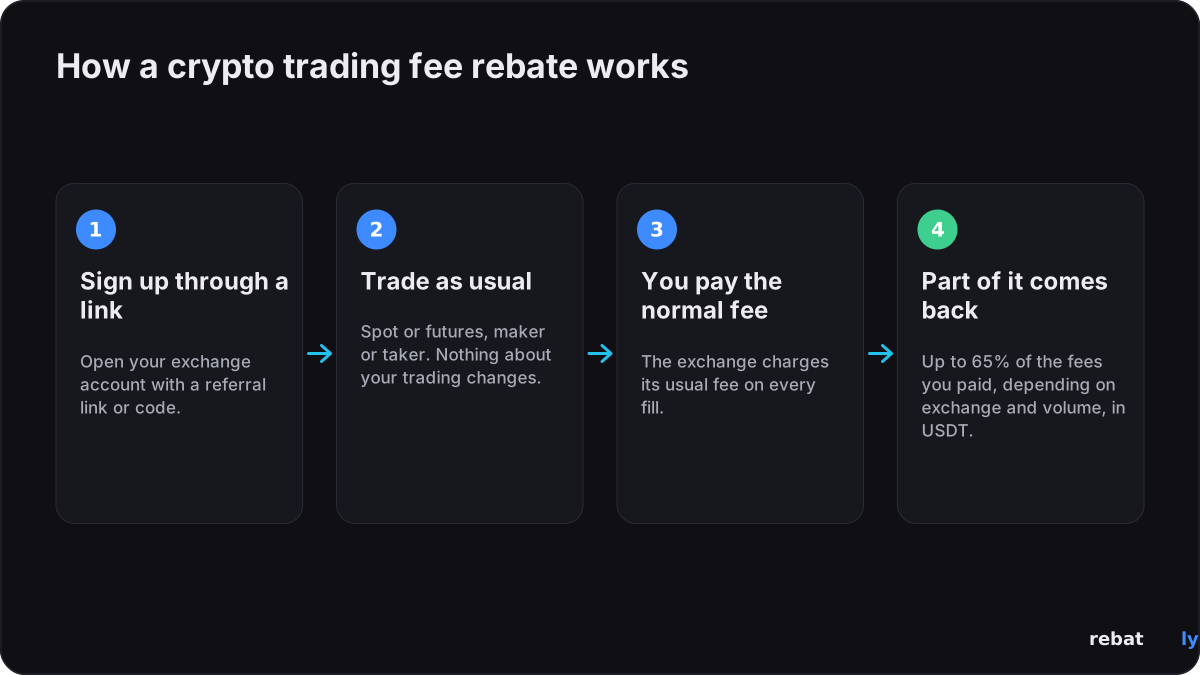
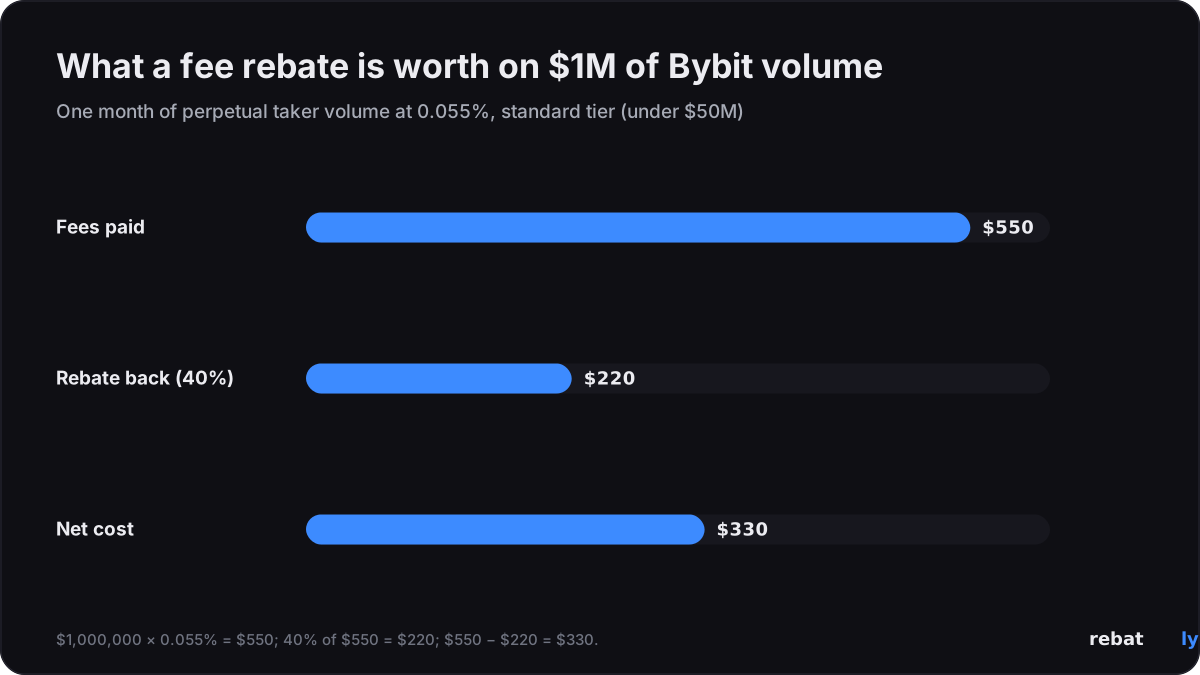
A fee rebate is cashback on your trading fees: up to 65% of what you pay comes back to you, depending on the exchange and your monthly volume. You sign up through a referral link, trade normally, and receive a percentage of your fees back in USDT, automatically. The maths is one multiplication: $1,000,000 a month of perpetual taker volume on Bybit at 0.055% is $550 in fees, and at the standard tier, with up to 40% back, up to $220 of it comes back each month.
Fee rebates vs maker rebates, fee vouchers and zero-fee promos
Four different things get called a rebate or a fee discount, and they work differently.
Trading fee rebate. You pay the exchange's normal fee on each trade, and part of it comes back to you afterwards: with Rebatly, up to 65%, depending on the exchange and your monthly volume. It applies to the fees you actually paid, on spot and futures, maker and taker.
Maker rebate. A negative maker fee: the exchange itself pays you a small amount for each limit order that adds liquidity. Where exchanges offer one, it is usually reserved for market-maker programmes or the top volume tiers, and it is set by the exchange, not by a referral code.
Fee voucher or fee saver. A one-off credit from an exchange campaign, such as a welcome reward, that pays some future fees for you. It expires, it is not cash, and fees covered by a voucher are not fees you paid, so don't count on a rebate on them.
Zero-fee promo. The exchange charges 0% on certain pairs or products. Nothing is paid, so there is nothing to rebate: under Bitget's rules, for example, zero-fee trades aren't eligible for a rebate.
Is a fee rebate worth it?
Yes, if you trade with any regularity. Fees are a constant drag on returns. At a 50% rebate your effective fee is halved, which lowers the breakeven on every position. The only requirement is signing up through the right link — the rebate costs you nothing extra.
Start getting your fees back
$10M+ rebates paid · Paid daily in USDT · No password or API keys, ever
Already signed up? Check your link and rebate with @rebatlybot on Telegram, or reach our support at @rebatly.
🔔 Get a Telegram alert each time your rebate is paid: tap “Activate notifications” in @rebatlybot. New to trading? Your first trade in 5 steps.