How many bitcoins are left? Bitcoin supply, the 21 million cap and who holds the most (2026)
So, how many bitcoins are left? About 896,000 BTC are still to be mined. Roughly 20.1 million bitcoins already exist, out of a hard cap of 21 million, so about 95.7% of all the bitcoin that will ever exist is already out there. New coins now trickle out at about 450 BTC a day, that pace halves again around 2028, and the very last fraction of a bitcoin is expected around 2140. Below: how the 21 million cap works, how many coins are probably lost for good, and the top 10 bitcoin holders, from Satoshi Nakamoto to BlackRock, Strategy and governments, with where each number comes from.
 NO KYCSign up to BloFin
 Sign up to Bybit
 Sign up to OKX
 Sign up to Bitget
 Sign up to MEXC
 Sign up to OrangeX
 Sign up to Toobit
The short answer: bitcoin supply in numbers
Bitcoin's supply is public. Anyone can count it from the blockchain, and the explorers we read (mempool.space, Blockchair and blockchain.com) agree to within a few dozen coins.
| Bitcoin | |
|---|---|
| Bitcoins in circulation | ≈ 20.1 million BTC |
| Maximum supply (hard cap) | 21 million BTC |
| Share already mined | ≈ 95.7% |
| Bitcoins left to mine | ≈ 896,000 BTC |
| New bitcoin per block | 3.125 BTC |
| New bitcoin per day (target) | ≈ 450 BTC |
| Next halving | around April 2028 (block 1,050,000) |
| Last bitcoin mined | around 2140 |
Why there will only ever be 21 million bitcoin
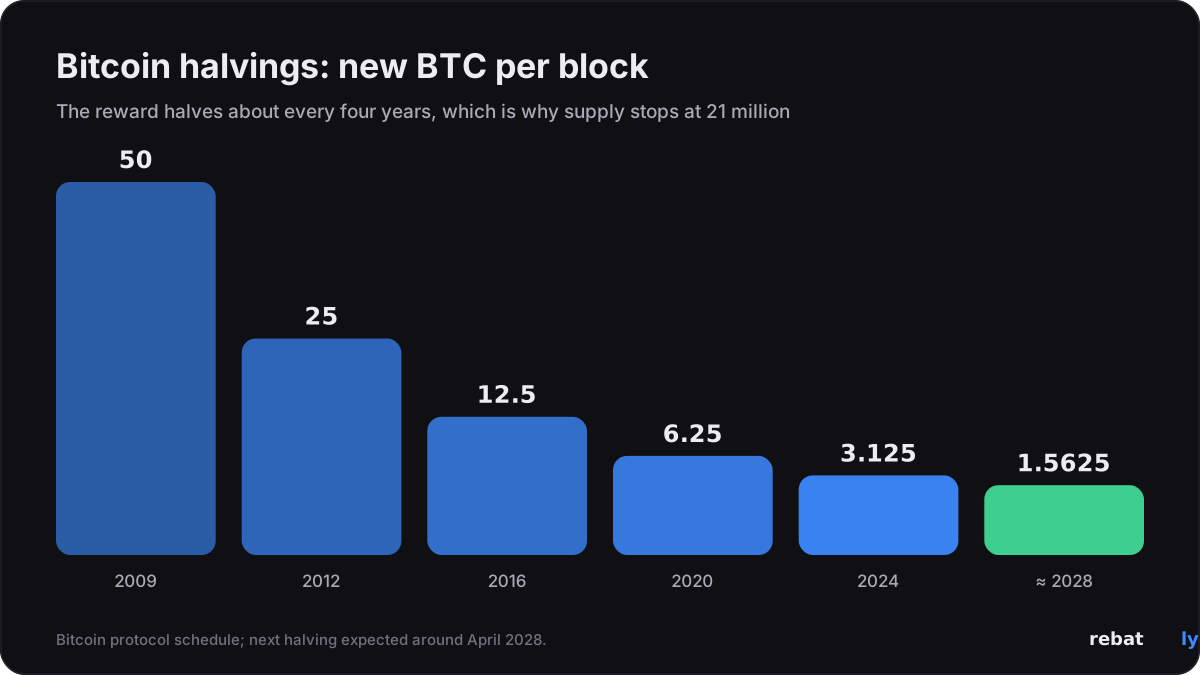
Bitcoin pays miners a fixed reward for every new block, roughly one block every 10 minutes. Every 210,000 blocks, about every four years, that reward is cut in half. This is the halving. Add up all the rewards from 50 BTC at launch down to the last sat and you get just under 21 million. No company, government or developer can quietly print more: a node that accepted extra coins would simply be ignored by the rest of the network.
That fixed schedule is why people call bitcoin "digital gold" and why every halving gets so much attention. The supply shock is known years in advance; what changes is how much demand shows up to meet it.
| Halving | Year | New BTC per block |
|---|---|---|
| Launch | 2009 | 50 |
| 1st halving | 2012 | 25 |
| 2nd halving | 2016 | 12.5 |
| 3rd halving | 2020 | 6.25 |
| 4th halving | 2024 (20 April) | 3.125 |
| 5th halving | ≈ 2028 (expected around April) | 1.5625 |
How many bitcoins are left to mine, and when is the last one?
About 896,000 BTC are still to be mined, a little over 4% of the cap. At today's 3.125 BTC per block that is about 450 BTC a day, or roughly 164,000 BTC a year. After the next halving, expected around April 2028, the daily amount drops to about 225 BTC, and it keeps halving every four years after that.
The result is a very long tail: most of what is left arrives over the next decade or so, but the final satoshis (one satoshi, or "sat", is 0.00000001 BTC) only trickle out until about 2140. After that, miners are paid by transaction fees alone.
How many bitcoins are lost forever?
Nobody knows exactly, because a coin that has not moved for years could be lost or just sitting in cold storage. The estimates range widely:
Chainalysis put lost coins at 2.78 to 3.79 million BTC in 2017, and its widely quoted 2020 figure of about 3.7 million counts coins that had not moved in five or more years, which is "dormant", not proven lost. River has published both 3 to 4 million (2023) and about 1.6 million (newer pages, counting Satoshi's coins separately). At the high end, Timothy Peterson of Cane Island Alternative Advisors estimated about 6 million in 2023.
Take any of them and the practical point is the same: the bitcoin that can actually change hands is noticeably less than 20.1 million, which makes the remaining supply even tighter.
Who owns the most bitcoin? The top 10 bitcoin holders
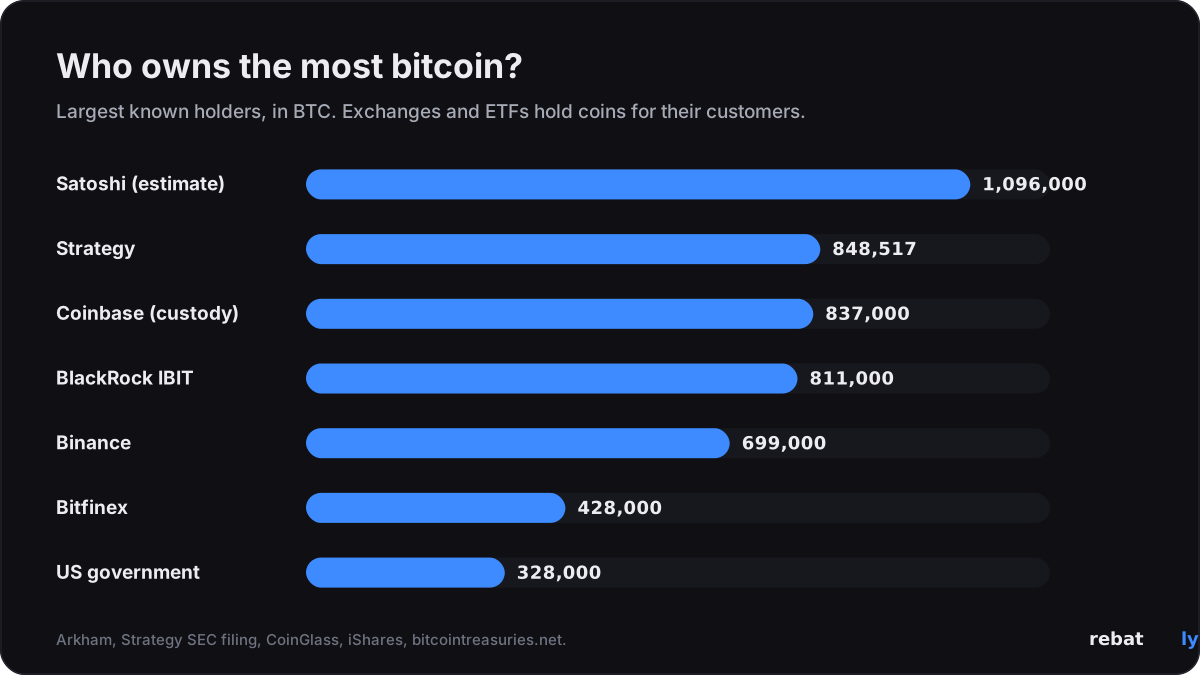
Here are the biggest known holders by BTC, using the best public figure for each. Read the third column carefully: an exchange or custodian holds coins for its customers, an ETF holds them for its shareholders, and some numbers are estimates rather than disclosures. Coinbase's figure also includes coins it keeps in custody for several of the ETFs below, so the rows overlap.
| # | Holder | BTC (approx.) | What it is | How the number is known |
|---|---|---|---|---|
| 1 | Satoshi Nakamoto | ≈ 1.1 million | Bitcoin's anonymous creator | Estimate (Arkham ≈ 1,096,000; River ≈ 968,000). The coins have never moved. |
| 2 | Strategy (MicroStrategy) | 848,517 | Public company | Company's own SEC filing of 19 October 2026 |
| 3 | Coinbase | ≈ 837,000 | Exchange and custodian (customer coins, incl. ETF custody) | Tracker estimate (CoinGlass); Arkham's labels give more |
| 4 | BlackRock iShares Bitcoin Trust (IBIT) | ≈ 811,000 | Spot bitcoin ETF | Fund's published holdings |
| 5 | Binance | ≈ 699,000 | Exchange (customer coins) | Tracker estimate (CoinGlass); CryptoQuant ≈ 663,000 |
| 6 | Bitfinex | ≈ 428,000 | Exchange (customer coins) | Tracker estimate (CoinGlass) |
| 7 | US government | ≈ 328,000 | Government (seized coins) | Tracker (bitcointreasuries.net); includes ≈ 94,600 BTC from the Bitfinex hack owed back to Bitfinex |
| 8 | China (government) | ≈ 190,000 (disputed) | Government (seized in the PlusToken case) | Estimate (bitcointreasuries.net); River puts it at 15,000. Neither can be checked. |
| 9 | Fidelity Wise Origin Bitcoin Fund (FBTC) | ≈ 184,000 | Spot bitcoin ETF | Fund holdings via bitcointreasuries.net |
| 10 | Block.one | ≈ 164,000 | Private company | Company's own 2022 statement, not proven on-chain |
Whales, ETFs and treasury companies: who is stacking sats now
The biggest change of the last two years is who the whales are. It used to be early miners and exchanges; now it is funds and listed companies. By bitcointreasuries.net's count, 201 public companies hold about 1.29 million BTC between them, led by Strategy, with Metaplanet, Twenty One, Strive and MARA among the next largest. Spot ETFs such as BlackRock's IBIT, Fidelity's FBTC and Grayscale's GBTC hold well over a million more for their shareholders. Governments hold about 645,000 BTC, roughly 3% of the 21 million cap, almost all of it seized in criminal cases rather than bought.
For ordinary holders this cuts both ways. Big, steady buyers soak up a lot of the new supply, but when ETFs see outflows or a treasury company sells, the market feels it. Strategy itself sold 3,588 BTC in early July 2026.
Does a small group of whales control bitcoin?
Less than the headlines suggest. Rich lists rank addresses, not people, and the biggest addresses belong to exchanges and custodians holding coins for millions of users. The single largest address, a Binance cold wallet, holds about 248,600 BTC on behalf of Binance customers. On CoinLore's rich list the top 100 addresses together hold about 9.3% of all bitcoin, and most of them are exchange wallets. Going the other way, one person can spread their coins over hundreds of addresses. Blockchair counts almost 60 million addresses with a balance today.
What a fixed supply means for you as a trader
Scarcity is the story behind most long-term bitcoin views, but day to day your results also depend on something much more boring: what you pay to trade. Every buy and sell carries an exchange fee, and an active trader can pay more in fees over a year than they realise. Our guides to reducing crypto trading fees and maker vs taker fills show where the money goes, and the Bybit fee calculator puts a number on your own volume.
Sign up through Rebatly and part of every trading fee comes back to you: up to 50% on Bybit and Bitget, up to 40% on BloFin and OKX, up to 60% on MEXC and up to 65% on OrangeX futures, paid daily in USDT. On Toobit, code Rebatly gives up to 60%, credited by Toobit itself. See every code in the best crypto referral codes.
Rebatly is an independent affiliate; not financial advice.
Get fees back on every trade
$10M+ rebates paid · Paid daily in USDT · No password or API keys, ever
Already signed up? Check your link and rebate with @rebatlybot on Telegram, or reach our support at @rebatly.
🔔 Get a Telegram alert each time your rebate is paid: tap “Activate notifications” in @rebatlybot. New to trading? Your first trade in 5 steps.
October 26, 2026 — published. Supply read from mempool.space, Blockchair and blockchain.com on 26 October 2026; holder figures from bitcointreasuries.net, Arkham, River, CoinGlass (via TokenPost), CryptoQuant, the iShares IBIT fund page and Strategy's SEC filing of 19 October 2026; lost-coin estimates from Chainalysis, River and Cane Island Alternative Advisors.