South Korea's crypto tax delay: the plan to move it to 2029, explained
South Korea's crypto tax is set to start on 1 January 2027, but the government and the ruling Democratic Party are now weighing a fourth delay, to 2029. The tax would take 22% of yearly crypto gains above 2.5 million won. Officials say the problem is data: until the United States starts sharing crypto trading records in 2029, only gains made on Korean exchanges would be easy to tax. This article explains what is proposed, how the tax keeps moving, what happens next, and why your trading fees are a cost you pay either way. Nothing here is decided yet, and we say who reported what.
 NO KYCSign up to BloFin
 Sign up to Bybit
 Sign up to OKX
 Sign up to Bitget
 Sign up to MEXC
 Sign up to OrangeX
 Sign up to Toobit
South Korea crypto tax delay: what is on the table
On 25 October the Korean news agency Newsis reported, citing officials, that the government is leaning towards pushing the crypto gains tax back again, this time to 2029. CoinDesk, The Block and Korean papers including the Herald Business and Seoul Economic Daily followed. Nothing has changed in law yet: the National Tax Service still lists 1 January 2027 as the start date, and a new delay needs the National Assembly to amend the Income Tax Act.
Two things are moving at once. On 16 October, Democratic Party lawmaker Park Min-kyu and 13 other lawmakers filed a bill that ties the start of the tax to international data sharing: tax would begin on 1 January two years after the year Korea first exchanges crypto trading data with other countries. With the first exchange due in 2027, that means 1 January 2029. And according to Seoul Economic Daily, the government and the Democratic Party meet on 28 October to settle whether to delay, with the paper reporting that no Democratic lawmaker opposed a delay in a closed-door meeting. Other bills already filed put the start at 2029 or 2030, and the opposition People Power Party also backs a delay, the Herald Business reports.
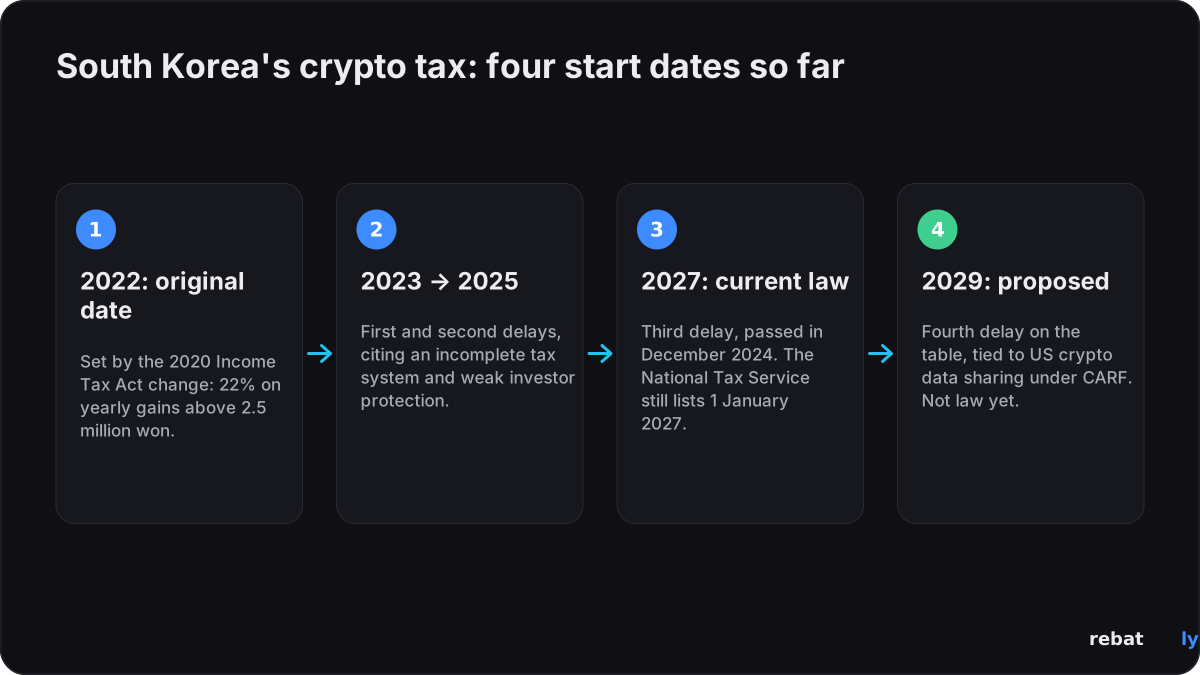
How Korea's crypto tax kept moving
The tax was written into the Income Tax Act in 2020 and was first due in 2022. It has been postponed three times since, each time with reasons such as an incomplete tax system and weak investor protection. If the 2029 plan passes, it will be the fourth delay, seven years after the original date.
| Start date | What happened |
|---|---|
| 1 January 2022 | Original start date in the 2020 law |
| 1 January 2023 | First delay |
| 1 January 2025 | Second delay |
| 1 January 2027 | Third delay, passed by the National Assembly in December 2024: the current law |
| 1 January 2029 | Proposed fourth delay (Park Min-kyu bill, October 2026): not law |
What the Korean crypto tax would charge
Under the current law, gains from selling or lending crypto (virtual assets) are added up over the year. Acquisition costs and other necessary expenses come off, a basic deduction of 2.5 million won (about $1,887, CoinDesk's conversion) is taken off, and the rest is taxed at 22%: 20% income tax plus 2% local income tax.
A simple example: if your net crypto gain for the year is 10 million won, 7.5 million won is taxable after the deduction, and the tax is 1.65 million won. This is a rough illustration of the headline rule, not a tax calculation; how losses, fees and costs are counted will depend on the final rules and your situation.
| Item | Under the current law (start 2027) |
|---|---|
| What is taxed | Yearly gains from transferring or lending virtual assets |
| Basic deduction | 2.5 million won a year |
| Rate | 22% (20% + 2% local income tax) |
| Example: 10 million won net gain | 7.5 million won taxable → 1.65 million won tax |
Why delay the crypto tax again? The US data gap
The main reason given is fairness between exchanges. Korea can see what its own exchanges' users trade, but not what they do on foreign platforms. The fix is the OECD's Crypto-Asset Reporting Framework (CARF), under which countries automatically swap crypto trading records. According to the Herald Business, 46 countries including Korea start exchanging in 2027, 29 more in 2028, and the United States in 2029. An official quoted by Newsis via CoinDesk called the missing US data "the biggest obstacle", adding that "almost half of the crypto market is the U.S."
Park Min-kyu's bill makes the same case: until CARF fully works, the tax would fall mainly on people who trade on Korean exchanges. Not everyone agrees. The tax centre of the civic group People's Solidarity for Participatory Democracy urged the government to start on schedule, warning that repeated delays damage the predictability of tax policy. CoinDesk also noted that the US, the UK and Japan already tax crypto without waiting for data sharing.
| First CARF data exchange | Who |
|---|---|
| 2027 | 46 countries, including South Korea |
| 2028 | 29 more countries |
| 2029 | United States |
What happens next for the Korean crypto tax
• 28 October 2026: the government and the Democratic Party meet to decide on a delay, according to Seoul Economic Daily. A deal there is a political decision, not yet law.
• November to early December 2026: the National Assembly works through the year's tax bills. A final decision on the crypto tax is expected by early December, CoinDesk and the Herald Business report.
• 1 January 2027: the tax starts as the law stands today, unless the Assembly changes it first.
Until a bill passes, the 2027 date stays in force. We will update this article when the decision is made.
Tax or no tax, trading fees hit every trade
Whatever the start date, the gains tax only applies to profit, once a year. Trading fees come off every single trade, win or lose, starting today. For active traders they add up faster than most people expect.
Take someone who trades 100 million won a month in perpetual futures, all as a taker, at Bybit's base taker fee of 0.055%. That is 55,000 won in fees a month, or 660,000 won a year, before any tax. Using limit orders where you can (Bybit's base maker fee is 0.02%) cuts that, and a fee rebate returns part of what is left: at the 40% starting tier on Bybit, 264,000 won of that 660,000 would come back.
Whichever way the tax goes, keep a record of your trades and the fees you paid. Our guide to checking the fees you paid on Bybit, OKX and Bitget shows where to export them, and how to reduce crypto trading fees covers the rest.
Get part of every trading fee back
Sign up through Rebatly and part of every trading fee comes back to you: up to 50% on Bybit and Bitget, up to 40% on BloFin and OKX, up to 60% on MEXC and up to 65% on OrangeX futures, paid daily in USDT. On Toobit, code Rebatly gives up to 60%, credited by Toobit itself. Nothing changes in how you trade, and we never ask for your password or API keys.
This article reports news and is not tax, legal or financial advice. For your own tax position, check the final rules or ask a Korean tax professional. Rebatly is an independent affiliate; not financial advice.
Get fees back on every trade
$10M+ rebates paid · Paid daily in USDT · No password or API keys, ever
Already signed up? Check your link and rebate with @rebatlybot on Telegram, or reach our support at @rebatly.
🔔 Get a Telegram alert each time your rebate is paid: tap “Activate notifications” in @rebatlybot. New to trading? Your first trade in 5 steps.
October 28, 2026 — published. Sources: Newsis, CoinDesk, Herald Business, Seoul Economic Daily, National Tax Service, Bybit.