Clarity Act update: where the crypto bill stands after the Democratic sweep of Congress
The Clarity Act has not become law. As of Tuesday 10 November 2026 (02:00 UTC), the US crypto market-structure bill remains stalled in the Senate, where a procedural vote failed 49–50 on 15 September, short of the 60 needed. What changed is who will run Congress next year. In the 3 November midterms Democrats won both chambers, with AP calling the Senate shortly before midnight New York time (about 05:00 UTC on Wednesday 4 November). This article explains what the bill does, how it got here, what the sweep changes, what prediction markets show and what traders should watch.
 NO KYCSign up to BloFin
 Sign up to Bybit
 Sign up to OKX
 Sign up to Bitget
 Sign up to MEXC
 Sign up to OrangeX
 Sign up to Toobit
What is the Clarity Act?
The Clarity Act (H.R. 3633, the Digital Asset Market Clarity Act) is a US bill that would set the main rules for crypto markets. Its core job is to settle who regulates what, a question that has been fought over for years between two agencies: the Securities and Exchange Commission (SEC), which oversees investments such as shares, and the Commodity Futures Trading Commission (CFTC), which oversees commodities and derivatives.
• CFTC: would get the lead role over spot trading of tokens treated as digital commodities.
• SEC: would keep authority over tokens sold as investments, including how they are first offered to the public.
• Exchanges and brokers: would get a registration path written into law, instead of relying on agency guidance.
That is the broad design of the House text; the Senate versions changed many details. Stablecoins are covered by a separate law, the GENIUS Act, which is already on the books. In short, GENIUS deals with stablecoins and Clarity would deal with the rest of the market.
Clarity Act timeline: from the House to the Senate stall
The bill cleared the House with bipartisan support, then slowed in the Senate. The House tally comes from the Clerk's official roll call; the Senate figures are as reported by the sources named below.
| Date | What happened | Vote or detail |
|---|---|---|
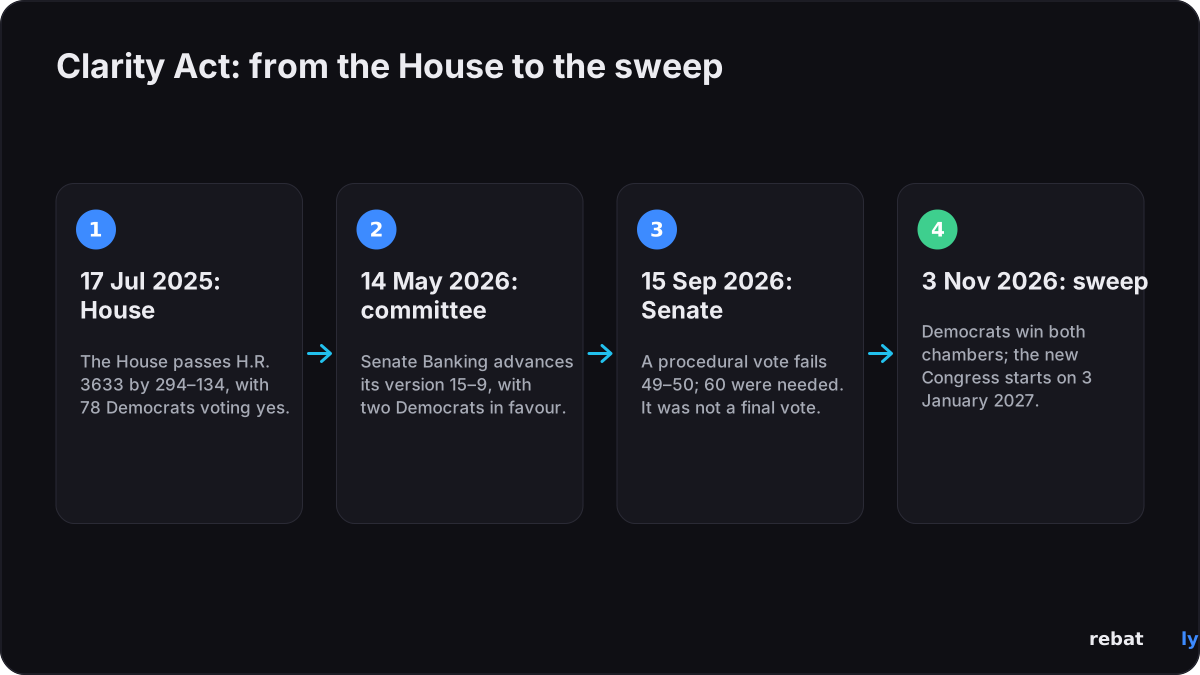
| 17 July 2025 | House passes H.R. 3633 | 294–134, with 216 Republicans and 78 Democrats in favour (House Clerk, Roll Call 199) |
| 29 January 2026 | Senate Agriculture advances its own bill, the Digital Commodity Intermediaries Act | 12–11 on party lines (Latham & Watkins) |
| 14 May 2026 | Senate Banking advances its version of the Clarity Act | 15–9: all 13 Republicans plus two Democrats (Latham & Watkins) |
| 1 June 2026 | Bill placed on the Senate calendar | Calendar No. 423 (Latham & Watkins, DeFi Rate) |
| 14 September 2026 | Sponsors release a final draft with new ethics and stablecoin-reward language | Not adopted (DeFi Rate) |
| 15 September 2026 | Senate fails to end debate on starting the bill | 49–50, with 60 needed; Roll Call 234 (American Banker, Decrypt, DeFi Rate) |
| 3 November 2026 | Democrats win the House and the Senate in the midterms | Control changes in January 2027 |
Why the Senate vote failed
The 15 September vote was a procedural step, not a final vote on the bill. Republicans Susan Collins, Josh Hawley, Jerry Moran and Thom Tillis voted no, Chris Coons did not vote, and no Democrat voted yes, according to AMINA Bank's account; American Banker names the same four Republicans. Tillis voted no so that he could enter a motion to reconsider, which keeps another vote possible in this Congress.
• Ethics: Democrats wanted enforceable limits on the president and senior officials profiting from crypto. Senator Ruben Gallego blamed Republicans for refusing to stand up to the president, American Banker reported.
• Stablecoin yield: banks and crypto firms fought over rewards paid on stablecoins. Banking groups argued such rewards could pull deposits away and reduce lending, DeFi Rate reported, while Senator Elizabeth Warren objected to the bill's provisions on banks and crypto activities.
What the Democratic sweep changes for the Clarity Act
Democrats won control of both chambers on 3 November. In the Senate, NBC News and AP both showed 54 seats for Democrats and 44 for Republicans in their latest counts, with seven seats flipped; Republicans held 53 seats before the election. Two Senate races are still uncalled:
• Mississippi: Democrat Scott Colom led Republican Senator Cindy Hyde-Smith by more than 2,500 votes late on 9 November, CBS News reported. About 3,300 mail ballots were still outstanding on 6 November, the state does not allow recounts, and counties must certify by 13 November.
• Alaska: Democrat Mary Peltola led Republican Senator Dan Sullivan by fewer than 700 votes with 74% of ballots counted, Alaska's News Source reported on 7 November. The ranked-choice tabulation will not happen before 18 November.
For the House, AP had called 254 seats for Democrats and 162 for Republicans as of 8 November, with 19 races uncalled, against the 218 needed. NBC News showed 252 to 165 with 18 uncalled. Two Louisiana seats go to a runoff on 12 December. These counts are not final until the states certify them.
Control matters for three reasons:
• Time limit: the current Republican-led Congress keeps working in a lame-duck session until 3 January 2027. Any bill not enacted by then ends with this Congress and would have to be reintroduced, Coindoo noted.
• Vote maths: in the lame duck the same senators would vote again, so the bill would still need 11 more yes votes. Tillis and Cynthia Lummis, two of its most active Senate backers, are leaving. Rebatly found no report of Senate Majority Leader John Thune committing to a new vote.
• The 2027 route: a new bill would be written under Democratic chairs, and the Senate would still need 60 votes for most legislation, MS NOW noted.
| Committee | Possible chair from January 2027 | As reported |
|---|---|---|
| Senate Banking | Elizabeth Warren | The Wall Street Journal says she is expected to chair it, though this is not final (crypto.news, 6 November); Reuters calls her the frontrunner |
| House Financial Services | Maxine Waters | Reuters calls her the lead contender; American Banker says she will likely chair it again |
| Senate Agriculture | Sherrod Brown (possible) | Raised by The Block; Coindoo stresses no assignment has been made |
What supporters and critics say
These are views, not outcomes, and Rebatly does not take a side.
• Sceptical of the bill's chances: Mati Greenspan of Quantum Economics told CoinDesk the sweep may be "the final nail in the Clarity Act's coffin". Jaret Seiberg of TD Cowen told clients that Democratic investigations of President Trump's crypto ties may make a version the industry could back impossible, The Block reported, and TD Cowen sees the bill as unlikely to advance over the next two years.
• Still hopeful on crypto policy: Kara Calvert of Coinbase expects headwinds for bipartisan bills but said crypto remains bipartisan, The Block reported. Stuart Alderoty of Ripple said the picture is more nuanced than a setback, CoinDesk reported. Stand With Crypto counted 19 senators and 226 House members it rates as pro-crypto among those elected.
• Critics of the industry: Mark Hays of Americans for Financial Reform called the result a defeat for the industry's political strategy, CoinDesk reported. Sherrod Brown won in Ohio by nearly 5% even though the Fairshake super PAC spent $56 million against him.
• Democrats' own plan: Bitcoin Magazine reported, citing journalist Eleanor Terrett and three industry sources, that House Democrats led by Waters want a market-structure bill next Congress with a bigger SEC role and a smaller CFTC role. No text has been released and no lawmaker has confirmed it.
Clarity Act odds: what prediction markets show
People searching for Clarity Act odds or the Clarity Act on Polymarket will find low numbers. The figures below are prices as reported by the named outlets at the stated times. They are not a forecast by Rebatly, and the two Kalshi readings differ without explanation. Rebatly found no outlet reporting a newer Kalshi figure after 5 November. Warren plans to target what an aide called the "Wild West-style lack of oversight" of prediction markets once she holds the Banking gavel, Bitcoin Magazine reported, citing Punchbowl News.
| Market | Question | Reported figure | Reported by, and when |
|---|---|---|---|
| Polymarket | H.R. 3633 signed in 2026 | 3.1% to 3.2% | DeFi Rate, 18:24 UTC on 1 November |
| Kalshi | Law before 1 January 2027 | 6% | Disruption Banking, 4 November |
| Kalshi | Law before 1 January 2027 | 3.7% | DeFi Rate, 11:08 UTC on 5 November |
| Kalshi | Law before 1 January 2028 | 26% | Disruption Banking, 4 November |
| Kalshi | Law before 1 January 2028 | 19% | DeFi Rate, 11:08 UTC on 5 November |
| Polymarket | H.R. 3633 signed in 2026 | 1.1% | Polymarket's own market data, read by Rebatly at 02:02 UTC on 10 November |
How the crypto market reacted
Prices rose after the results, though that does not show the election was the cause. CoinGecko hourly data show bitcoin at about $76,199 at 03:00 UTC on 4 November, about $80,669 at 23:00 UTC and about $80,229 at 11:11 UTC on 5 November. Ether went from about $2,247 at 04:00 UTC on 4 November to about $2,417 at 11:11 UTC on 5 November. Decrypt reported that analysts saw the sweep as largely priced in. The gain did not last: at 02:01 UTC on 10 November CoinGecko showed bitcoin at about $75,006 and ether at about $2,124.
Rebatly does not forecast prices. Our earlier article on the US midterms and crypto regulation covers the election background.
What the Clarity Act stall means for traders
Nothing changes today: the rules in force on 10 November are the same as before the election, because no bill has become law. The agencies are still working under the powers they already have. The SEC has proposed Regulation Crypto Assets, and comments closed on 20 October, AMINA Bank reported. The CFTC is taking comments until 14 December on an early proposal for crypto markets, according to DeFi Rate. Lawyers quoted by CoinDesk disagree on how much the election slows this work.
The GENIUS Act is separate and passed the House 308–122 in July 2025 (House Clerk, Roll Call 200). It is due to take effect on 18 January 2027, CoinDesk and AMINA Bank reported.
On days when US policy headlines move prices, spreads can widen and market orders can fill worse than the price on screen. Our guide to trading costs on big news days shows with real fee rates how limit orders cut that cost.
What happens next for the Clarity Act
• Lame duck: the Senate returned on 9 November. Roll Call's preview of the week listed a permitting bill, nominee confirmations and Republican leadership elections on 10 November, not the Clarity Act. Watch whether Thune brings back Tillis's motion to reconsider. A new filing would be the first sign that leaders think the votes exist.
• 13 November: deadline for Mississippi's counties to certify results, CBS News reported.
• 18 November: the earliest date for Alaska's ranked-choice tabulation, according to Alaska's News Source.
• 12 December: runoffs for two Louisiana House seats.
• 14 December: the CFTC comment period closes.
• 15 December: the earliest date Sherrod Brown could return to the Senate, according to The Block.
• 3 January 2027: this Congress ends and the new one begins. The new majority then picks committee chairs, and unfinished bills must start again.
• 18 January 2027: the GENIUS Act is due to take effect.
Rebatly does not forecast whether or when the bill will pass. We will update this article if the Senate acts.
Trade with lower fees
Whatever Congress does next, every trade you make carries a fee. Sign up through Rebatly and part of every trading fee comes back to you: up to 50% on Bybit and Bitget, up to 40% on BloFin and OKX, up to 60% on MEXC and up to 65% on OrangeX futures. On Toobit, code Rebatly gives up to 60%, credited by Toobit itself. Rebates are paid daily in USDT. Our guide to how a fee rebate works explains the rest.
This article reports news and is not financial advice. Rebatly is an independent affiliate; not financial advice.
Get fees back on every trade
$10M+ rebates paid · Paid daily in USDT · No password or API keys, ever
Already signed up? Check your link and rebate with @rebatlybot on Telegram, or reach our support at @rebatly.
🔔 Get a Telegram alert each time your rebate is paid: tap “Activate notifications” in @rebatlybot. New to trading? Your first trade in 5 steps.
November 10, 2026 — updated with the latest Senate and House counts, prediction-market odds and prices. November 5, 2026 — published. Sources: CoinDesk, The Block, Decrypt, American Banker, Reuters, CBS News, CNBC, MS NOW, Bitcoin Magazine, Latham & Watkins, AMINA Bank, BitGo, DeFi Rate, Disruption Banking, Coindoo, US House Clerk, NBC News, AP, Alaska's News Source, Roll Call, crypto.news, Polymarket, CoinGecko.