UK crypto exchange market making ban: what the FCA's final rules say, when they apply (25 October 2027), who is covered, and what it could mean for spreads and trading costs
UK crypto exchange market making ban: from 25 October 2027, operators of UK-authorised crypto trading platforms will not be allowed to make markets or trade their own capital on the platforms they run, under the Financial Conduct Authority's final rules for cryptoassets, published on 30 June. Crypto Briefing and crypto.news cite the rule as CRYPTO 6.6.1R. It is not a blanket ban on market making: on 18 November 2026, HM Treasury made regulations adding Article 9UA, which excludes market making on such a platform from the licence needed to deal as principal, so independent market makers can keep quoting prices. The story spread on 22 and 23 November after the Treasury instrument was published. This article sets out what the rules say, the dates, who is covered and what is known about the effect on trading costs. All times are UTC.






What the FCA rule says
The UK regime calls a regulated crypto exchange a qualifying cryptoasset trading platform, or QCATP. The FCA's final rules for these platforms are in policy statement PS26/11, one of five policy statements the FCA published on 30 June 2026. On market making, the rules cover four points:
• No own-account trading on its own venue: under CRYPTO 6.6.1R, an operator cannot execute trades with its own capital on the platform it runs, Crypto Briefing reports. The FCA's guidance quoted by crypto.news says "a firm cannot act as a market maker on a UK QCATP it operates".
• Matched principal is allowed: an operator may still stand between a buyer and a seller if it takes no open market position, follows the platform's non-discretionary rules and holds the right permission, law firm Simmons & Simmons says. That permission "does not cover proprietary or other non-matched trading", the firm notes.
• Third-party market makers stay: operators must identify, document and monitor the users who act as market makers on their platform. Formal contracts are not required, but any incentive scheme must be documented and disclosed, Simmons & Simmons says.
• Start date: the rules apply when the regime starts on 25 October 2027, the FCA says.
Rebatly could not open the final FCA Handbook text itself, which is not yet in force; the rule number and wording above are as reported by Crypto Briefing and crypto.news and match law-firm summaries of PS26/11.
Article 9UA: the Treasury's market-maker exclusion
The Financial Services and Markets Act 2000 (Cryptoassets) (Miscellaneous Amendments) Regulations 2026 (SI 2026/1219) were made on 18 November 2026, legislation.gov.uk shows. They insert a new Article 9UA, headed "proprietary trading", into the UK's list of regulated activities. It takes two kinds of activity out of article 9T, dealing in qualifying cryptoassets as principal:
• trading carried on otherwise than to provide a service to another person, and
• trading "as a market maker on a qualifying cryptoasset trading platform".
In plain terms, a firm that only quotes prices as a market maker on a UK platform does not need its own dealing-as-principal permission for that. Draft FCA guidance in consultation CP26/36 (draft PERG 18.8.18A) says a market maker that responds to requests for quotes on a QCATP may also rely on the exclusion, Freshfields reports.
The exclusion does not lift the FCA rule on operators: it applies to market makers, while the operator of the platform remains barred from trading its own capital there, crypto.news notes.
Who is covered
On overseas firms, the FCA's guidance on international crypto firms (FG26/7) expects a UK presence, and Simmons & Simmons says authorisation is mandatory for firms serving UK consumers from overseas. crypto.news, citing the FCA's September guidance, says overseas firms "could fall within its scope"; whether a given firm is covered depends on how it serves UK users.
| Who | From 25 October 2027 | Source |
|---|---|---|
| Operator of a UK QCATP trading its own capital on that platform | Not allowed (CRYPTO 6.6.1R) | Crypto Briefing, crypto.news |
| Operator acting as matched principal on its own platform | Allowed with the right permission, no open position, non-discretionary rules | Simmons & Simmons, crypto.news |
| Independent market maker quoting on a QCATP | Allowed; excluded from dealing-as-principal permission by Article 9UA | legislation.gov.uk |
| Firm trading only for itself, not as a service | Excluded from dealing-as-principal permission by Article 9UA | legislation.gov.uk |
| Overseas platform serving UK consumers | Needs FCA authorisation, so the same platform rules apply | Simmons & Simmons, Crypto Briefing |
Why regulators care
Rebatly found no separate FCA statement on this rule; the reasons below come from the regulators' documents and named summaries:
• Conflicts of interest: the FCA's final rules require firms to manage conflicts between their own trading and client orders, for example through functional separation, and allow affiliates to trade on a platform only with conflict controls, Simmons & Simmons says.
• Keeping liquidity onshore: the Treasury's policy note says an overseas firm could provide liquidity to UK platforms without being authorised, while a UK firm would need permission, which "stands to push firms offshore". Article 9UA is meant to let firms provide market making in the UK "without being penalised", it says.
• Transparent incentives: the rule that incentive schemes for market makers be documented and disclosed means users can see what market makers are offered, Simmons & Simmons says.
UK crypto regime timeline
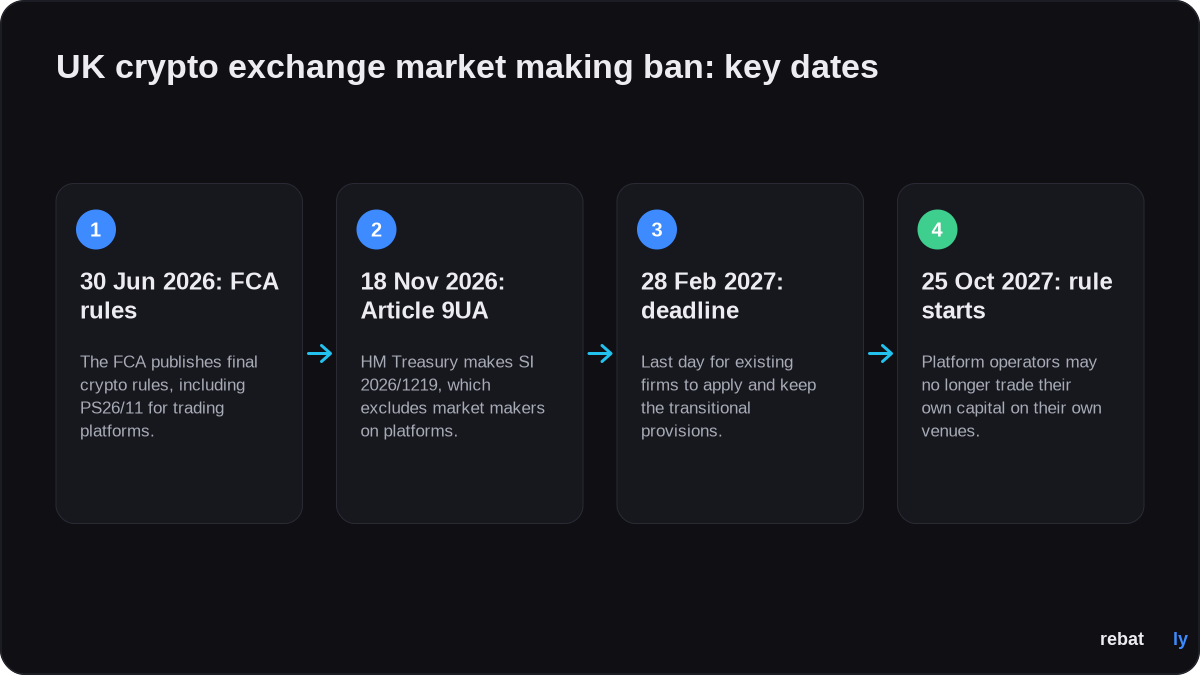
The main dates, from the FCA, the Treasury and legislation.gov.uk (Rebatly's chart follows this table):
| Date | What happened | Source |
|---|---|---|
| January 2020 | Crypto businesses in the UK must register with the FCA under the Money Laundering Regulations | FCA |
| 4 February 2026 | Parliament passes the Cryptoassets Regulations (SI 2026/102), the legal base of the regime | FCA, legislation.gov.uk |
| 30 June 2026 | FCA publishes final rules in five policy statements, including PS26/11 on trading platforms | FCA, Freshfields |
| 30 September 2026 | Application window opens for firms that want to keep operating while they apply | FCA |
| 21 October 2026 | FCA publishes CP26/36, draft perimeter guidance including PERG 18.8.18A on Article 9UA | Freshfields |
| 18 November 2026 | Treasury makes SI 2026/1219, adding Article 9UA; CP26/36 closes the same day | legislation.gov.uk, Freshfields |
| 28 February 2027 | Application window closes; firms that apply later cannot rely on the transitional provisions | FCA |
| 25 October 2027 | Regime starts; operators may no longer trade their own capital on their own platforms | FCA, Crypto Briefing |
Rebatly found no published FCA date for the final perimeter guidance; Freshfields notes that firms may have to apply before the CP26/36 guidance is final. The FCA also says it plans a formal review about two years after the regime starts.
What it could mean for spreads and trading costs
No outlet we reviewed quoted an analyst estimate of how the rule will change spreads, liquidity or fees for UK users, and the FCA's published cost-benefit summary gives no figure for spreads. The FCA says only that it still expects its rules "to deliver net positive benefits to market participants". What is known:
• Operators that rely on in-house market making will have to restructure before October 2027, Crypto Briefing reports.
• Independent market makers can keep quoting on UK platforms without a separate dealing permission, under Article 9UA.
• Incentive schemes for market makers must be disclosed, so users will be able to see them.
Rebatly does not forecast spreads, prices or fees. For how costs behave when markets move fast, see our guide to trading costs on big news days.
How fees and spreads make up your trading cost
Whatever the rules, a trade's total cost has the same parts:
• Trading fee: a maker fee if your order adds to the order book, a taker fee if it fills against it; charged on the full trade size, both on the way in and on the way out.
• Spread: the gap between the best buy price and the best sell price. Market makers earn it; a taker pays about half of it each time they cross the book.
• Slippage: a large market order that fills through several price levels pays more than the price on screen.
Standard entry-tier trading fees from each exchange's fee pages:
| Exchange (entry tier) | Spot maker | Spot taker | Perpetual maker | Perpetual taker |
|---|---|---|---|---|
| Bybit (VIP 0) | 0.10% | 0.10% | 0.02% | 0.055% |
| OKX (regular user) | 0.08% | 0.10% | 0.02% | 0.05% |
| Bitget (standard) | 0.10% | 0.10% | 0.02% | 0.06% |
Worked example (illustrative): a $10,000 spot trade on Bybit, bought and later sold with market orders, pays the 0.10% taker fee twice: $20. If the spread is 0.02% each time, crossing it adds about $2 more, for about $22 in total. A fee rebate lowers only the fee part: with up to 50% back on Bybit, the $20 in fees would come down by up to $10. A rebate does not change the spread or slippage. Our guide to maker vs taker fills goes further. This is general information, not financial advice.
What happens next
• Final perimeter guidance: the FCA has to finalise CP26/36, including the guidance on Article 9UA; no date has been published.
• 28 February 2027: the application window for existing firms closes.
• Before 25 October 2027: platforms that make markets on their own venues must change how they provide liquidity, for example by moving to matched principal or third-party market makers.
• Deferrals: the FCA has proposed deferring some execution-venue requirements to January 2028, Simmons & Simmons says.
• Review: the FCA plans a formal review about two years after the regime starts.
We will update this article as more is published.
Trade with lower fees
Wherever the rules land, every trade carries a fee. Sign up through Rebatly and part of every trading fee comes back to you: up to 50% on Bybit and Bitget, up to 40% on BloFin and OKX, up to 60% on MEXC and up to 65% on OrangeX futures. On Toobit, code Rebatly gives up to 60%, credited by Toobit itself, and BloFin credits its up to 40% itself every hour; the other rebates are paid daily in USDT. Our guide to how a fee rebate works explains the rest.
This article reports news and is not financial advice. Rebatly is an independent affiliate; not financial advice.
Get fees back on every trade
$10M+ rebates paid · Paid daily in USDT · No password or API keys, ever
Already signed up? Check your link and rebate with @rebatlybot on Telegram, or reach our support at @rebatly.
🔔 Get a Telegram alert each time your rebate is paid: tap “Activate notifications” in @rebatlybot. New to trading? Your first trade in 5 steps.
November 23, 2026 — published. Sources: FCA, HM Treasury, legislation.gov.uk, Crypto Briefing, crypto.news, Simmons & Simmons, Freshfields, Bybit, OKX, Bitget.