US CPI report on 10 November: time, forecasts and what it means for crypto
The US CPI report for October comes out on Tuesday 10 November 2026 at 13:30 UTC (8:30 a.m. in New York). Forecasters expect prices to rise 0.2% to 0.3% in the month, a calmer reading than September's 0.6%, and this time the report may not show an annual inflation rate at all, because October 2025 prices were never collected during the government shutdown. It is the last inflation reading before the Fed's 9 December decision, where prediction markets price a rate hike as the main case. This guide covers the time, the forecasts, how bitcoin moved on every CPI report this year, and what a fast market does to the cost of a trade. We don't forecast the numbers or prices; where we mention expectations, we say who said it.
 NO KYCSign up to BloFin
 Sign up to Bybit
 Sign up to OKX
 Sign up to Bitget
 Sign up to MEXC
 Sign up to OrangeX
 Sign up to Toobit
CPI report time today (UTC)
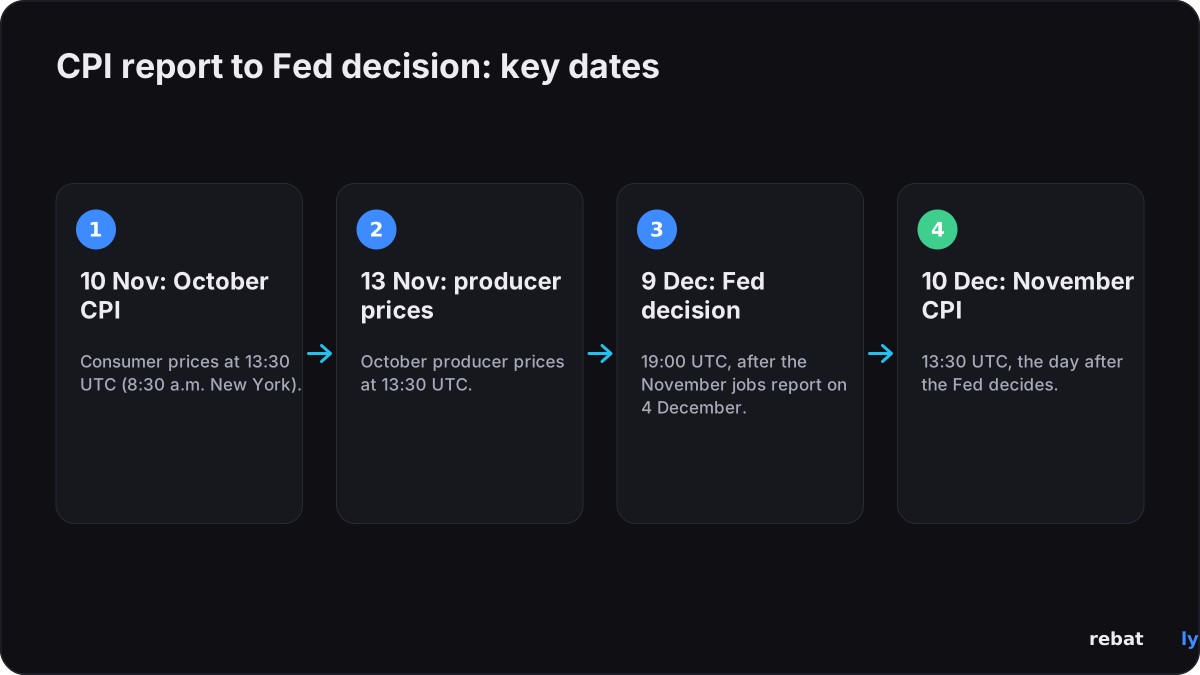
The Bureau of Labor Statistics publishes the Consumer Price Index for October at 8:30 a.m. Eastern Time on Tuesday 10 November 2026, which is 13:30 UTC. The next CPI report, for November, is due on Thursday 10 December at the same time, one day after the Fed's December decision. That makes the October report the last inflation reading the Fed sees before it decides.
What the CPI report is
The Consumer Price Index, or CPI, measures how much the prices that US households pay for goods and services changed. Markets watch four numbers in it:
• Headline CPI, month: the change in all prices from the month before, adjusted for seasonal swings.
• Headline CPI, year: the change over 12 months, the figure most news reports lead with.
• Core CPI: the same measure without food and energy, whose prices jump around. Many economists see it as the better guide to where inflation is heading.
• Shelter: rents and housing costs, the biggest single part of the index.
The Fed's own target uses a different measure, the PCE price index, but CPI comes out earlier and moves markets more.
Why the October CPI report may have no annual rate
This report has a gap. During the US government shutdown in the autumn of 2025, the Bureau of Labor Statistics could not collect October 2025 prices, and for most series it never published October 2025 indexes. Its shutdown FAQ says it "will not publish 12-month percent changes for October 2026 for indexes where October 2025 data are not available."
The FAQ does not say in so many words whether that covers the headline and core numbers. Wells Fargo's economists, via FXStreet, and the market news site MLQ both expect neither to carry an annual rate this time, so the monthly changes will do the work. Some economic calendars still show a forecast for the annual rate; treat those with care. The September report put annual inflation at 3.7% and core at 2.6%.
What the last CPI report showed
The September report, published on 14 October, showed prices rising faster. Consumer prices rose 0.6% in the month and 3.7% over the year, up from 3.4% in August, the Bureau of Labor Statistics said. Petrol was the main driver: the gasoline index rose 9.1% in the month, "accounting for over half of the monthly all items increase", and energy prices were 20.4% higher than a year earlier. Core prices rose 0.3% in the month and 2.6% over the year, up from 2.4%. The annual rate beat the 3.6% that forecasters expected, investingLive reported.
| Measure | August | September |
|---|---|---|
| Headline CPI, month | 0.4% | 0.6% |
| Headline CPI, 12 months | 3.4% | 3.7% |
| Core CPI, month | 0.3% | 0.3% |
| Core CPI, 12 months | 2.4% | 2.6% |
| Energy, month | 2.1% | 5.2% |
| Shelter, month | 0.3% | 0.4% |
CPI forecast for October
Forecasts point to a calmer month than September. Rebatly doesn't forecast the data; here is what others published:
• Bloomberg survey, via MLQ (8 November): headline prices up 0.3% in the month, core up 0.2%.
• Wells Fargo, via FXStreet (6 November): headline up 0.28%, core up 0.21%. The bank still expects the Fed to raise rates in December.
• TD Securities, via FXStreet (19 October): headline up 0.30%, core up 0.21%.
• Continuum Economics (27 October): headline and core both up about 0.2%, which it called "a more moderate month".
Markets react to the gap between the forecast and the actual number more than to the number itself. A core reading of 0.3% or more would be above every forecast listed here.
How bitcoin moved on every CPI report in 2026
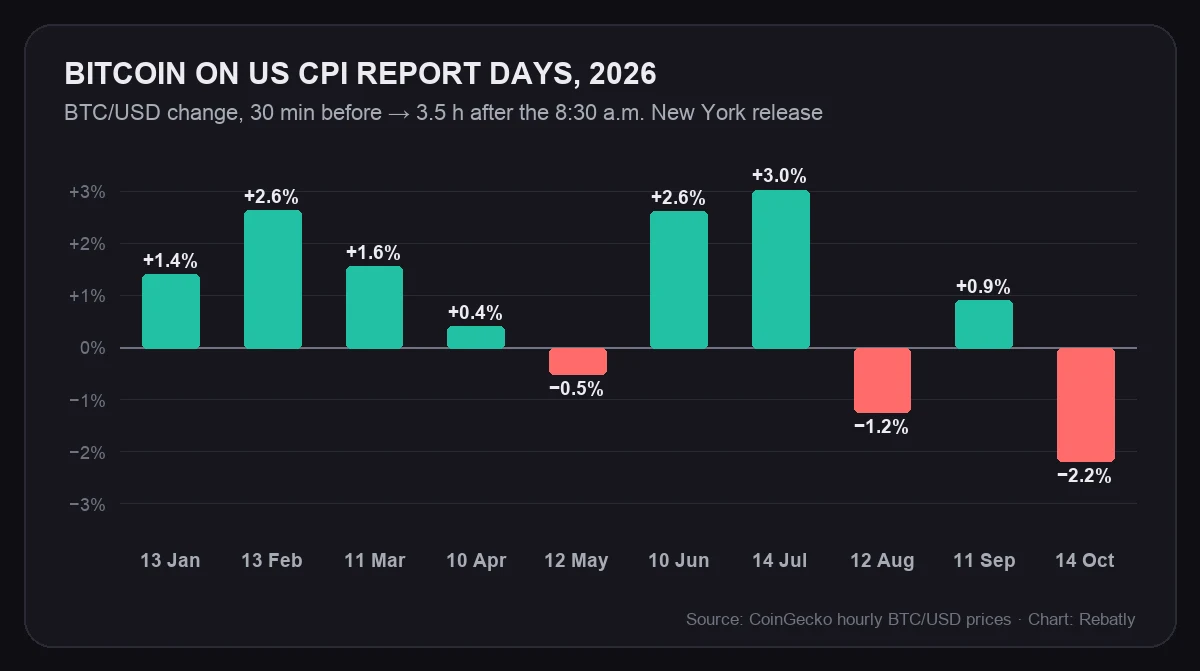
We took CoinGecko's hourly bitcoin prices for each of this year's ten CPI reports and compared the price half an hour before the release with the price half an hour and three and a half hours after it. Hourly data miss the fastest swings inside the hour, so read these as rough figures.
Bitcoin was higher four hours later after 7 of the 10 reports. The move was bigger than 1% seven times, and the average move, up or down, was about 1.7%. The latest one went the other way: after the hotter-than-expected September report on 14 October, bitcoin fell 2.2% within four hours, from $83,391 to about $81,600. Ten reports are a small sample, and each move also reflected everything else going on that day. Past moves say nothing about the next one.
| Release | Data for | Bitcoin before | About 1 hour | About 4 hours |
|---|---|---|---|---|
| 13 Jan | December 2025 | $91,996 | −0.1% | +1.4% |
| 13 Feb | January | $67,126 | +0.2% | +2.6% |
| 11 Mar | February | $69,228 | +0.2% | +1.6% |
| 10 Apr | March | $72,126 | +0.1% | +0.4% |
| 12 May | April | $80,748 | +0.1% | −0.5% |
| 10 Jun | May | $60,996 | +0.9% | +2.6% |
| 14 Jul | June | $62,790 | +1.7% | +3.0% |
| 12 Aug | July | $64,181 | −0.2% | −1.2% |
| 11 Sep | August | $76,996 | +1.2% | +0.9% |
| 14 Oct | September | $83,391 | −0.8% | −2.2% |
Why the CPI report matters for crypto now
The Fed raised its target range by a quarter point to 3.75% to 4% in September, then held it on 28 October in a 10–2 vote; the two dissenters wanted another hike, and the Fed statement said "inflation remains elevated." Then the October jobs report on 6 November showed 165,000 new jobs, far above forecasts. Our article on the jobs report and crypto has the numbers.
Prediction markets now treat a December hike as the main case. At 23:26 UTC on 8 November, a quarter-point hike traded at 77% on Kalshi and about 76.5% on Polymarket, by our reading of each market's public data. These are market prices, not forecasts by Rebatly, and they can move within minutes. CoinDesk's Stephen Alpher wrote that the week's consumer and producer price data "will likely be more important in the Fed's decision" than the jobs report, in CoinDesk's live coverage. Our article on a December Fed rate hike and crypto goes further.
Crypto goes into the report on the back foot. Bitcoin fell to $74,762 on 6 November, its lowest since 21 August, Cointelegraph reported, and US spot bitcoin ETFs lost $1.28 billion over the week to 6 November, according to Farside data cited by crypto.news. CoinGecko showed bitcoin at about $75,400 at 23:18 UTC on 8 November. A hot reading would add to the case for a hike, which tends to lift the dollar and bond yields and weigh on risky assets such as crypto; a soft one would do the opposite. The link is not mechanical, as the table above shows.
Trading costs on CPI day
Your exchange's fee rate doesn't change at 13:30 UTC. What changes is how much of your trade gets eaten on the way in and out. In the seconds after the release, spreads widen, order books thin out and market orders can fill well away from the price on screen. A study by the research firm Kaiko found that slippage on BTC-USD "tripled within hours" around the sell-off of 5 August 2024, which followed weak US jobs data.
Take a $10,000 BTC perpetual position on Bybit at the base fee tier, opened and closed once. With market orders, the taker fee of 0.0550% costs $5.50 each way, $11 in total. With limit orders that rest on the book, the maker fee of 0.0200% costs $2 each way, $4 in total. If each market order also fills 0.05% worse than the screen price, an example rather than a measurement, that adds $10, so the same trade costs $21 instead of $4.
If you do trade on CPI day, a few habits keep costs down:
• Use limit and post-only orders where you can.
• Check where your stops sit. A stop that triggers in the first seconds becomes a market order at the worst moment.
• Know your liquidation price before the release, and watch funding rates on perpetual futures afterwards.
Our guides to trading costs on Fed days and maker and taker fills go further. Whether to trade on CPI day is your call; this is general information, not financial advice.
What happens next
• 10 November, 13:30 UTC: US consumer prices for October.
• 13 November, 13:30 UTC: US producer prices for October.
• Around 18 November: minutes of the Fed's October meeting.
• 4 December, 13:30 UTC: the November jobs report.
• 9 December, 19:00 UTC: the Fed's decision.
• 10 December, 13:30 UTC: consumer prices for November.
Rebatly does not forecast prices. We update this guide after each CPI report.
Trade with lower fees
Whatever the CPI report shows, every trade you make carries a fee. Sign up through Rebatly and part of every trading fee comes back to you: up to 50% on Bybit and Bitget, up to 40% on BloFin and OKX, up to 60% on MEXC and up to 65% on OrangeX futures. On Toobit, code Rebatly gives up to 60%, credited by Toobit itself. Rebates are paid daily in USDT. Our guide to how a fee rebate works explains the rest.
This article reports news and is not financial advice. Rebatly is an independent affiliate; not financial advice.
Get fees back on every trade
$10M+ rebates paid · Paid daily in USDT · No password or API keys, ever
Already signed up? Check your link and rebate with @rebatlybot on Telegram, or reach our support at @rebatly.
🔔 Get a Telegram alert each time your rebate is paid: tap “Activate notifications” in @rebatlybot. New to trading? Your first trade in 5 steps.
November 8, 2026 — published. Sources: US Bureau of Labor Statistics, Federal Reserve, Bloomberg, Wells Fargo, TD Securities, Continuum Economics, FXStreet, MLQ, investingLive, CoinDesk, Cointelegraph, crypto.news, Farside Investors, Kaiko, Kalshi, Polymarket, Bybit, CoinGecko.