Bitcoin options expiry: about $7 billion settled on 27 November, and $10 billion is due on 25 December
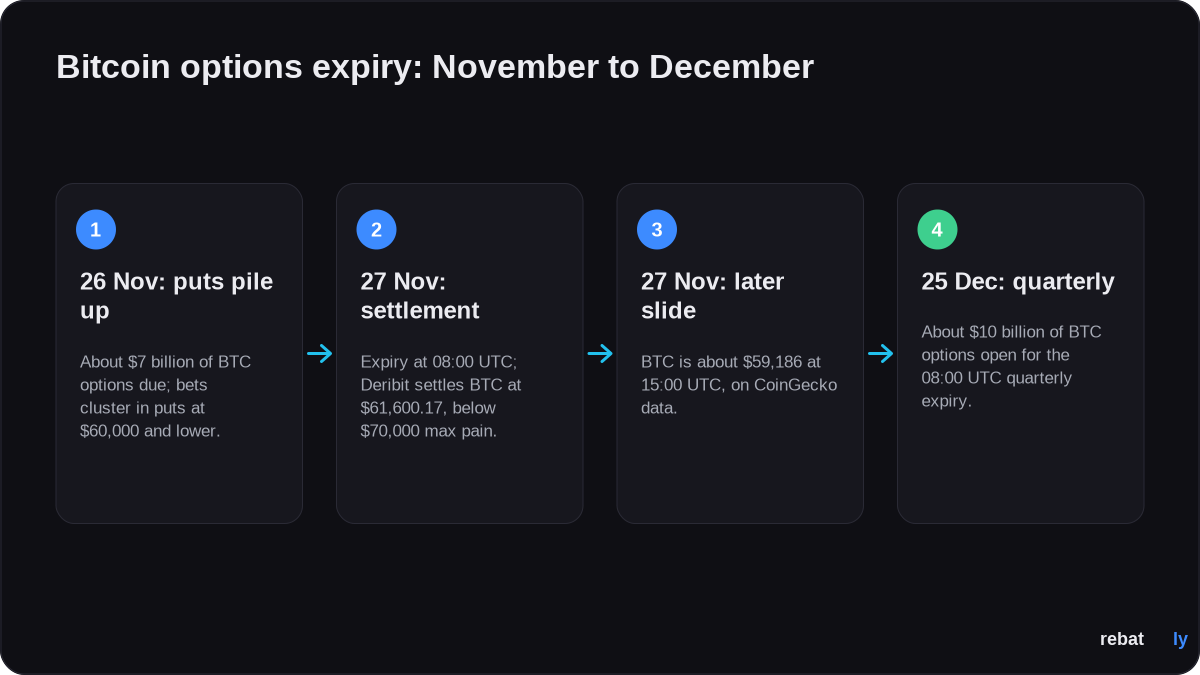
The November Bitcoin options expiry is already done. About $7 billion of BTC options on Deribit, the largest crypto options exchange, expired at 08:00 UTC on Friday 27 November, CoinDesk and TokenPost reported, with about $0.6 billion of ETH options alongside. Deribit's own data puts the BTC settlement price at $61,600.17, well below the $70,000 "max pain" level that analysts flagged. Today, Saturday 28 November, brings only a small daily expiry. The next large one is the quarterly expiry on 25 December, with about $10 billion of BTC options open. This article explains what expired, what options expiry is, what max pain means, and what futures traders should watch.






What expired on 27 November
Outlets report slightly different totals for the same expiry, because they read Deribit's data at different times and value it at different prices. BTC figures run from $6.8 billion (Decrypt, citing CryptoQuant; Odaily) to about $7 billion (CoinDesk, TokenPost). The settlement prices are Deribit's own:
| BTC options | ETH options | |
|---|---|---|
| Notional value expiring (reported) | $6.8 billion to $7 billion | About $0.6 billion to $0.65 billion |
| Contracts (reported by Odaily) | About 110,000 BTC | About 370,000 ETH |
| Put/call ratio (reported) | 0.89 (CoinDesk, before expiry); 0.79 (Odaily) | 0.56 (Odaily) |
| Max pain (reported by Odaily) | $70,000 | $2,100 |
| Settlement price (Deribit) | $61,600.17 | $1,730.14 |
What the positioning said before expiry
The bets looked very different from October. CoinDesk reported on 26 November that open interest for this expiry was heavily stacked in puts at strikes of $60,000 and lower, with large puts at $60,000, $58,000, $50,000 and $40,000, while October's biggest bets were calls at $90,000 to $100,000. A put is a contract that pays if the price falls below its strike, so heavy put buying usually reflects demand for protection against a drop.
CoinDesk put the put/call ratio for the expiry at 0.89, against 0.55 for October's, and reported Deribit's implied volatility index, DVOL, at 55.45, up from 38 in October. A higher DVOL means options traders were paying more for protection against large moves. Together, the 27 November BTC and ETH options were about a quarter of all open options on Deribit, CoinDesk reported.
Bitcoin price around the expiry
BTC did not move much in the hour around settlement, on CoinGecko's data. It was about $61,770 at 07:30 UTC on 27 November, about $61,617 at 08:00 UTC and about $61,670 at 09:00 UTC. Later in the day it fell: CoinGecko showed about $59,186 at 15:00 UTC, and Decrypt reported that BTC dropped below $59,000 later on Friday. At 03:14 UTC on 28 November CoinGecko showed about $59,961, down 2.5% in 24 hours. No source we read tied the afternoon drop to the expiry itself.
Rebatly does not forecast prices. Big scheduled events can bring fast moves and wider spreads; our guide to trading costs on big news days shows with real fee rates how limit orders cut that cost.
What is options expiry, in plain words
A Bitcoin option is a contract that gives the right, not the obligation, to buy (a call) or sell (a put) BTC at a set price, the strike, on a set date. On Deribit each BTC option is for 1 BTC and each ETH option is for 1 ETH. Deribit options are European style: they can only be exercised at expiry. Options that finish in the money are exercised automatically and only the profit is paid, in BTC for BTC options and in ETH for ETH options; Deribit routes this through the matching futures contract, which settles at the same price.
• When: Deribit options expire at 08:00 UTC. There are daily, weekly (Friday), monthly (last Friday of the month) and quarterly (last Friday of March, June, September and December) expiries; the monthly and quarterly ones are the big ones.
• At what price: the settlement price is a time-weighted average of the Deribit BTC index over the 30 minutes before 08:00 UTC, which makes it hard for one trade to move it.
• What "notional" means: the number of open contracts times the BTC price. It is not money that changes hands; options that finish out of the money expire worthless, and only the in-the-money part is paid out.
What max pain means, and why prices can pin
Max pain is the strike price at which the most options, calls and puts together, would expire worthless, so option buyers as a group would collect the least. Some traders watch it because the dealers on the other side of large positions hedge by buying or selling BTC, and that hedging can pull the price toward heavily traded strikes in the last hours before expiry, an effect called pinning.
Pinning is a tendency, not a rule. This month it did not happen: max pain was $70,000 and BTC settled at $61,600.17, about $8,400 lower. Once a large expiry is gone, the hedges tied to it are unwound, and some traders expect bigger moves afterwards, but no source we read showed a consistent pattern after recent monthly expiries.
Today's expiry and the 25 December quarterly
Open interest by expiry, from Deribit's public data at 03:13 UTC on 28 November. Notional values are our calculation at the Deribit BTC index of $59,928 and ETH index of $1,663 at that time; max pain is our calculation from Deribit's open interest by strike:
| Expiry (08:00 UTC) | BTC options open | Notional | Put/call | Max pain |
|---|---|---|---|---|
| 28 Nov (daily) | About 4,900 BTC | About $0.29 billion | 0.99 | $60,500 |
| 4 Dec (weekly) | About 29,500 BTC | About $1.8 billion | ||
| 25 Dec (quarterly) | About 167,700 BTC | About $10.05 billion | 0.69 | $70,000 |
| 25 Dec ETH (quarterly) | About 719,000 ETH | About $1.2 billion | 0.42 | $2,200 |
Where the 25 December bets sit
The 25 December expiry holds about 48% of all BTC options open on Deribit, on our count of its data at 03:13 UTC on 28 November; Decrypt also put it at about 165,000 BTC and about $10 billion. Unlike November's, it leans to calls, with a put/call ratio of 0.69. The largest call positions are at $80,000 (about 8,400 BTC) and $100,000 (about 6,500 BTC); the largest put positions are at $60,000 (about 6,900 BTC) and $40,000 (about 5,500 BTC). Many of these positions were opened when BTC was much higher, and open interest changes every day until expiry, so these numbers will move.
The market backdrop
The expiry came in a weak month. BTC fell about 22% from $77,275 at 00:00 UTC on 31 October to $59,961 at 03:14 UTC on 28 November, on CoinGecko's data. The Crypto Fear & Greed Index read 10, extreme fear, on 28 November, after 12 and 11 on the two days before (Alternative.me); our guide to the Crypto Fear & Greed Index explains what it measures.
US spot bitcoin ETFs had net outflows of $5.39 billion in November up to 25 November, according to SoSoValue data reported by CoinDesk, more than the previous monthly record of $4.51 billion in June 2026. Final November figures were not yet published when we checked. The Federal Reserve's quiet period, when officials do not speak publicly on policy, runs from 28 November to 10 December, around its 8–9 December meeting, according to the Fed's calendar and communication rules.
What futures traders should watch around expiry
• Volatility: large expiries can bring sharp moves before and after 08:00 UTC, and leveraged futures positions can be liquidated in a quick swing even if the price comes back. Check your margin and liquidation price before the event.
• Thin markets: weekends, and holidays like 25 December, often have less liquidity, which can mean wider spreads and more slippage on market orders.
• Fees add up in the chop: at a taker fee of 0.055%, an example rate, opening and closing a $10,000 futures position costs $11. Ten round trips in a choppy day cost $110 in fees, whatever the result. Our fee calculator shows what part of that a rebate returns.
• Settlement, not spot: options settle on Deribit's 30-minute index average, so the settlement price can differ from the last trade on any one exchange.
This is general information, not financial advice. Rebatly does not give trade calls.
What happens next
• Every day at 08:00 UTC: daily Deribit options expire; they are small next to the monthly and quarterly ones.
• 4 December: the next weekly expiry, about $1.8 billion of BTC options on our count.
• 8–9 December: the Federal Reserve's policy meeting; the quiet period runs until 10 December.
• 25 December: the quarterly expiry, about $10 billion of BTC options open.
We will update this article before the 25 December expiry with fresh Deribit data.
Trade with lower fees
Whichever exchange you use, every trade carries a fee. Sign up through Rebatly and part of every trading fee comes back to you: up to 50% on Bybit and Bitget, up to 40% on BloFin and OKX, up to 60% on MEXC and up to 65% on OrangeX futures. On Toobit, code Rebatly gives up to 60%, credited by Toobit itself, and BloFin credits up to 40% itself every hour; the other rebates are paid daily in USDT. Our guide to how a fee rebate works explains the rest.
This article reports news and is not financial advice. Rebatly is an independent affiliate; not financial advice.
Get fees back on every trade
$10M+ rebates paid · Paid daily in USDT · No password or API keys, ever
Already signed up? Check your link and rebate with @rebatlybot on Telegram, or reach our support at @rebatly.
🔔 Get a Telegram alert each time your rebate is paid: tap “Activate notifications” in @rebatlybot. New to trading? Your first trade in 5 steps.
November 28, 2026 — published. Sources: Deribit, CoinDesk, Decrypt, TokenPost, Odaily, CryptoQuant, SoSoValue, Federal Reserve, Alternative.me, CoinGecko.