BlackRock tokenized money market fund in Hong Kong: what stablecoin access means
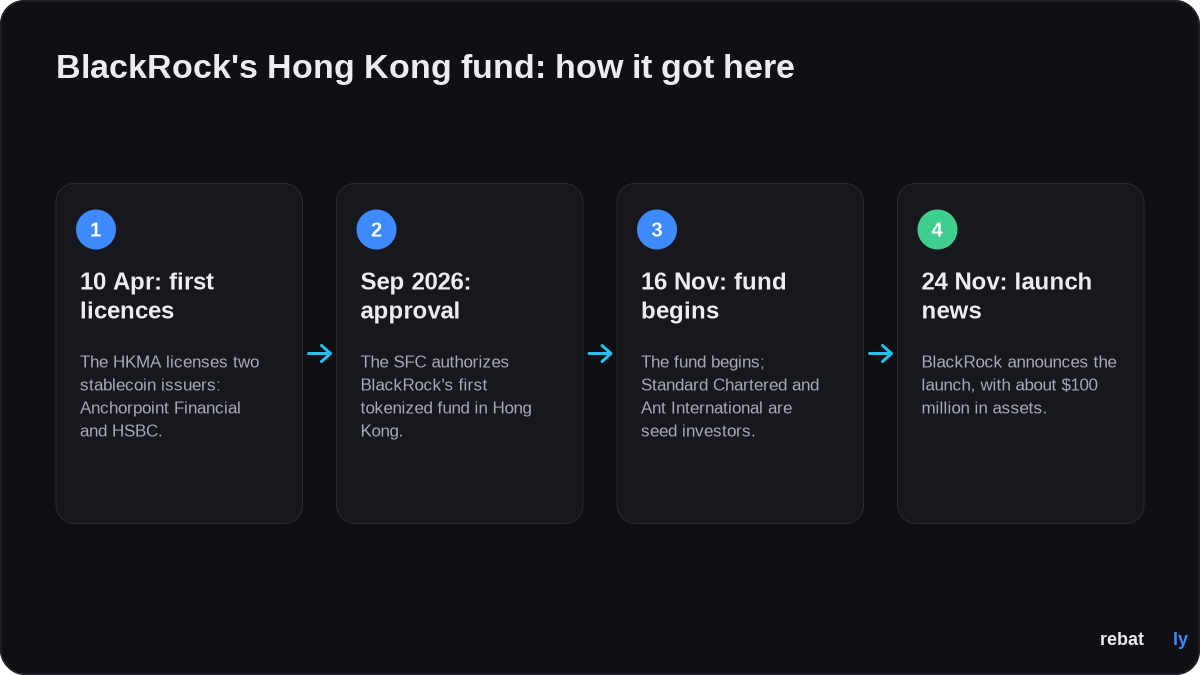
The BlackRock tokenized money market fund in Hong Kong, the BlackRock HKD Digital Liquidity Fund, is BlackRock's first in Asia-Pacific. It began on 16 November 2026, and BlackRock announced the launch on 24 November with about $100 million in assets as of 20 November, The Block and Cointelegraph report. Professional investors can subscribe and redeem with HKDAP, a Hong Kong dollar stablecoin from a licensed issuer; retail investors pay in ordinary Hong Kong dollars. The fund itself is not a stablecoin, BlackRock says. This article explains who can buy it, what it costs, what stands behind each unit and how it differs from holding a stablecoin.





What BlackRock launched in Hong Kong
The fund holds short-term Hong Kong dollar instruments and comes in conventional and tokenized units. The main facts below come from BlackRock's Product Key Facts statement for the tokenized classes, its website and news reports:
| Item | What is published | Source |
|---|---|---|
| Fund | BlackRock HKD Digital Liquidity Fund, domiciled in Hong Kong, priced in Hong Kong dollars | BlackRock |
| Start and launch | Began 16 November 2026; launch announced 24 November 2026 | BlackRock, The Block |
| Size | About $100 million as of 20 November | The Block |
| Seed investors | Standard Chartered and Ant International | The Block, Cointelegraph |
| Class D OnChain (tokenized) | Distributing or accumulating; minimum first subscription HK$10, then HK$1 | BlackRock |
| Blockchain | Ethereum smart contracts on a permissioned platform run by Standard Chartered Bank (Hong Kong) | BlackRock |
| Payment | Cash or digital cash; HKDAP for professional investors, Hong Kong dollars for retail | BlackRock, Cointelegraph |
| Costs (Class D OnChain) | Ongoing charges estimated at 0.37% a year, including a management fee of up to 0.31% | BlackRock |
| Dealing | Daily, with a 03:00 UTC cut-off; distributors may set an earlier one | BlackRock |
| Secondary trading | None, and no peer-to-peer transfers | BlackRock |
What is a tokenized money market fund?
A money market fund pools investors' cash and puts it into short-term, high-quality debt and deposits, and pays out or reinvests the income after costs. A tokenized money market fund does the same thing, but records who owns the units on a blockchain.
• What it holds: at least 99.5% of the fund's net assets go into short-term Hong Kong dollar instruments issued or guaranteed by governments and public bodies, reverse repurchase agreements, and deposits at investment-grade institutions, the Product Key Facts statement says. These are not cryptocurrencies, BigGo Finance notes, and digital cash must stay under 10% of gross assets.
• Liquidity rules: at least 15% of net assets in daily liquid assets and at least 50% in weekly liquid assets.
• Price: the distributing classes aim for a constant HK$10.00 per unit. The accumulating classes keep their income, so their price moves.
• Yield: BlackRock's product page showed a 1-day net yield of 1.83% for D OnChain (distributing) on 25 November. Its 7-day figure, 0.26%, covers only the first days of that class. The conventional D class showed a 7-day net yield of 2.06% on the same date. These rates change every day and are not a promise.
• The record: Standard Chartered keeps the official register of tokenized units on the blockchain, and on-chain settlement is final.
Who can buy it, and with which stablecoin
The fund is open to retail and institutional investors in Hong Kong, The Block reports, but the stablecoin route is narrower than many headlines suggest.
• Professional investors: can subscribe and redeem with digital cash, including HKDAP. HKDAP is issued by Anchorpoint Financial, a joint venture of Standard Chartered's Hong Kong bank, HKT and Animoca Brands.
• Retail investors: may hold tokenized units only through an eligible distributor, meaning an SFC-licensed virtual asset trading platform or a securities dealer licensed for virtual assets and appointed by BlackRock, the Product Key Facts statement says. At launch they pay and are paid in ordinary Hong Kong dollars, Cointelegraph and crypto.news report. HKDAP itself is still limited to corporations and professional investors, BigGo Finance reports.
• Which stablecoins: the fund documents allow tokenized deposits and stablecoins from issuers licensed by the Hong Kong Monetary Authority (HKMA). HKDAP is the only stablecoin named in BlackRock's announcements. USDT and USDC do not qualify under that definition, as their issuers are not on the HKMA register.
• Not published: we found no public list of the appointed distributors.
Rebatly reports this as news. We do not offer this fund and make no claim about who else can or will be able to buy it.
Fund vs stablecoin: the key differences
Both can sit on a blockchain and both aim for a steady price, but they give you different rights. "The fund is not a stablecoin", BlackRock says.
| Question | Licensed HKD stablecoin | BlackRock fund (D OnChain) |
|---|---|---|
| What you hold | A token you can redeem with the issuer at par | A unit in a fund |
| Who earns the income | The issuer; paying interest to holders is banned in Hong Kong | The investor, after charges |
| What stands behind it | Segregated reserves worth at least the coins in circulation | The fund's bills, deposits and reverse repos, with Standard Chartered Trustee (Hong Kong) as trustee |
| Getting out | Normally processed within 1 business day after a valid request | Daily dealing at the next price; settlement on trade date, BlackRock lists |
| Transfers | Can move between wallets where the issuer allows it | No peer-to-peer transfers or secondary market |
| Can you lose money? | Yes, if the issuer, reserves or technology fail | Yes; the fund does not guarantee repayment of principal |
What stablecoin access changes, and what it does not
A professional investor who already holds HKDAP can move into the fund, and back out, without first converting to bank money, Cointelegraph reports. That can shorten the gap during which cash earns nothing.
It does not make the fund a 24/7 market. A stablecoin can move at night, but a fund order is still priced at the next dealing point, as crypto.news points out. BlackRock's cut-off is 03:00 UTC on each dealing day, and an order after that waits. A holder also cannot sell a token to another wallet: the way out is a redemption, after which the token is burned.
There are stress limits too. The manager can charge a liquidity fee, use redemption gates, suspend dealing, or switch the fund to a floating price if the gap between its stable price and market value grows too large (the Product Key Facts statement gives 0.50% as an example). BlackRock also lists smart contract, wallet key and stablecoin issuer risks.
Hong Kong's stablecoin and tokenization rules
Two regulators share the rules.
• Stablecoins (HKMA): the Stablecoins Ordinance has applied since 1 August 2025. The HKMA's public register lists two licensed issuers, Anchorpoint Financial and HSBC's Hong Kong bank, both licensed from 10 April 2026.
• No interest: a licensed issuer must not pay interest on its stablecoin, must keep reserves worth at least the coins in circulation and separate from its own money, and must redeem at par, the HKMA's supervision guideline says.
• Funds (SFC): the Securities and Futures Commission (SFC) authorizes funds sold to the public. Authorization is not a recommendation. The fund is not supervised by the HKMA and is not a bank deposit, its documents state.
• Secondary trading pilot: in April 2026 the SFC set up a pilot for trading tokenized funds on licensed platforms, starting with money market funds, The Standard reported. As of March 2026 there were 13 tokenized products offered to the public, with HK$10.7 billion in their tokenized classes. BlackRock's tokenized units are not traded on a secondary market.
BUIDL and other tokenized funds
The Hong Kong fund is small next to the dollar funds. It is also separate from BUIDL, BlackRock's US dollar fund tokenized by Securitize. Ledger Insights notes that the new fund adds a fourth currency to a tokenized range that already spans dollars, euros and pounds. RWA.xyz showed $14.08 billion in tokenized US Treasury funds on 25 November:
| Tokenized fund | Value on RWA.xyz, 25 November 2026 |
|---|---|
| Ondo USDY | $2.38 billion |
| Circle USYC | $2.12 billion |
| Franklin Templeton iBENJI | $1.65 billion |
| BlackRock BUIDL | $1.55 billion |
| Franklin Templeton BENJI | $1.36 billion |
HSBC's RedCoin fund: the retail comparison
BlackRock was not first to link a licensed stablecoin to a fund. On 19 November, HSBC let Hong Kong customers buy a tokenized class of its own Hong Kong dollar money market fund with its RedCoin stablecoin, from HK$100, CoinLaw and Cointelegraph report. Estimated ongoing charges are 0.38% a year and there is no secondary trading.
The two use different ownership records, the reports show: HSBC's official register stays off-chain, while BlackRock's fund keeps it on the blockchain.
How the market reacted
A Hong Kong dollar cash fund is not expected to behave like a crypto asset, and there is no token of it to trade. At 15:14 UTC on 25 November, CoinGecko showed bitcoin at about $57,880, down about 3.4% in 24 hours, and Ethereum at about $1,633, down about 2.8%. We found no evidence linking those moves to the fund. BUIDL's value was about $1.55 billion on CoinGecko as well.
Rebatly does not forecast prices. Our guide to trading costs on big news days shows how limit orders can cut costs when prices move fast.
What to watch for
• Fake tokens: the units have no secondary market, so treat any "BlackRock Hong Kong token", presale or airdrop as a likely scam. Check issuers on the HKMA register.
• Read the class name: D, I, distributing and accumulating classes have different minimums and income rules.
• Protect your accounts: use official channels only, never share passwords or 2FA codes, and check API keys and your withdrawal whitelist. Our article on exchange data breaches and scam messages shows what fake messages look like.
• Token is not the same as stock: our article on OKXICE tokenized stocks explains another kind of tokenized security.
This is general security information, not financial advice.
What happens next
• Distributors: which licensed platforms will offer the tokenized units to retail clients.
• Retail stablecoin payments: retail use of HKDAP is planned for a later stage, BigGo Finance reports. No date is confirmed.
• Fund data: assets, yields and the gap between the stable price and market value, which the manager publishes on each dealing day.
• More payment forms: the approval announcement carried by Hubbis mentioned tokenized deposits as well as stablecoins.
Trade with lower fees
Whichever exchange you use, every trade carries a fee. Sign up through Rebatly and part of every trading fee comes back to you: up to 50% on Bybit and Bitget, up to 40% on BloFin and OKX, up to 60% on MEXC and up to 65% on OrangeX futures. On Toobit, code Rebatly gives up to 60%, credited by Toobit itself, and BloFin credits up to 40% itself every hour; the other rebates are paid daily in USDT. Our guide to how a fee rebate works explains the rest.
This article reports news and is not financial advice. Rebatly is an independent affiliate; not financial advice.
Get fees back on every trade
$10M+ rebates paid · Paid daily in USDT · No password or API keys, ever
Already signed up? Check your link and rebate with @rebatlybot on Telegram, or reach our support at @rebatly.
🔔 Get a Telegram alert each time your rebate is paid: tap “Activate notifications” in @rebatlybot. New to trading? Your first trade in 5 steps.
November 25, 2026 — published. Sources: BlackRock, HKMA, The Block, Cointelegraph, Ledger Insights, crypto.news, Hubbis, BigGo Finance, CoinLaw, The Standard, RWA.xyz, CoinGecko.