Bithumb hack and Coinbase data leak: what happened and how to protect your account
Two crypto exchanges reported data incidents within a day of each other. South Korea's Bithumb was hacked through an internal system its employees use, and personal information leaked; on the same day, Coinbase said a third-party vendor had exposed contact details of a small group of its customers. Both say customer crypto was not touched. What happens next is the bigger risk for most users: scam messages that use the news as bait. This article sets out what each company has said, what the leaked data can be used for, and the steps that protect your exchange account today.
 NO KYCSign up to BloFin
 Sign up to Bybit
 Sign up to OKX
 Sign up to Bitget
 Sign up to MEXC
 Sign up to OrangeX
 Sign up to Toobit
Bithumb hack: what happened
Bithumb, South Korea's second-largest crypto exchange by trading volume, said an outsider broke into its in-house mobile system, which employees use to message each other and work, and that personal information leaked. It found the intrusion on Tuesday 27 October and reported it the same day to the Korea Internet & Security Agency (KISA) and the Personal Information Protection Commission, according to Yonhap as carried by Reuters and CoinDesk.
Bithumb said it is still working out the exact scope, "including the possibility of member information being involved", and that it will make an official announcement. It also said the breached system is separate from its trading platform, so customer crypto cannot be reached through this breach. As of 28 October, no crypto was reported lost, and Bithumb had not said how many people were affected.
Not just Bithumb: attacks on Korean finance
Bithumb was one of three financial firms that reported attacks on the same day, Reuters reported, citing Yonhap. Earlier in October, the Financial Services Commission said a wave of hacking had hit 16 South Korean financial firms, including banks, causing around 100,000 cases of data leaks.
| Company | What it reported (27–28 October 2026) |
|---|---|
| Bithumb (crypto exchange) | Internal mobile system hacked; personal information leaked; checking whether member data is included |
| Daishin Securities (broker) | Personal and credit information of 38,490 customers leaked (CoinDesk); emergency measures taken |
| Mirae Asset Global Investments (asset manager) | Blocked abnormal access to some web systems; says investor information was not affected (CoinDesk) |
Coinbase data leak: the Amplitude vendor incident
Coinbase said the problem started at Amplitude, a third-party analytics provider, not in its own systems. Contact information for a "small subset" of Coinbase customers was exposed, along with data from other Amplitude clients. Coinbase denied reports that it had been hacked, said customer funds are safe and that it has found no unauthorized access to its systems, and said it is emailing affected customers "as required by law", CoinDesk reported on 28 October. Coinbase has not said how many customers are affected or exactly which contact details were involved.
What leaked contact details are used for
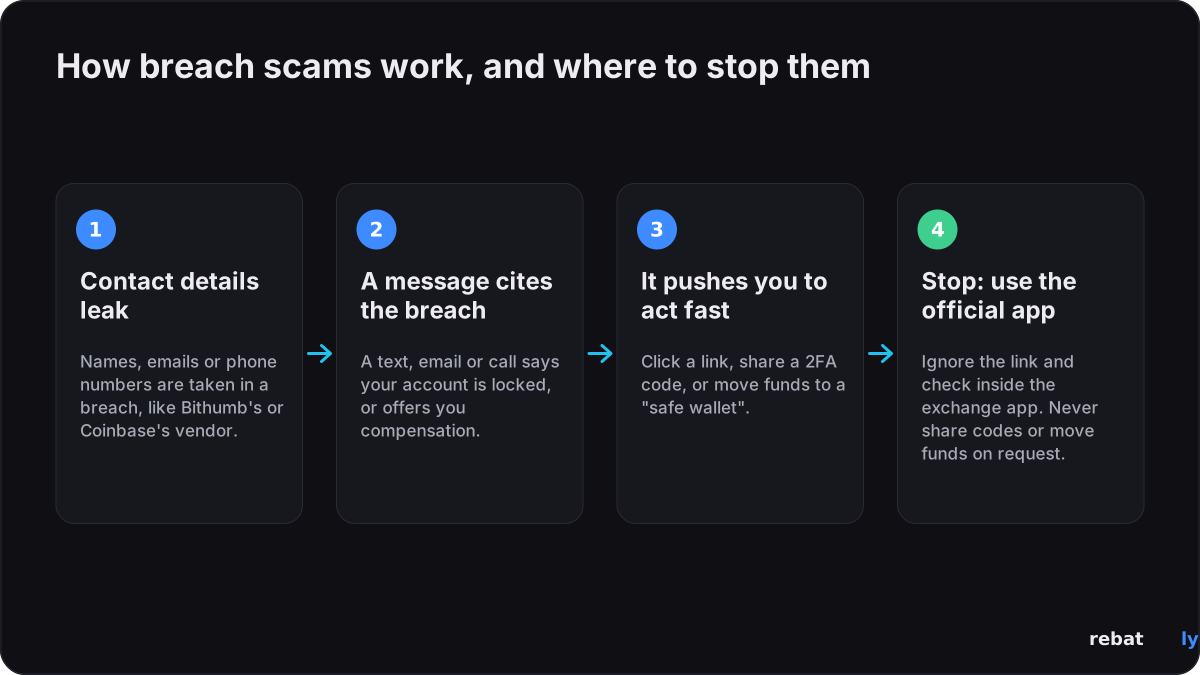
Names, phone numbers and email addresses can't move your crypto on their own. Scammers use them to sound convincing. After a leak, expect messages that mention the incident by name: a text saying your account is "locked after the hack", an email about "compensation" with a link to claim it, or a call from someone posing as exchange support who wants you to "secure" your funds by moving them to a new wallet. CoinDesk noted that exposed emails and phone numbers can be used for exactly this kind of phishing and social engineering.
The bait is the news itself. Neither Bithumb nor Coinbase had announced any compensation scheme as of 28 October, so treat any message offering one as suspect until you see it in the exchange's own app or official notices.
How to protect your exchange account now
These steps work on any exchange, whether or not your data was in a leak.
| Do this | Why it matters |
|---|---|
| Open the exchange app or type its address yourself; don't use links in texts or emails about the breach | Breach-themed messages are the most common follow-up scam |
| Use app-based 2FA (an authenticator app) or a passkey, not SMS codes alone | A leaked phone number makes SMS codes easier to attack, for example through a SIM swap |
| Change your password if you have used it anywhere else | Reused passwords let one leak open other accounts |
| Turn on the withdrawal address whitelist | Withdrawals can only go to addresses you have approved in advance |
| Check your API keys and logged-in devices, and remove any you don't use | Old keys and sessions are an easy way in |
| Never share 2FA codes or your password, and never move funds to a "safe wallet" someone gives you | Treat any request like this as a scam, whoever it claims to come from |
Earlier breaches at Bithumb and Coinbase
Neither company is new to this. Both have had earlier leaks that started outside their trading systems, through a person or a partner with access to customer data.
| When | What happened |
|---|---|
| Bithumb, 2017 | A PC used for Bithumb work was infected through a spear-phishing email and 36,487 personal records leaked; the Korea Communications Commission fined Bithumb about 60 million won (Dailian, December 2017) |
| Coinbase, 2025 | Contractors at outsourcing firm TaskUs leaked customer data; Coinbase estimated the cost at $180 million to $400 million (reported by Reuters and CryptoSlate, May 2025) |
| Bithumb and Coinbase, October 2026 | Bithumb's internal mobile system hacked; Coinbase customer contacts exposed through the vendor Amplitude |
What happens next
• Bithumb has promised an official announcement on the scope of the leak, including whether member data was involved. Korea's Financial Supervisory Service was assessing Bithumb and two other firms on 28 October, CoinDesk reported.
• Coinbase is emailing the customers whose details were exposed.
• You: expect breach-themed scam messages over the coming weeks, and check anything that asks you to act inside the official app.
We will update this article when Bithumb publishes the scope of the leak.
What Rebatly never asks for
Rebatly never asks for your password, 2FA codes or API keys, and never asks you to move funds. Rebates are matched to your exchange account by its UID and paid daily in USDT by internal transfer. If anyone using the Rebatly name asks for any of these, it isn't us: contact us on Telegram at @rebatly or at hello@rebatly.io.
Sign up through Rebatly and part of every trading fee comes back to you: up to 50% on Bybit and Bitget, up to 40% on BloFin and OKX, up to 60% on MEXC and up to 65% on OrangeX futures. On Toobit, code Rebatly gives up to 60%, credited by Toobit itself. Our guide to how a fee rebate works explains the rest.
This article reports news and is not security, legal or financial advice. Rebatly is an independent affiliate; not financial advice.
Get fees back on every trade
$10M+ rebates paid · Paid daily in USDT · No password or API keys, ever
Already signed up? Check your link and rebate with @rebatlybot on Telegram, or reach our support at @rebatly.
🔔 Get a Telegram alert each time your rebate is paid: tap “Activate notifications” in @rebatlybot. New to trading? Your first trade in 5 steps.
October 28, 2026 — published. Sources: Reuters, Yonhap News Agency, CoinDesk, Dailian, CryptoSlate.