Bybit TradFi Fees (November 2026): Stock, Gold and Forex Perps, MT5 CFDs and Direct Stocks
Bybit offers several ways to trade traditional markets: perpetuals on stocks, ETFs, gold, silver and forex; CFDs on MT5; and, for US stocks, Direct Stocks, xStocks and Perp Options. Each is priced differently. TradFi perps currently cost 0% maker and 0.0275% taker at VIP 0, falling to 0.015% taker at Supreme VIP, while Bybit's discount lasts. MT5 CFDs cost $6 per lot on forex and gold in Tight-Spread mode; in Zero-Fee mode, the default, there is no separate fee and the cost sits in a wider spread. Direct Stocks, launched on 12 October 2026, is advertised as "$0 commission", but it charges a 0.1% service fee with a 0.35 USDC minimum per order. On a 5 USDC order that minimum is 7%. xStocks tokens cost 0.2% a side. Perps cost nothing in fees with resting limit orders at the current discount, but you pay or receive funding while you hold them. This guide covers each product's fees as Bybit publishes them, what a 1,000 USDT round trip costs in each, what 30 days of holding cost using real funding data, and where a fee rebate does and does not apply.
UK residents can no longer register, and UK-registered accounts become withdrawal-only on 21 October 2026. From that date they can only make crypto and fiat withdrawals and use Convert Small Balances, and they cannot place new orders (Bybit notice of 21 September 2026). Bybit says its Direct Stocks Product Terms hold the detailed restrictions. That page loads only with JavaScript, so we could not read it. Check it, or the Stocks page after you log in, before relying on this list.





The short answer
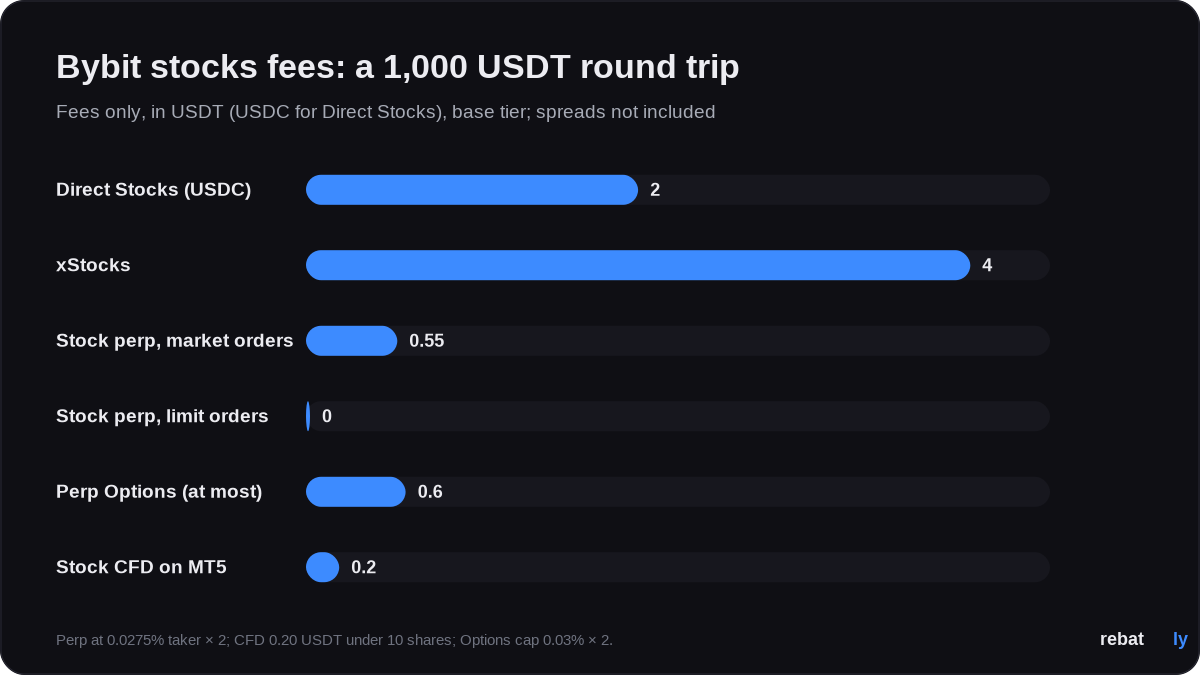
On published fees, a stock perp traded with limit orders that rest on the book is the cheapest way to trade a US stock on Bybit: at the current 0% maker rate the round trip costs nothing. With market orders, a 1,000 USDT perp round trip costs about 0.55 USDT. A stock CFD charges less commission on the same position (0.20 USDT if you hold fewer than 10 shares) but adds a spread that Bybit does not publish. Direct Stocks cost 2.00 USDC for the same round trip, plus the spread built into the price. Small orders cost far more in percentage terms because of the 0.35 USDC minimum. xStocks cost 4.00 USDT.
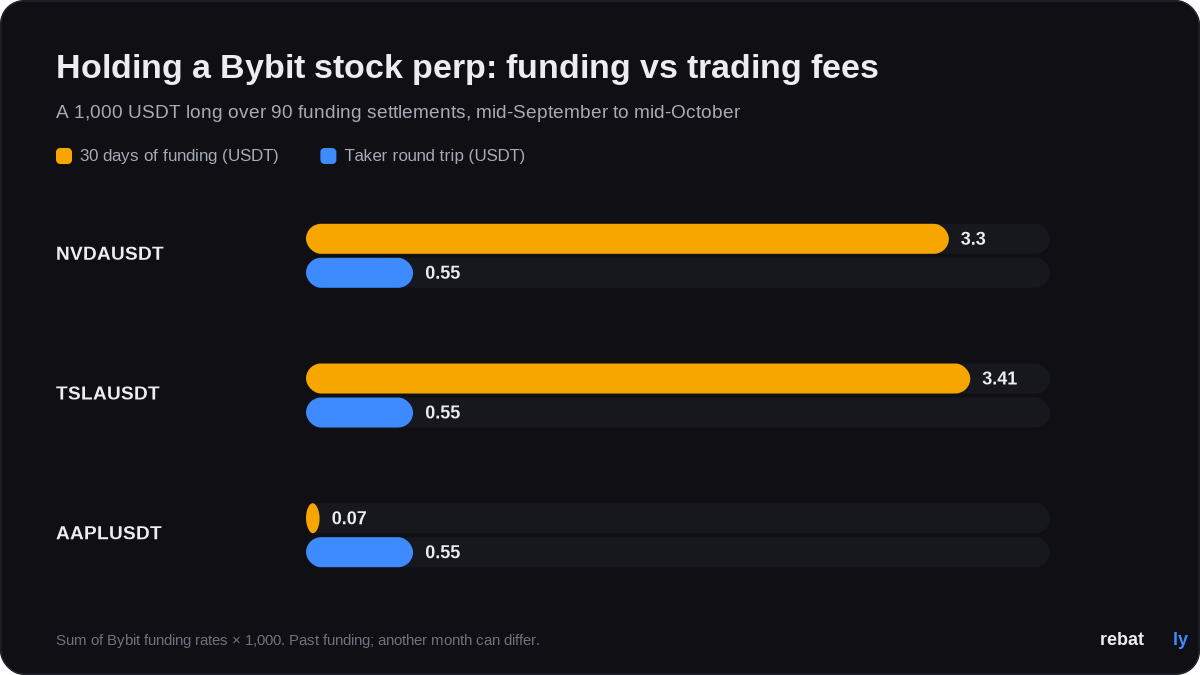
The fee is only half of the comparison. A perp carries funding for as long as you hold it. Over the 30 days to 13 October 2026, funding on the NVDAUSDT perp cost a 1,000 USDT long 3.30 USDT, six times its taker round trip. Direct Stocks and xStocks have no funding. Perp Options add the premium, and stock CFDs add an overnight swap.
A Rebatly fee rebate applies only to the fees Bybit counts as eligible. TradFi perp taker fees count toward it. Rebates on Perp Options and MT5 CFDs are not confirmed (see below). No rebate is claimed on the Direct Stocks service fee or on xStocks. The table gives each product's headline cost and its source. The sections below show the arithmetic.
| Product | What you pay (base tier) | Source, date |
|---|---|---|
| Direct Stocks (real US shares, paid in USDC) | No commission. 0.1% service fee per order, minimum 0.35 USDC. Spread built into the price | Introduction to Bybit Stocks |
| xStocks (tokenised stocks, spot pairs against USDT) | 0.2% maker and 0.2% taker at VIP 0 | Bybit Trading Fee Structure |
| TradFi perps: stocks, ETFs, gold, silver, forex (USDT-settled) | 0% maker; 0.0275% taker at VIP 0, down to 0.015% at Supreme VIP, while the discount lasts ("until further notice"). Funding every 8 hours (gold and silver every 4) | Futures fee page; discount announcement, 2026-08-11; Bybit API |
| Perp Options (options on stock perps) | 0.03% maker and taker on notional until 31 Dec 2026, capped at 7% of the premium. API lists a 0.02% delivery fee rate | Fee schedule, 2026-09-09; PerpOptions help page |
| Stock CFDs (MT5) | 0.02 USDT per share, minimum 0.2 USDT per order, in Tight-Spread mode, charged when the position opens. Plus spread and an overnight swap | CFD fees page; CFD listing, 2026-09-30 |
| Forex, gold and other CFDs (MT5) | Tight-Spread mode: $6 per lot on forex and metals, charged when the position opens. Zero-Fee mode (the default): no separate fee, the cost is built into a wider spread. Plus an overnight swap | CFD fees page; MT5 CFD account guide |
TradFi perps: maker and taker fees by VIP level
Since 16 June 2026, Bybit's TradFi perpetuals have had their own fee schedule, at half the standard crypto perp taker rate (announcement of 9 June 2026). Bybit's futures fee page shows the rates under "TradFi Perps 50% off". Its public fee-group API puts the stock, gold, silver and forex perps in one TradFi group, and the June announcement covers index ETF perps too, so all of them pay the rates below. Makers pay 0% at every VIP level. Bybit's 11 August announcement lists the discount as available "until further notice" and excludes pre-IPO perps, so treat these as current rates rather than permanent ones. The XAUTUSDT perp, on tokenised gold, is in Bybit's crypto fee group, so it pays crypto perp rates, not these.
Because a maker fill pays nothing, only taker fees can earn a rebate. The last column assumes the top tier, up to 50% back; with up to 40% back, the VIP 0 taker rate comes to 0.0165%.
| Bybit tier | Maker | Taker | Taker after up to 50% back |
|---|---|---|---|
| VIP 0 (regular user) | 0% | 0.0275% | 0.01375% |
| VIP 1 | 0% | 0.020% | 0.010% |
| VIP 2 | 0% | 0.0187% | 0.00935% |
| VIP 3 | 0% | 0.0175% | 0.00875% |
| VIP 4 | 0% | 0.016% | 0.008% |
| VIP 5 | 0% | 0.016% | 0.008% |
| Supreme VIP | 0% | 0.015% | 0.0075% |
Gold and silver perps
Gold (XAUUSDT) and silver (XAGUSDT) perps are USDT-settled TradFi contracts, so they pay the rates in the table above: 0% maker and 0.0275% taker at VIP 0, or 0.55 USDT for a 1,000 USDT round trip with market orders. Unlike the stock, ETF and forex perps, they settle funding every 4 hours rather than every 8. Bybit's public API currently caps each settlement at ±0.267%, so one capped settlement on a 1,000 USDT position is 2.67 USDT, nearly five times that round trip. On MT5, gold and silver CFDs cost $6 per lot in Tight-Spread mode, plus an overnight swap (see the MT5 section below). As with every TradFi perp, the rebate counts taker fees; a 0% maker fill earns nothing.
Forex perps: EUR/USD, GBP/USD and USD/JPY
Bybit added EUR/USD, GBP/USD and USD/JPY perpetuals (EURUSDUSDT, GBPUSDUSDT and USDJPYUSDT) on 8 September 2026. They are in the same TradFi fee group, so they pay 0% maker and 0.0275% taker at VIP 0: a 1,000 USDT round trip with market orders costs 0.55 USDT, and one with resting limit orders costs nothing. Funding settles every 8 hours, and Bybit's public API currently caps each settlement at ±0.5% (5 USDT on a 1,000 USDT position). Bybit's FX perps guide says they trade around the clock, weekends included, and are available on its main site only. Forex CFDs on MT5 work differently: they carry an overnight swap instead of funding, tripled once a week (usually on Wednesday), and cost $6 per lot in Tight-Spread mode.
MT5 CFDs: Zero-Fee mode vs Tight-Spread mode
Bybit's CFDs trade in a separate MT5 CFD account, which starts in Zero-Fee mode. In that mode the trading fee is built into the spread: there is no separate fee, but spreads are wider, and Bybit publishes no per-lot figure for the cost. In Tight-Spread mode spreads are narrower and Bybit charges a trading fee per lot, which it calls a commission, once, when the position opens, per its CFD fees page. One lot of gold or EUR/USD in Tight-Spread mode therefore costs $6 in fees. To switch, Bybit's MT5 account guide requires a cumulative deposit of at least USD 3,000 and no active orders or open positions. In both modes, a position held overnight pays or receives a swap, set per symbol. Which mode costs less depends on the Zero-Fee spread, which Bybit does not publish, so compare the quotes in MT5 before you switch.
| CFD type | Tight-Spread fee per lot |
|---|---|
| Forex | $6 per lot |
| Metals (gold, silver) | $6 per lot |
| Commodities | $3 per lot |
| Oil | $3 per lot |
| Nikkei 225 | $0.10 per lot |
| HK50 and TWINDEX | $1.50 per lot |
| HKTECH | $0.50 per lot |
| Other indices | $3 per lot |
| US stock CFDs | $0.02 per lot (minimum $0.20 per order) |
Direct Stocks: what "$0 commission" leaves out
Bybit's launch announcement of 12 October 2026 says you "pay $0 commission", and that is true of the commission line only. Its help page, Introduction to Bybit Stocks, adds a service fee of 0.1% of the executed order value, with a minimum of 0.35 USDC per order: "For orders valued below USD 350, the minimum service fee of USDC 0.35 will apply." The fee is reserved when you place the order and deducted separately when it executes.
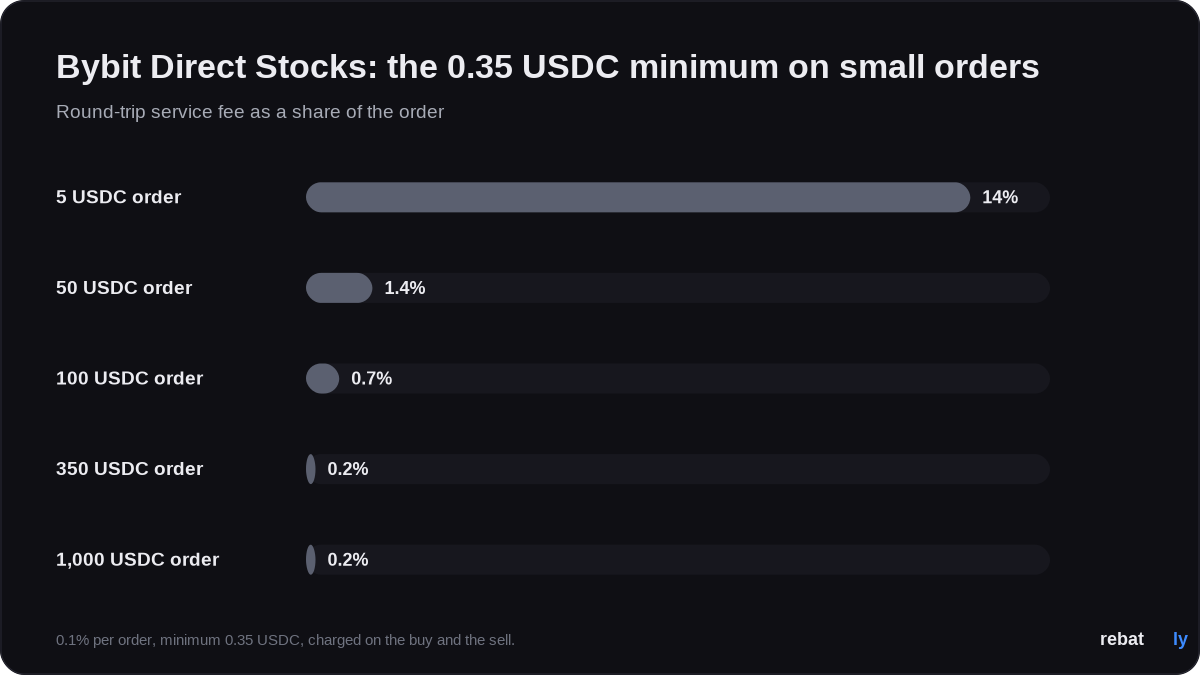
The minimum applies per order, so the fee as a share of the order rises steeply below 350 USDC. Bybit's smallest allowed order is 5 USDC, and on that the service fee is 7% each way. Splitting one purchase into several small orders multiplies the minimum. Ten orders of 50 USDC pay 3.50 USDC in total; one order of 500 USDC pays 0.50 USDC.
The service fee is not the whole cost. Bybit's own overview table lists the trading cost as "Spread built into execution price". Part of what you pay sits inside the price you get and never appears as a fee line, and Bybit's public pages do not say how wide that spread is. The announcement also links a separate "Stock Trading Fee Detail" page. It redirected to Bybit's homepage from our location, so we could not read it.
The table shows the service fee only, one way and for a round trip (buy, then sell the same amount).
| Order value | Service fee each way | Each way, % of order | Round-trip fee | Round trip, % of order |
|---|---|---|---|---|
| 5 USDC (minimum order) | 0.35 USDC | 7.00% | 0.70 USDC | 14.00% |
| 50 USDC | 0.35 USDC | 0.70% | 0.70 USDC | 1.40% |
| 100 USDC | 0.35 USDC | 0.35% | 0.70 USDC | 0.70% |
| 350 USDC | 0.35 USDC | 0.10% | 0.70 USDC | 0.20% |
| 1,000 USDC | 1.00 USDC | 0.10% | 2.00 USDC | 0.20% |
Direct Stocks: the small print, and where Bybit's pages disagree
Funding and limits. Orders are paid and settled in USDC from your Unified Trading Account, and Advanced Identity Verification is required. The help page sets these limits: 5 USDC minimum and 1,000,000 USDC maximum per order, up to 200 active orders, and a 1,000,000 USDC maximum position per user. The Bybit Stocks FAQ says API trading is supported.
Hours and market orders. Trading runs 5×24 in four sessions (pre-market, regular, post-market and, for supported stocks, overnight, all in US Eastern Time). It closes at weekends and on market holidays. Market orders execute only in regular trading hours: "Market orders placed outside Regular Trading Hours are queued and will execute at the next market open, at a price that may differ significantly from the previous close." The fee is the same in every session, but the fill price of a queued order is unknown until the open.
"No other fees"? The help page's overview table says "No other fees incurred with Direct Stocks". The same page's notes on corporate actions say "Taxes, withholding, processing fees, or other deductions may apply to certain corporate actions". The FAQ says cash dividends are credited in USDC "after applicable withholding tax". Read "no other fees" as "no other Bybit trading fees".
Voting. The help page says "Shareholder voting is not currently available." The launch announcement says "You retain full voting rights". The help page is the product's reference document. Until Bybit makes the two agree, do not count on voting.
Who provides it. Bybit names Infra Capital Limited as the introducing broker, regulated by the Financial Services Commission, Mauritius (GB23202169). US clearing, settlement and custody are by Alpaca Securities LLC, a FINRA/SIPC member. Bybit's "Full Stocks Ahead" launch campaign runs from 12 to 31 October 2026 and is not intended for EEA residents.
xStocks: 0.2% a side, twice the crypto spot rate
xStocks are tokenised stocks that trade as spot pairs against USDT. Bybit prices them in the "Spot Trading Adventure Zone & xStocks" table of its Trading Fee Structure page. They cost 0.2000% maker and 0.2000% taker at VIP 0, against 0.1000% each way for crypto spot pairs. At VIP 1 the rates drop to 0.1000% maker and 0.1500% taker. Bybit's public spot API lists 11 xStocks pairs trading.
A 1,000 USDT round trip costs 2.00 USDT each way, 4.00 USDT in total. That is twice the Direct Stocks service fee at the same size. For small orders the comparison reverses. The Direct Stocks fee has a 0.35 USDC floor and the xStocks fee has none, so on fees xStocks cost less for orders below about 175 (0.2% of 175 = 0.35), and Direct Stocks cost less above that. Neither figure includes the spread.
There is no funding on xStocks. We have not confirmed whether xStocks fees are eligible for a rebate, so this guide makes no rebate claim for them.
TradFi stock perps: cheap to trade, funding to hold
Bybit's TradFi perpetuals are USDT-settled contracts that track the price of a stock, ETF, commodity or currency. Their standard fees "follow the same fee structure as regular USDT Perpetual Contracts", per Introduction to TradFi Perpetual Contracts. At VIP 0 that is 0.0200% maker and 0.0550% taker. A discount announced on 11 August 2026 cuts these to 0% maker and 0.0275% taker at VIP 0, lower at higher VIP levels (see the table above), on every TradFi perp except pre-IPO contracts.
The discount's availability period is "Until further notice". We found no announcement ending it in Bybit's announcement feed. Bybit's derivatives fee update of 24 August changed only Pro and market-maker rates, and says "VIP retail pricing remains unchanged".
At the discounted rate, a 1,000 USDT round trip with market orders costs 1,000 × 0.0275% × 2 = 0.55 USDT (1.10 USDT at the standard rate). With limit orders that rest on the book, both sides fill at 0% and the round trip costs nothing. The maker vs taker guide explains how to get maker fills.
You do not own the underlying stock. Bybit says the contract carries no shareholder rights and no dividends. Instead, "the dividend's economic effect is reflected in pricing and funding through arbitrage between the perpetual and the underlying shares."
What holding a stock perp costs: 30 days of real funding
Funding is "exchanged directly between long and short position holders", per Bybit's Funding Fee Calculation page, so Bybit keeps none of it. A positive rate means longs pay shorts; a negative rate means shorts pay longs. The amount is position value × rate. Since 7 August 2026 Bybit has fixed the TradFi perp interval at 8 hours, with no automatic interval changes, though it may still adjust rates and intervals "in extreme market conditions". In the public API, all 270 stock and ETF perps settle every 8 hours. Of the 277 TradFi perps trading, only gold and silver settle every 4.
The cap on a single settlement varies by contract. It is ±2% on 227 of the 277 TradFi perps. Thirteen contracts are capped at ±0.5%, among them NVDAUSDT, TSLAUSDT, AAPLUSDT, MSFTUSDT, METAUSDT, AMZNUSDT and GOOGLUSDT. QQQUSDT is capped at ±0.75% and SPYUSDT at ±0.3%. Among stock and ETF perps the caps run from ±0.3% to ±2.5%, the widest on six contracts. One settlement at a ±2% cap on a 1,000 USDT position is 20 USDT, 36 times the discounted taker round trip. At ±0.5% it is 5 USDT. Check the cap on the contract page rather than assuming a small one.
The table sums every settlement from 14 September 00:00 UTC to 13 October 16:00 UTC (90 settlements) for three of the ±0.5% contracts, using Bybit's funding-history API. They illustrate cost only and are not suggestions to trade anything. Most settlements were exactly 0, on weekdays as well as weekends. Bybit does not document why, so treat the zeros as observed data only. The cost to a 1,000 USDT long is the sum of the rates × 1,000, assuming the position value stays at 1,000 USDT. A short received the same amounts.
On two of the three contracts, 30 days of funding cost about six times the round-trip fee. On the third it barely registered. Another month can differ in both size and sign. The funding vs trading fees guide shows how to work out when funding overtakes fees.
| Contract | Settlements: zero / positive / negative | Highest single rate | Sum of 90 rates | Funding paid by a 1,000 USDT long | Funding plus discounted taker round trip |
|---|---|---|---|---|---|
| NVDAUSDT | 54 / 36 / 0 | +0.0242% (9 Oct, 00:00 UTC) | +0.3297% | 3.30 USDT | 3.85 USDT |
| TSLAUSDT | 73 / 17 / 0 | +0.0511% (30 Sep, 00:00 UTC) | +0.3414% | 3.41 USDT | 3.96 USDT |
| AAPLUSDT | 78 / 9 / 3 | +0.0062% (24 Sep, 08:00 UTC) | +0.0071% | 0.07 USDT | 0.62 USDT |
Perp Options: 0.03% on notional, capped at 7% of the premium
Perp Options are European-style options written on Bybit's TradFi perps. They are cash-settled in USDT, with a contract multiplier of 1 and a minimum of one contract. Bybit's fee schedule of 9 September 2026 sets a launch rate of 0.0300% maker and taker for non-VIP accounts from 17 September to 31 December 2026, against a "comparative baseline rate of 0.0320%". The fee is charged "on notional value at the time of trade execution", on a schedule separate from crypto options.
The fee is capped. Bybit's Introduction to PerpOptions gives the formula: Trading Fee = min(Fee Rate × Notional Value per contract, 7% × Option Premium per contract) × Number of Contracts. In Bybit's own example, one call has 620 USDT of notional and a 2 USDT premium, so the fee is min(0.186, 0.14) = 0.14 USDT. On 1,000 USDT of notional the fee is at most 0.30 USDT a side, or 0.60 USDT for a round trip. The cap only lowers it when the premium is under about 4.29 USDT per 1,000 USDT of notional (0.43%).
Two more costs sit on top. The first is the premium, the price of the option itself: a buyer pays it and loses it if the option expires out of the money. The second is a delivery fee. Bybit's public API lists a delivery fee rate of 0.02% on every Perp Options contract across all eight live underlyings; BTC options show 0.015%. No Bybit help page says how that delivery fee is calculated or capped for Perp Options. Bybit's crypto options fee page caps delivery fees at 12.5% of the option's value and exempts daily options, but it does not say those rules apply to Perp Options.
Settlement is at 20:00 UTC during US daylight saving time and 21:00 UTC during standard time, per the PerpOptions FAQ. Like the perps, Perp Options give you no ownership, voting or dividend rights.
Stock CFDs on MT5, and mStocks
Stock CFDs trade in a separate MT5 CFD account. Bybit's CFD fees page charges US stock CFDs 0.02 USD per lot, minimum 0.2 USD per order, and one lot is one share. Its CFD listing of 30 September 2026 gives the same rate as "0.02 USDT/share (min 0.2 USDT/order)". The commission is charged once, when the position opens: in Bybit's own example of opening and closing one lot, there is a single 0.20 charge. On a 1,000 USDT position you pay the 0.20 minimum whenever you hold fewer than 10 shares, which means at any share price above 100. In "Zero-Fee mode", Bybit builds the commission into the trade instead of charging it separately.
Two more costs vary by symbol. One is the spread. The other is the swap, an overnight charge on positions held past 00:00 server time. It is calculated as quantity × share price × swap rate ÷ 360, and the 30 September listing puts the triple (3-day) swap for stock CFDs on Fridays. Bybit's own worked example uses a long rate of −6.88%, which is an illustration, not today's rate. At that rate a 1,000 USDT long pays about 0.19 USDT a night, or about 5.73 USDT over 30 days. Bybit's "Contracts Available on MT5 and Specifications" page lists the live values, but it was not served to us in any English locale. The contract info inside MT5 shows them for each symbol. Long CFD positions are credited dividend adjustments, and short positions are charged them. Older third-party pages may quote different stock CFD commissions; the figures here are from Bybit's own pages.
mStocks are the second product on Bybit's Stocks help page, which says both products are "backed 1:1 by real underlying shares held in custody". Bybit's "Make Your Move" announcement of 1 October says mStocks "trade 24/7". The same announcement lists an mStock trade as one of its tasks. But Bybit's public spot API lists no mStocks instrument, and we found no Bybit page that gives a launch date or a fee, so there is nothing to price yet.
Pre-IPO perps
Bybit also lists perpetuals that track the estimated valuation of private companies before an expected IPO. Five are in pre-launch status in the public API. They are excluded from the TradFi fee discount, and Bybit does not publish a separate retail rate for them. The API flags them as pre-listing contracts, and Bybit's 24 August fee update moved TradFi pre-listing contracts into the TradFi fee group for Pro and market-maker accounts. The closest published retail table, "Pre Market Perpetual", shows 0.04% maker and 0.10% taker at VIP 0, but Bybit does not say that table applies to them. Check the fee in the order panel before you place an order.
Side by side: a 1,000 USDT round trip in each product
Each row uses the same notional and base-tier rates. The first columns show fees only; the next shows what it costs to keep the position open. Direct Stocks is in USDC, and the rest settle in USDT. Spreads are left out of every row because Bybit does not publish them for Direct Stocks or CFDs. Bybit's fee page also warns that "the actual fee rates may vary depending on your region". Your own rates are on the My Fee Rate page after verification.
Volume also counts toward your VIP level, which lowers the rates. Bybit's VIP rules count Options and TradFi Perpetual volume as derivatives volume, and stock CFD volume at one fifteenth. They say nothing about Direct Stocks or xStocks. The Bybit VIP vs Pro guide covers the thresholds.
| Product | Round-trip fee on 1,000 | % of notional | Cost of holding | What you hold |
|---|---|---|---|---|
| Direct Stocks | 2.00 USDC + spread | 0.20% | None from Bybit; dividends arrive after withholding tax | Real shares, held in custody by Alpaca |
| xStocks | 4.00 USDT | 0.40% | None | Tokenised stock (spot) |
| TradFi stock perp, market orders | 0.55 USDT | 0.055% | Funding every 8 hours: 0.07 to 3.41 USDT over 30 days in the examples above | Contract, no ownership or dividends |
| TradFi stock perp, resting limit orders | 0 USDT | 0% | The same funding | Contract, no ownership or dividends |
| Perp Options (non-VIP) | At most 0.60 USDT; less if 7% of the premium is lower | At most 0.06% | The premium; the API lists a 0.02% delivery fee rate | Option contract, cash-settled in USDT |
| Stock CFD (MT5) | 0.20 USDT with fewer than 10 shares, + spread | 0.02% | Swap each night: about 0.19 USDT at Bybit's example rate | CFD, no ownership |
Where a fee rebate applies
Rebatly's Bybit rebate is up to 50% of your trading fees, tiered by monthly trading volume: up to 40% under 50,000,000 USDT a month, up to 45% from 50,000,000 and up to 50% from 150,000,000. It is calculated from the fees Bybit reports for your account, so whether a product qualifies depends on which product categories Bybit counts.
TradFi perps (stocks, ETFs, gold, silver and forex): yes. TradFi Perpetual is one of the categories Bybit counts. Taker fees on these perps therefore count toward your rebate the same way crypto perp fees do. On the 1,000 USDT taker round trip above, 1,000 × 0.0275% × 2 = 0.55 USDT in fees, and up to 50% of that (up to 0.275 USDT) comes back. At the lowest tier (up to 40%), up to 0.22 USDT comes back, so you pay at least 0.33 USDT net. A 0% maker fill pays no fee, so it earns no rebate.
Perp Options and MT5 CFDs: not confirmed. Bybit lists Options and TradFi CFD as separate categories. We have not confirmed whether Bybit books Perp Options under Options or under TradFi Perpetual, so we do not promise a rebate specifically on Perp Options. On MT5, only Tight-Spread mode charges a separate per-lot fee; in Zero-Fee mode the cost is built into the spread. We have not confirmed a rebate on MT5 trades in either mode. Contact us at t.me/rebatly to confirm before you rely on it.
No rebate claimed: the Direct Stocks service fee, which is outside the categories Bybit counts; xStocks, whose coverage is not confirmed; and anything that is not a trading fee, such as funding, option premiums, CFD swap and spreads. Funding passes between traders and Bybit keeps none of it, so it is not a fee that can be rebated. The fee rebate explainer covers why.
To set it up, use the code REBATLY when you open the account. The Bybit referral code guide covers setup, including the 14-day window for adding the code to an account registered without one.
If you also use Bitget
Bitget's stock perps charge 0.02% maker and 0.06% taker at the standard tier, per its stock perps FAQ. Bitget's public contracts API shows the same rates on all 366 contracts it flags as RWA (its stock, ETF, index, commodity and currency perps). Its US stock perps settle funding every 8 hours; 15 of the 366, mostly commodities, settle every 4. A 1,000 USDT round trip costs 1.20 USDT with market orders and 0.40 USDT with resting limit orders. On Bybit, while the discount lasts, the same trades cost 0.55 USDT and nothing.
Bitget handles dividends differently. It pays cash dividends through funding: in a dividend notice of 12 October 2026, long holders "receive the corresponding dividend amount ... in the form of a funding fee", and shorts have it deducted. Bybit reflects dividends only in prices and funding rates. Bitget's US stock spot tokens (rTokens) are on a promotional rate of 0.05% maker and taker, and the end date is "currently undetermined" (notice of 1 September 2026). That makes a 1,000 USDT round trip 1.00 USDT.
Bitget is not available everywhere either. Its site states that its services are not intended for individuals residing in Singapore, for example, so check that Bitget serves your country before you register. We have not confirmed whether Bitget's stock perps or rTokens are eligible for a rebate, so no rebate is claimed for them here. The Bitget referral code guide covers the rebate on Bitget's crypto products.
Fees are the part you can plan
Funding, premiums and spreads move with the market. The fee schedule does not. It is published, charged on every fill and the same whichever way the price moves, so it is the cost you can know before you choose a product. On Bybit's stock products that means three things: the 0.35 USDC floor on Direct Stocks, the 0.2% on xStocks, and stock-perp fees that are discounted for now while funding is not.
Enter the code REBATLY when you open a new Bybit, OKX or Bitget account (afterwards only Bybit lets an account with no code add it, within 14 days of registering), mexc-Rebatly on a new MEXC account (or, within 30 days of registering, on a main account with no referrer yet) or rebatly on a new OrangeX account. You then get a rebate of up to 50% of your trading fees on Bybit and Bitget, up to 40% on BloFin and OKX, up to 60% on MEXC and up to 65% on OrangeX futures, tiered by monthly trading volume. On a new Toobit account, code Rebatly gives up to 60% instead, credited by Toobit itself rather than paid by Rebatly, so the payout details that follow do not apply there. Rebates are calculated daily on the fees you actually paid. They are sent the next day in USDT by internal transfer into your own exchange account, usually between 04:00 and 12:00 UTC. The minimum payout is 1 USDT, and smaller amounts carry over. Rebatly needs nothing from you beyond the referral code: no API keys, no passwords, no custody, no deposits. Check your balance in t.me/rebatlybot. For support, contact t.me/rebatly or hello@rebatly.io.
To run your own numbers, use the Bybit fee calculator for your volume and order mix. The spot vs perpetual fees guide compares the two fee structures in general, and the fees-paid guide shows where Bybit lists what you were actually charged. More fee guides are in the guides index.
Rebatly is an independent affiliate. It is not affiliated with, operated by or endorsed by Bybit, OKX, Bitget, MEXC, OrangeX, Toobit or BloFin. This is not financial advice.
Get fees back on every trade
$10M+ rebates paid · Paid daily in USDT · No password or API keys, ever
Already signed up? Check your link and rebate with @rebatlybot on Telegram, or reach our support at @rebatly.
🔔 Get a Telegram alert each time your rebate is paid: tap “Activate notifications” in @rebatlybot. New to trading? Your first trade in 5 steps.
October 21, 2026 — Bitget rebate raised to the same tiers as Bybit (up to 50%). October 14, 2026 — published. Fees and terms were read from these Bybit pages: Introduction to Bybit Stocks and FAQ — Bybit Stocks; the Direct Stocks launch announcement (Oct 12, 2026); Service Restricted Countries; the notice on service changes for UK-registered users (Sep 21, 2026); Trading Fee Structure; the TradFi perpetual fee discount announcement (Aug 11, 2026) and the Bybit Learn TradFi perpetuals page; the derivatives fee update (Aug 24, 2026); Introduction to TradFi Perpetual Contracts; the TradFi funding-interval announcement (Aug 7, 2026); the TradFi Perp Options fee schedule (Sep 9, 2026), Introduction to PerpOptions and FAQ — PerpOptions, and Options Trading: Fees Explained; Funding Fee Calculation; Bybit's pre-IPO perpetual listing notices (August and September 2026); Bybit CFD: Fees Explained and the stock CFD listing (Sep 30, 2026); and Make Your Move (Oct 1, 2026). We checked Bybit's announcement feed for any end to the TradFi perp discount. Bitget figures come from its stock perps FAQ, its cash-dividend settlement notice (2026-10-12) and its rToken fee notice (2026-09-01). Instrument counts, funding caps and intervals, Perp Options delivery fee rates and xStocks pairs come from Bybit's public instruments-info API, and Bitget's rates and intervals from its public contracts API. Funding sums come from Bybit's funding-history API for 2026-09-14 00:00 to 2026-10-13 16:00 UTC and show that window only. We could not read three pages, so none of their content is used: Bybit's Stock Trading Fee Detail page, the Direct Stocks Product Terms and the MT5 contract specifications page. Rebate coverage by product reflects the product categories in Rebatly's Bybit affiliate account. All fee figures are arithmetic on the published rates. TradFi perp rates by VIP level come from Bybit's futures fee page and its TradFi perpetuals fee schedule announcement (effective 16 June 2026); the forex perp listing date and the gold, silver and forex funding intervals and caps from Bybit's public instruments-info and fee-group APIs and its FX perps guide; MT5 per-lot fees and account modes from Bybit CFD: Fees Explained, How to Get Started With MT5 CFD Account and Bybit's Zero-Fee vs Tight-Spread guide.