Crypto liquidations explained: bitcoin's slide toward $65,000, up to $1.64 billion in forced closures, how liquidation works and what it costs traders
Crypto liquidations topped $1.6 billion in 24 hours on 13 November 2026 as bitcoin fell below $70,000 and then $68,000, according to CoinGlass data cited by CoinDesk. Almost nine in ten of the positions closed were longs, bets that prices would rise. The slide continued on 14 November: CoinGecko showed bitcoin at $65,593 at 17:32 UTC, down 4.5% in 24 hours and about 12% below its 11 November high. Outlets point to rising bets on a US rate hike at the 9 December Federal Reserve meeting, a stronger dollar and outflows from spot bitcoin ETFs. This article covers what happened, why, and then explains how a liquidation works, with a worked example, what it costs beyond the loss, and how to check your own liquidation price. For the wider picture, see why bitcoin is down today. All times are UTC.
 NO KYCSign up to BloFin
 Sign up to Bybit
 Sign up to OKX
 Sign up to Bitget
 Sign up to MEXC
 Sign up to OrangeX
 Sign up to Toobit
What happened: bitcoin's slide and the liquidation totals
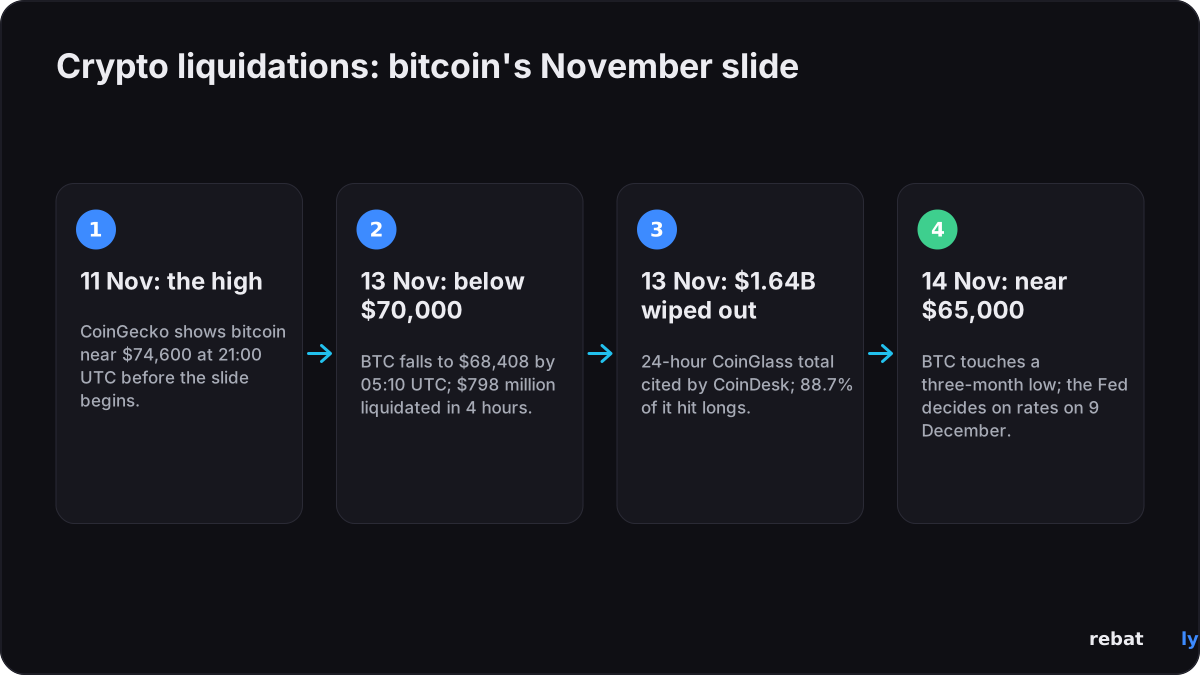
• The high: CoinGecko's hourly data shows bitcoin at about $74,600 at 21:00 UTC on 11 November.
• Below $70,000: early on 13 November BTC fell to $69,000, its lowest since August, CoinDesk reported. The Block put it at $68,408 at 05:10 UTC, down 7% in 24 hours, and ether at $1,921.
• The 13 November low: CoinDesk reported a low of $67,770 and Cointelegraph about $67,500, near bitcoin's 200-week moving average.
• 14 November: BTC touched a fresh three-month low of $65,000, CoinDesk reported. CoinGecko's hourly low was $65,287 at 17:00 UTC; at 17:32 UTC bitcoin was $65,593 and ether $1,843, both down 4.5% in 24 hours.
Liquidation totals depend on the time window and on which exchanges are counted, so outlets report different numbers. Each figure below is from CoinGlass data as cited by the outlet named:
| Window (UTC) | Total liquidated | Longs | Reported by |
|---|---|---|---|
| 24 hours to about 03:40, 13 Nov | more than $1.3 billion (BTC $677 million) | not given | CoinDesk |
| 4 hours to about 06:20, 13 Nov | $798 million | $718.5 million | The Block |
| 24 hours to about 06:20, 13 Nov | $1.47 billion, 175,299 traders | $1.31 billion | The Block |
| 24 hours to about 11:50, 13 Nov | $1.64 billion (BTC $916 million, ETH $289 million) | 88.7% | CoinDesk |
| 1 hour, 14:22 to 15:22, 14 Nov (Binance, Bybit, OKX only) | $49.83 million | $48.96 million | TokenPost |
The largest single liquidation was a $31.1 million bitcoin long on Hyperliquid at $72,250, CoinDesk reported. Open interest in crypto futures fell 4.6% to $120.2 billion over the same day, as forced closures removed positions from the market. Totals from different windows overlap and should not be added together.
Why the market fell: what outlets cite
• Rate-hike bets: after a hotter-than-expected October CPI, markets priced roughly an 88% to 90% chance of a 25 basis point hike at the 8-9 December FOMC meeting and a 10% to 12% chance of 50 basis points, CoinDesk and Cointelegraph reported, citing CME data. BTSE's Jeff Mei told The Block a 50 basis point move could push bitcoin lower.
• A stronger dollar: the Dollar Index rose above 103, its highest since April 2025, CoinDesk reported.
• ETF outflows: US spot bitcoin ETFs lost $1.07 billion in the week to 13 November and about $1.71 billion over seven sessions since 5 November, Cointelegraph reported, citing Farside. SoSoValue data cited by CoinDesk put the funds at $1.56 billion of net outflows for the year.
• Leverage and thin liquidity: "The sharp leg lower in crypto looks like a leverage event as BTC broke key levels," Rick Maeda of Laevitas told The Block. Talos said bitcoin's order-book depth was about 33% below normal (Cointelegraph), and Greeks.Live data cited by CoinDesk showed options dealers in negative gamma between about $58,000 and $72,000, which can amplify moves.
• Stocks and AI: some commentators linked the selloff to Nvidia's CEO change and the Anthropic IPO drawing capital; others quoted by CoinDesk saw no direct link.
Rebatly does not forecast prices. For how Fed meetings affect trading costs, see our guide to FOMC and crypto trading costs.
What is a liquidation in crypto?
A liquidation is the forced closure of a leveraged position by the exchange when the trader's margin can no longer cover potential losses. It applies to futures, perpetual contracts and margin trading, not to coins bought outright on the spot market.
• Margin: the collateral you put up. With 10x leverage, 1,000 USDT of margin controls a 10,000 USDT position.
• Maintenance margin: the minimum margin the exchange requires to keep the position open, set as a percentage of the position's value. Larger positions usually need a higher rate.
• Liquidation price: the price at which your margin falls to the maintenance level. Exchanges trigger it on the mark price, a fair-value price built from several venues, rather than the last trade, which reduces liquidations caused by a single spike.
• Bankruptcy price: the price at which your margin is fully gone. The gap between the liquidation price and the bankruptcy price is the buffer the exchange uses to close the position in the market.
When many positions sit near the same price, one wave of liquidations pushes the price further and triggers the next. That chain reaction is often called a liquidation cascade, and it is what traders describe as a long squeeze when longs are wiped out, as on 13 November.
Isolated margin vs cross margin
• Isolated margin: each position has its own margin. If it is liquidated, you lose the margin assigned to that position, and the rest of your balance is not touched.
• Cross margin: the whole balance in the account backs every open position. A losing position can draw on all of it, which pushes the liquidation price further away, but a liquidation can take much more of your balance. Profits on one position can support another.
In OKX's words, "Isolated margin calculates requirements for each position separately; Cross margin calculates requirements based on the combined risk across all positions." MEXC notes that "the liquidation price in cross margin mode may change at any time", because it depends on the rest of the account.
Worked example: a 10x bitcoin long
The numbers below are an example only, with round figures and a simplified formula. They are not current prices or any exchange's exact rules. Assume an isolated long with an entry price of $50,000 and a maintenance margin rate of 0.5%. A simplified liquidation price for a long is entry × (1 − 1/leverage + maintenance rate); for a short it is entry × (1 + 1/leverage − maintenance rate).
| Leverage (example) | Margin for a 10,000 USDT position | Liquidation price (long) | Price fall that triggers it |
|---|---|---|---|
| 2x | 5,000 USDT | $25,250 | 49.5% |
| 5x | 2,000 USDT | $40,250 | 19.5% |
| 10x | 1,000 USDT | $45,250 | 9.5% |
| 20x | 500 USDT | $47,750 | 4.5% |
| 50x | 200 USDT | $49,250 | 1.5% |
| 100x | 100 USDT | $49,750 | 0.5% |
In the 10x case, a 9.5% fall closes the position and the trader loses the 1,000 USDT of margin, minus whatever is left above the bankruptcy price, which exchanges generally pass to the insurance fund. The same 10x position as a short would be liquidated near $54,750, a 9.5% rise. Real liquidation prices are usually a little closer to entry than this, because exchanges also count fees, tiered maintenance rates and, in cross margin, the rest of the account.
Insurance fund and auto-deleveraging (ADL)
• Insurance fund: when a liquidation fills at a better price than the bankruptcy price, the leftover margin goes into the exchange's insurance fund. When it fills at a worse price, the fund covers the shortfall so the winning side still gets paid. OKX calls it a security fund and says it "does not guarantee that your losses will be protected or satisfied by its security funds".
• Auto-deleveraging: if the insurance fund cannot absorb losses, the exchange closes part of the most profitable, most leveraged positions on the other side. They are ranked by profit and leverage. OKX, Bitget and MEXC all describe this ranking on their own help pages.
• Why it matters: ADL can close a winning position without the trader asking, so even profitable traders can be affected in a fast market.
What a liquidation costs beyond the loss
• The margin itself: in isolated margin, the margin on the position; in cross margin, potentially much more of the balance.
• Taker fees on entry: leverage multiplies fees, because they are charged on the full position size, not the margin. At an example taker rate of 0.055%, opening a 10,000 USDT position costs 5.50 USDT, whatever the margin.
• Funding: perpetual positions pay or receive funding, usually every eight hours. At an example rate of 0.01%, a 10,000 USDT long pays 1 USDT per interval. Our guide to funding rates vs trading fees explains how they add up.
• Liquidation or clearance fees: some exchanges charge an extra fee when they close a position for you. Here is how three exchanges describe it on their own help pages:
| Exchange | What its help page says about liquidation fees |
|---|---|
| OKX | Charges a liquidation fee at your taker fee rate, and may add a liquidation clearance fee to cover slippage; both go to its security fund |
| Bitget | Builds the taker fee rate into the liquidation price; no additional fee when the system takes over a position |
| MEXC | Includes a liquidation fee in its maintenance margin formula; the rate is not published on the page we read |
| Bybit, BloFin, Toobit | We could not confirm their fee wording from their own help pages; check your exchange's liquidation rules |
Sources: OKX, Bitget and MEXC help pages, read on 14 November 2026. Rules change, so check the current page before you trade.
How to check your liquidation price and margin mode
• Positions tab: every major exchange shows an estimated liquidation price next to each open position, along with the mark price and margin ratio.
• Margin mode: the order panel shows whether a position is isolated or cross. On most exchanges you can only switch while no position or order is open in that contract.
• Margin ratio: the closer it gets to 100%, the closer the position is to liquidation. Adding margin or reducing the position moves the liquidation price away.
• Calculator: most futures order panels include a calculator that shows the liquidation price before you place an order.
• Risk tiers: larger positions often carry a higher maintenance margin rate, so the liquidation price can move closer as the position grows.
This is general information, not financial advice.
What happens next
• US data: outlets quoted by The Block point to the PCE inflation report in late November.
• 9 December, FOMC decision: the Fed ends its 8-9 December meeting with a rate decision and new projections.
• ETF flows: daily spot bitcoin ETF flows from Farside and SoSoValue are a running gauge of demand.
• Open interest and funding: after a wipe-out, traders watch whether leverage rebuilds. Rebatly does not forecast prices.
We will update this article on the next major liquidation event.
Trade with lower fees
Liquidations make fees more visible, because leverage multiplies what you pay on every trade. Sign up through Rebatly and part of every trading fee comes back to you: up to 50% on Bybit and Bitget, up to 40% on BloFin and OKX, up to 60% on MEXC and up to 65% on OrangeX futures. On Toobit, code Rebatly gives up to 60%, credited by Toobit itself, and BloFin credits up to 40% itself every hour; the other rebates are paid daily in USDT. Our guide to how a fee rebate works explains the rest.
This article reports news and is not financial advice. Rebatly is an independent affiliate; not financial advice.
Get fees back on every trade
$10M+ rebates paid · Paid daily in USDT · No password or API keys, ever
Already signed up? Check your link and rebate with @rebatlybot on Telegram, or reach our support at @rebatly.
🔔 Get a Telegram alert each time your rebate is paid: tap “Activate notifications” in @rebatlybot. New to trading? Your first trade in 5 steps.
November 14, 2026 — published. Sources: CoinDesk, The Block, Cointelegraph, TokenPost, CoinGlass, Farside, SoSoValue, CoinGecko, OKX, Bitget, MEXC.