Why is bitcoin down today? The 5 November fall below $76,000 and what drove it
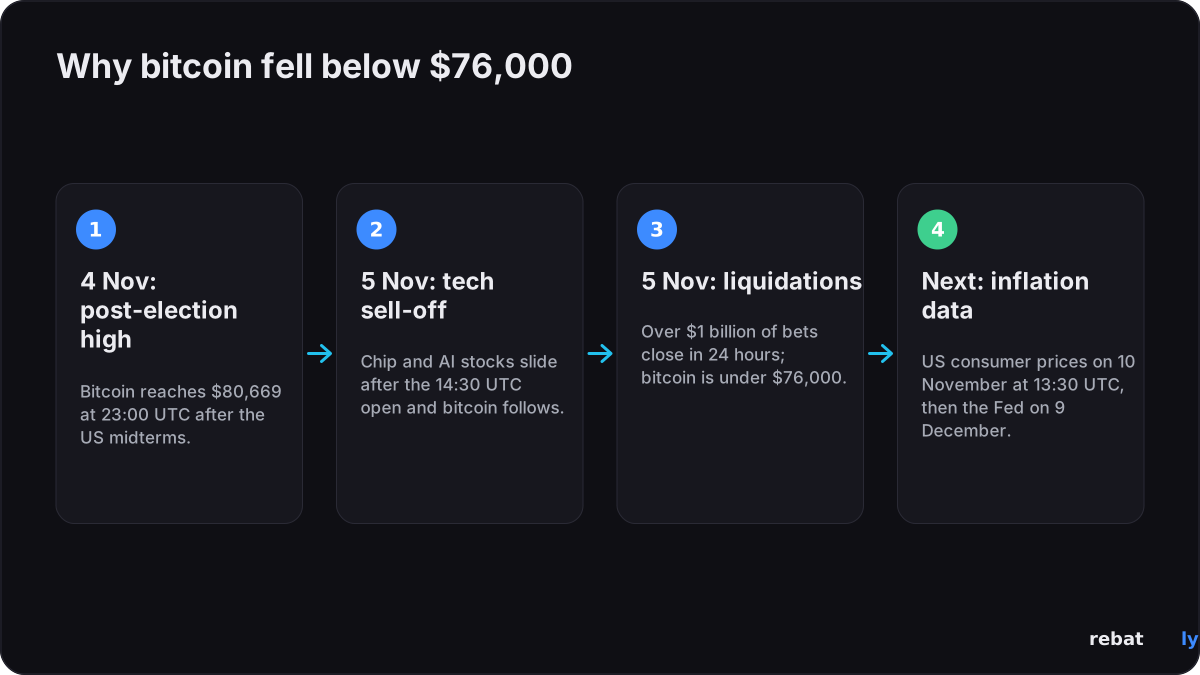
Why is bitcoin down today? Bitcoin fell below $76,000 on Thursday 5 November 2026 as a sharp sell-off in US tech and chip stocks spread into crypto and more than $1 billion of leveraged bets were liquidated in 24 hours. CoinGecko showed about $75,653 at 18:06 UTC that day, down 6.2% in 24 hours and near its lowest level in seven weeks. Two days later it had barely changed: about $75,890 at 14:48 UTC on Saturday 7 November, after a strong US jobs report on Friday. No single event explains the fall. This article sets out what happened, the causes reported by several outlets, how far bitcoin has fallen and what is scheduled next.

 NO KYCSign up to BloFin
 Sign up to Bybit
 Sign up to OKX
 Sign up to Bitget
 Sign up to MEXC
 Sign up to OrangeX
 Sign up to Toobit
What happened: bitcoin's fall hour by hour
Bitcoin spent most of Thursday near $80,000, then lost more than $4,000 within about two hours of the US stock market open. These are CoinGecko prices:
| UTC | Bitcoin | What was happening |
|---|---|---|
| 23:00, 4 Nov | $80,669 | Highest hourly price after the US election |
| 12:00, 5 Nov | $80,332 | Still near $80,000 before the US session |
| 14:00, 5 Nov | $79,600 | Half an hour before the US stock market opened |
| 15:00, 5 Nov | $78,172 | Half an hour after the 14:30 UTC open, as tech stocks fell |
| 16:00, 5 Nov | $75,960 | Below $76,000 as leveraged positions were force-closed |
| 18:06, 5 Nov | $75,653 | Reading when this article was first published |
| 13:00, 6 Nov | $75,966 | Half an hour before the US jobs report |
| 15:05, 6 Nov | $75,105 | Dip after the jobs report and the US stock market open |
| 14:48, 7 Nov | $75,890 | Latest reading at the time of this update |
Cause 1: the tech and chip stock sell-off
This is the cause most outlets put first. Chip and AI shares led Wall Street down on Thursday, and bitcoin fell with them. Reports tie the stock sell-off to doubts about AI spending, possible closer scrutiny of data centres after the midterms, Qualcomm's miss on handset sales and about 600,000 Nvidia H200 chips held up on the way to China (IBTimes, citing Reuters).
At Thursday's close the Nasdaq Composite was down 5.5%, the S&P 500 about 4.4% and the Dow 3.4%, CNBC reported. On Friday the Nasdaq rose 1.1% and the S&P 500 0.3%, while the Dow fell 0.5%, AP reported.
Earlier reports of the Nasdaq's fall differ because they cover two different indexes at different moments of the same session. All of these are intraday readings, not closing figures:
| Index | Reported fall | Reported by |
|---|---|---|
| Nasdaq Composite | As much as 3.9%, earlier in the session | CNBC, via Bitcoin Magazine |
| Nasdaq Composite | More than 5%, later in the session (5.1% in one reading) | Seeking Alpha, The Private Banker |
| Nasdaq 100 | More than 4.4% within an hour of the open | CryptoPotato, via Bitkub |
| Nasdaq 100 | As much as 5.7% | The Private Banker |
| Nasdaq 100 | 6.4%, with no time stated | Bloomberg, via Bloomingbit |
| S&P 500 | About 2%, then about 3.4% | Bitcoin Magazine, Seeking Alpha |
Cause 2: leveraged long liquidations
When prices fall fast, traders who borrowed to bet on higher prices are force-closed, and that selling can push prices lower. The totals in circulation look far apart, from about $370 million to more than $1 billion, but they mostly measure different time windows:
| Window | Liquidated | Reported by |
|---|---|---|
| About 1 hour | About $370 million | Bitcoin Magazine, The Private Banker |
| 1 hour | $503.23 million to more than $560 million | CoinGlass, via ETHNews and CryptoPotato |
| 4 hours | $870.84 million | CoinGlass, via ETHNews |
| 24 hours | $1.03 billion to $1.06 billion | CoinGlass, via ETHNews and Crypto News Flash |
Who was liquidated
ETHNews counted 199,365 traders liquidated in 24 hours, with $924.94 million, or 89.4%, on bets that prices would rise. Figures of about $840 million to $850 million also circulated; we could not confirm which window they cover. Liquidation totals are snapshots and keep changing as the window moves.
Cause 3: spot bitcoin ETF flows
ETF flows were a weight in the days before the fall, not the trigger on Thursday. The two figures that seem to clash cover different days: about $1 billion left over several sessions, and $74.6 million came in on Wednesday. Outflows then returned on Thursday and Friday. Daily net flows, from Farside data published by WhaleRoom, 24/7 Wall St. and crypto.news:
| Day | US spot bitcoin ETF net flow |
|---|---|
| Friday 30 October | −$643.2 million |
| Monday 2 November | −$398.6 million |
| Tuesday 3 November | −$115.6 million |
| Wednesday 4 November | +$74.6 million |
| Thursday 5 November | −$430.2 million |
| Friday 6 November | −$411.9 million |
Why the ETF figures seem to clash
The three outflow days to Tuesday add up to about $1.16 billion. On Wednesday Fidelity's FBTC took in about $237 million while BlackRock's IBIT lost $201.2 million, which brought IBIT's four-session outflow to $935.2 million, Cointelegraph reported from Farside data. The "about $900 million from IBIT" in Bloomberg's account, as carried by Bloomingbit, gives no dates but appears to describe that same run. For the week of 2 to 6 November, net outflows came to about $1.28 billion, with IBIT losing $1.21 billion, crypto.news reported from Farside data. Our article on bitcoin ETF outflows explains how to read these numbers.
Cause 4: the Binance hack hangover
The Binance hack of 29 October, about $6.3 billion, is a week old. Bloomingbit and The Private Banker both list it as part of the weak mood, and The Private Banker notes that the recent ETF outflows include the days after the hack. We found no report of a new development in the hack on 5 November, so it reads as background rather than Thursday's trigger.
Cause 5: Fed rate expectations, a hike rather than a cut
Crypto is not falling on fading hopes of a rate cut, because a cut was barely in the picture. The Fed held rates at 3.75% to 4% in October, and DeFi Rate's average of Kalshi and Polymarket prices at 1:05 p.m. New York time on 5 November (18:05 UTC) showed about 67% for a hike at the 9 December meeting, about 31% for no change and about 3% for a cut. These are market prices, not a forecast by Rebatly.
Thursday's data pointed the same way: weekly jobless claims came in at 189,000 against 196,000 expected, Bitcoin Magazine reported, citing Reuters, and it noted that a tight labour market gives the Fed little reason to ease. Our article on the October Fed decision has the background.
Friday's jobs report added to that. The US added 165,000 jobs in October against forecasts of 59,000 to 65,000, and unemployment fell to 4.1%. At 11:30 a.m. New York time (16:30 UTC) on 6 November, Polymarket showed 76.5% for a December hike and Kalshi about 78%, The Rio Times reported. Bitcoin barely reacted: CoinGecko showed $75,966 at 13:00 UTC and $75,914 at 17:00 UTC. Bitcoin Magazine wrote that most of the week's damage came from stocks, not the labour market. Our articles on the jobs report and a December Fed hike have the details.
Cause 6: the post-election mood
Bitcoin rose from about $76,199 at 03:00 UTC on 4 November to $80,669 at 23:00 UTC as markets took in the Democratic win of both chambers of Congress, then gave all of that back within a day (CoinGecko). The Private Banker describes the rally as reversed within about 24 hours.
The link to politics is an interpretation, not an established cause. Reports connect the election to the tech sell-off through possible limits on data centres, and Dan Ives of Yorkville Ives said the build-out could slow given the political map, Seeking Alpha reported. On crypto policy, TD Cowen's Jaret Seiberg said the new Congress could make it harder to advance a version of the Clarity Act, Crypto News Flash reported. Before the fall, James Butterfill of CoinShares told Cointelegraph that a Democratic sweep was largely priced in and warned against giving the election too much credit; CK Zheng of ZX Squared Capital pointed to liquidity, institutional flows and risk appetite as the more immediate drivers.
How far bitcoin has fallen
Bloomberg, as carried by Bloomingbit, called Thursday's fall bitcoin's lowest level in seven weeks, and The Private Banker said the lowest since 16 September. CoinGecko's daily price for that date was $75,590, which fits. Prices vary by exchange: reported lows were about $75,463 on Bitstamp (The Private Banker) and $75,568 on a BTC/USDT chart (Crypto News Flash). On Friday, after the jobs report, Cointelegraph reported a low of $74,762 on TradingView data, the lowest since 21 August. Bitcoin Magazine put the day's low at about $75,240, and CoinGecko's five-minute data showed $75,105 at 15:05 UTC. Measured from $75,653 at 18:06 UTC on 5 November, on our own CoinGecko count:
| Compared with | Bitcoin then | Change |
|---|---|---|
| Post-election high, 4 November | $80,669 | −6.2% |
| Start of November (1 November) | $77,521 | −2.4% |
| Start of October (1 October) | $83,576 | −9.5% |
| 30-day high, 6 October | $85,722 | −11.7% |
| All-time high, 6 October 2025 | $126,080 | −40.0% |
Not the same as October's fall
This is a separate move from October's fall. For that story, see why crypto was down in October.
Why is crypto down today, not just bitcoin?
The fall was market-wide. At 18:06 UTC on 5 November CoinGecko showed ether at about $2,242, down 7.7% in 24 hours, and Solana at about $88.88, down 7.3%, against 6.2% for bitcoin. At 14:48 UTC on 7 November ether was about $2,244 and Solana about $90.04. Rebatly does not forecast prices. On days like this prices can jump in seconds, the gap between buy and sell prices can widen and market orders can fill worse than the price on screen. Our guide to trading costs on big news days shows with real fee rates how limit orders cut that cost.
What happens next
These are calendar facts, not predictions:
• 10 November, 8:30 a.m. New York time (13:30 UTC): US consumer price data for October.
• 18 November, 2:00 p.m. New York time (19:00 UTC): minutes of the Fed's October meeting.
• 4 December, 8:30 a.m. New York time (13:30 UTC): the US jobs report for November. Our jobs report guide explains why crypto traders follow it.
• 9 December, 2:00 p.m. New York time (19:00 UTC): the Fed's next rate decision.
Trade with lower fees
In any market, every trade you make carries a fee. Sign up through Rebatly and part of every trading fee comes back to you: up to 50% on Bybit and Bitget, up to 40% on BloFin and OKX, up to 60% on MEXC and up to 65% on OrangeX futures. On Toobit, code Rebatly gives up to 60%, credited by Toobit itself. Rebates are paid daily in USDT. Our guide to how a fee rebate works explains the rest.
This article reports news and is not financial advice. Rebatly is an independent affiliate; not financial advice.
Get fees back on every trade
$10M+ rebates paid · Paid daily in USDT · No password or API keys, ever
Already signed up? Check your link and rebate with @rebatlybot on Telegram, or reach our support at @rebatly.
🔔 Get a Telegram alert each time your rebate is paid: tap “Activate notifications” in @rebatlybot. New to trading? Your first trade in 5 steps.
November 7, 2026 — updated with closing figures, ETF flows and the jobs report. November 6, 2026 — published. Sources: 24/7 Wall St., AP, Bitcoin Magazine, Bloomberg, Bloomingbit, CNBC, Cointelegraph, CoinGlass, CoinGecko, crypto.news, CryptoPotato, Crypto News Flash, DeFi Rate, ETHNews, IBTimes, NewsBTC, Seeking Alpha, The Private Banker, The Rio Times, US Bureau of Labor Statistics, WhaleRoom.