Why is crypto down? Bitcoin heads for its worst October since 2014
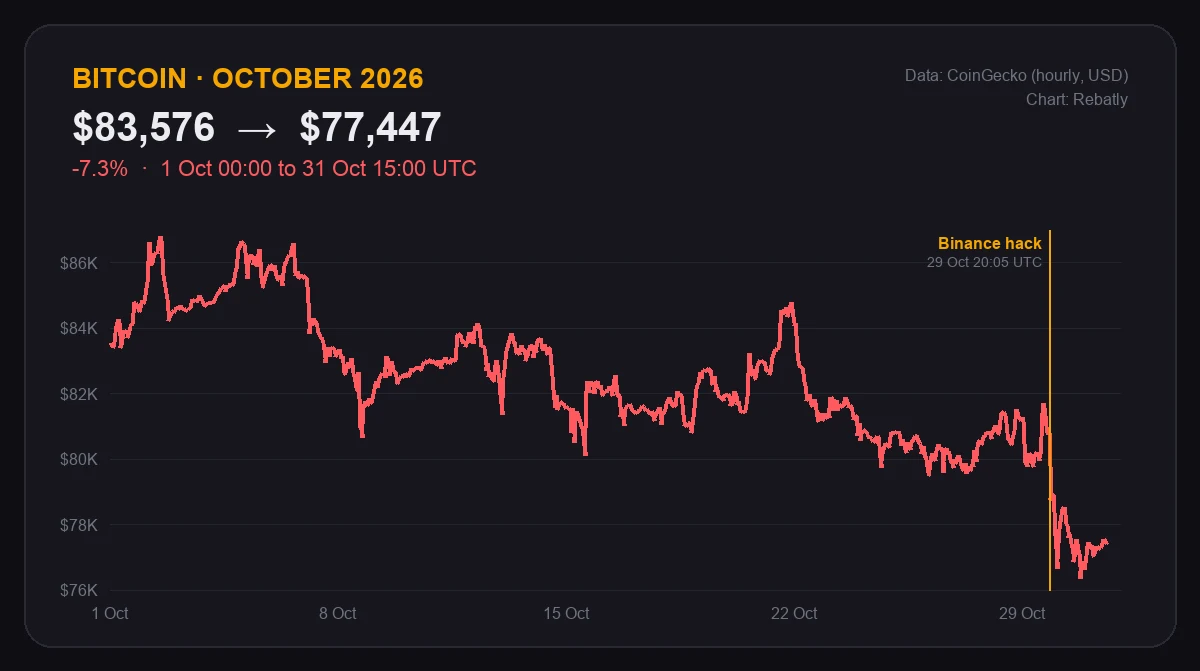
Why is crypto down? In two days, three things hit the market at once: the record $6.3 billion Binance hack, more than $1.5 billion of leveraged bets being force-closed, and a sell-off in tech stocks that even pulled gold lower. Bitcoin traded near $77,355 at 15:05 UTC on 31 October, down about 7% for the month, which puts it on course for its weakest October since 2014. This article pulls together what CoinDesk, Cointelegraph, The Block, Analytics Insight and market data show, and what to watch next.

 NO KYCSign up to BloFin
 Sign up to Bybit
 Sign up to OKX
 Sign up to Bitget
 Sign up to MEXC
 Sign up to OrangeX
 Sign up to Toobit
Why is crypto down today: the short answer
No single event explains the drop. Reports from several outlets point to three causes that landed within about 36 hours of each other:
| What happened | When | Effect on crypto |
|---|---|---|
| Binance, the largest exchange, lost about $6.3 billion in a hack | From 20:05 UTC on 29 October | BNB fell about 6% to 8% on the news; withdrawals on Binance are still paused |
| Leveraged long positions were force-closed as prices fell | 29–30 October | About $1.5 billion to $1.6 billion of futures positions liquidated in 24 hours |
| Tech stocks sold off after weak forecasts from Intel and others | 30 October | The Nasdaq Composite fell between 2.5% and 3%; gold and bitcoin fell with it |
How far bitcoin has fallen in October
Bitcoin started October near $83,576 (CoinGecko, 1 October). At 15:05 UTC on 31 October it was about $77,355, a fall of about 7.4% by our count. Cointelegraph and Analytics Insight, using CoinGlass monthly data, put the October loss at 7.7%; the gap comes from slightly different start prices. On either figure, bitcoin is heading for its weakest October since 2014, when it fell about 13%, according to the same CoinGlass data. October has usually been a strong month for bitcoin, which is why traders call it "Uptober".
On 30 October bitcoin dipped to about $76,300 to $76,400, its lowest price since 18 September, CoinDesk and Cointelegraph reported. Ether briefly touched $2,170 and BNB fell toward $700. The monthly candle closes at 00:00 UTC on 1 November, so the final number can still change.
The Binance hack shook confidence
Attackers drained about $6.3 billion from Binance's hot wallets on 29 October, the largest crypto theft on record. Binance says user funds are safe and has set aside more than $6.34 billion to cover the losses, but withdrawals stay paused while it rebuilds its systems. Co-CEO Richard Teng said Binance hopes to restart withdrawals by Sunday 1 November and plans a first proof-of-reserves update before a full report on Monday, CoinDesk reported.
The hack also moved money off exchanges: institutional investors began pulling funds from centralised exchanges to rebalance after the news, CoinDesk reported, citing people familiar with the matter. Our full report on the Binance hack covers what happened and what users should do.
$1.5 billion of leveraged bets wiped out
When prices fall fast, traders who borrowed to bet on higher prices get force-closed: the exchange sells their position before the loss exceeds their margin. That selling pushes prices lower and closes more positions. CoinDesk counted $1.57 billion of liquidations, four times the day before, including $522 million in bitcoin and $361 million in ether. Cointelegraph, using CoinGlass data, put the rolling 24-hour total at $1.56 billion, of which $1.31 billion were long positions. Open interest in crypto futures fell 3% to $136.3 billion while trading volume jumped 74% to $346.1 billion, CoinDesk reported.
A liquidation also costs fees: the position is closed at market, often at a worse price than the screen showed. Our guide to funding rates and trading fees explains what leverage really costs.
Stocks and gold fell too
Crypto did not fall alone. On 30 October the Nasdaq Composite fell 2.5% to about 25,500, its lowest level since 3 August, Cointelegraph reported; Analytics Insight put the day's drop at more than 3% and the S&P 500 at more than 2%. Intel shares fell 26% before the open and nearly 30% at the open after it guided fourth-quarter sales below expectations, and Alphabet fell 13% after missing earnings targets, according to Cointelegraph. JPMorgan pointed to "renewed fears over AI monetization", CNBC reported.
Even gold, often seen as a safe haven, fell as low as $3,891 an ounce, its weakest level in a year. QCP Capital said macro conditions, tech fears and the Binance hack had "created a period of heightened market repricing", Cointelegraph reported.
What analysts are saying
Views differ. Geoffrey Kendrick, head of digital assets research at Standard Chartered, told CoinDesk: "I suspect the negative price action still has some way to go." He added that a new base would come "only after assets are unfrozen and more detail of the hack emerges". Kendrick also said the hack could push more trading toward decentralised exchanges.
Cointelegraph pointed to signs some traders read as oversold: bitcoin's daily RSI fell to 34.7, its lowest since 30 June, and the price closed below the lower Bollinger Band on 29 October for the first time since 25 June. Indicators like these describe the past and do not predict prices. Rebatly does not forecast prices.
Washington reacts
President Donald Trump said on 30 October that his administration is looking into the Binance hack. "But it's a hack," he said. "That's the problem." Senator Cynthia Lummis wrote on X that "every minute lost is money gone for good" and argued that the CLARITY Act would have helped crypto firms freeze suspicious transfers faster, The Block reported. Others disagree on whether the bill would have changed anything. The election on 3 November decides who writes those rules next: our article on the US midterms and crypto explains the timing.
What this means for crypto traders
Fast markets cost more to trade. Spreads widen, market orders fill below the price on screen and leveraged positions can be liquidated in minutes. A few habits help:
• Use limit orders where you can: they cap the price you pay and usually pay the lower maker fee.
• Check your leverage and margin before volatile events, not during them.
• Watch funding rates on perpetual futures: they can swing sharply after a sell-off.
• Keep 2FA and a withdrawal whitelist on at every exchange you use, and ignore any "refund" or "compensation" messages that are not from an exchange's official channels.
Our guide to trading costs on big news days shows with real fee rates how much limit orders save. This is general information, not financial advice.
What to watch next
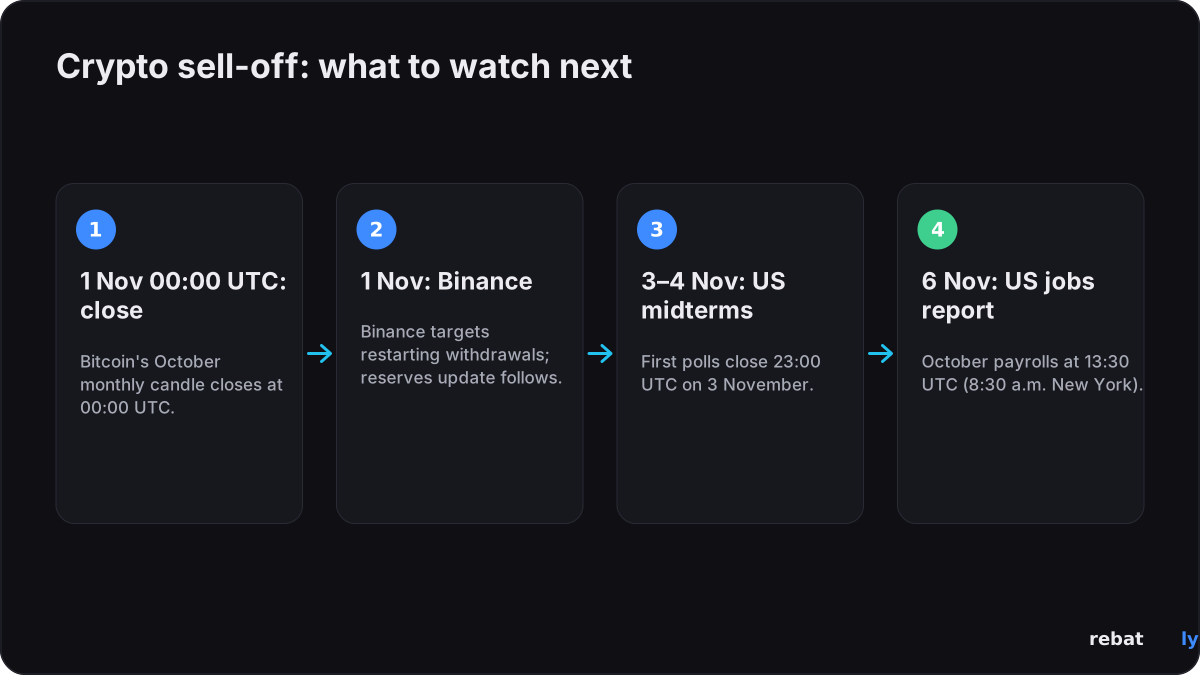
• 1 November, 00:00 UTC: bitcoin's October monthly close.
• Sunday 1 November: Binance's target to restart withdrawals; a first proof-of-reserves update follows, with a full report on Monday, CoinDesk reported.
• 3–4 November: US midterm elections; the first polls close at 23:00 UTC on 3 November.
• 6 November, 13:30 UTC: the US jobs report for October (8:30 a.m. New York time).
Rebatly does not forecast prices. We will update this article if the picture changes.
Trade with lower fees
In any market, every trade you make carries a fee. Sign up through Rebatly and part of every trading fee comes back to you: up to 50% on Bybit and Bitget, up to 40% on BloFin and OKX, up to 60% on MEXC and up to 65% on OrangeX futures. On Toobit, code Rebatly gives up to 60%, credited by Toobit itself. Rebates are paid daily in USDT. Our guide to how a fee rebate works explains the rest.
This article reports news and is not financial advice. Rebatly is an independent affiliate; not financial advice.
Get fees back on every trade
$10M+ rebates paid · Paid daily in USDT · No password or API keys, ever
Already signed up? Check your link and rebate with @rebatlybot on Telegram, or reach our support at @rebatly.
🔔 Get a Telegram alert each time your rebate is paid: tap “Activate notifications” in @rebatlybot. New to trading? Your first trade in 5 steps.
October 31, 2026 — published. Sources: CoinDesk, Cointelegraph, The Block, Analytics Insight, CoinGlass, CoinGecko.