Binance hack: about $6.3 billion stolen in the largest crypto theft on record
The Binance hack of 29 October 2026 is the largest crypto theft on record. Binance estimates about $6.3 billion left its hot wallets, mostly within about 20 minutes, starting at 20:05 UTC. Binance says user funds are safe and that it has set aside over $6.34 billion of its own resources to cover all losses. This article sets out what happened, what Binance has said, how much has been frozen, how the market reacted and what users should watch.

 NO KYCSign up to BloFin
 Sign up to Bybit
 Sign up to OKX
 Sign up to Bitget
 Sign up to MEXC
 Sign up to OrangeX
 Sign up to Toobit
What happened in the Binance hack
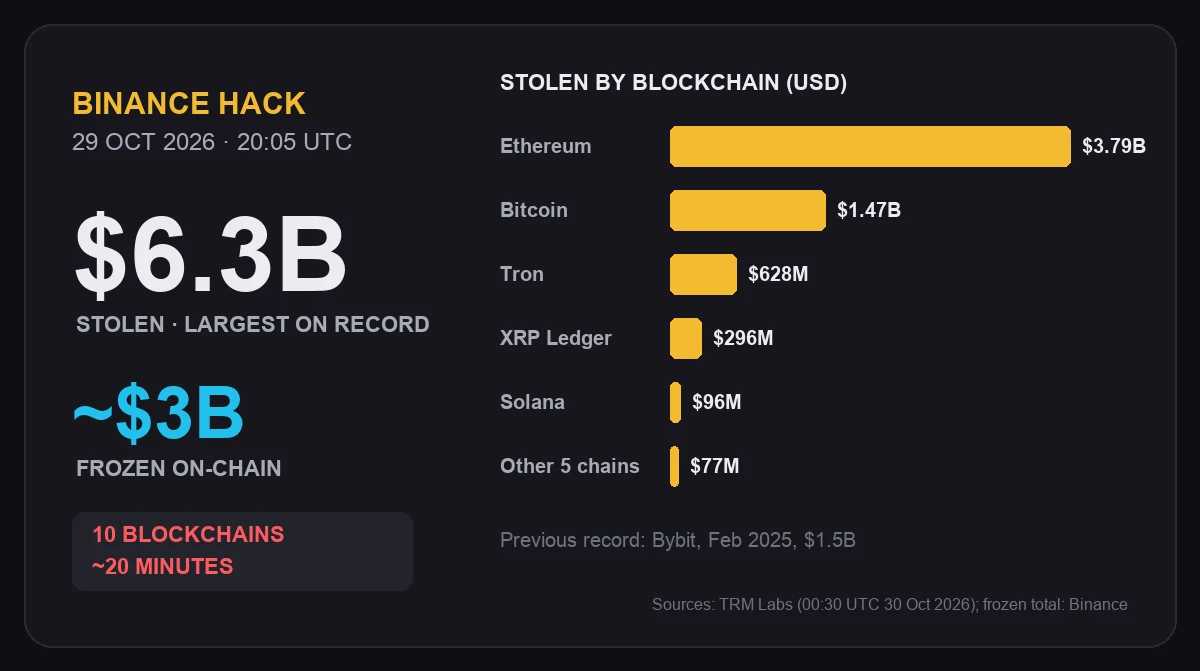
Blockchain analytics firm TRM Labs says the funds left Binance wallets on ten blockchains, starting at 20:05 UTC on 29 October. Its count, as of 00:30 UTC on 30 October, is about $6.36 billion at the prices when each asset was taken:
| Blockchain | Taken from Binance wallets |
|---|---|
| Ethereum | About $3.79 billion, including 200,630 ETH and 1.875 billion USDT |
| Bitcoin | 18,270 BTC, about $1.47 billion |
| Tron | 612.7 million USDT and 46.4 million TRX, about $628 million |
| XRP Ledger | 233.46 million XRP, about $296 million |
| Solana | 970,500 SOL, about $96 million |
| Arbitrum, Optimism, Base, Avalanche and Polygon | About $77 million combined |
How the attack worked
Binance said its initial investigation suggests the incident "may involve a compromised DevOps engineer's laptop", which may have let the attacker reach an internal service and submit unauthorized withdrawals, CoinDesk reported. Binance said it has found no evidence of a wallet private key leak.
TRM Labs wrote that wallets on ten chains, with different key types, all signed for the attacker within about half an hour, and assessed that the attacker gained control of Binance's hot wallet signing system. On Ethereum, TRM says the attacker used EIP-7702, a feature added in the May 2025 Pectra upgrade that lets a wallet hand its behaviour to a smart contract. Binance has not yet published a root cause; it says a detailed technical post-mortem will follow.
Update, 30 October: Binance later said it had found "additional points of breach" beyond the laptop, Decrypt reported. CEO Richard Teng wrote that the attacker "did not simply use one engineer's permissions, and this was not a single 'one-click' action." Binance still says it has seen no evidence of a private key leak.
Who is behind it
TRM Labs attributes the theft "with high confidence" to TraderTraitor, a North Korean hacking unit linked to the Lazarus Group. The FBI named the same group for the $1.5 billion Bybit hack of February 2025. Chainalysis also said it has high confidence that North Korea is responsible, and on-chain investigator ZachXBT named the Lazarus Group as the likely attacker, CoinDesk reported. These are assessments by analytics firms, not an official finding; Binance says it is working with law enforcement to identify the attackers.
What Binance says: user funds, SAFU and withdrawals
• User funds: Binance says user funds are safe and that it will cover all losses from its SAFU fund and company funds. Co-CEO Yi He said on X that the platform would cover "all hacking losses".
• $6.34 billion set aside: on 30 October Binance said it had set aside over $6.34 billion of its own company resources to restore customer balances. About $5 billion is already held in the same tokens that were taken, and it is buying the rest on public markets and over the counter, CoinDesk reported. Binance said user funds are not being used to cover the losses, and that the $6.34 billion does not include the frozen assets.
• SAFU: the Secure Asset Fund for Users was set up in 2018 to protect customers in emergencies. CoinDesk reported that it holds roughly $1 billion in bitcoin, so most of the cover would have to come from company funds.
• Withdrawals: Binance suspended withdrawals on the night of the hack. On 30 October Yi He said deposits are running normally and that withdrawals are expected to resume within 48 hours, U.Today reported. Later that day Binance said withdrawals stay paused during "a security revamp of the withdrawal service and its related addresses" and that it was on track to resume them in about 45 hours, Decrypt reported.
• Founder: Changpeng Zhao, Binance's largest shareholder, said he expects all user funds to be fully covered.
For scale: before the hack Binance held roughly $144 billion in assets, according to DefiLlama data cited by CoinDesk, so the theft equals about 4% of that.
How much has been frozen
Binance said late on 29 October that about $3 billion of the stolen assets had been frozen on-chain, including $2.3 billion in USDT and USDC. Tether CEO Paolo Ardoino said Tether froze over $1.57 billion in USDT, and Circle CEO Jeremy Allaire said Circle froze over $800 million in USDC, CoinDesk reported. TRM Labs also counted freezes by Ripple (40.5 million RLUSD), World Liberty Financial (27.8 million USD1) and the Arbitrum Security Council.
Frozen does not mean returned: the funds are blocked where they sit. TRM says the attacker still holds about $2.4 billion that no issuer can freeze, including the bitcoin, which is already being split into smaller amounts.
How the market reacted
On the news, bitcoin fell 4.8% to below $77,000, ether fell 5.7% and Binance's own token BNB fell 8%, CoinDesk reported. At 09:30 UTC on 30 October, CoinGecko showed bitcoin at about $77,600, down about 3% in 24 hours, and BNB at about $703, down about 6.5%.
Rebatly does not forecast prices. On days like this prices can jump in seconds, the gap between buy and sell prices can widen and market orders can fill worse than the price on screen. Our guide to trading costs on big news days shows with real fee rates how limit orders cut that cost.
Biggest crypto exchange hacks
The Binance hack is about four times the size of the previous record, TRM Labs says:
| Exchange | When | Stolen |
|---|---|---|
| Binance | October 2026 | About $6.3 billion |
| Bybit | February 2025 | About $1.5 billion |
| Coincheck | January 2018 | About $530 million |
| Binance | May 2019 | 7,000 BTC, about $40 million at the time |
What Binance users should do now
• Follow official channels only: check Binance's own app, website and verified X accounts for updates on withdrawals and compensation.
• Expect scams: after big hacks, fake "compensation", "refund" or "wallet verification" messages follow. Binance will never ask for your password, 2FA codes or seed phrase; never click links in unexpected texts or emails. Our article on exchange data breaches and scam messages shows what they look like.
• Check your account: review your withdrawal address list, API keys and login devices, and keep 2FA switched on.
• Know the risk: "Any assets held at a centralised exchange are only as safe as the exchange itself," Sean Foley of Macquarie University told Al Jazeera.
This is general security information, not financial advice.
What happens next
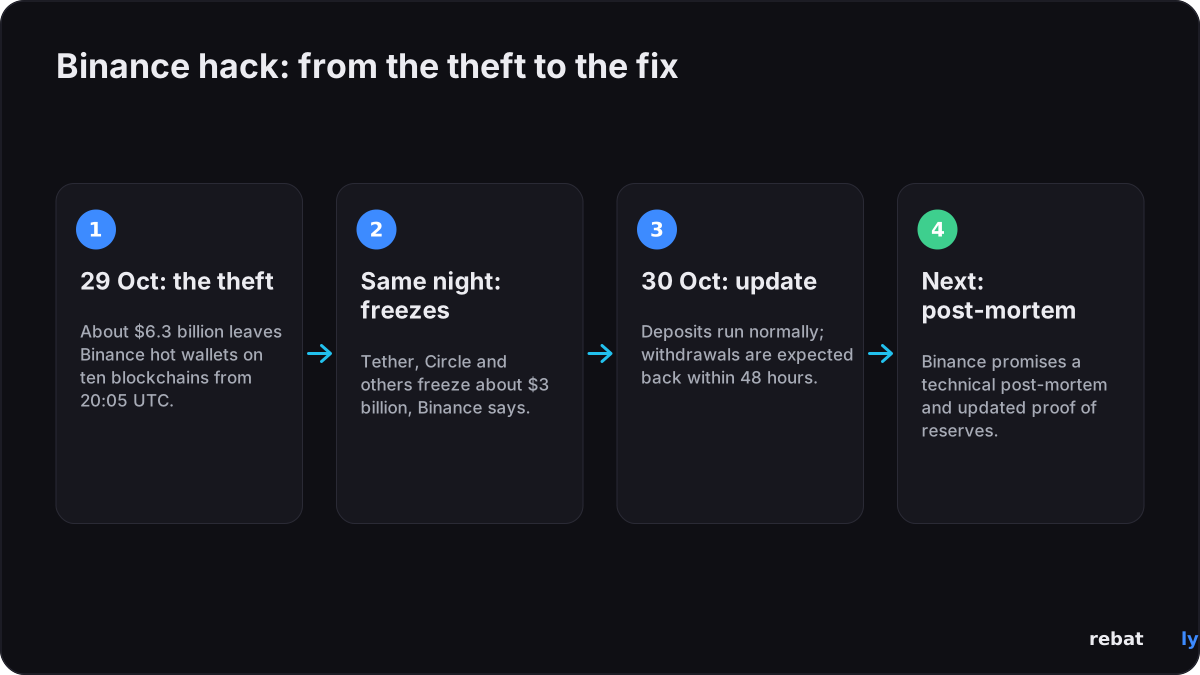
• Within about 45–48 hours of 30 October: Binance expects withdrawals to resume, according to Yi He and Decrypt. Deposits are already open.
• Next: a technical post-mortem from Binance, and an updated proof of reserves after the fix, Bitcoin.com reported.
• Ongoing: analytics firms are tracking the stolen funds; more freezes are possible as the attacker tries to swap or move them.
We will update this article as Binance publishes more.
Trade with lower fees
Whichever exchange you use, every trade carries a fee. Sign up through Rebatly and part of every trading fee comes back to you: up to 50% on Bybit and Bitget, up to 40% on BloFin and OKX, up to 60% on MEXC and up to 65% on OrangeX futures. On Toobit, code Rebatly gives up to 60%, credited by Toobit itself. Rebates are paid daily in USDT. Our guide to how a fee rebate works explains the rest.
This article reports news and is not financial advice. Rebatly is an independent affiliate; not financial advice.
Get fees back on every trade
$10M+ rebates paid · Paid daily in USDT · No password or API keys, ever
Already signed up? Check your link and rebate with @rebatlybot on Telegram, or reach our support at @rebatly.
🔔 Get a Telegram alert each time your rebate is paid: tap “Activate notifications” in @rebatlybot. New to trading? Your first trade in 5 steps.
October 30, 2026 — updated: Binance's $6.34 billion set aside to cover losses (CoinDesk, 30 October), additional points of breach and withdrawal timing (Decrypt, 30 October). October 30, 2026 — published. Sources: TRM Labs, CoinDesk, Decrypt, Bitcoin.com, U.Today, Al Jazeera, TechCrunch, CoinGecko.