Bitcoin ETF outflows: $643 million left on Friday, the most in four months, after the Binance hack
Bitcoin ETF outflows reached $643 million on Friday 30 October 2026, the largest one-day withdrawal from the US spot bitcoin funds since 25 June, in the first trading session after the Binance hack. The funds' net flows are counted per US trading day; Friday's session ran from 13:30 to 20:00 UTC, and the issuers' figures were compiled that evening in New York. Trackers put the day at $643.2 million (Farside Investors) to $643.3 million (SoSoValue). The outflow erased a four-day run of inflows, pushed October into the red and cut the funds' 2026 net inflows to about $361 million. On Monday 2 November a further $399 million left, according to preliminary SoSoValue data. This article sets out which funds saw the money leave, how the week, the month and the year now look, what analysts say about why, and how to read the daily flow numbers.
 NO KYCSign up to BloFin
 Sign up to Bybit
 Sign up to OKX
 Sign up to Bitget
 Sign up to MEXC
 Sign up to OrangeX
 Sign up to Toobit
Bitcoin ETF outflows on 30 October, fund by fund
Twelve US spot bitcoin ETFs report their flows each trading day. On Friday five of them recorded net outflows and the other seven were flat, by the figures that Farside Investors and SoSoValue published and that Cointelegraph, The Block and Decrypt relayed. BlackRock's IBIT and Fidelity's FBTC together accounted for about two thirds of the day's total.
| Fund | Issuer | Net flow on 30 October |
|---|---|---|
| IBIT | BlackRock | −$233.7 million |
| FBTC | Fidelity | −$201.0 million (SoSoValue: −$201.4 million) |
| ARKB | ARK Invest and 21Shares | −$129.5 million |
| GBTC | Grayscale | −$53.3 million |
| BITB | Bitwise | −$25.7 million |
| BTCO, EZBC, BRRR, HODL, BTCW, BTC (Grayscale Mini), MSBT | Invesco/Galaxy, Franklin, Valkyrie (CoinShares), VanEck, WisdomTree, Grayscale, Morgan Stanley | $0 |
| Total | 12 funds | −$643.2 million to −$643.3 million |
Two things stand out. First, no fund took in money that day; even IBIT, which had absorbed $932.1 million in October before Friday, saw its largest outflow since 22 October, when it lost $254.1 million, Farside Investors data shows. Second, the money did not disappear from bitcoin itself: a redemption means the fund hands coins back to a market maker, who may sell them, hold them or deliver them to another buyer. The next section explains that mechanism. Treat the last decimal as provisional: issuers sometimes revise a day's figure the following morning, which is why the two trackers differ by $0.1 million.
Daily, weekly and monthly context: largest since June, October in the red
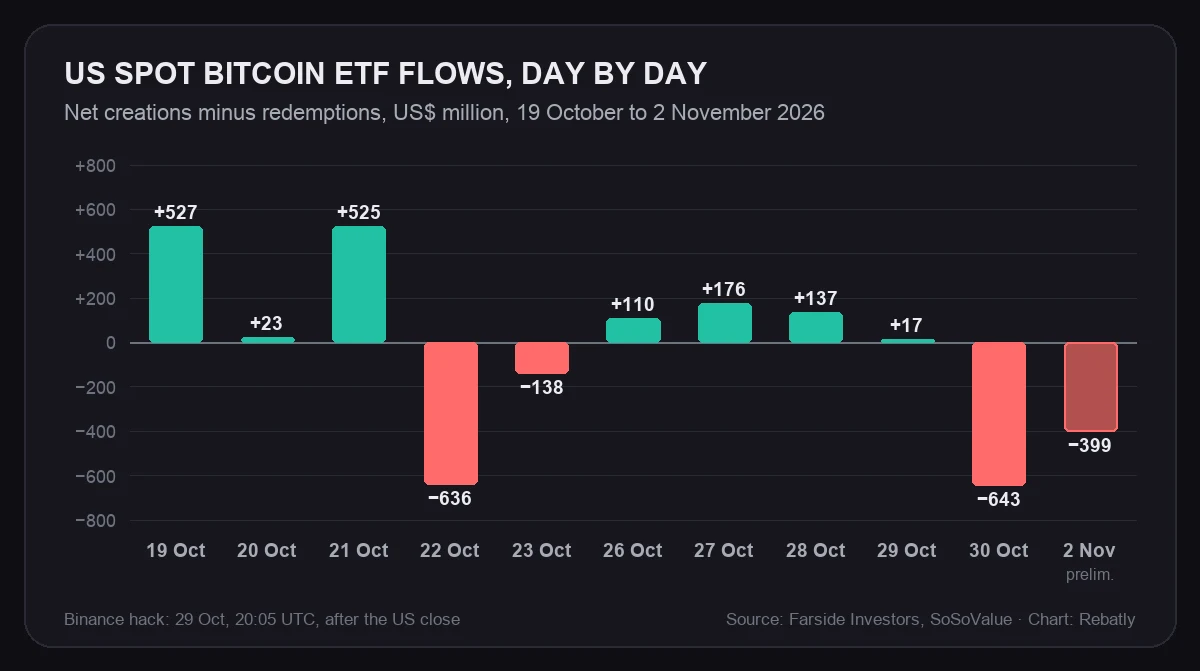
The chart above shows the eleven trading days from 19 October to 2 November, from the Farside Investors table cross-checked against SoSoValue (the two differ by at most $3.6 million on any day, on 21 October). Three points of context, each from the trackers' own totals:
• The day: Friday's $643.3 million was the largest single-day outflow since 25 June, when $696.3 million left, and the twelfth largest since the funds began trading in January 2024, CoinDesk reported, citing SoSoValue. It narrowly beat the $635.5 million outflow of 22 October, eight days earlier.
• The week: Monday to Thursday brought in about $441 million (+$110.3 million, +$176.0 million, +$137.3 million and +$17.2 million). Friday wiped that out and left the week ending 30 October at a net outflow of $202.6 million (SoSoValue, via The Block) or $202.4 million (Farside).
• The month: October closed at a net outflow of about $515 million (SoSoValue) to $515.9 million (Farside), the funds' first negative month since June, Cointelegraph noted. Before Friday the month had been up $127.3 million. Inside that total, IBIT gained $932.1 million while the other eleven funds together lost about $1.45 billion.
• The year: 2026 net inflows stood at just over $1 billion before Friday; the outflow removed 63.6% of that and left about $361 million for the year to date, CoinDesk and Cointelegraph reported from SoSoValue data. In 2025 the same funds attracted tens of billions, so 2026 is, in CoinDesk's words, "barely green now".
• Since launch: cumulative net inflows since January 2024 were about $57.05 billion (Farside) to $57.4 billion (Decrypt's tracker) after Friday, and about $56.58 billion after Monday (SoSoValue). Total net assets fell to $98.1 billion by SoSoValue's count, below $100 billion, or $102.8 billion to $103.2 billion by other trackers that value the holdings differently; the gap is a methodology difference, not a dispute about the flows.
Monday 2 November added a second day of outflows: $398.6 million by SoSoValue's count, reported by TokenPost and Crypto Briefing, with IBIT alone at −$405.3 million and Fidelity's FBTC the only fund with an inflow, $6.7 million. When this article was written, at 06:40 UTC on 3 November, Farside's own table still showed IBIT's Monday figure as pending, so treat Monday's total as preliminary until both trackers agree.
Ether and Solana funds: a longer losing streak
The bitcoin funds' outflow was the biggest headline, but it came after a smaller and longer slide in the US spot ether ETFs. On Friday they lost $155.7 million (Farside, via Decrypt) to $155.9 million (SoSoValue, via The Block), their largest day since 7 October, and $431.5 million for the week. October was their worst month on record at about $1.61 billion of net outflows, above the previous record of $1.42 billion set in November 2025, and it erased their 2026 inflows, leaving roughly $45 million of net outflows for the year, Cointelegraph reported. Monday brought a sixth straight day of redemptions, $140 million, against total assets of about $13.2 billion, according to Crypto Briefing. The newer US spot Solana ETFs lost $10.8 million on Friday, their fifth straight day of outflows, and about $72 million for the week, by Decrypt's tracker.
Why investors pulled money: the views on record
Nobody can see who redeemed or why; flows are published as totals, not by holder. What follows are attributed views, not Rebatly's.
• The Binance hack as a sentiment shock. Attackers drained about $6.3 billion from Binance's hot wallets from 20:05 UTC on Thursday 29 October, after the US market close, so Friday was the first session in which ETF investors could react; our articles on the Binance hack and Binance withdrawals after the hack have the detail. Nick Forster, chief executive of the options exchange Derive, told CoinDesk: "The market was already under pressure, but the Binance hack added another layer of uncertainty." Jeff Ko, chief analyst at ViaBTC, called the outflows a "sentiment shock" in comments to The Block, pointing out that spot ETF holders have no direct exposure to Binance because the funds' bitcoin sits with regulated custodians.
• A de-risking day, not capitulation. Rick Maeda, head of markets at Laevitas, told The Block the outflow was under 1% of the funds' assets and called it a "de-risking day" rather than capitulation, citing the market's recovery after the Bybit hack in the first quarter of 2025 as a precedent. Jeff Ko likewise described roughly $640 million as modest against total assets near $100 billion.
• A market already weak. Bitfire Research, cited by CoinDesk, said spot buying momentum had "visibly faded" before the hack, with the Coinbase premium negative at −0.18% to −0.27% and the Crypto Fear & Greed Index in the 30 to 34 range; The Block put the index at 37, in "fear", on Sunday. Bitcoin had already fallen to about $77,000 on Thursday after the Federal Reserve held rates at 3.75% to 4% on 28 October with two officials voting for a hike, Cointelegraph and Decrypt noted; see our Fed rate decision article.
• A custody question. Yishi, founder and chief executive of the hardware-wallet maker OneKey, warned on X that IBIT relies heavily on Coinbase to hold its bitcoin and could face security threats of its own, Cointelegraph reported in paraphrase. Neither BlackRock nor Coinbase has reported any incident, and no outlet has linked ETF custody to the Binance hack.
• Cautious near term. Dominick John, an analyst at Zeus Research, told The Block that demand is likely to stay cautious and that a sustained return of inflows depends on market stability and investor confidence.
These are opinions from people with positions in the market. Rebatly does not endorse any of them and does not forecast flows or prices.
How bitcoin ETF flows work, and who publishes the numbers
A spot bitcoin ETF does not buy and sell coins every time an investor trades its shares on Nasdaq, Cboe or NYSE Arca. Shares change hands between investors all day. Only when demand pushes the share price away from the value of the bitcoin behind it does an authorised participant, a large trading firm, step in: it creates new shares by delivering bitcoin or cash to the fund, or redeems shares and takes bitcoin or cash out. The daily "flow" is the dollar value of creations minus redemptions, measured at the fund's net asset value. A $643 million outflow therefore means the funds shrank by that amount; it does not say what the market makers did with the coins afterwards, and it is not the same as $643 million of selling on an exchange.
Who publishes what, and when:
• The issuers (BlackRock, Fidelity, Grayscale and the rest) post each fund's creations and redemptions after the US close. Some report the next morning, which is why the latest day in any table can change.
• Farside Investors, a London-based firm, compiles the issuer figures into the daily table most news reports quote, usually complete by the next morning in Asia.
• SoSoValue publishes a similar daily table with net assets and cumulative totals; its numbers can differ from Farside's by a few tenths of a million because of timing and rounding.
• The Block, Decrypt and other outlets run their own trackers on the same issuer data.
• CoinShares publishes a weekly report on Mondays that covers exchange-traded products worldwide, including Europe, Canada and Hong Kong, not only the US spot funds, so its weekly figures are larger and are not directly comparable with the daily US table.
Flow tables are published in US dollars for the US session. Friday's flows cover trading up to 20:00 UTC, and the complete figure is normally available by Saturday morning in Asia.
How the market reacted
Bitcoin fell about 4% on Friday to roughly $76,400, with more than $1.3 billion of leveraged positions liquidated, Decrypt reported. By our reading of CoinGecko hourly prices, bitcoin traded between $78,523 and $76,586 during 30 October, was $77,839 at 00:00 UTC that day and $76,553 at 06:00 UTC on 3 November, down 1.7% over the four days. Ether moved from $2,249 to $2,245 over the same period, almost unchanged. The Block quoted bitcoin at $78,491 late on Sunday in New York, up 1% on the day, before Monday's second day of outflows. The price move around the flows is small compared with the swings of early October. Rebatly does not forecast prices. Our guide to trading costs on big news days explains why spreads and order types matter most in weeks like this one.
Context: October's biggest flow days
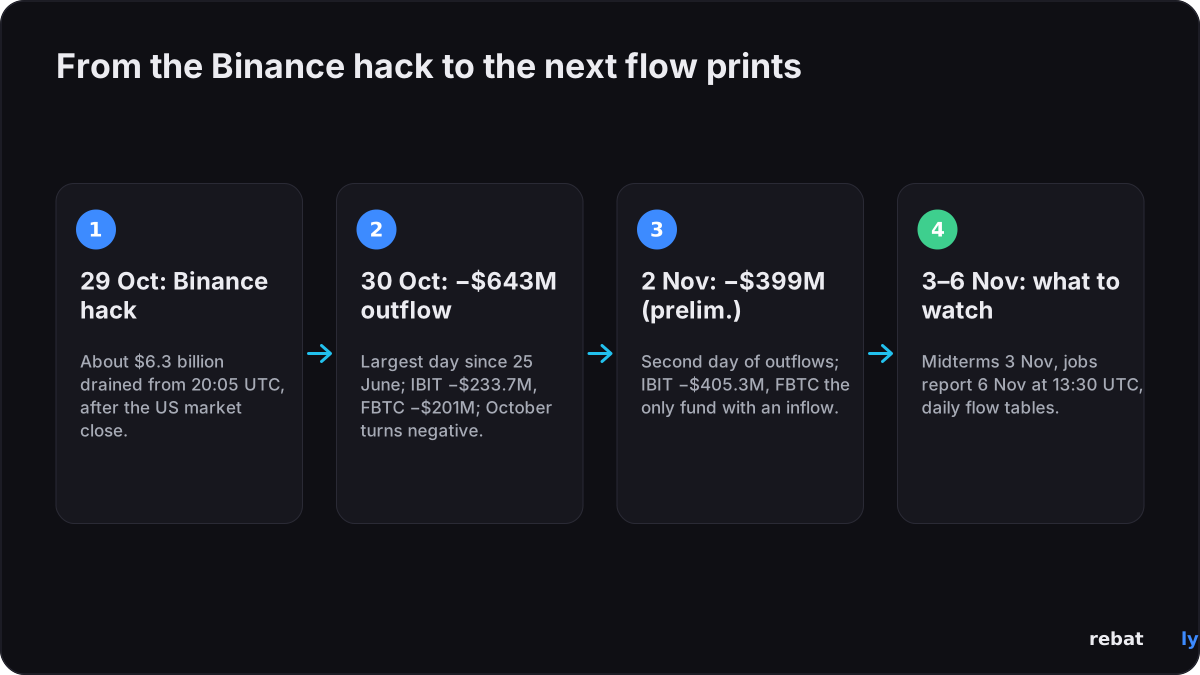
October 2026 was a two-way month for the bitcoin funds, with two of the year's largest inflow days and two of its largest outflow days inside a fortnight. All figures from Farside Investors, cross-checked against SoSoValue:
| Date | Net flow | What was happening |
|---|---|---|
| 19 October | +$526.7 million | IBIT alone took in $665.2 million |
| 21 October | +$524.8 million (SoSoValue: +$528.4 million) | Inflows across eight funds |
| 22 October | −$635.6 million | The month's first big exit; IBIT −$254.1 million, FBTC −$217.5 million |
| 30 October | −$643.2 million | First session after the Binance hack; largest since 25 June |
| 2 November | −$398.6 million (preliminary) | IBIT −$405.3 million; FBTC the only fund with an inflow |
The largest outflow of 2026 remains 25 June's $696.3 million, by CoinDesk's reading of SoSoValue data. Nothing in this table says what the funds will do next; a big outflow day has been followed by inflows within days several times this year, and by further outflows at other times.
What to watch next
• The next flow prints: Tuesday's figures arrive on Wednesday morning in Asia. Whether Monday's $399 million is revised, and whether IBIT's outflows continue, will show up in the Farside and SoSoValue tables first.
• US midterm elections, 3 November: polls close on Tuesday evening in the United States, from 23:00 UTC. Our article on the US midterms and crypto regulation sets out what is at stake for the industry.
• US jobs report, 6 November: October payrolls at 8:30 a.m. New York time, 13:30 UTC; see our jobs report guide.
• The Fed, 9 December: the next rate decision, with the committee split after two votes for a hike in October.
• CoinShares' weekly report: due on Monday 9 November for the week that includes Friday's outflow and Monday's.
• Binance's recovery: withdrawals have been reopening in stages since Sunday 1 November; The Block reported about $3.64 billion of net outflows from Binance in the first nine and a half hours after they resumed. ETF investors have no exposure to those balances, but the headlines move sentiment.
• Index decisions: Bitfire Research, via CoinDesk, flagged MSCI's pending list of "non-operating companies", which could affect bitcoin-treasury stocks such as Strategy and Metaplanet.
Rebatly does not forecast flows or prices. We will update this article when the trackers agree on Monday's figure and when the week's totals are final.
Trade with lower fees
Whatever the ETF tables show, the fee on each trade you make is a cost you can cut today. Sign up through Rebatly and part of every trading fee comes back to you: up to 50% on Bybit and Bitget, up to 40% on BloFin and OKX, up to 60% on MEXC and up to 65% on OrangeX futures. On Toobit, code Rebatly gives up to 60%, credited by Toobit itself. Rebates are paid daily in USDT. Our guide to how a fee rebate works explains the rest.
This article reports news and is not financial advice. Rebatly is an independent affiliate; not financial advice.
Get fees back on every trade
$10M+ rebates paid · Paid daily in USDT · No password or API keys, ever
Already signed up? Check your link and rebate with @rebatlybot on Telegram, or reach our support at @rebatly.
🔔 Get a Telegram alert each time your rebate is paid: tap “Activate notifications” in @rebatlybot. New to trading? Your first trade in 5 steps.
November 3, 2026 — published. Sources: CoinDesk, The Block, Decrypt, Cointelegraph, Crypto Briefing, TokenPost, Farside Investors, SoSoValue, CoinGecko.