Binance withdrawals after the hack: what's open and what to check
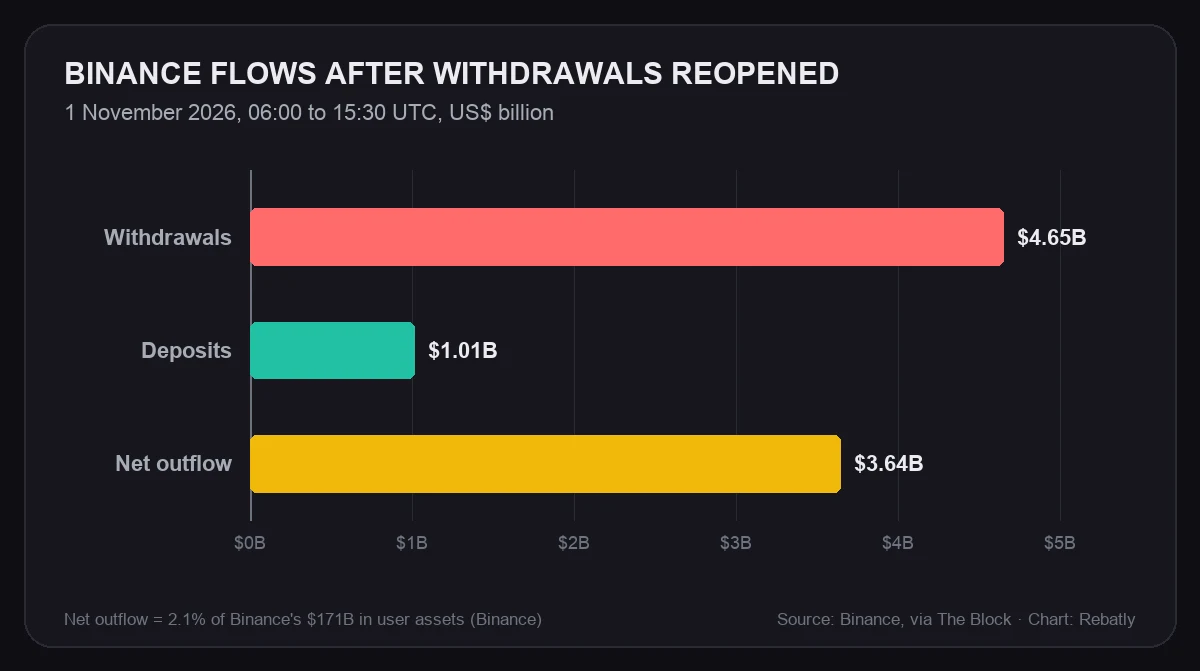
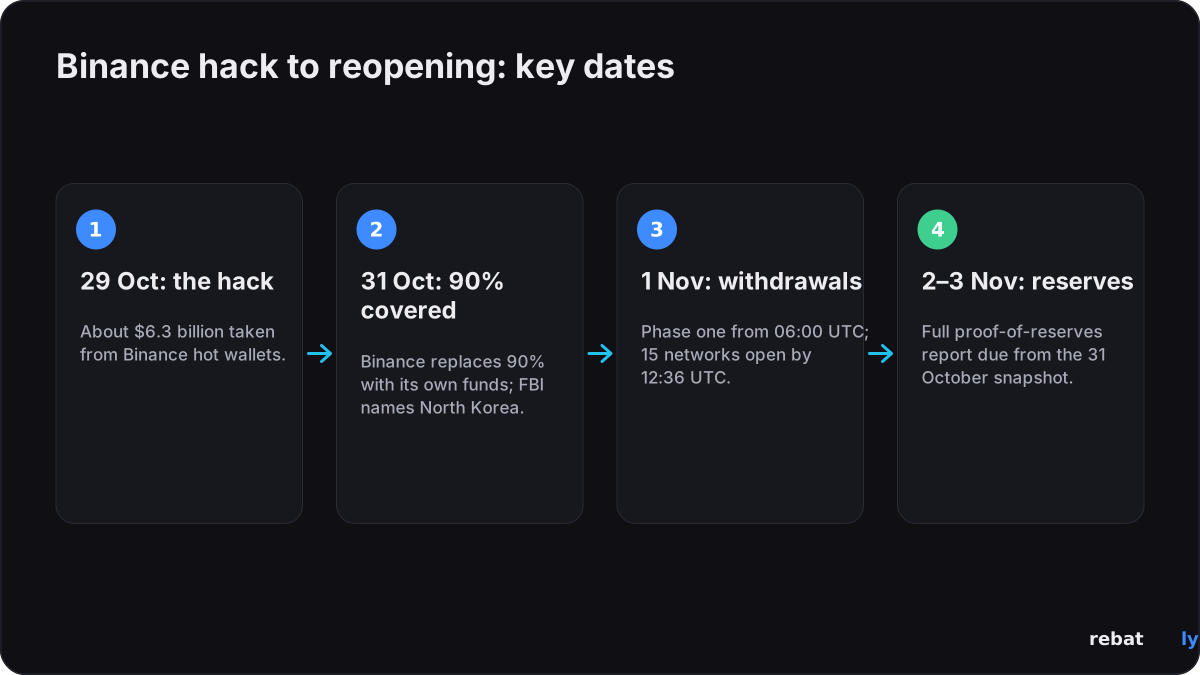
Binance withdrawals began reopening on Sunday 1 November 2026 at 06:00 UTC, three days after about $6.3 billion was stolen from the exchange's hot wallets. Bitcoin came first, and by 12:36 UTC all 15 networks in the first phase were open again. Withdrawals for most coins are still suspended. In the first nine and a half hours users withdrew $4.65 billion and deposited $1.01 billion, Binance says. This guide covers what is open, what is still closed, how much has left, and what to check before you move funds.
 NO KYCSign up to BloFin
 Sign up to Bybit
 Sign up to OKX
 Sign up to Bitget
 Sign up to MEXC
 Sign up to OrangeX
 Sign up to Toobit
Binance withdrawal status: are withdrawals open?
Partly. Binance is reopening withdrawals one blockchain at a time, and each network has to pass its own security and stability checks first, CoinDesk reported. Binance has given no dates for the later phases; it says it will publish the next schedule once testing is done.
At 11:22 a.m. New York time on 1 November (16:22 UTC), Binance's status page still showed 531 of 552 coins suspended and 14 partly restored, including bitcoin and ether, The Block reported. Cardano, Chainlink, Hyperliquid, Litecoin and NEAR were among the networks still being tested. Because the list changes during the day, check the withdrawal page in the Binance app for the exact coin and network before you start. This guide covers crypto withdrawals; for bank and card withdrawals, check the Binance app.
Which networks reopened first
Binance picked the networks users had asked for most. These 15 were in the first phase, according to Binance's update as reported by Bitcoin.com:
| Network | Coins reported open |
|---|---|
| Bitcoin | BTC |
| Ethereum | ETH, USDT, USDC |
| BNB Smart Chain | BNB, USDT, USDC |
| Solana | SOL, USDT, USDC |
| Tron | TRX, USDT |
| XRP Ledger | XRP |
| Dogecoin | DOGE |
| Base, Optimism, Arbitrum | ETH and stablecoins; ARB on Arbitrum |
| Polygon, Avalanche C-Chain | POL, AVAX, USDT, USDC |
| Sui, TON, Zcash | SUI, USDT on TON, ZEC |
A coin can be open on one network and closed on another. USDT, for example, came back on Ethereum, BNB Smart Chain, Solana and Tron, but not on every network Binance supports.
How much has left Binance
Between 06:00 and 15:30 UTC on 1 November, Binance processed $4.65 billion of withdrawals and $1.01 billion of deposits, a net outflow of about $3.64 billion, the exchange said in a post on X reported by The Block and CNBC. Binance put that at 2.1% of its $171 billion in user assets. Withdrawals peaked at $733 million in the half hour from 08:00 UTC, Bitcoin.com reported. USDT made up the largest share of withdrawals, followed by USDC and then BTC, Cointelegraph reported, citing Binance's data. Binance said withdrawals "initially surged" and then slowed and stabilised.
Outside trackers measure different wallets over different windows, so their numbers differ:
| Measure | Window | Net outflow |
|---|---|---|
| Binance's own figure | 06:00 to 15:30 UTC, 1 November | About $3.64 billion |
| DefiLlama, via The Block | 24 hours to 16:37 UTC, 1 November | About $4.05 billion |
| DefiLlama, via Cointelegraph | 24 hours | About $5.8 billion |
| Tracked wallets, via CryptoSlate | 1 November | About $2.5 billion |
On-chain flows also include Binance moving funds between its own wallets, including the new ones it is switching to, so not all of it is customers leaving, CryptoSlate noted. Over the same 24 hours, DefiLlama counted about $368 million of net inflows across the next ten exchanges it tracks, led by OKX with $316.8 million, and CoinGlass showed Binance's bitcoin balance down about 19,289 BTC, The Block reported.
Are the stolen funds covered?
Binance says users will not bear the loss. "Binance will absorb the financial impact of these stolen funds, not our users," it said, as quoted by CNBC. Here is how its coverage has changed:
• 30 October: Binance said it had set aside $6.34 billion of company funds, The Block reported.
• 31 October: co-CEO Richard Teng said 90% of the stolen assets had been replaced, using part of the SAFU fund, part of the futures insurance fund and the company treasury.
• 1 November: about 95%, Forbes and CoinDesk reported. The rest is smaller tokens outside Binance's top ten, which take longer to buy; Binance is buying them on the market and over the counter.
"Replaced" means Binance put its own assets back in, not that the stolen coins came back. About $3 billion of the stolen funds has been frozen, mostly USDT and USDC that their issuers can block, CoinDesk reported. Bitcoin and ether cannot be frozen that way. The FBI said on 31 October that North Korea's TraderTraitor group was behind the attack.
Binance's proof of reserves
Binance took a new proof-of-reserves snapshot at 00:00 UTC on 31 October. It said building the full zero-knowledge proof would take about 40 to 50 hours, with the report due on 2 or 3 November. At the time of writing it had not been published. Binance says ten tokens are fully backed: BTC, ETH, USDT, BNB, SOL, USDC, XRP, USD1, RLUSD and ZEC.
A proof of reserves shows whether customer balances are backed at a point in time. It does not show whether the weakness that let the attacker in has been fixed; Binance has promised a separate post-incident report.
Before you withdraw: what to check
• The network: the network you choose on Binance must match the network of the receiving address. Sending on the wrong network can lose the funds.
• Memo or tag: XRP, TON and some other coins need a memo or tag when you send to an exchange. Copy it exactly.
• The fee and minimum: the withdrawal screen shows the network fee and the minimum amount before you confirm. Withdrawal fees are separate from trading fees and differ by network, so the same coin can cost less to move on one chain than another.
• Start small: with a large amount, send a small test first and wait for it to arrive.
• Expect delays: Binance warned that heavy traffic could slow some bitcoin withdrawals to outside addresses. A pending withdrawal is not a lost one; check its status in your withdrawal history.
• Ignore "compensation" messages: fake refund and wallet-verification messages follow every big hack. Binance will never ask for your password, 2FA codes or seed phrase. Our guide to exchange data breaches and scam messages shows what they look like.
For how the attack happened, see our article on the Binance hack. This is general security information, not financial advice.
How the market reacted
Prices barely moved while the withdrawals reopened. Bitcoin was at $77,804 at 06:00 UTC on 1 November and $77,921 at 16:00 UTC, up 0.2%, by our count of CoinGecko hourly prices. BNB went from $704.82 to $714.10, up 1.3%. At 06:19 UTC on 2 November, bitcoin was at $78,211 and BNB at $708.32. Rebatly does not forecast prices. Our guide to trading costs in fast markets explains why spreads and fees matter most on days like this.
What happens next
• Proof of reserves: the full report from the 31 October snapshot, due on 2 or 3 November.
• The next phases: more networks and coins as each passes testing, with the schedule to be announced by Binance.
• The last 5%: Binance is still buying the smaller tokens it needs to fully replace what was stolen.
• A post-incident report: promised once Binance's investigation ends.
• The stolen funds: the FBI expects more laundering, and more freezes are possible as the attacker moves them.
We will update this article as Binance reopens more networks.
Trade with lower fees
Moving funds is a good moment to look at what your trades cost. Sign up through Rebatly and part of every trading fee comes back to you: up to 50% on Bybit and Bitget, up to 40% on BloFin and OKX, up to 60% on MEXC and up to 65% on OrangeX futures. On Toobit, code Rebatly gives up to 60%, credited by Toobit itself. Rebates are paid daily in USDT. Our guide to how a fee rebate works explains the rest.
This article reports news and is not financial advice. Rebatly is an independent affiliate; not financial advice.
Get fees back on every trade
$10M+ rebates paid · Paid daily in USDT · No password or API keys, ever
Already signed up? Check your link and rebate with @rebatlybot on Telegram, or reach our support at @rebatly.
🔔 Get a Telegram alert each time your rebate is paid: tap “Activate notifications” in @rebatlybot. New to trading? Your first trade in 5 steps.
November 2, 2026 — published. Sources: CoinDesk, The Block, CNBC, Cointelegraph, Bitcoin.com, Forbes, CryptoSlate, DefiLlama, CoinGlass, CoinGecko.