FinCEN breach: what the US Treasury hack means for crypto users
The FinCEN breach was confirmed on 24 November 2026, when the US Treasury's Financial Crimes Enforcement Network said it was investigating a cybersecurity incident that "resulted in unauthorized access to a limited subset of its systems". FinCEN took some systems offline as a precaution and gave filers until 30 December 2026 for some overdue reports. FinCEN runs the database that receives suspicious activity reports from banks and money services businesses, including crypto exchanges that do business in the United States. FinCEN has not said what, if anything, was taken. This article sets out what is confirmed, what is not, and what it means for crypto users.
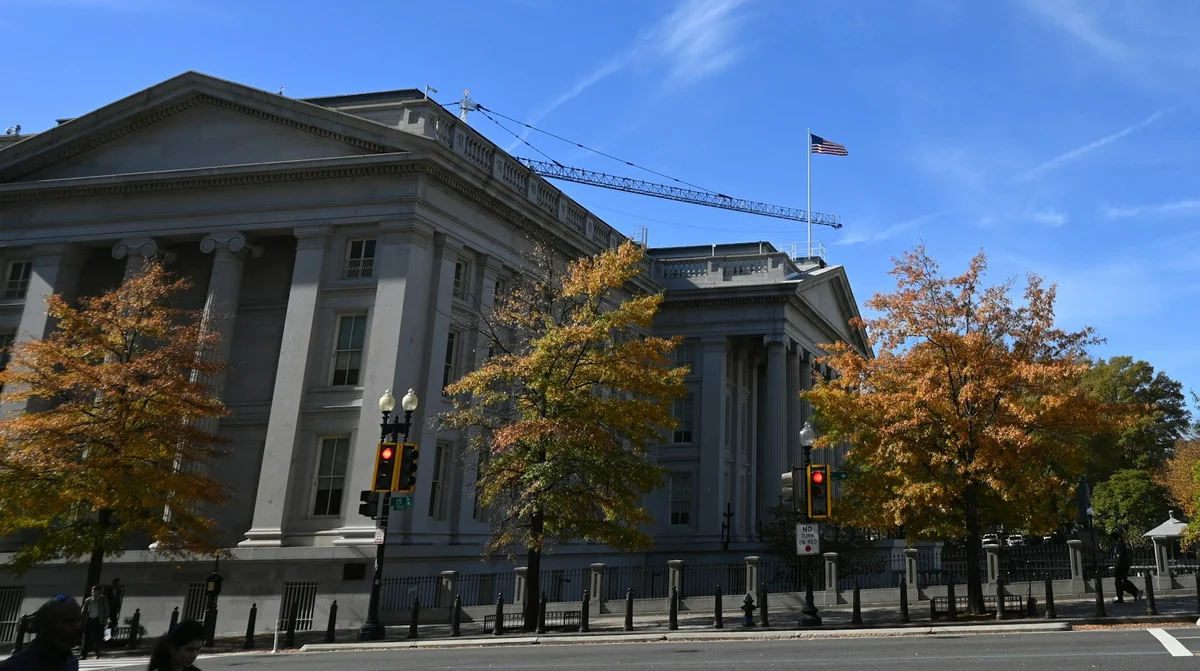





What FinCEN has confirmed
FinCEN posted a service alert on its BSA E-Filing website on 24 November. The Verge was first to report it, Nextgov/FCW said. Here is where things stand, based on FinCEN's own order and statements to Newsweek, The Register and Reuters:
| Question | What is known |
|---|---|
| What happened | A cybersecurity incident with "unauthorized access to a limited subset of its systems", FinCEN said |
| Systems offline | "Some systems", taken offline "as a proactive measure". FinCEN has not named them |
| Still working | The BSA E-Filing website, although some services may be unavailable, and the Financial Institutions Hotline |
| Investigators | Treasury, with the FBI, CISA and third-party forensic examiners |
| Data taken | Not determined. FinCEN has not said what data, if any, was accessed |
| When it began, who did it | Not disclosed |
The filing relief: order FIN-2026-R002
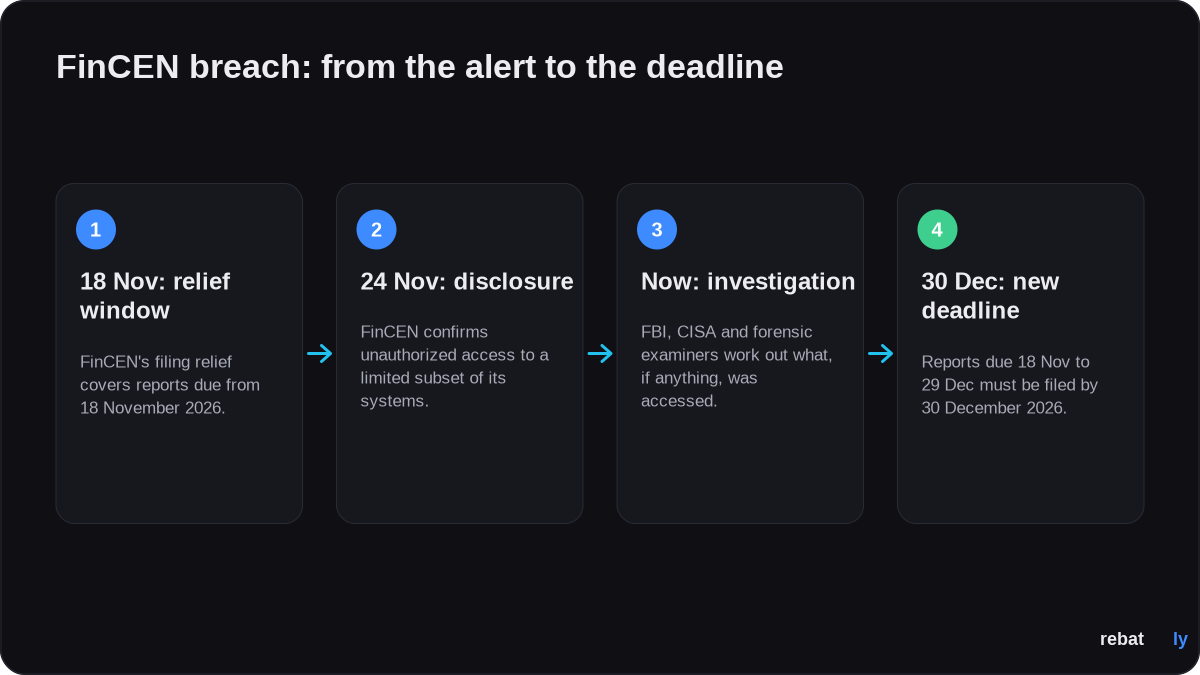
On 24 November FinCEN issued order FIN-2026-R002. It grants "temporary, limited exceptive relief in response to a service disruption that is hindering filers' ability to adhere to reporting obligations". The order says:
• Who: financial institutions that, as of 18 November 2026, used Secure Data Transfer Mode (SDTM) to submit Bank Secrecy Act reports. SDTM is FinCEN's automated channel for bulk filing.
• Which reports: Bank Secrecy Act reports due from 18 November to 29 December 2026, plus beneficial ownership reports and FinCEN ID updates due in the same window.
• New deadline: 30 December 2026. FinCEN "may modify or extend this order at its discretion".
• What does not change: institutions must still monitor for suspicious transactions. Urgent suspicious activity can go to law enforcement through FinCEN's hotline, which FinCEN says "is not impacted by this service disruption".
The order does not name the affected systems. The Register reads it as a sign that SDTM was among them; Cryptopolitan noted that the 18 November start date suggests the bulk channel was down for close to a week. FinCEN has not confirmed either reading.
Was any data accessed?
This is the open question, and the answer so far is preliminary. A FinCEN official told Reuters that investigators had found no evidence of a breach of the Bank Secrecy Act or beneficial ownership databases, Cyber Security News reported. The Register and Newsweek reported the same, and both noted that the forensic work is ongoing and the finding could change.
FinCEN itself has not said which systems the intruder reached, how they got in or how long they had access. A FinCEN official said Treasury is working with the FBI, the Cybersecurity and Infrastructure Security Agency and outside forensic examiners "to determine the scope and impact of the incident", and that FinCEN "will provide an update when the systems are restored". No person or group has been named as responsible.
Is it linked to the CIA breach?
No link has been confirmed. FinCEN's disclosure came hours after The New York Times reported an intrusion into an unclassified open-source intelligence system used by the CIA and the Office of the Director of National Intelligence. An ODNI official said there were "no disruptions to critical capabilities or classified systems", Coin Edition and Cryptopolitan reported. Nextgov/FCW wrote that officials have not publicly linked that or other recent federal breaches to FinCEN's incident, and Newsweek said it is not known whether the two are connected.
Why this matters for crypto users
FinCEN enforces the Bank Secrecy Act, the main US anti-money-laundering law. Its 2019 guidance (FIN-2019-G001) says the rules for money services businesses cover transactions in convertible virtual currency "regardless of" the technology used, and that a money services business is any person "wherever located" doing business "wholly or in substantial part within the United States". Crypto exchanges and other businesses that accept and transmit crypto in that way are treated as money transmitters, which must report suspicious activity to FinCEN.
So the FinCEN database holds reports filed by exchanges as well as banks. FinCEN has not said that crypto-related filings were affected, and no exchange has said its filings were exposed.
What a suspicious activity report contains
According to FinCEN's own guidance, a suspicious activity report (SAR) generally includes:
• The filer: details of the institution that files it.
• The subject: information on the person or persons involved.
• The activity: the type of suspicious activity and the total amount involved.
• A narrative: "a detailed description of the activity" in the filer's own words.
FinCEN's guidance says a SAR is normally filed within 30 days of the facts being detected, and filers generally keep copies for five years. SARs are confidential by law: disclosing one is prohibited. A SAR is a report of possible suspicious activity, not a finding that anyone did anything wrong.
Past incidents involving FinCEN and Treasury data
For context only; none of these has been linked to the current incident:
| When | Incident | What was reported |
|---|---|---|
| September 2020 | FinCEN Files | More than 2,100 SARs, obtained by BuzzFeed News and shared with ICIJ, covering over $2 trillion in transactions from 1999 to 2017. A FinCEN employee pleaded guilty to conspiring to disclose them |
| December 2024 | Treasury workstations | Hackers used a stolen BeyondTrust remote-support key to reach some Treasury workstations and unclassified documents. Treasury attributed it to a China state-sponsored actor; China denied it |
| November 2026 | FinCEN systems | Unauthorized access to "a limited subset" of FinCEN systems; scope under investigation |
What crypto users can and cannot do
• No action has been asked of users: SARs and other Bank Secrecy Act reports are filed by institutions, not by customers, and FinCEN has not asked the public to do anything.
• You cannot check for a SAR: by law, institutions do not tell customers whether a report was filed about them, so there is nothing to look up.
• Expect breach-themed scams: fraudsters often use news like this. Be wary of emails, calls or texts that mention the FinCEN breach and ask you to "verify" an account, pay a fee or move funds. Government agencies and exchanges will never ask for your password, 2FA codes or seed phrase. Our article on exchange data breaches and scam messages shows what they look like.
• Keep your own records: keep copies of your exchange statements and transaction history, and keep 2FA switched on.
This is general security information, not legal or financial advice.
What happens next
• Ongoing: the FBI, CISA and forensic examiners are working to find the scope of the incident.
• When systems return: FinCEN says it will give an update when the systems are restored.
• 30 December 2026: the new deadline for reports covered by order FIN-2026-R002, unless FinCEN extends it.
We will update this article when FinCEN says what was accessed.
Trade with lower fees
Whichever exchange you use, every trade carries a fee. Sign up through Rebatly and part of every trading fee comes back to you: up to 50% on Bybit and Bitget, up to 40% on BloFin and OKX, up to 60% on MEXC and up to 65% on OrangeX futures. On Toobit, code Rebatly gives up to 60%, credited by Toobit itself, and BloFin credits up to 40% itself every hour; the other rebates are paid daily in USDT. Our guide to how a fee rebate works explains the rest.
This article reports news and is not financial advice. Rebatly is an independent affiliate; not financial advice.
Get fees back on every trade
$10M+ rebates paid · Paid daily in USDT · No password or API keys, ever
Already signed up? Check your link and rebate with @rebatlybot on Telegram, or reach our support at @rebatly.
🔔 Get a Telegram alert each time your rebate is paid: tap “Activate notifications” in @rebatlybot. New to trading? Your first trade in 5 steps.
November 27, 2026 — published. Sources: FinCEN, Newsweek, The Register, Nextgov/FCW, Reuters, Cyber Security News, Cryptopolitan, Coin Edition, ICIJ.