French Senate rejects crypto wallet disclosure rule: what it means
The French Senate has rejected a rule that would have made taxpayers declare self-custody crypto wallets worth 100,000 euros or more. Senators voted the measure down on 24 November 2026 while debating France's 2027 budget bill, together with a tax on swaps into stablecoins and an extension of the exit tax to crypto, the French Senate, CoinDesk and Cointelegraph report. The government and the Senate's finance committee both opposed the measures. The budget is not final yet. This article explains what was proposed, what was rejected, what still applies and what happens next. It is not tax advice.






What the French Senate rejected
Three crypto amendments to the first part of the 2027 budget bill (projet de loi de finances, PLF 2027) were rejected on 24 November, according to the Senate amendment pages, Journal du Coin and Cointribune:
| Amendment | What it proposed | Tabled by |
|---|---|---|
| I-2447 rect. and I-2992 rect. bis (identical) | Declare crypto wallets held without a service provider if they held 100,000 euros or more on 31 December | Pascal Savoldelli, Pierre Barros and the CRCE-K group; Anne-Sophie Romagny and seven other senators |
| I-2421 | Tax gains when crypto is swapped into euro or dollar e-money stablecoins, from 1 January 2027 | Pascal Savoldelli and Pierre Barros |
| I-2428 | Extend the exit tax to unrealised crypto gains when someone moves abroad, above 800,000 euros | The CRCE-K group |
What the wallet disclosure rule would have meant
The amendment text on the French Senate site would have added one paragraph to article 1649 bis C of the French tax code. People and companies based in France, who under that article already declare crypto accounts opened abroad, would also have had to declare the crypto wallets they hold directly, outside any crypto-asset service provider, when the crypto in them was worth 100,000 euros or more on 31 December. That covers self-custody wallets such as hardware wallets and wallet apps where the user holds the keys.
• No sale needed: the declaration would have applied even if no crypto was sold during the year, Cryptoast notes.
• Penalties: the text applied the existing fines of article 1729 C ter to it; the Romagny amendment's explanation and Journal du Coin put the maximum at 10,000 euros per breach.
• The aim: the authors called undeclared self-held wallets "the digital equivalent of an undeclared safe" and said the threshold would leave small holders out.
A declaration is not a tax. The rule would not have changed how crypto gains are taxed, Cointribune points out.
Why the government and the committee said no
Minister for Public Accounts David Amiel said a purely declarative obligation would not help the authorities track crypto used in money laundering or tax fraud, and that the EU's DAC8 directive already makes platforms send data to the tax authority, CoinDesk and Decrypt report. On the stablecoin tax, he said stablecoins are not money because they are not legal tender. Christine Lavarde, the finance committee's rapporteur general, recommended rejecting all three amendments on the committee's behalf, Cryptoast reports.
Supporters on the left saw a gap. CRCE-K senator Alexandre Basquin argued that the closer platforms are watched, the more large holders move to self-custody, Decrypt reports. Faustine Fleuret of the DeFi company Morpho told Cointelegraph the rule would put "a blanket suspicion" on users acting in good faith and treat crypto differently from jewellery or art.
The security worry: a list of wallet holders
Many French holders warned that a register of people with 100,000 euros or more in self-custody would become a target list. France has seen more than 70 crypto-related kidnapping or sequestration cases in the first eight months of 2026, according to a Gendarmerie count reported by Cryptoast and cited by CoinDesk. CoinDesk also points to a February breach of FICOBA, the national bank account register, that exposed details linked to 1.2 million accounts. These figures are as reported by those outlets; Rebatly has not checked them against official statistics.
How the measure got to the Senate
• 16 October: the National Assembly adopted a stablecoin swap tax from deputy Nicolas Sansu, 38 votes to 37, Journal du Coin reports.
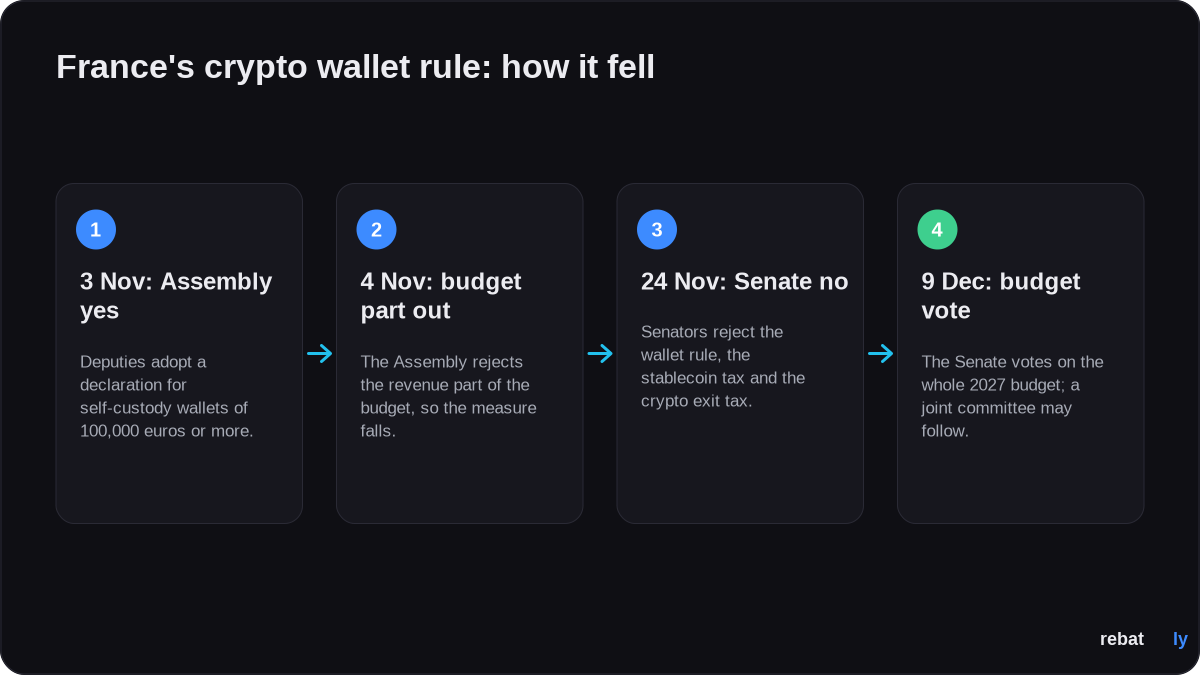
• 3 November: deputies adopted the 100,000 euro wallet declaration from Charles de Courson, 150 votes to 44, according to Journal du Coin; Cointelegraph and CoinDesk also date it to 3 November.
• 4 November: the Assembly rejected the whole revenue part of the budget, so these measures fell with it. CoinDesk reports the vote as 458 to 0.
• 19 November: the bill went to the Senate in the government's original version, without the deputies' crypto changes.
• 24 November: the Senate rejected the amendments that tried to add them back. The Senate's list of recorded public votes does not include them, and no vote count has been officially published.
What was rejected and what still applies
The vote did not remove any existing rule. The table separates what fell on 24 November from what is still in force, based on Journal du Coin, Cointribune and CoinDesk:
| Rule | Status |
|---|---|
| Declaring self-custody wallets of 100,000 euros or more | Rejected by the Senate on 24 November |
| Tax on crypto-to-stablecoin swaps | Rejected; crypto-to-crypto swaps stay untaxed until you sell for euros or spend |
| Exit tax on crypto gains when moving abroad | Rejected |
| Declaring crypto accounts opened abroad (form 3916-bis) | Still applies |
| Tax on crypto gains when you sell for euros or pay with crypto | Still applies, unchanged |
| DAC8: platforms report users' data to tax authorities | Collection since 1 January 2026; first reports in 2027 |
| MiCA: EU licensing for crypto service providers | Still applies |
How the market reacted
At 08:17 UTC on 26 November, CoinGecko showed bitcoin at about $60,533 and ether at about $1,687, both up about 3% in 24 hours. We found no sign that the French vote moved prices; it concerns tax reporting in one country.
Rebatly does not forecast prices. Our guide to trading costs on big news days shows how limit orders can cut costs when prices move fast.
What French crypto holders should do
• Keep filing what is already required: the vote changes nothing about existing declarations or about tax on gains.
• Use official sources: check rules on impots.gouv.fr or with a tax adviser, not social media posts.
• Watch for scams: fake "tax office" messages asking you to "declare" or "verify" a wallet, or to enter a seed phrase, are scams. The tax authority never needs your seed phrase.
• Protect your accounts: never share passwords, seed phrases or 2FA codes, and check API keys and your withdrawal whitelist. Our article on exchange data breaches and scam messages shows what fake messages look like.
This is general information, not financial or tax advice.
What happens next
• 28 November: the Senate votes on the whole first part of the budget, possibly on 29 November, according to the Senate agenda.
• 9 December: the Senate votes on the whole 2027 budget bill at 15:30 UTC.
• Joint committee: a commission mixte paritaire of seven deputies and seven senators can then try to agree one text, Cryptoast reports. No date has been published.
• Could it come back? Yes. Measures can be re-tabled while the budget is still in Parliament, Cointribune notes, and the government could also pass the budget under article 49.3 or by ordinance, Journal du Coin reports.
• Still pending: an amendment from senator Thomas Dossus would raise the fine for refusing tax authorities' information requests from 10,000 to 50,000 euros per request, Cointelegraph reports.
Trade with lower fees
Whatever the tax rules, every trade carries a fee. Sign up through Rebatly and part of every trading fee comes back to you: up to 50% on Bybit and Bitget, up to 40% on BloFin and OKX, up to 60% on MEXC and up to 65% on OrangeX futures. On Toobit, code Rebatly gives up to 60%, credited by Toobit itself, and BloFin credits up to 40% itself every hour; the other rebates are paid daily in USDT. Our guide to how a fee rebate works explains the rest.
This article reports news and is not financial advice. Rebatly is an independent affiliate; not financial advice.
Get fees back on every trade
$10M+ rebates paid · Paid daily in USDT · No password or API keys, ever
Already signed up? Check your link and rebate with @rebatlybot on Telegram, or reach our support at @rebatly.
🔔 Get a Telegram alert each time your rebate is paid: tap “Activate notifications” in @rebatlybot. New to trading? Your first trade in 5 steps.
November 26, 2026 — published. Sources: French Senate, CoinDesk, Cointelegraph, Decrypt, Cryptoast, Journal du Coin, Cointribune, CoinGecko.