Hyperliquid and regulation: what the CFTC chair said about onchain venues, why Hong Kong's SFC put Hyperliquid on its alert list, and what perp traders should check
Hyperliquid regulation moved on two fronts this week. On 18 November 2026 Hong Kong's Securities and Futures Commission (SFC) added Hyperliquid to its alert list of suspicious virtual asset trading platforms, saying it is not licensed by the SFC. A day later, on 19 November, CFTC Chairman Michael Selig said onchain venues such as Hyperliquid that want to offer derivatives to US retail traders would have to register as an exchange or partner with one that is already registered. The same day 1inch added Hyperliquid's perpetual futures to its wallet and dApp. Hyperliquid had not responded publicly to the SFC listing by 20 November. This article sets out what each regulator said, what an alert-list entry means, how onchain perps differ from exchange perps, and what traders should check.






What the CFTC chair said about Hyperliquid
Selig spoke in an interview at the Capitol Crypto Forum, run by The Hill and The Block in Washington, on 19 November. Asked how a decentralized platform like Hyperliquid could enter the US, he described two routes, The Block reported:
• Become an exchange: register as a designated contract market (DCM), with a clearing house (DCO) behind it.
• Partner with one: work through an exchange that is already registered with the CFTC.
"You're going to have to come in and partner with an exchange or obtain your own exchange," Selig said, adding that this does not change the features of crypto and blockchain. Platforms can keep their onchain technology but must follow the same rules as other exchanges. He pointed to Backpack as an example of the first route. In a statement on 16 November, Selig said the Commission had approved a DCM designation and a DCO registration for a firm using blockchain-based architecture, and that such firms must meet the same standards as traditional market infrastructure: anti-money laundering, customer protection, surveillance and risk management. Backpack said it received three US licences that week; The Block, Crypto Briefing and Cryptopolitan reported on it.
This was a description of possible routes, not a ruling on Hyperliquid. Crypto Briefing noted that customer business under either route runs through registered brokers (FCMs) with the usual customer checks. No timetable was given.
Why Hong Kong's SFC put Hyperliquid on its alert list
The SFC entry, added on 18 November 2026, names "Hyperliquid / Hyperliquid Hong Kong" and the website app.hyperliquid.xyz/trade under the type "Suspicious virtual asset trading platforms". Its remarks say the entity is not licensed by the SFC and is "suspected of operating, or holding itself out as operating, a virtual asset trading platform in Hong Kong and/or actively marketing its services to the Hong Kong public."
Cointelegraph, which first reported the listing on 19 November, counted 69 entries on that list. Recent additions include BTCC on 22 October 2026. The SFC keeps a separate list of licensed trading platforms; its version of 16 October 2026 names 13 of them, and Hyperliquid is not among them. Crypto.news, Bitcoin.com and Crypto Briefing also covered the entry.
What an SFC alert-list entry means, and what it does not
The SFC describes the list as entities that have come to its attention because they are unlicensed in Hong Kong, and as an early warning to investors that does not replace their own checks. It says the list is not complete.
• It is: a public warning that a platform is not licensed in Hong Kong and may be serving or marketing to the Hong Kong public.
• It is not: a court finding, a fraud accusation or a fine. Bitcoin.com noted that the entry carries no stated fine, asset freeze or court order.
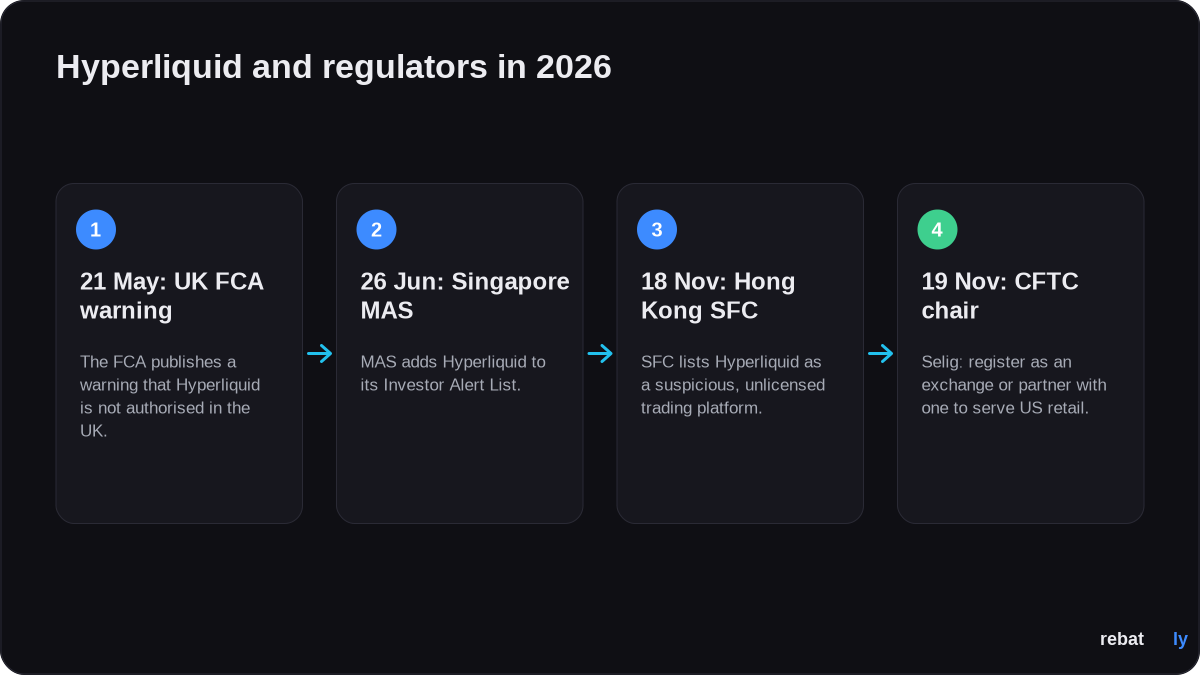
Hong Kong is the third regulator to warn about Hyperliquid in 2026. The UK's Financial Conduct Authority (FCA) published a warning on 21 May 2026, Decrypt reported, and the Monetary Authority of Singapore (MAS) added it to its Investor Alert List on 26 June 2026, Cointelegraph and Bitcoin.com reported. After the Singapore listing, Hyperliquid said on X that such a listing "does not constitute a ban, an enforcement action, or a finding of wrongdoing". Whatever the platform, the rules that apply are those of the place where the trader lives.
1inch adds Hyperliquid perpetual futures
On 19 November 1inch added Hyperliquid perpetual futures to the 1inch Wallet on Android and to its 1inch.com dApp, with iOS to follow. Users swap tokens into USDC as margin and can trade crypto contracts and HIP-3 markets that track stocks, commodities and currencies, with market, limit and TWAP orders. Hyperliquid handles matching, funding and liquidations, TokenPost reported, and 1inch says collateral deposited for perps is held by Hyperliquid, not by 1inch, and that it does not act as counterparty. 1inch co-founder Sergej Kunz told The Block that users should be able to do whatever they want in DeFi through 1inch. Fees may apply and are shown in the app; 1inch has not published a figure.
The integration shows the trend regulators are reacting to: onchain perps are reaching users through other front ends, not only Hyperliquid's own site.
Has Hyperliquid responded?
Not to the Hong Kong listing. Cointelegraph, Crypto.news and Bitcoin.com reported no reply by the time they published, and we found no public statement from Hyperliquid or the Hyper Foundation by 20 November 2026. We also found no response to Selig's remarks. We will update this article if Hyperliquid comments.
Hyperliquid by the numbers
Snapshot on 20 November 2026 (UTC):
| Measure | Figure | Source, time |
|---|---|---|
| HYPE price | About $65.50, down about 3.9% in 24 hours | CoinGecko, 06:45 UTC |
| HYPE market value | About $15.55 billion | CoinGecko, 06:45 UTC |
| Perp open interest | About $6.55 billion | Hyperliquid public API, 06:40 UTC |
| Perp open interest | About $5.38 billion | DefiLlama, 06:40 UTC |
| Perp volume, last 24 hours | About $7.46 billion | Hyperliquid public API, 06:40 UTC |
| USDC bridged in | About $5.71 billion | DefiLlama, 06:40 UTC |
The two open-interest figures differ because Hyperliquid's API is a live snapshot across 235 markets while DefiLlama reports its own daily measure. Rebatly does not forecast prices. Our guide to trading costs on high-volatility days explains what fast markets do to spreads and fills.
How onchain perps differ from exchange perps
A perpetual future works the same way on both: no expiry, and a funding payment that keeps the price close to the spot market. What differs is who holds the money and who runs the risk engine:
| Topic | Centralised exchange perps | Hyperliquid perps |
|---|---|---|
| Custody | The exchange holds your margin | Margin sits on Hyperliquid's chain; you hold the wallet keys |
| Account | Exchange account with identity checks (KYC) | A self-custody wallet; deposits are USDC |
| Funding | Often every 8 hours; some pairs more often | Every hour, capped at 0.5% an hour |
| Fees (standard tier) | Maker about 0.02%, taker 0.05% to 0.06% | Maker 0.015%, taker 0.045%, plus any front-end builder fee |
| Liquidations | The exchange's engine and insurance fund | Market orders first, then the HLP vault takes over the position |
| If you lose your key | Account recovery through support | Anyone with your seed phrase can take the funds |
Hyperliquid's docs say builder fees can be at most 0.1% on perps; the exchange rates come from each venue's published fee pages and depend on your tier. Funding and liquidation rules differ by contract, so read the contract page before you trade.
Perp trading costs and rebates on centralised exchanges
Fees add up fastest on perps because positions are often opened and closed many times. On centralised exchanges a fee rebate returns part of each fee. Standard-tier USDT perp rates, checked on 20 November 2026:
| Venue | Maker / taker | Rebate through Rebatly |
|---|---|---|
| Bybit | 0.02% / 0.055% | Up to 50% |
| Bitget | 0.02% / 0.06% | Up to 50% |
| OKX | 0.02% / 0.05% | Up to 40% |
| BloFin | 0.02% / 0.06% | Up to 40%, credited hourly by BloFin |
| Hyperliquid | 0.015% / 0.045% | None |
Example: a $10,000 taker order on Bybit at 0.055% costs $5.50 in fees; with a rebate of up to 50%, up to $2.75 comes back. Hyperliquid's rates are from its fee docs. Rates change, so check each venue's fee page before you trade.
How to stay safe around Hyperliquid news
• Check the domain: news spikes bring phishing clones and fake airdrops. Type the address yourself or use a saved bookmark, and never connect a wallet from an ad, a direct message or a search result you did not check.
• Never share your seed phrase: no platform, support agent or "compliance check" needs it.
• Check approvals: review and revoke wallet approvals you no longer use.
• Know your local rules: regulators in Hong Kong, the UK and Singapore have warned about unlicensed platforms. The rules where you live decide what you may use, so check them yourself.
• On an exchange: check 2FA, API keys and the withdrawal whitelist; our article on what to do after a crypto exchange data breach walks through it.
This is general security information, not financial advice.
What happens next
• United States: watch whether Hyperliquid or a partner applies to the CFTC through either route Selig described.
• Hong Kong: the SFC entry stays on its list until the SFC removes it; watch for any response from Hyperliquid.
• Other regulators: the FCA, MAS and SFC warnings show the pattern; more alert lists may follow.
• Integrations: 1inch plans to bring Hyperliquid perps to iOS in the coming weeks.
We will update this article when Hyperliquid or a regulator makes the next move.
Trade with lower fees
Whichever venue you trade perps on, every trade carries a fee. Sign up through Rebatly and part of every trading fee comes back to you: up to 50% on Bybit and Bitget, up to 40% on BloFin and OKX, up to 60% on MEXC and up to 65% on OrangeX futures. On Toobit, code Rebatly gives up to 60%, credited by Toobit itself, and BloFin credits its 40% itself every hour; the other rebates are paid daily in USDT. Our guide to how a fee rebate works explains the rest.
This article reports news and is not financial advice. Rebatly is an independent affiliate; not financial advice.
Get fees back on every trade
$10M+ rebates paid · Paid daily in USDT · No password or API keys, ever
Already signed up? Check your link and rebate with @rebatlybot on Telegram, or reach our support at @rebatly.
🔔 Get a Telegram alert each time your rebate is paid: tap “Activate notifications” in @rebatlybot. New to trading? Your first trade in 5 steps.
November 20, 2026 — published. Sources: SFC, CFTC, The Block, Cointelegraph, Crypto Briefing, Crypto.news, Bitcoin.com, Decrypt, Cryptopolitan, TokenPost, 1inch, Hyperliquid, CoinGecko, DefiLlama.