Nvidia's $290 million crypto mining settlement: what happened
Nvidia has agreed to pay $290 million in cash to settle the shareholder lawsuit over how it disclosed crypto mining sales of its GeForce graphics cards in 2017 and 2018. The deal was filed with the federal court in Oakland, California on 24 November 2026 and still needs a judge's approval, according to the court filing, Cointelegraph and Decrypt. It covers people who bought Nvidia shares between 10 August 2017 and 15 November 2018. Nvidia has denied the claims and does not admit wrongdoing, Decrypt reports. This article explains what was alleged, how the case got here, and what happens next. It is not legal or investment advice.





What Nvidia agreed to
The main terms, from the plaintiffs' motion for preliminary approval (case 4:18-cv-07669-HSG) and press reports:
| Term | Detail |
|---|---|
| Amount | $290 million in cash, paid into an escrow account |
| Who is covered | Anyone who bought or acquired Nvidia common stock from 10 August 2017 to 15 November 2018 and was damaged |
| Court | U.S. District Court, Northern District of California (Oakland), Judge Haywood S. Gilliam Jr. |
| Share of damages | About 14% of $2.059 billion, the plaintiffs' expert's maximum damages estimate |
| Lawyers' fees | Up to 21.4% of the fund, about $62 million (Decrypt, ForkLog) |
| Who pays | Insurers cover the majority, according to Nvidia (The Block) |
| Status | Proposed; preliminary approval hearing on 4 February 2027 |
What the lawsuit alleged
The investors, led by Swedish fund manager Lannebo Kapitalförvaltning (formerly E. Öhman J:or Fonder) and Dutch pension fund PGB, say Nvidia hid how much of its gaming growth came from crypto miners. Their complaint, as summarised in the court filing, makes three points:
• Crypto was called small: Nvidia told investors that sales to miners were insignificant overall.
• Gaming was called gaming: soaring Gaming revenue was described as sales to gamers.
• Crypto was said to sit in OEM: Nvidia launched a mining-only card in May 2017 and booked it in its OEM segment, while almost two-thirds of crypto-related revenue came from GeForce cards booked as Gaming, the plaintiffs say.
A plaintiffs-commissioned analysis estimated that Nvidia understated crypto-related GPU sales by about $1.1 billion, Cointelegraph and Decrypt report. The class certification order cites an RBC Capital Markets estimate of $1.95 billion in crypto-related revenue, against roughly $602 million Nvidia had indicated, The Block reported in March. These are the plaintiffs' and analysts' estimates, not court findings.
What Nvidia says
Nvidia has consistently denied wrongdoing and does not admit liability under the deal, Decrypt and ForkLog report. In the case, Nvidia argued that its internal estimates of GPU sales to miners were unreliable and so not fit to publish, that there was no intent to hide anything, and that investors already knew crypto was driving part of Gaming sales before November 2018, according to the court filing. Nvidia told The Block that insurers will pay most of the $290 million. The settlement is not related to the separate turmoil around chief executive Jensen Huang in recent days, Decrypt notes.
How the case got here
The dates below come from the court filing, unless another source is named:
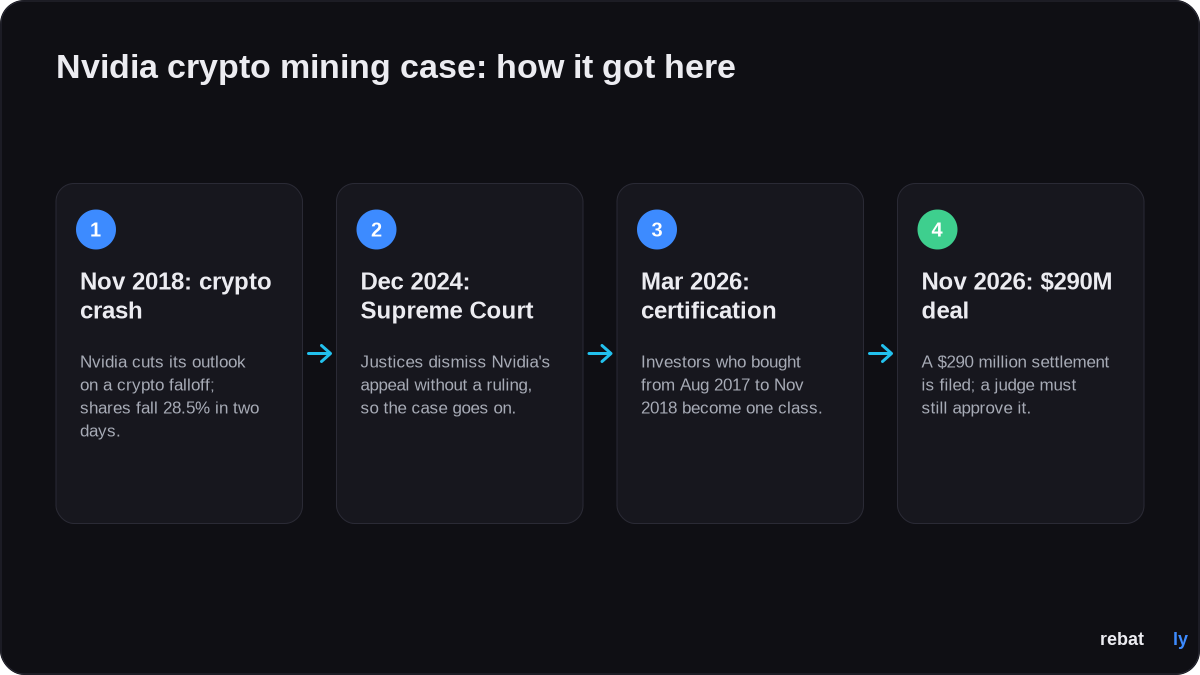
• 16 August 2018: Nvidia cut its revenue outlook and said it expected no more crypto contribution. The stock fell 4.9%.
• 15 November 2018: Nvidia cut its fourth-quarter outlook, citing a "sharp falloff in crypto demand" and excess gaming card inventory. The stock fell 28.5% over two trading sessions, the plaintiffs say.
• 21 December 2018: the first complaint was filed.
• 2 March 2021: the district court dismissed the amended complaint.
• 2023: the Ninth Circuit Court of Appeals revived the claims against Nvidia and Huang, while dismissing those against two other executives.
• 11 December 2024: the Supreme Court, which had agreed in June 2024 to hear Nvidia's appeal, dismissed it as "improvidently granted" after oral argument, without ruling on the merits, the filing and Engadget report.
• 25 March 2026: the court certified the investor class; the Ninth Circuit refused Nvidia's request to appeal that on 26 May 2026.
• 24 September 2026: both sides accepted a $290 million recommendation from mediator Layn Phillips, a former federal judge.
• 24 November 2026: the settlement agreement was signed and filed.
The SEC case over the same disclosures
This is not the first time regulators looked at the issue. On 6 May 2022 the SEC announced settled charges against Nvidia for not disclosing, in two quarterly reports for its fiscal year 2018, that crypto mining was a significant part of its Gaming revenue growth. Nvidia paid a $5.5 million penalty and agreed to a cease-and-desist order, without admitting or denying the SEC's findings. The SEC said Nvidia had information that the rise in gaming sales was driven in significant part by mining. The $290 million deal is a separate, private case brought by shareholders.
What the case says about the 2017-2018 mining boom
In 2017, rising crypto prices made mining with graphics cards profitable, and miners bought GeForce cards "in droves", the complaint says. When prices fell in 2018, that demand disappeared and unsold cards piled up: Nvidia said in August 2018 that GeForce inventory had risen more than 36%, and it took a $57 million charge in the November quarter after the "sharp falloff in crypto demand", the court filing quotes. Analysts at the time estimated that mining made up as much as $440 million, or 25%, of Gaming revenue in one quarter, the filing notes.
The next boom brought a different response. On 18 February 2021 Nvidia announced CMP, a line of cards made only for mining, and a driver limit that cut the RTX 3060's Ethereum mining speed by about half, Tom's Hardware reported. GPU mining of ether ended when Ethereum moved to proof of stake in September 2022.
How the market reacted
At 11:03 UTC on 26 November, CoinGecko showed bitcoin at about $60,464 and ether at about $1,693, both up about 3% in 24 hours. We found no sign that the settlement moved crypto prices; it concerns a 2018 dispute between Nvidia and its shareholders.
Rebatly does not forecast prices. Our guide to trading costs on big news days shows how limit orders can cut costs when prices move fast.
If you bought Nvidia shares in 2017-2018
• Wait for the official notice: if the judge grants preliminary approval, a court-approved claims administrator, JND Legal Administration, will send notices and a claim form, according to the court filing.
• Never pay to claim: class members do not pay fees up front. Be wary of messages or sites promising a quick Nvidia settlement payout.
• Use official channels only: rely on the court-approved notice and website, your broker, or a lawyer, not social media posts.
• Protect your accounts: never share passwords, seed phrases or 2FA codes, and check API keys and your withdrawal whitelist. Our article on exchange data breaches and scam messages shows what fake messages look like.
This is general information, not legal or financial advice.
What happens next
• 4 February 2027, 22:00 UTC: Judge Gilliam hears the motion for preliminary approval in Oakland, according to the court filing and Cointelegraph.
• Notice and claims: if approved, class members receive notice and can file claims, object or opt out.
• Final hearing: the plaintiffs ask for it about 130 days after preliminary approval, Decrypt reports. The judge then decides whether the deal is fair and how much the lawyers get.
• Not final yet: the court can reject the settlement, and no money is paid out to class members before final approval.
Trade with lower fees
Whatever happens in court, every trade carries a fee. Sign up through Rebatly and part of every trading fee comes back to you: up to 50% on Bybit and Bitget, up to 40% on BloFin and OKX, up to 60% on MEXC and up to 65% on OrangeX futures. On Toobit, code Rebatly gives up to 60%, credited by Toobit itself, and BloFin credits up to 40% itself every hour; the other rebates are paid daily in USDT. Our guide to how a fee rebate works explains the rest.
This article reports news and is not financial advice. Rebatly is an independent affiliate; not financial advice.
Get fees back on every trade
$10M+ rebates paid · Paid daily in USDT · No password or API keys, ever
Already signed up? Check your link and rebate with @rebatlybot on Telegram, or reach our support at @rebatly.
🔔 Get a Telegram alert each time your rebate is paid: tap “Activate notifications” in @rebatlybot. New to trading? Your first trade in 5 steps.
November 26, 2026 — published. Sources: U.S. District Court for the Northern District of California, Cointelegraph, Decrypt, The Block, ForkLog, SEC, Engadget, Nvidia, Tom's Hardware, CoinGecko.