Spain lets Sepblac freeze crypto accounts without a judge: what changes
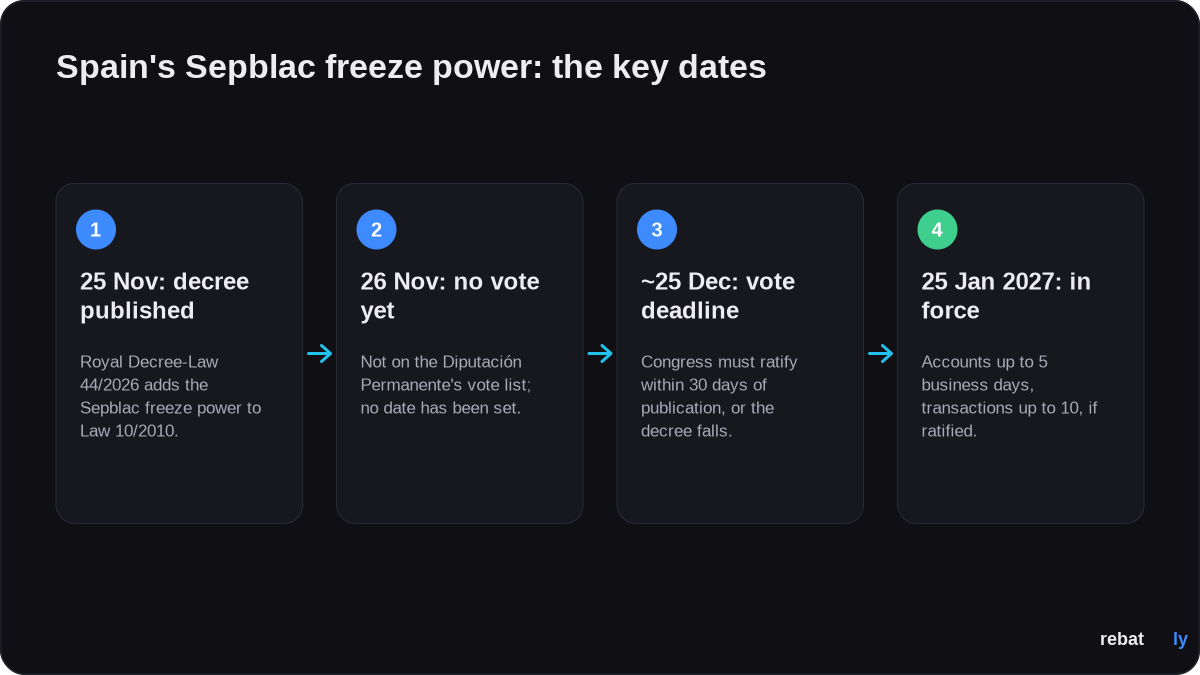
Spain has given its financial intelligence unit, Sepblac, the power to freeze crypto accounts without a judge, as well as bank and payment accounts, for up to five business days. Transactions already in progress can be held for up to ten business days. The power is in Royal Decree-Law 44/2026, published in Spain's official gazette, the BOE, on 25 November 2026. It is due to apply from 25 January 2027, but only if Congress ratifies the decree first, and that vote has not happened yet. This article explains what the decree says, how a freeze would work, the fines for firms that ignore an order, and what users in Spain can do now.
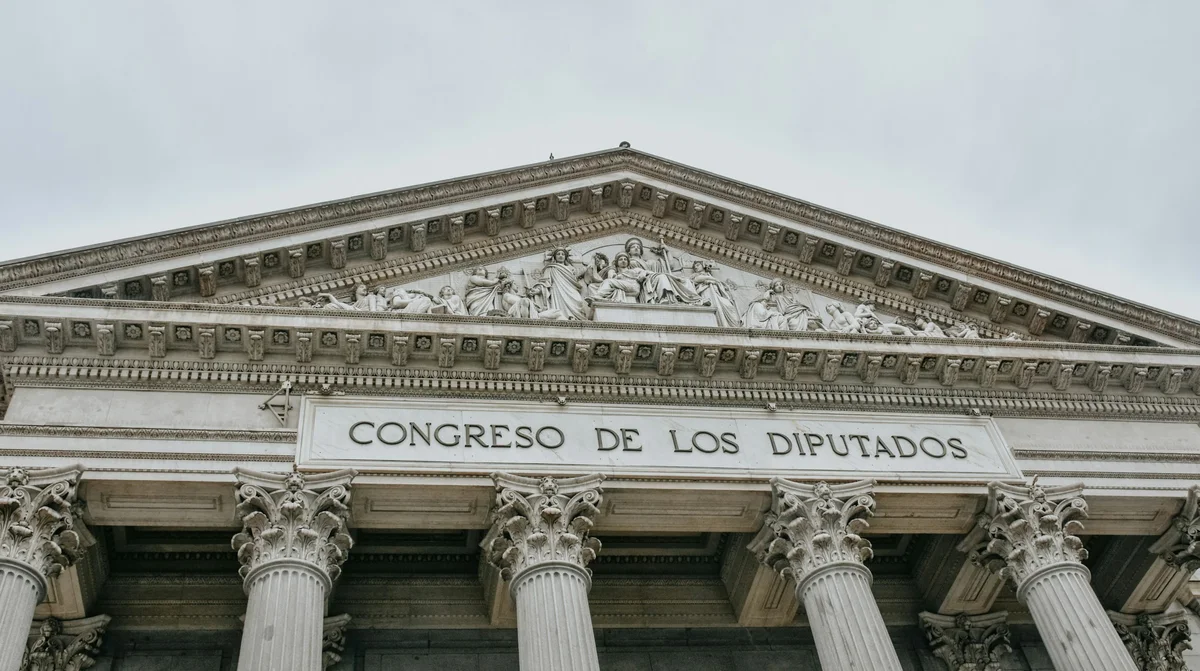





What the Sepblac decree says
The change is a new article 46 bis in Spain's anti-money-laundering law, Law 10/2010. It sits in the sixth final provision of a decree that is mostly about consumer credit. The key points, from the BOE text:
| Item | What the decree says |
|---|---|
| Name | Royal Decree-Law 44/2026 of 24 November (BOE-A-2026-24702), published 25 November 2026 |
| Who can act | Sepblac, the executive service of Spain's anti-money-laundering commission and the country's financial intelligence unit |
| What it can freeze | Bank accounts, payment accounts, crypto-asset accounts and business relationships, plus single transactions in progress |
| Trigger | Signs ("indicios") that the funds may be linked to money laundering or terrorist financing |
| Accounts | Up to five business days |
| Transactions in progress | Up to ten business days |
| Longer freezes | Only if a court ratifies or extends the measure, at the public prosecutor's request, before the deadline |
| Fines | Ignoring an order becomes a very serious offence, with fines from €150,000 |
| Start date | Two months after publication, which outlets put at 25 January 2027 |
How a freeze would work
• Who starts it: Sepblac can act on its own analysis, on a suspicious-activity report from a bank or crypto firm, or at the request of Spanish police or a foreign financial intelligence unit.
• How fast: after a suspicious-activity report, Sepblac has up to three business days to issue the order; after its own analysis, "as soon as possible", the decree says.
• How long: five business days for an account, ten for a transaction. The freeze must be lifted earlier once it is no longer needed.
• After the deadline: the freeze ends unless a court ratifies or extends it. The prosecutor must apply before the deadline, and appeals follow Spain's criminal procedure law. The text sets no maximum for a court extension.
• Notice: the article does not require anyone to tell the account holder. BitcoinWorld notes that the law already bars firms from tipping off customers about suspicious-activity reports.
• Liability: Sepblac, its staff and firms that carry out an order are exempt from liability, and Blockchain Reporter notes the text offers no compensation route.
Until now Sepblac could suspend transactions only when a foreign financial intelligence unit asked it to, Crypto Briefing and Cointelegraph report. The decree deletes that older rule in article 48 bis and replaces it with the wider power. A freeze is a temporary suspension, not a seizure or a transfer of ownership, DiarioBitcoin and Criptoinforme point out.
Fines for firms that ignore a freeze order
The decree rewrites article 51.1 g) of Law 10/2010 so that failing to carry out a Sepblac suspension counts as a very serious offence. The decree itself sets no amounts; they come from article 56 of the same law. For a very serious offence, the fine is at least €150,000 and can reach the largest of: 10% of the firm's annual turnover, twice the value of the transaction, five times the profit from the offence, or €10 million. It comes with a public reprimand or, for licensed firms, a suspension or loss of the licence. Managers can be fined €60,000 to €10 million each.
The rules apply to every firm covered by the law: banks, payment companies and crypto-asset service providers alike. Compliance specialist Nikolai Timofejev of Prifinance told Cointelegraph that crypto firms should name a person who receives Sepblac's orders and can freeze client withdrawals the same day.
Is it law yet? The Congress vote
A Spanish royal decree-law must be ratified ("convalidación") by the Congress of Deputies within 30 days of publication, or it is repealed. Where things stand:
| Step | Status | Source |
|---|---|---|
| Published in the BOE | Done, 25 November 2026 | BOE |
| Congress ratification vote | Not held yet. With parliament dissolved for the 29 November general election, the vote falls to the Diputación Permanente, a standing committee of Congress. The decree was not among the five it voted on 26 November, and no date has been set | Criptoinforme, Hoy Aragón |
| 30-day deadline | About 25 December 2026, counted from publication | Particle, Cointelegraph |
| If it is rejected | The whole decree falls, including the Sepblac power: the vote is yes or no to the full text | Criptoinforme, Hoy Aragón |
| If it is ratified | The Sepblac power applies from 25 January 2027 | BOE, Crypto Briefing |
Who opposes the decree, and why
Three trade groups, the fintech association AEFI, the payment and e-money association AEMIP and the digital economy association Adigital, asked the Diputación Permanente on 24 November not to ratify the decree, elEconomista and Criptoinforme report. They want it handled as a normal bill, with an opinion from the Council of State and a parliamentary debate. Their objection is to the new caps on the cost of consumer credit, not to the Sepblac power; their statement does not mention crypto. Because the vote is all or nothing, the outcome of that fight also decides the fate of article 46 bis.
The committee has 69 members: 34 from the bloc that backed the government and 33 from PP and Vox, with one each from Junts and PNV, Criptoinforme reports, citing Hoy Aragón.
Why Spain is doing this now
The decree says the change transposes article 24 of EU Directive 2024/1640, the anti-money-laundering directive adopted in 2024, which asks member states to give their financial intelligence units the power to suspend suspicious transactions and accounts. The directive's transposition deadline is 10 July 2027, BitcoinWorld notes. The same EU package created the new EU anti-money-laundering authority, AMLA, and a directly applicable regulation, the AMLR.
The government also points to standards from the Financial Action Task Force (FATF) and the speed at which funds now move, Crypto Briefing and DiarioBitcoin report. Particle reports that Spain's FATF on-site evaluation visit is due in February 2027 and that crypto-related suspicious-activity reports rose to 1,672 in 2025.
How it fits with MiCA and other Spanish crypto rules
• MiCA: crypto firms in Spain still need authorisation under the EU's Markets in Crypto-Assets Regulation (MiCA), which Spain's securities regulator, the CNMV, oversees. The Sepblac power adds an anti-money-laundering layer on top, Cointelegraph and Blockchain Reporter note.
• Who is covered: since October 2026, Law 10/2010 lists crypto-asset service providers, defined by reference to MiCA, among the firms it covers. Older virtual-currency providers registered with the Banco de España are also covered.
• Tax: a separate bill that would have let the Tax Agency seize crypto for tax debts lapsed when the early election was called, Criptoinforme reports. The Sepblac power is not a tax measure.
• EU pressure: the European Commission has an open infringement case against Spain over DAC8, the EU crypto tax-reporting directive, Criptoinforme and BitcoinWorld report.
How the market reacted
No source we read links price moves to the Spanish decree. At 06:24 UTC on 27 November, CoinGecko showed bitcoin at about $61,721, up about 2.1% in 24 hours, and ether at about $1,739, up about 3.2%.
Rebatly does not forecast prices. Our guide to trading costs on big news days shows how limit orders can cut costs when prices move fast.
What crypto users in Spain should know
• Nothing changes yet: the power is not in force before 25 January 2027, and only if Congress ratifies the decree.
• A freeze is temporary: up to five business days for an account and ten for a transaction, unless a court extends it. It is not a confiscation.
• You may not be told why: the decree does not require notice to the account holder, and firms may not tip off customers about suspicion reports. If an account is blocked, contact your provider through its official app or website and ask what it can tell you.
• Keep records of where your funds come from: bank transfers into the exchange, exchange account statements and trade history, transaction IDs for on-chain deposits and withdrawals, payslips, sale contracts or invoices for large amounts, and the tax returns where you declared gains.
• Answer source-of-funds checks: if your provider asks for documents, reply through its official channels, and keep copies.
• Watch for scams: be wary of anyone who contacts you offering to "unfreeze" an account for a fee, or who claims to act for Sepblac or a court and asks for a payment, your password or a 2FA code. Our guide to what to do after a crypto exchange data breach covers how to spot fake messages.
• If a court extends a freeze: it becomes a court matter; a qualified Spanish lawyer can advise on your case.
This is general information, not legal or financial advice.
What happens next
• Congress vote: the Diputación Permanente must vote on the decree; no date has been set.
• About 25 December 2026: the 30-day ratification deadline, counted from publication.
• 25 January 2027: the Sepblac power applies, if the decree is ratified.
• February 2027: Spain's FATF on-site evaluation visit, as reported by Particle.
• 10 July 2027: the EU deadline to transpose Directive 2024/1640.
Rebatly will update this article when Congress votes.
Trade with lower fees
Whichever exchange you use, every trade carries a fee. Sign up through Rebatly and part of every trading fee comes back to you: up to 50% on Bybit and Bitget, up to 40% on BloFin and OKX, up to 60% on MEXC and up to 65% on OrangeX futures. On Toobit, code Rebatly gives up to 60%, credited by Toobit itself, and BloFin credits up to 40% itself every hour; the other rebates are paid daily in USDT. Our guide to how a fee rebate works explains the rest.
This article reports news and is not financial advice. Rebatly is an independent affiliate; not financial advice.
Get fees back on every trade
$10M+ rebates paid · Paid daily in USDT · No password or API keys, ever
Already signed up? Check your link and rebate with @rebatlybot on Telegram, or reach our support at @rebatly.
🔔 Get a Telegram alert each time your rebate is paid: tap “Activate notifications” in @rebatlybot. New to trading? Your first trade in 5 steps.
November 27, 2026 — published. Sources: BOE, Cointelegraph, Crypto Briefing, Blockchain Reporter, BitcoinWorld, Particle, Criptoinforme, DiarioBitcoin, CriptoTendencias, Hoy Aragón, elEconomista, CoinGecko.