Thanksgiving crypto trading: how market depth, spreads and fees shape your real cost
Thanksgiving crypto trading runs 24 hours a day, but the US markets around it do not: NYSE is closed on Thursday 26 November 2026 and closes early, at 18:00 UTC, on Friday 27 November. US inflation data is scheduled for 13:30 UTC on Wednesday 25 November, just before the break. Exchanges quote a fixed maker or taker fee, yet the price you get also depends on market depth: how many orders are waiting near the current price. On Kraken's Canadian dollar market last weekend, 10.42 BTC sold within a single second averaged nearly 18% less than the first fill, Cointelegraph reports. This article explains depth, spread, slippage and market impact, what published data shows about them, and how they compare with the fee. No source we read has published order-book depth for this Thanksgiving, so we do not assume how thin the books will be.





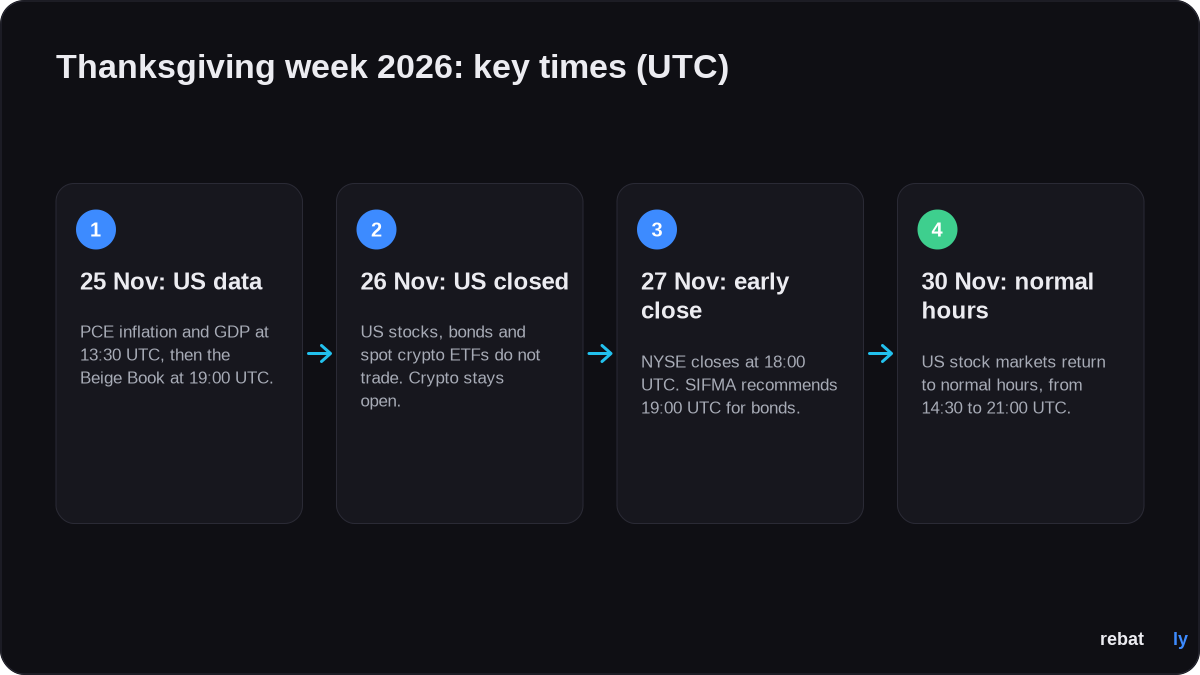
Thanksgiving week 2026: the calendar in UTC
Most of the week's US data lands on one day, and then US markets close or shorten their hours. The times come from BEA, NYSE and SIFMA, with MLQ.ai for the Beige Book and Lincoln Park Financial for CME crypto futures, converted to UTC:
| Date | What happens | Time (UTC) |
|---|---|---|
| Wed 25 Nov | US personal income and outlays for October, including PCE inflation, and the second estimate of third-quarter GDP | 13:30 |
| Wed 25 Nov | Federal Reserve Beige Book | 19:00 |
| Thu 26 Nov | Thanksgiving: US stock and bond markets closed; US spot crypto ETFs do not trade | All day |
| Thu 26 Nov | CME crypto futures trade through the holiday, with a short daily break | 22:00 |
| Fri 27 Nov | NYSE early close | 18:00 |
| Fri 27 Nov | US bond markets: early close recommended by SIFMA | 19:00 |
| Mon 30 Nov | US stock markets return to normal hours | 14:30 to 21:00 |
Market depth, spread, slippage and market impact explained
An order book lists the buy orders (bids) and sell orders (asks) waiting at each price. Parameter and Cointelegraph describe four ideas that decide what a trade costs beyond the fee:
• Market depth: the value of orders waiting within a set distance of the middle price, often 1%. A deep book can fill a large order close to the quoted price; a thin book cannot.
• Bid-ask spread: the gap between the best ask and the best bid. If you buy and then sell at once, you pay it, before any fee.
• Slippage: the gap between the price you expected and the average price you got.
• Market impact: the part of that move your own order causes, as it uses up one price level after another.
A narrow spread does not mean a deep book. If the best bid covers only part of your order, the rest fills at lower prices, Cointelegraph points out. Parameter gives two examples: buying 4 BTC from its sample bitcoin book costs about 0.0141% more than the best ask, while buying 5,000 units of a thinly traded token costs 3% more than the quote. Both are illustrations, not market data.
What published market depth data shows
These are the most recent figures we found. Each source measures depth on its own set of exchanges and price range, so the figures cannot be compared with each other:
| Date | What was measured | Figure | Source |
|---|---|---|---|
| 7 Oct 2026 | Bitcoin orders within 1% of the price | About $11.7 million, about 75% more than on 10 October 2025 | CoinDesk Research, via KuCoin News |
| 7 Oct 2026 | Altcoin basket, orders within 5% of the price | About $2 million, down about one-third since early 2025 | CoinDesk Research, via KuCoin News |
| 9 Nov 2026 | Bitcoin order-book depth across major exchanges | $72 million, roughly 33% below normal | Talos, via Cointelegraph |
| 19 Nov 2026 | Bitcoin orders within 1% of the middle price | Down nearly 38% from the 2026 peak | TokenPost |
| 26 Nov 2026 | Depth over Thanksgiving | Not published | None of the sources we read |
How market depth shaped a weekend bitcoin sale
From Friday evening 20 November to Saturday morning 21 November, 592.24 BTC changed hands on Kraken's Canadian dollar market at an average of CA$51,886, Cointelegraph reports. The benchmark, based on Kraken's US dollar trades and the Bank of Canada's Friday exchange rate, was CA$82,798. That is an average discount of 37.3% over 14 hours.
Inside that window, one second on Saturday shows what a thin book does to a single run of sales:
• First fill: CA$31,000 per coin, the first of 104 fills.
• Average: CA$25,505 across the 10.42 BTC sold, nearly 18% lower.
• The lesson: the price on the screen applied only to the first part of the sale.
This was one pair on one exchange, not the bitcoin market as a whole, and the report does not say who sold or why. Our guide to crypto Black Friday covers the week's exchange deals.
Are crypto order books thinner on Thanksgiving?
Possibly, but nobody can say by how much in advance. Lacie Zhang, research analyst at Bitget Wallet, expects thinner Thanksgiving liquidity that may amplify moves in either direction, Crypto Briefing reports. Crypto Economy notes that closed US stock and ETF markets can leave crypto with less participation. These are expectations, not measurements.
The closest data is about weekends, when US markets are also closed:
• Volume: weekday spot bitcoin volumes in 2025 were two to three times weekend volumes, according to a Coinbase Institutional study of more than 40 exchanges, cited by Cointelegraph.
• Share: weekends fell from about 25% of bitcoin volume in 2018–2021 to 13% in 2024, according to Kaiko, cited by Bitsgap.
• Slippage under stress: in the sell-off of 5 August 2024, a Monday, a simulated $100,000 bitcoin sell order would have slipped up to 5.53% on Zaif's yen pair, according to Kaiko, cited by Cointelegraph.
A holiday is not a weekend: Thanksgiving is a normal working day in most of the world. Volume also counts trades already done, while depth counts orders still waiting, so one does not prove the other.
The fee you see and the cost you pay
Take a $10,000 market order in perpetual futures at Bybit's standard VIP 0 taker fee of 0.055%. The fee is $5.50 whatever the book looks like. The slippage levels below are our own illustration, not a forecast of holiday conditions:
| Slippage | Slippage cost | Taker fee | Total |
|---|---|---|---|
| 0.01% | $1.00 | $5.50 | $6.50 |
| 0.05% | $5.00 | $5.50 | $10.50 |
| 0.10% | $10.00 | $5.50 | $15.50 |
| 1% | $100.00 | $5.50 | $105.50 |
Maker vs taker orders on a thin order book
A taker order, such as a market order, fills at once against orders already on the book. It pays the taker fee plus whatever spread and slippage the book imposes. A maker order rests on the book until someone trades against it. On Bybit perpetual futures at VIP 0 a maker pays 0.02%, or $2.00 on $10,000, against $5.50 for a taker.
• A limit order caps the price, not the wait: on a thin book it may fill slowly, partly or not at all.
• A limit order can still be a taker: if it crosses the spread it fills at once and pays the taker fee. Our guide to maker and taker fills explains post-only orders.
• A stop-market order becomes a taker order: once triggered, it fills at the prices available, which can be far from the trigger on a thin book.
• Resting orders carry risk too: a maker order can fill just as the price moves against it.
Our guide to trading costs on big news days covers spreads around data releases such as PCE inflation.
Where the market stands before Thanksgiving
At 21:35 UTC on 24 November, CoinGecko showed bitcoin at about $59,875, down about 2.4% in 24 hours, and ether at about $1,680, down about 2.5%. Bitcoin had fallen to $55,130 over the previous weekend, Binance News and Crypto Economy report. Spot bitcoin ETFs recorded about $1.1 billion in net outflows last week, Binance News reports.
PCE prices rose 3.6% in the year to September, BEA says. Forecasts cited by Binance News and Crypto Economy put the October monthly rise at 0.3%, after 0.5% in September. A forecast is not a result: BEA publishes the actual figure at 13:30 UTC on 25 November.
Rebatly does not forecast prices.
What to check before placing an order
• The book, not only the price: look at how much is waiting on the side you would trade against, near the price.
• The pair: a smaller pair or coin can be far thinner than BTC/USDT on the same exchange.
• The size: compare the order with the depth near the price.
• The order type: a market order puts speed first; a limit order puts price first.
• Leverage: a short spike can reach a liquidation price before the price recovers. Our guide to crypto liquidations explains how.
• Holiday scams: treat "Thanksgiving giveaway" links and support staff who contact you first as likely scams. Use official channels only, and never share a password, 2FA code or API key.
This is general information, not financial advice.
What happens next
• PCE inflation and GDP: both at 13:30 UTC on 25 November, according to BEA.
• US markets: closed on 26 November, then an early close at 18:00 UTC on 27 November, according to NYSE.
• Crypto: exchanges keep trading throughout, and so do CME crypto futures apart from the daily break.
• Spot crypto ETFs: no trading on 26 November, so price moves that day happen without ETF flows, Binance News notes.
• Depth data: data firms may publish figures on holiday liquidity afterwards.
Trade with lower fees
Whichever exchange you use, every trade carries a fee. Sign up through Rebatly and part of every trading fee comes back to you: up to 50% on Bybit and Bitget, up to 40% on BloFin and OKX, up to 60% on MEXC and up to 65% on OrangeX futures. On Toobit, code Rebatly gives up to 60%, credited by Toobit itself, and BloFin credits up to 40% itself every hour; the other rebates are paid daily in USDT. Our guide to how a fee rebate works explains the rest.
This article reports news and is not financial advice. Rebatly is an independent affiliate; not financial advice.
Get fees back on every trade
$10M+ rebates paid · Paid daily in USDT · No password or API keys, ever
Already signed up? Check your link and rebate with @rebatlybot on Telegram, or reach our support at @rebatly.
🔔 Get a Telegram alert each time your rebate is paid: tap “Activate notifications” in @rebatlybot. New to trading? Your first trade in 5 steps.
November 25, 2026 — published. Sources: BEA, NYSE, SIFMA, Cointelegraph, TokenPost, KuCoin News, Crypto Briefing, Crypto Economy, Binance News, Bitsgap, Parameter, Lincoln Park Financial, MLQ.ai, CoinGecko.