Tokenized Anthropic stock: holders doubled in three days. A checklist for comparing trading costs
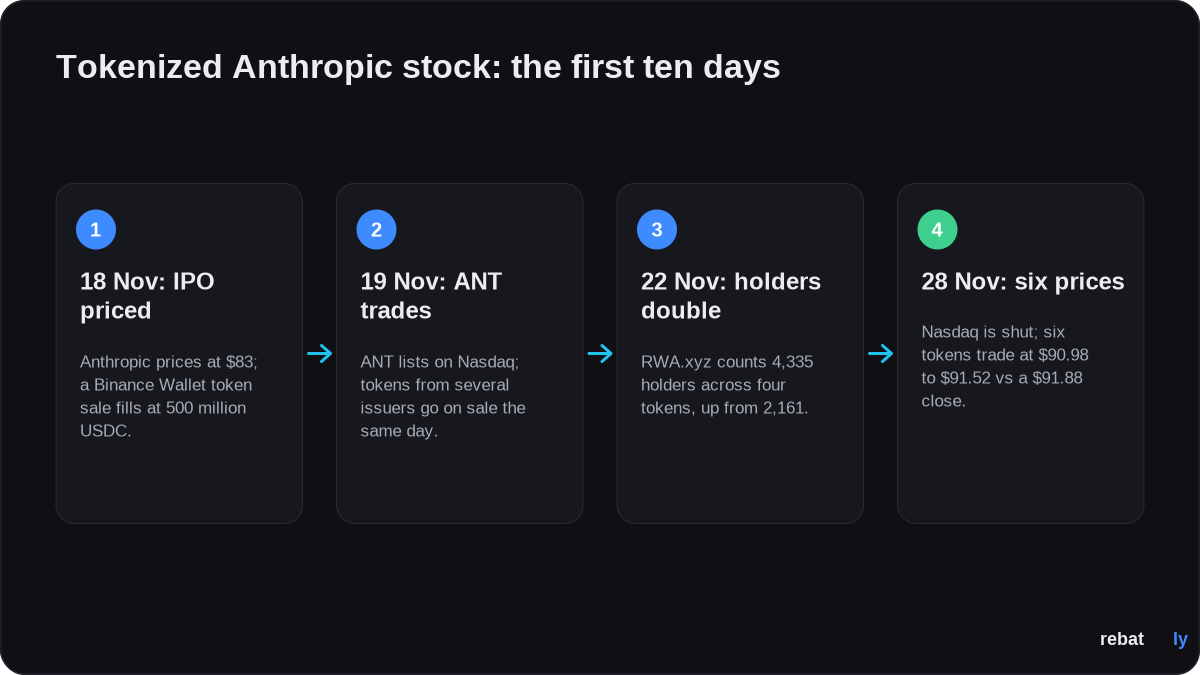
Tokenized Anthropic stock is drawing buyers fast. Across the four tokenized Anthropic products tracked by RWA.xyz, the number of holders doubled from 2,161 on 19 November 2026, the day Anthropic began trading on Nasdaq as ANT, to 4,335 on 22 November, The Block and Lookonchain reported. The market is still small: about $30 million in combined value at the time, by The Block's count. But one share of Anthropic now comes in several on-chain wrappers, and they do not all cost the same. At 13:03 UTC on Saturday 28 November, CoinGecko showed six of them between $90.98 and $91.52, while ANT itself last closed at $91.88 on Friday. This article sets out what was reported, why the prices differ, and a checklist for comparing what a tokenized asset really costs to trade, wherever it is offered.





Tokenized Anthropic holders: what the data show
The figures come from RWA.xyz, a data firm that tracks tokenized real-world assets. The Block, Lookonchain and our own CoinGecko check report them as follows:
| Figure | Source | |
|---|---|---|
| Holders, 19 November | 2,161, across 4 tokenized Anthropic products | RWA.xyz, via The Block and Lookonchain |
| Holders, 22 November | 4,335, about double | RWA.xyz, via The Block and Lookonchain |
| Combined value, around 22 November | About $30 million, of which about $25 million in xStocks' ANTx | The Block; Lookonchain |
| Combined CoinGecko market cap of six tokens, 13:03 UTC 28 November | About $61.3 million | CoinGecko, our sum |
| Whole tokenized-stock market, 28 November | About $3.77 billion, 5.03 million holders | RWA.xyz |
Why the holder count jumped
Anthropic priced its IPO at $83.00 a share on 18 November, selling 980 million Class A shares, about $81.3 billion, according to the company. Its shares began trading on the Nasdaq Global Select Market on 19 November under the ticker ANT. Tokenized versions from several issuers went on sale the same day, The Block and Lookonchain reported; Lookonchain names xStocks, Backpack and Ondo, and The Block's chart lists xStocks' ANTx, Robinhood's ANT, ANTc and Ondo's ANTon.
Demand was building before the listing. Binance Wallet ran a sale of tokenized Anthropic shares from 06:00 UTC on 18 November that was capped at 500 million USDC and ended early when it filled, crypto.news reported. Changpeng Zhao named bStocks, Ondo and xStocks as the platforms bringing the tokens to BNB Chain. Ondo said it has no partnership with Anthropic and took no part in the IPO, Bitcoin.com News reported.
A doubling from about 2,000 holders is a small base. The 4,335 holders are a tiny fraction of Anthropic's investors, and RWA.xyz counts wallets, not people. Our guide to the Anthropic IPO has the deal itself.
One stock, six prices
On Saturday 28 November Nasdaq was closed, yet the tokens kept trading. At 13:03 UTC CoinGecko showed these prices against ANT's Friday close of $91.88 (reported by The Motley Fool and others):
| Token (issuer) | Price | Gap to Friday close | 24h volume |
|---|---|---|---|
| ANTon (Ondo) | $91.52 | 0.4% below | $10.9 million |
| ANT (Robinhood token) | $91.41 | 0.5% below | $20.5 million |
| ANTx (xStocks) | $91.40 | 0.5% below | $8.9 million |
| ANTB (bStocks) | $91.33 | 0.6% below | $22.9 million |
| ANTC (Coinbase tokenized stock) | $91.33 | 0.6% below | $11.0 million |
| EQANT (EQX) | $90.98 | 1.0% below | $12,895 |
CoinGecko prices and volumes at 13:03 UTC on 28 November 2026; gaps are our calculation against the $91.88 close on 27 November. CoinGecko also lists a pre-IPO token from PreStocks at $65.74; it was priced on a different basis and is not comparable.
Why tokenized prices differ
The gap between the highest and the lowest token was $0.54, about 0.6%. On a $1,000 purchase that is about $6, before any trading fee. Several things cause it:
• The market is shut: at weekends and on holidays the share has no live price, so token prices drift with demand. Ondo says bid-ask spreads "can be wider during Off-Hours", and that quote requests may be declined once an asset hits its limit.
• Thin trading: one token above traded about $12,895 in 24 hours, the others millions. In a thin market a single order moves the price.
• Different designs: some tokens are backed by shares and can be redeemed; others give only price exposure. Ondo's tokens are "total return trackers" that reinvest dividends after withholding tax, so one token can drift from one share over time.
• Different fees to create and redeem: Ondo's documents list no fee to mint and 0.05% to redeem, and Ondo keeps any gap between its quoted price and its execution price. The Binance Wallet sale added a 5% xStocks service fee on top of the price, crypto.news reported.
Checklist: comparing the cost of a tokenized asset
These checks work for any tokenized stock, ETF or fund, wherever it is offered. Read the issuer's own documents for each one.
• 1. What you own: a token backed by real shares, a certificate, or a contract that only tracks the price. Check whether it can be redeemed, by whom, and for shares or for cash.
• 2. The gap to the real price: compare the token's price with the last price of the share itself. A premium or discount is a cost, even if no fee is shown.
• 3. The spread: look at the bid and the ask, not just the last trade. The gap between them is paid on every round trip.
• 4. Depth: check 24-hour volume and the order book. A large order in a thin market can cost far more than the fee.
• 5. The trading fee: maker and taker rates where you trade; limit orders usually pay less than market orders.
• 6. Mint, redeem and service fees: they range from zero to several percent. A pre-IPO Anthropic certificate listed on RWA.xyz, Colb's CANP, charges 2.5% to subscribe, for example.
• 7. Hours: creation and redemption may run 24/5 with the stock market, while the token trades 24/7. Weekend prices can stray further.
• 8. Network costs: gas on the blockchain and withdrawal fees to move the token.
• 9. Dividends and taxes: paid out, reinvested, or not passed on, and how much tax is withheld first.
• 10. Who may buy: issuers restrict eligibility and many require identity checks. Read their terms before you buy.
Add the costs up for the size you plan to trade. The cheapest-looking fee is not always the cheapest trade.
A token is not a share
Most tokenized Anthropic products give price exposure, not ownership. Lookonchain notes that most "offer price exposure rather than direct equity or redemption rights". Ondo's documents say holders "do not receive shareholder voting rights, statutory information rights or other shareholder rights". Binance's terms for its sale said buyers get no voting rights, dividends or other privileges, crypto.news reported. xStocks says each token is backed 1:1 by the underlying asset in regulated custody and can be redeemed for its cash value or the underlying.
Before the IPO, Anthropic warned against pre-IPO structures. In May 2026 it updated its investor warning page to say it does not permit special purpose vehicles to hold its stock and that such transfers are void under its transfer restrictions, CoinMarketCap reported. Tokens issued after the listing that are backed by publicly traded shares are a different product, but the lesson holds: check what stands behind a token. The Block expects liquidity to gather around tokens that redeem into real shares.
How the price has moved
ANT has been volatile since its debut. It closed its first day at about $97, Forbes reported, then closed below the $83 IPO price on 24 and 25 November, before rising about 11% to $91.88 on Friday 27 November, according to The Motley Fool and KuCoin News. The tokens tracked that move: at 13:03 UTC on 28 November CoinGecko showed them between $90.98 and $91.52.
Rebatly does not forecast prices. Prices can move fast around big news; our guide to trading costs on big news days shows with real fee rates how limit orders cut that cost.
Staying safe
• Use official sources: check the issuer's own website and documents for a token's contract address. Fake tokens with familiar names appear quickly after big listings.
• Expect scams: ignore offers of "pre-IPO allocations", airdrops or guaranteed returns in direct messages.
• Basic security: review your API keys, turn on the withdrawal whitelist and use app-based 2FA. Our guide to what to do after an exchange data breach walks through the steps.
This is general information, not financial advice.
What happens next
• Holder counts: whether growth continues after the first week, in RWA.xyz data.
• Price gaps: whether the gaps between tokens narrow when Nasdaq reopens on Monday 30 November.
• Redemption: The Block expects liquidity to gather in tokens that can be redeemed for real shares.
• Anthropic: any comment from the company on tokenized versions of its listed shares.
We will update this article if the holder count or the price gaps change sharply.
Trade with lower fees
Whatever you trade, the trading fee is the one cost on this checklist you can cut. Sign up through Rebatly and part of every trading fee comes back to you: up to 50% on Bybit and Bitget, up to 40% on BloFin and OKX, up to 60% on MEXC and up to 65% on OrangeX futures. On Toobit, code Rebatly gives up to 60%, credited by Toobit itself, and BloFin credits up to 40% itself every hour; the other rebates are paid daily in USDT. Our guide to how a fee rebate works explains the rest.
This article reports news and is not financial advice. Rebatly is an independent affiliate; not financial advice.
Get fees back on every trade
$10M+ rebates paid · Paid daily in USDT · No password or API keys, ever
Already signed up? Check your link and rebate with @rebatlybot on Telegram, or reach our support at @rebatly.
🔔 Get a Telegram alert each time your rebate is paid: tap “Activate notifications” in @rebatlybot. New to trading? Your first trade in 5 steps.
November 28, 2026 — published. Sources: The Block, Lookonchain, RWA.xyz, CoinGecko, Anthropic, Ondo Finance, xStocks, crypto.news, Bitcoin.com News, CoinMarketCap, Forbes, The Motley Fool, KuCoin News.