Ukraine passes crypto legalization law with a 23% tax: what it means
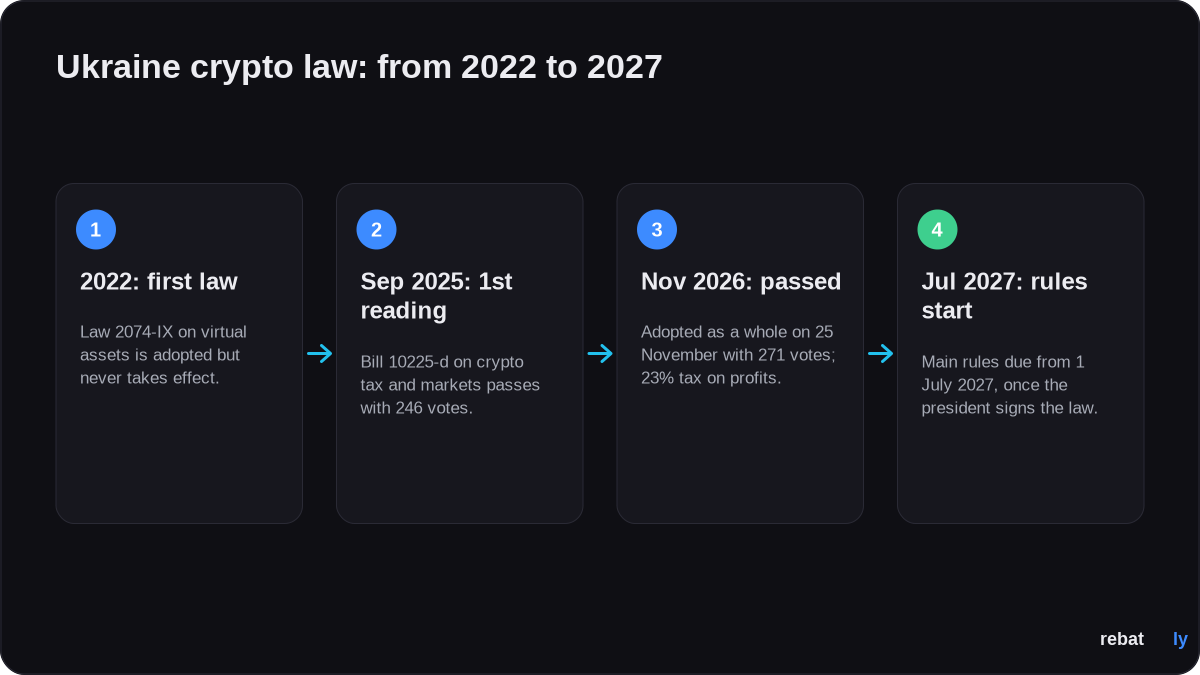
Ukraine's parliament has passed a crypto legalization bill that would tax profits from crypto at 23%. On 25 November 2026 the Verkhovna Rada adopted bill No. 10225-d in its second reading and as a whole, with 271 votes in favour, Interfax-Ukraine, Forbes Ukraine, Cointelegraph and The Block reported. It sets rules for crypto firms and splits supervision between the securities regulator and the central bank. It is not in force yet: the president still has to sign it, and its main rules are due to start on 1 July 2027. This explainer covers what was passed, how the tax works and what is still pending. It is not tax or legal advice.






What Ukraine's parliament passed
The Verkhovna Rada, Ukraine's parliament, adopted bill No. 10225-d on 25 November 2026 in its second reading and as a whole. The key facts, as reported across Ukrainian and crypto media:
| Item | What was reported | Source |
|---|---|---|
| Bill | No. 10225-d, amendments to the Tax Code and other laws on virtual assets | Interfax-Ukraine, Liga |
| Vote | 25 November 2026, second reading and as a whole: 271 in favour (226 needed); 8 against, per two outlets | Interfax-Ukraine, Forbes Ukraine, Cointelegraph, The Cryptonomist |
| First reading | 3 September 2025, 246 votes | crypto.news, The Cryptonomist |
| Standard tax | 18% personal income tax + 5% military levy = 23% on net annual profit | Forbes Ukraine, Finance.ua, Cointelegraph |
| Reduced rate | 5% + 5% on the full amount when crypto bought before the law is sold for money by the end of 2028, most outlets report | Forbes Ukraine, Finance.ua, Cointelegraph |
| Supervisors | NSSMC for crypto firms; National Bank of Ukraine for e-money tokens and crypto-to-money exchange | Interfax-Ukraine, Kyiv Post |
| Start date | Main rules from 1 July 2027, after the president signs | Interfax-Ukraine, Cointelegraph, The Block |
How the 23% crypto tax works
Under the bill, individuals pay two taxes on their net crypto profit for the year:
• 18% personal income tax plus a 5% military levy, 23% in total, the same mix that applies to most other income in Ukraine, Cointelegraph and Ukrinform report.
• Swaps are not taxed: exchanging one crypto asset for another does not trigger tax; tax is due when crypto is turned into money or other value, Cointelegraph and The Cryptonomist report.
• Losses carry forward: a loss in one year can reduce taxable profit in later years, Cointelegraph and Ukrinform report.
• Small profits and VAT: yearly profit up to one minimum wage would be exempt, and crypto transactions would carry no VAT, Forbes Ukraine and Finance.ua report.
• Reporting: crypto providers serving Ukrainian residents, including foreign ones, would register with the tax service and report client transactions each year, Liga Zakon reports.
Lawmaker Yaroslav Zhelezniak expects the law to bring in an extra UAH 15 billion in budget revenue, UNN and Ukrinform reported; The Block put that at about $332 million. That is his estimate, not a measured figure.
The reduced rate for crypto you already hold
The bill gives a lower rate to people who bought crypto before the law takes effect and want to cash out. Most outlets describe it as 5% income tax plus 5% military levy, 10% in total, charged on the full sale amount rather than on the profit, for sales into money until the end of 2028. Cointelegraph, The Cryptonomist and The Block report it this way, and UNN quotes Zhelezniak as saying it applies to the entire transaction volume until 2028.
Reports differ on the details. crypto.news mentions only the 5% income tax, Finance Magnates applies the rate to the gain, and one report described the reduced rate as lasting only the law's first year, as the 2025 first-reading text did. Committee-stage reports in early November, such as Liga Zakon, described a 5% income tax on assets bought before the law, with the military levy on top.
Separately, Finance.ua reports that people could legalise crypto bought before the law, without proving where the money came from, by paying 5% of its value. Rebatly has not seen the final signed text, so treat the exact terms of both as reported, not confirmed.
Who will regulate crypto in Ukraine
The law splits supervision between two bodies:
• NSSMC (the National Securities and Stock Market Commission) licenses and supervises crypto service providers, such as exchanges and custodians, and can ask a court to block unlicensed ones, Kyiv Post and crypto.news report.
• National Bank of Ukraine authorises and supervises issuers of e-money tokens and providers that exchange crypto for money, and covers currency supervision, Interfax-Ukraine and Kyiv Post report.
• Client assets: providers must keep customers' crypto separate from their own, crypto.news and The Block report.
• EU rules: the framework follows the main approaches of the EU's Markets in Crypto-Assets rules (MiCA), Interfax-Ukraine and crypto.news report; the Kyiv Independent ties the bill to Ukraine's work towards EU membership.
The National Bank had objected to an earlier version over foreign tokens, market concentration and how firms would be authorised; amendments before the final vote dealt with this, Finance Magnates and Kyiv Post reported. After the vote, the National Bank said its proposals were reflected in the final text, Interfax-Ukraine reported.
Why Ukraine needed a new law
Ukraine already passed a law on virtual assets, No. 2074-IX: parliament adopted it with the president's proposals on 17 February 2022, with 272 votes, Ukraine's government said at the time. It never took effect, because it was tied to changes to the Tax Code that were never adopted, The Block and Finance Magnates report. Bill 10225-d supplies those tax rules and updates the market rules, so that crypto has both a legal status and a way to be taxed.
Zhelezniak called it a step that had not been possible for 35 years, The Block reported. The Rada's press service said the main goal was not to hold back new technology, crypto.news reported.
Passed vs still pending
The vote is a big step, but it is not the end of the process. What is done and what is not:
| Step | Status | Source |
|---|---|---|
| Parliament vote | Done: passed 25 November 2026 with 271 votes | Cointelegraph, Ukrinform |
| President's signature | Pending | Cointelegraph, The Block |
| Main rules in force | Due 1 July 2027, after signing | Cointelegraph, Kyiv Post |
| Detailed rules for firms | Pending: to be written by the NSSMC and the National Bank | crypto.news, Interfax-Ukraine |
| Licences for crypto firms | Not yet issued; Kyiv Post reports early applications could start 1 May 2027 (not confirmed) | Kyiv Post |
How the market reacted
No source we read links price moves to the Ukrainian vote. At 13:46 UTC on 26 November, CoinGecko showed bitcoin at about $60,836, up about 4.5% in 24 hours, and ether at about $1,703, up about 4.4%.
Rebatly does not forecast prices. Our guide to trading costs on big news days shows how limit orders can cut costs when prices move fast.
What Ukrainian crypto users should know
• Nothing changes today: the law still needs the president's signature, and its main rules start on 1 July 2027.
• Keep records: tax is on net profit, and the reduced rate depends on when crypto was bought, so dates and prices of purchases and sales matter.
• Licensed firms: once licensing starts, the NSSMC is to publish which providers are authorised; check official channels, not adverts.
• Watch for scams: fraudsters often use new laws as a hook, with fake tax demands or "legalization" services. Never share passwords, 2FA codes or API keys. Our article on exchange data breaches and scam messages covers common tricks.
This is general information, not tax, legal or financial advice. For your own situation, ask a qualified tax adviser in Ukraine.
What happens next
• President: the adopted bill goes to President Volodymyr Zelensky for signature; no date for signing has been reported.
• 1 July 2027: the main rules, including the tax regime, are due to start, Cointelegraph and The Block report.
• Secondary rules: the NSSMC and the National Bank must write the detailed licensing and supervision rules.
• End of 2028: the reduced rate for crypto held before the law is reported to end.
• Final text: once the signed text is published, we will update this article with the exact terms.
Trade with lower fees
Whichever exchange you use, every trade carries a fee. Sign up through Rebatly and part of every trading fee comes back to you: up to 50% on Bybit and Bitget, up to 40% on BloFin and OKX, up to 60% on MEXC and up to 65% on OrangeX futures. On Toobit, code Rebatly gives up to 60%, credited by Toobit itself, and BloFin credits up to 40% itself every hour; the other rebates are paid daily in USDT. Our guide to how a fee rebate works explains the rest.
This article reports news and is not financial advice. Rebatly is an independent affiliate; not financial advice.
Get fees back on every trade
$10M+ rebates paid · Paid daily in USDT · No password or API keys, ever
Already signed up? Check your link and rebate with @rebatlybot on Telegram, or reach our support at @rebatly.
🔔 Get a Telegram alert each time your rebate is paid: tap “Activate notifications” in @rebatlybot. New to trading? Your first trade in 5 steps.
November 26, 2026 — published. Sources: Verkhovna Rada, Interfax-Ukraine, Forbes Ukraine, Finance.ua, Liga, Cointelegraph, The Block, Kyiv Post, Ukrinform, UNN, crypto.news, The Cryptonomist, Finance Magnates, Kyiv Independent, CoinGecko.