Cheapest way to trade crypto futures: fees on 7 exchanges, before and after a rebate
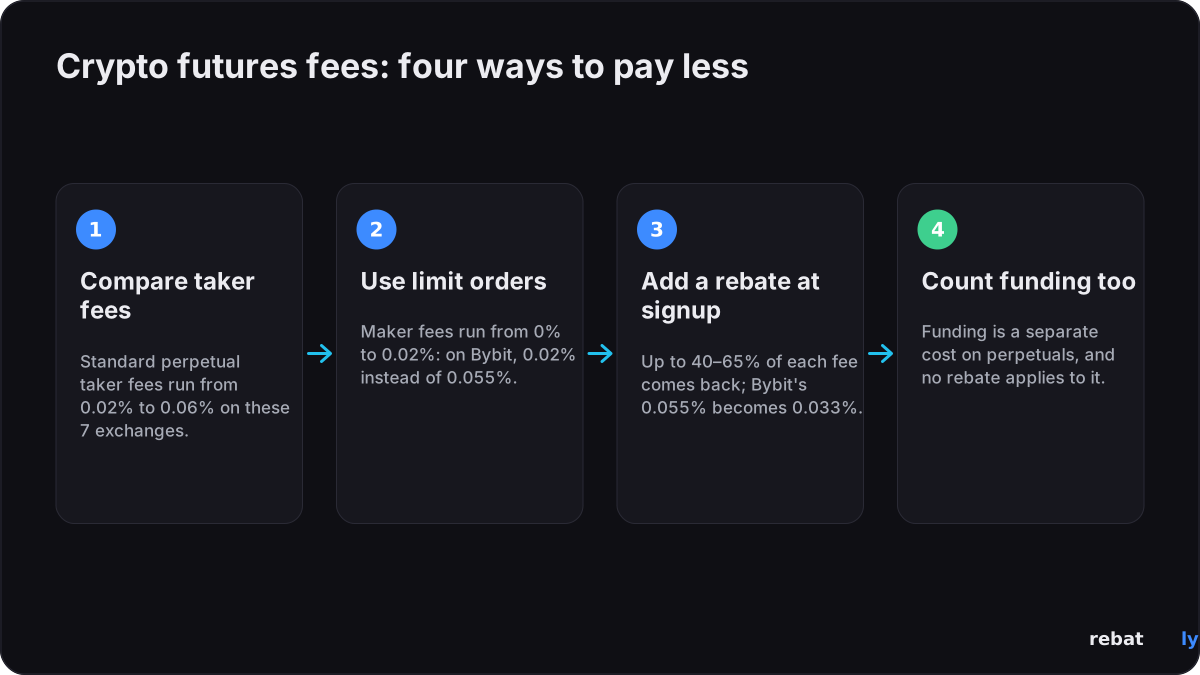
The cheapest way to trade crypto futures is to cut the fee on every trade: use limit (maker) orders where you can, and trade on an account that pays part of each fee back. Standard perpetual futures taker fees on the seven exchanges below run from 0.02% (MEXC, BTC perpetuals) to 0.06%, with most at 0.05–0.06%, and maker fees run from 0% to 0.02%. A fee rebate returns up to 40–65% of what you pay, so Bybit's 0.055% taker fee becomes 0.033% at the standard 40% rebate. Every fee below comes from the exchange's official fee page, checked on 17 November 2026.
 NO KYCSign up to BloFin
 Sign up to Bybit
 Sign up to OKX
 Sign up to Bitget
 Sign up to MEXC
 Sign up to OrangeX
 Sign up to Toobit
Crypto futures fees on 7 exchanges, checked 17 November 2026
Standard (non-VIP) fees for USDT-margined perpetual futures, from each exchange's official fee page on 17 November 2026 UTC (BloFin: its fee page as read on 9 November 2026). The rebate column is what comes back with the Rebatly code; the last column is the taker fee after that rebate, at the standard tier and at the top tier, which starts at $150M of monthly volume. MEXC's fee differs by pair: the figure shown is for BTC perpetuals. Toobit and BloFin credit their rebate themselves; the others are paid by Rebatly daily in USDT.
| Exchange | Maker / taker fee | Rebate with the Rebatly code | Taker fee after the rebate |
|---|---|---|---|
| Bybit | 0.02% / 0.055% | Up to 50% (40% standard) | 0.033%; 0.0275% at the top tier |
| OKX | 0.02% / 0.05% | Up to 40% (30% standard) | 0.035%; 0.03% at the top tier |
| Bitget | 0.02% / 0.06% | Up to 50% (40% standard) | 0.036%; 0.03% at the top tier |
| MEXC | 0% / 0.02% (BTC) | Up to 60% (40% standard) | 0.012%; 0.008% at the top tier |
| OrangeX | 0.02% / 0.06% | Up to 65% (55% standard) | 0.027%; 0.021% at the top tier |
| Toobit | 0.02% / 0.06% | Up to 60%, credited by Toobit | 0.024% |
| BloFin | 0.02% / 0.06% | Up to 40%, credited by BloFin | 0.036% |
Maker vs taker: why limit orders cost less
Limit orders that wait in the order book pay the lower maker fee; orders that fill at once pay the taker fee. On Bybit that is 0.02% instead of 0.055%, so $100,000 of volume costs $20 as maker and $55 as taker, and on MEXC's BTC perpetuals the maker fee is 0%. The catch: a limit order can go unfilled if the price moves away, so it suits trades that can wait. The rebate applies to both maker and taker fees. Our guide to maker vs taker fills shows when each one makes sense.
Spot vs perpetual futures fees
Perpetual futures usually charge less per trade than spot on the same exchange. Standard spot fees are 0.08% maker and 0.1% taker on OKX, and 0.1% on both sides on Bitget and BloFin, against 0.05–0.06% taker on their perpetuals; MEXC charges 0% maker and 0.05% taker on BTC spot, and Toobit charges no spot fees outside its Assessment Zone pairs. Futures add costs that spot does not have, such as funding payments, and leverage can turn a small price move into a large loss. Our guide to spot vs perpetual fees compares them side by side.
VIP fee tiers: only at high volume
Exchange VIP levels lower fees, but only once your 30-day volume or balance is large. On OKX the first VIP level needs 5,000,000 USD of 30-day futures volume (or 100,000 USD in assets) and lowers fees to 0.016% maker and 0.045% taker. On Toobit, Lv.1 needs 3,000,000 USDT of futures volume (or 500 USDT in assets) and lowers the taker fee to 0.05%. Bitget's first futures level, from 5,000,000 USDT, trims only the maker fee. Some exchanges limit rebates at the highest VIP levels, so high-volume traders should contact us first. More in our guide to exchange VIP programs.
Funding rates are a separate cost
Funding is not a trading fee: on perpetual futures, traders holding long and short positions pay each other a funding rate at set intervals, often every 8 hours, and the rate moves with the market. It is not on any exchange's fee schedule and no rebate applies to it, so a position held for days can cost more in funding than in fees. Our guide to funding rates vs trading fees shows how to compare the two.
How a fee rebate works
A fee rebate pays back part of every trading fee you pay. You trade at the exchange's normal fee, and a share comes back afterwards: on Bybit, OKX, Bitget, MEXC and OrangeX it is paid by Rebatly daily in USDT, usually the next day between 04:00 and 12:00 UTC; Toobit (up to 60%) and BloFin (up to 40%, every hour) credit it themselves. There is no minimum volume, and higher tiers unlock automatically from $50M and $150M of monthly volume. Fees covered by an exchange bonus earn no cashback. Our guide to how a fee rebate works has the details.
Worked example: $1M a month on Bybit
A trader who places $1M of taker orders a month on Bybit pays $550 in fees at the standard 0.055% rate. At the standard 40% rebate, $220 comes back, so the net cost is $330. Placing the same volume as maker orders at 0.02% would cost $200, or $120 after the rebate. The 50% top tier starts at $150M a month. These figures cover trading fees only, not funding or price moves.
How to pay less on every futures trade
• Compare the taker fee: it is the fee most active traders pay most often; the table above lists it for seven exchanges.
• Use limit orders when you can wait: the maker fee is 0–0.02% on these exchanges.
• Add a rebate at signup: the code goes in when the account is opened.
• Check your numbers: our fee calculators for Bybit, OKX, Bitget, MEXC, OrangeX, Toobit and BloFin work out the cost for your own volume.
New to trading? Start with your first crypto trade in 5 steps.
Trade with lower fees
Lower fees do not make futures less risky: leverage can lose money fast, so trade only what you can afford to lose. Sign up through Rebatly and part of every trading fee comes back to you: up to 50% on Bybit and Bitget, up to 40% on BloFin and OKX, up to 60% on MEXC and up to 65% on OrangeX futures. On Toobit, code Rebatly gives up to 60%, credited by Toobit itself, and BloFin credits up to 40% itself every hour; the other rebates are paid daily in USDT. Our guide to how a fee rebate works explains the rest.
This guide compares trading costs and is not financial advice. Rebatly is an independent affiliate; not financial advice.
Get fees back on every trade
$10M+ rebates paid · Paid daily in USDT · No password or API keys, ever
Already signed up? Check your link and rebate with @rebatlybot on Telegram, or reach our support at @rebatly.
🔔 Get a Telegram alert each time your rebate is paid: tap “Activate notifications” in @rebatlybot. New to trading? Your first trade in 5 steps.
November 17, 2026 — published; fees checked on 17 November 2026 UTC. Sources: Bybit Fee Rate, OKX Fees, Bitget Fee Rate, MEXC Fees, OrangeX API, Toobit Rate Level, BloFin Fees.