Coinbase prediction markets: the reported in-house plan for 2027, what changes from the Kalshi partnership, and how prediction-market fees compare with crypto trading fees
Coinbase prediction markets could move in-house: Bloomberg reported on 19 November 2026, citing a person familiar with the matter, that Coinbase plans to offer its own event contracts to US retail and institutional customers in the first half of 2027. Today those markets run through Kalshi. Running its own contracts would give Coinbase more say over which markets it lists and let it keep more of the trading revenue, Bloomberg and Decrypt reported. Coinbase has not confirmed the timeline: a spokesperson said the company had "nothing new to announce today". This article sets out what is reported and what is confirmed, the dated timeline, how prediction markets work, who else runs them, and how their fees compare with crypto spot and futures fees. All times are UTC.





Reported vs confirmed
Reported, not confirmed:
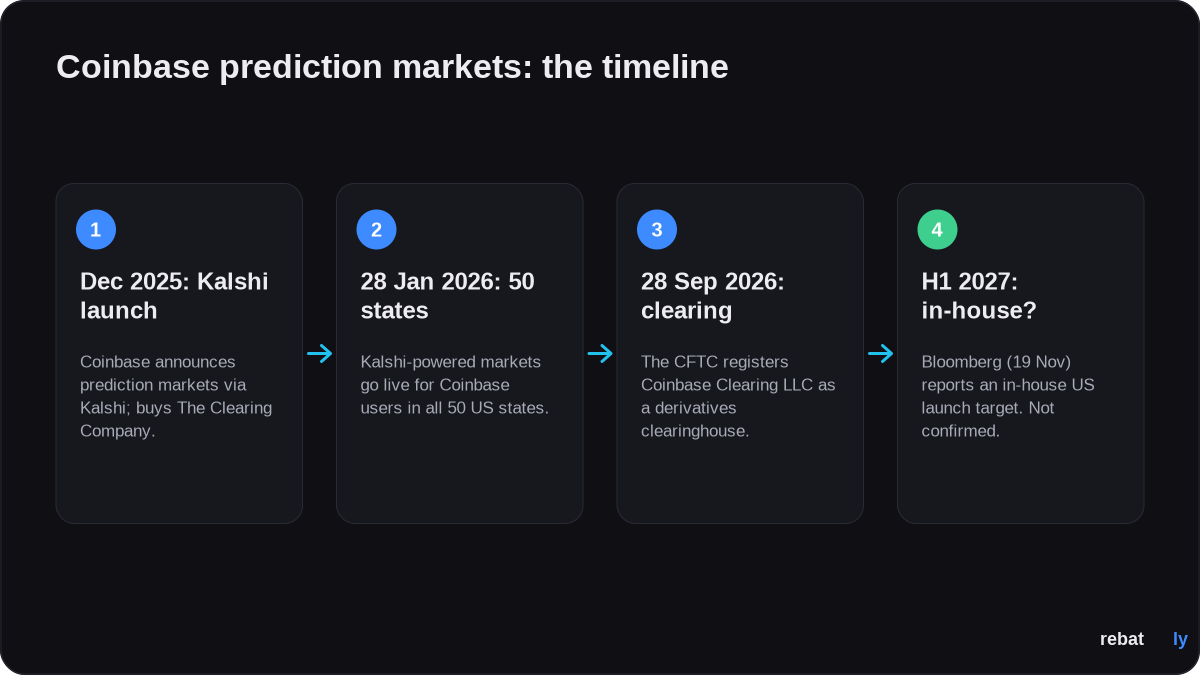
• The plan: Bloomberg reported on 19 November that Coinbase aims to launch its own US event contracts in the first half of 2027, for both retail and institutional customers. The report rests on one unnamed person familiar with the matter. Newsquawk carried the headline at 17:37 UTC that day.
• The reasons: more control over which contracts Coinbase lists, and a bigger share of the trading revenue, according to Decrypt, Finance Magnates and Stocktwits, all citing Bloomberg.
• The date: "the first half of 2027" is the reported target. Coinbase has not announced a launch date, and in-house build timelines can slip.
Confirmed by Coinbase or regulators:
• Coinbase offers prediction markets today through its partnership with Kalshi, a US exchange regulated by the Commodity Futures Trading Commission (CFTC).
• On 28 September 2026 the CFTC registered Coinbase Clearing LLC as a derivatives clearing organization, allowed to clear fully collateralized futures, options on futures and swaps (The Block, Finance Magnates). That registration did not list any specific prediction market.
• On Coinbase's third-quarter call, CFO Alesia Haas said the clearinghouse means Coinbase "can launch our own contracts" and earn "better economics", while still offering partner contracts such as Kalshi's. Asked about timing, she said: "We have not shared a timeline", Decrypt reported.
• Coinbase said on 29 October that prediction markets had passed an annualized revenue run rate of $200 million in the third quarter (Decrypt, Finance Magnates).
Coinbase prediction markets timeline
Dates are UTC. The 2027 entry is Bloomberg's report, not a Coinbase announcement.
| Date | What happened | Source |
|---|---|---|
| 17 December 2025 | Coinbase announces prediction markets through a partnership with Kalshi, first for a limited group of users | Fortune, The Block |
| 22 December 2025 | Coinbase agrees to buy The Clearing Company, a prediction-markets startup founded by Toni Gemayel, a former head of growth at Polymarket and Kalshi | The Block |
| 28 January 2026 | Coinbase prediction markets go live in all 50 US states via Kalshi; minimum trade $1 in USD or USDC | The Block |
| 28 September 2026 | The CFTC registers Coinbase Clearing LLC as a derivatives clearing organization | The Block, Finance Magnates |
| 29 October 2026 | Coinbase reports a prediction-market revenue run rate above $200 million a year for the third quarter | Decrypt, Finance Magnates |
| 19 November 2026 | Bloomberg reports an in-house launch target of the first half of 2027; Coinbase does not confirm timing | Bloomberg, Decrypt, Newsquawk |
What changes from the Kalshi partnership
• Today: Coinbase acts as the broker and the trades are listed and matched on Kalshi's exchange. When the product launched, Coinbase said all market flow would come from Kalshi, and that it planned to add other providers over time (The Block, Finance Magnates).
• In-house: Coinbase already has a designated contract market (Coinbase Derivatives), a futures commission merchant (Coinbase Financial Markets) and now its own clearinghouse (Coinbase Clearing). With all three, it could list and clear its own event contracts, subject to the usual CFTC rules for new contracts.
• Kalshi stays, for now: Haas said Coinbase would keep offering partner contracts, for example from Kalshi. No outlet has reported that the Kalshi partnership will end.
• For users: nothing changes today. Which contracts Coinbase would list itself, and their fees, have not been announced.
Coinbase's US banking plans are a separate matter; see our guide to the Coinbase trust charter.
How prediction markets work
• Event contracts: each contract asks a yes/no question, such as whether an economic figure will be above a level. A "yes" contract pays $1 if the event happens and $0 if it does not.
• Prices from 0 to 1: contracts trade between $0.01 and $0.99. A price of $0.40 means the market as a whole puts the chance at about 40%. It is a price set by traders, not a forecast.
• Two sides: buying "yes" at $0.40 is roughly the mirror of buying "no" at $0.60. You can sell before the result to lock in a gain or a loss.
• Regulated in the US: Kalshi is a CFTC-regulated exchange, and Coinbase offers its markets to US customers through Coinbase Financial Markets.
• Crypto-native venues: Polymarket's global site settles in USDC on a blockchain and runs under its own rules. Polymarket documents a separate US platform with its own terms.
• Legal fights: New York sued Coinbase and Gemini over their prediction-market offerings in April, and Louisiana's attorney general sued on 12 November, Decrypt reported. Coinbase has sued three states over their attempts to regulate prediction markets.
Who else runs prediction markets
Only names reported in our sources are listed, with no ranking:
• Kalshi: the CFTC-regulated exchange behind Coinbase's markets.
• Polymarket: a crypto-native venue. The Block reported that Polymarket and Kalshi together traded tens of billions of dollars in 2025.
• Robinhood: uses the same model as Coinbase, sourcing order flow from Kalshi, Fortune reported.
• Others named by The Block: CME Group through its partnership with FanDuel, Webull, and Goldman Sachs, which it said was exploring the space.
Coinbase's reported plan covers US customers only. It says nothing about other countries, and this article does not imply that Coinbase prediction markets are available anywhere else.
Prediction-market fees vs crypto trading fees
Prediction markets and crypto exchanges charge fees in different ways. Kalshi charges a fee on the contract's expected earnings, its help centre says. Its general fee schedule is round up(0.07 × contracts × price × (1 − price)), to the next cent, as Allium sets out; some markets have their own rates. Polymarket's global site charges takers only, shares × rate × price × (1 − price), with a rate of 0 to 0.05 by category since 20 November 2026 (Polymarket docs). Coinbase says its order preview shows the fee breakdown before you place an order (Coinbase help). Crypto exchanges charge a flat percentage of the trade size instead:
| Venue | How the fee is set | Fee at a $0.50 price, or on a $1,000 trade |
|---|---|---|
| Kalshi (general schedule) | 0.07 × contracts × price × (1 − price), rounded up | $1.75 per 100 contracts at $0.50, or 3.5% of the $50 cost |
| Polymarket (global, taker) | Rate 0 to 0.05 by category × shares × price × (1 − price); makers pay nothing | $1.25 per 100 shares at $0.50 at the 0.05 rate |
| Bybit spot | 0.1% maker / 0.1% taker (standard tier) | $1.00 |
| Bybit perpetual futures | 0.02% maker / 0.055% taker (standard tier) | $0.20 maker, $0.55 taker |
Worked example: $1,000 on each
• Event contract on Kalshi: 2,500 "yes" contracts at $0.40 cost $1,000. The fee is 0.07 × 2,500 × 0.40 × 0.60 = $42.00, or 4.2% of the stake. If the event happens they pay $2,500; if not, they pay $0 and the loss is $1,042. Selling early adds a second fee.
• Bitcoin spot on Bybit: buying $1,000 as a taker costs $1.00, and selling it again another $1.00.
• Bitcoin perpetual on Bybit: a $1,000 position costs $0.55 to open and $0.55 to close as a taker, $1.10 in all, plus funding while it is open.
• With a fee rebate: through Rebatly, up to 50% of Bybit's trading fee comes back, so up to $0.55 of the $1.10 is returned on the perpetual. Funding is not a fee and earns no rebate. Rebatly's partner exchanges are covered here for spot and futures fees only. This article does not say they offer prediction markets.
The products are not alike: an event contract can lose everything at one result, while spot and futures move with the price. Fee figures for Bybit are its standard rates as checked on 18 November 2026 for our guide to the cheapest way to trade crypto futures. See also spot vs perpetual fees and maker vs taker fills. These are cost examples, not a recommendation to trade anything.
Risks
• Contracts can go to zero: if the event does not happen, a "yes" contract is worth $0, and you lose the whole amount plus fees.
• Fees depend on the price: under the formulas above, the fee per contract is largest at $0.50, and as a share of the stake it is larger for cheap contracts.
• Thin markets: the gap between the best buy and sell price can be wide in small markets, and that gap costs as much as a fee.
• Legal uncertainty: state lawsuits and court orders can limit which contracts are offered where.
Rebatly does not encourage betting or trading on events. This is general information about costs and risks, not financial advice.
What happens next
• Coinbase: it has not confirmed the 2027 timeline. Any launch would most likely be announced by Coinbase itself or in a filing.
• New contracts: contracts Coinbase lists itself would go through its own exchange and clearinghouse under CFTC rules.
• Kalshi: Haas said partner contracts would continue alongside any in-house ones.
• The courts: a hearing on a longer injunction in the Louisiana case is set for 30 November, Decrypt reported.
We will update this article if Coinbase announces dates or fees.
Trade with lower fees
Whatever you trade, every trade carries a fee. Sign up through Rebatly and part of every trading fee comes back to you: up to 50% on Bybit and Bitget, up to 40% on BloFin and OKX, up to 60% on MEXC and up to 65% on OrangeX futures. On Toobit, code Rebatly gives up to 60%, credited by Toobit itself, and BloFin credits its up to 40% itself every hour; the other rebates are paid daily in USDT. Our guide to how a fee rebate works explains the rest.
This article reports news and is not financial advice. Rebatly is an independent affiliate; not financial advice.
Get fees back on every trade
$10M+ rebates paid · Paid daily in USDT · No password or API keys, ever
Already signed up? Check your link and rebate with @rebatlybot on Telegram, or reach our support at @rebatly.
🔔 Get a Telegram alert each time your rebate is paid: tap “Activate notifications” in @rebatlybot. New to trading? Your first trade in 5 steps.
November 22, 2026 — published. Sources: Bloomberg, Decrypt, Finance Magnates, Stocktwits, Newsquawk, The Block, Fortune, Kalshi, Polymarket, Allium, Coinbase, Bybit.