Coinbase trust charter: what the OCC's final approval allows, what it does not, and what changes for users
The Coinbase trust charter is final. The U.S. Office of the Comptroller of the Currency approved Coinbase National Trust Company on 6 November 2026, and Coinbase announced it on 9 November. The new federally chartered trust bank will hold digital assets in custody for clients, mainly institutions. It is not a full-service bank: it cannot take insured deposits or make loans, and assets held with it are not FDIC-insured. This article sets out what the OCC approved, what the charter allows and does not allow, the conditions attached, which other crypto firms hold one, who opposes it and what changes for users.
 NO KYCSign up to BloFin
 Sign up to Bybit
 Sign up to OKX
 Sign up to Bitget
 Sign up to MEXC
 Sign up to OrangeX
 Sign up to Toobit
What the OCC approved for Coinbase
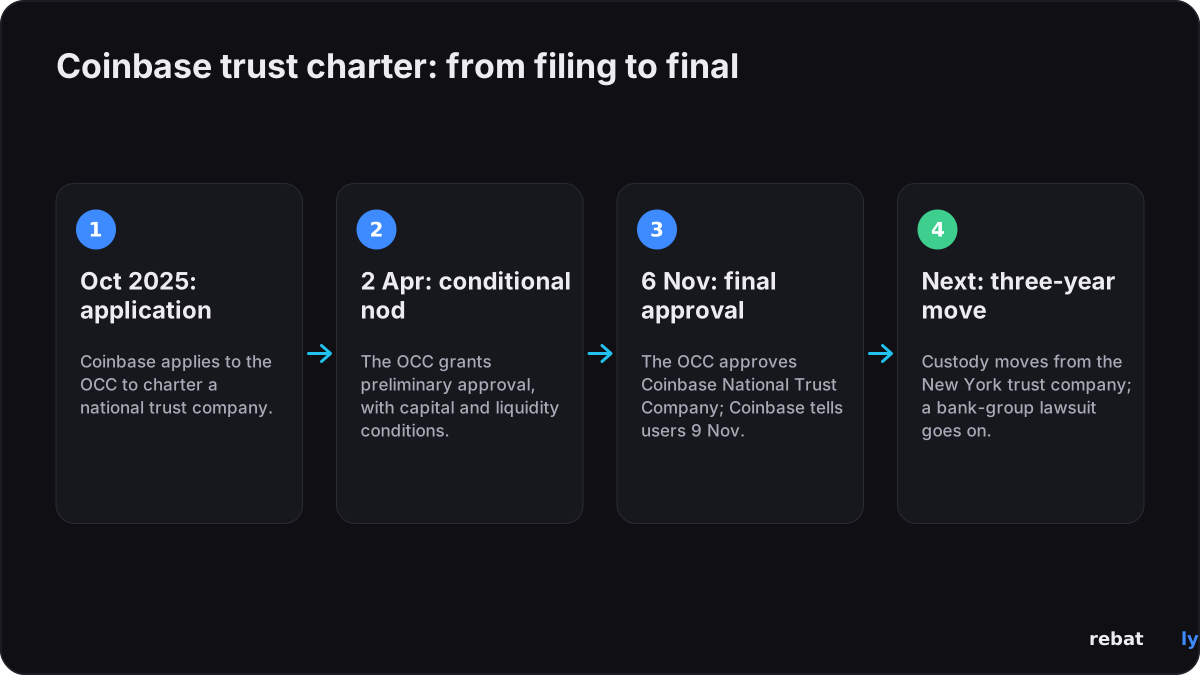
The Office of the Comptroller of the Currency (OCC), the U.S. federal regulator of national banks, gave final approval on Friday 6 November 2026 to charter Coinbase National Trust Company, Coinbase said in its announcement on 9 November. crypto.news, citing the OCC's licensing records, gives the same date. CoinDesk, Decrypt, Cointelegraph and American Banker all reported the approval on 9 November. The main facts, side by side:
| Item | Detail | Source |
|---|---|---|
| Entity | Coinbase National Trust Company, main office in New York, New York | OCC, Coinbase |
| Type | Uninsured national trust bank, limited to the operations of a trust company | OCC |
| Application filed | October 2025 | CoinDesk, Decrypt, Cointelegraph |
| Preliminary conditional approval | 2 April 2026 (OCC Corporate Decision 1370) | OCC |
| Final approval | 6 November 2026, announced by Coinbase on 9 November | Coinbase, crypto.news |
| Chief executive | Rick Schonberg, Coinbase's head of prime trading and custody | OCC, American Banker |
| Business moving over | All custody work of Coinbase Custody Trust Company, a New York trust company, over three years | OCC, crypto.news |
What a national trust charter allows
A national trust bank is a bank that may only do the work of a trust company: holding and managing assets for clients as a fiduciary. In its April decision, the OCC said Coinbase National Trust Company will provide:
• Custody: digital asset custody as a fiduciary, primarily for institutional clients. The OCC wrote that these custody services will be subject to fiduciary duties and standards of behavior.
• Transfers for custody clients: custody customers can accept, hold and transfer the fiat currency and digital assets in their custody accounts. Fiat cash held in custody sits in "for benefit of" accounts at third-party banks.
• Access to other Coinbase products: custody clients can reach staking, Prime trading and Prime financing, but those services are run by other Coinbase companies. The trust bank only connects clients to them, as a "finder".
The benefit for Coinbase is one federal rulebook instead of state-by-state rules. "Custody is foundational to our business," Schonberg wrote in Coinbase's announcement, adding that the charter brings "clear and consistent federal uniformity" to its custody. Coinbase vice chairman Ryan VanGrack told CoinDesk the approval "puts more of our business behind" Coinbase's long push for clear rules.
What it does not allow: no FDIC-insured deposits
The charter does not make Coinbase a full-service bank. The OCC's April decision is explicit on four points:
• No deposit insurance: the bank "will not be an insured depository institution". Assets held with it are not covered by FDIC deposit insurance; American Banker notes that assets consumers hold at trusts are not protected by federal deposit insurance.
• No commercial banking: it must limit itself to trust company operations and must not become a "bank" under the Bank Holding Company Act, which in practice means it cannot both take demand deposits and make commercial loans.
• No stablecoin issuance: the OCC noted that the bank "does not propose to issue stablecoins". Any future change would need the OCC's consent and would have to follow the GENIUS Act, the U.S. stablecoin law.
• No automatic Federal Reserve access: crypto.news reports that access to Fed payment systems needs a separate application.
Coinbase said the same when it won conditional approval in April: it is not becoming a commercial bank and will not take retail deposits or engage in fractional reserve banking, Decrypt reported.
Conditions attached to the charter
The OCC's approval came with written conditions that it can enforce like any other bank order. The main ones:
• Capital: at least $60 million in tier 1 capital, of which the greater of 50% or $30 million must be held in eligible liquid assets such as cash and short-term U.S. government debt.
• Liquidity: liquid assets equal to at least 180 days of operating expenses.
• No surprise changes: 60 days' written notice to the OCC, and the OCC's no-objection, before any significant change to the business plan.
• Compliance: anti-money-laundering and sanctions programmes in place, and the bank's systems reviewed by the OCC before opening.
The capital, liquidity and business-plan conditions apply for the bank's first three years of operation, the same period over which Coinbase moves its custody business from the New York trust company.
Which other crypto firms have a national trust charter
Coinbase joins Circle and Ripple, which won final approval earlier this year, Decrypt reported. Where the main names stand, as reported up to 9 November 2026:
| Company | Status | Reported by |
|---|---|---|
| Anchorage Digital Bank | National trust bank since 13 January 2021 | Anchorage Digital |
| Circle | Conditional approval 12 December 2025; final approval in July 2026 | Decrypt |
| Ripple National Trust Bank | Conditional approval 12 December 2025; final approval 26 October 2026 | Decrypt, crypto.news |
| Coinbase National Trust Company | Conditional approval 2 April 2026; final approval 6 November 2026 | OCC, Coinbase |
| BitGo, Fidelity Digital Assets, Paxos | Conditional approval 12 December 2025; no final approval reported | Decrypt |
| Crypto.com, Bridge (Stripe), Protego, a World Liberty Financial-linked firm | Conditional approvals | Cointelegraph, CoinDesk, Decrypt, ICBA |
| Kraken, Block | Applications filed | Decrypt |
Who opposes the charter
U.S. bank groups have fought these charters from the start. The OCC received five public comments on Coinbase's application, two of them from trade groups representing banks, and four questioned whether the OCC had the power to approve it. The OCC rejected those arguments in April.
The Independent Community Bankers of America (ICBA) said on 9 November that the approval rests on a "flawed chartering rule" and lets a non-traditional firm offer deposit-like services without deposit insurance. On 2 October 2026 the ICBA sued the OCC in the U.S. District Court for the District of Columbia, asking it to find the OCC's March 2026 chartering rule unlawful. Senator Elizabeth Warren has also called the approvals illegal, Decrypt reported. American Banker notes that the case may take years, and that a court ruling against the OCC could tighten the rules for trust banks already chartered.
What changes for Coinbase users and their funds
• Custody: the main change is the supervisor. Coinbase's custody business, which serves mainly institutions, moves from New York state oversight to federal OCC supervision over three years, with capital and liquidity rules attached.
• Safety of funds: a trust charter means fiduciary duties and bank-style supervision, not insurance. Crypto held in custody is not FDIC-insured.
• Retail accounts and trading fees: Coinbase's announcement does not mention any change to its retail app, account terms or trading fees. The charter covers custody, not trading.
• Market: at 08:45 UTC on 10 November, CoinGecko showed bitcoin at about $74,456, up 0.3% in 24 hours, and ether at about $2,110, little changed.
Rebatly does not forecast prices. Our guide to trading costs on big news days shows with real fee rates how limit orders cut costs when markets move fast.
What crypto users should watch out for
• "Coinbase bank account" offers: the trust bank does not offer retail deposit accounts or loans. Treat any message offering a "Coinbase bank account", "FDIC-insured crypto" or a high-interest Coinbase deposit as a likely scam.
• Official channels only: check Coinbase's own app, website and verified accounts. Coinbase will never ask for your password, 2FA codes or seed phrase. Our article on exchange data breaches and scam messages shows what fake messages look like.
• Check your own account: on any exchange, review your withdrawal address list, API keys and login devices, and keep 2FA switched on.
• Know what protects you: a regulator's charter is not a guarantee. Read who holds your assets and what protection, if any, applies.
This is general security information, not financial advice.
What happens next
• Next three years: Coinbase moves its custody business into the national trust company, under the OCC's capital and liquidity conditions.
• In court: the ICBA case against the OCC's chartering rule continues in Washington, D.C.; the ICBA says it will keep challenging the rule.
• More charters: BitGo, Fidelity Digital Assets, Paxos and others hold conditional approvals, and Kraken and Block have applied.
• Federal Reserve access: a separate application would be needed for direct access to Fed payment systems.
We will update this article as the OCC, Coinbase or the courts publish more.
Trade with lower fees
Whichever exchange you trade on, every trade carries a fee. Sign up through Rebatly and part of every trading fee comes back to you: up to 50% on Bybit and Bitget, up to 40% on BloFin and OKX, up to 60% on MEXC and up to 65% on OrangeX futures. On Toobit, code Rebatly gives up to 60%, credited by Toobit itself. Rebates are paid daily in USDT. Our guide to how a fee rebate works explains the rest.
This article reports news and is not financial advice. Rebatly is an independent affiliate; not financial advice.
Get fees back on every trade
$10M+ rebates paid · Paid daily in USDT · No password or API keys, ever
Already signed up? Check your link and rebate with @rebatlybot on Telegram, or reach our support at @rebatly.
🔔 Get a Telegram alert each time your rebate is paid: tap “Activate notifications” in @rebatlybot. New to trading? Your first trade in 5 steps.
November 10, 2026 — published. Sources: OCC, Coinbase, ICBA, CoinDesk, Decrypt, Cointelegraph, crypto.news, American Banker, Anchorage Digital, CoinGecko.