Ethereum picks Keccak-256 for post-quantum security: what it means
Ethereum should use Keccak-256 as the one hash function behind its post-quantum security, Ethereum Foundation (EF) researchers wrote in a blog post on 24 November 2026. Keccak-256 is the hash Ethereum already uses for addresses. The researchers chose it over Poseidon, BLAKE3, BLAKE2 and SHA2-256 because it has nearly 20 years of public attacks behind it and a wide safety margin, The Block and Cointelegraph report. It is a recommendation, not an Ethereum Improvement Proposal (EIP) or a scheduled upgrade, Unchained notes. This article explains what was decided, why hashes matter in a quantum world, and what it means for wallets and users.






What the Ethereum Foundation decided
The decision came in the second post of the EF's "PQAI" (post-quantum, post-AI) series, written by researcher Kev Wedderburn. The main points below come from the Ethereum Foundation post and news reports.
| Item | What is published | Source |
|---|---|---|
| Decision | Keccak-256 recommended as the hash for Ethereum's hash-based cryptography | Ethereum Foundation, The Block |
| Published | 24 November 2026 (blog post "PQAI #1") | Ethereum Foundation, Cointelegraph |
| Status | A research recommendation, not an EIP or a scheduled upgrade | Unchained |
| Candidates | Poseidon/Poseidon2, BLAKE3, BLAKE2, SHA2-256 and Keccak-256 | Ethereum Foundation, FXStreet |
| Hash family | Keccak-256 for hashing, Keccak-duplex for Fiat-Shamir proofs, SHAKE256 for random bits and key derivation | Ethereum Foundation |
| Proving target | About 500,000 hashes per second, roughly 1,000 attestations per second | Ethereum Foundation, Unchained |
| Deadline | December 2028 target proposed at Devcon; 2029 internal deadline, review in January 2027 | Ethereum Foundation, The Block |
Why one hash function matters so much
Today Ethereum's signatures use elliptic curves: ECDSA for user accounts and BLS for validators. The EF wants to replace them with hash-based signatures, whose security rests only on a hash function. Ethereum already relies on hashes being secure, so this adds no new assumption, the Ethereum Foundation wrote on 23 November.
The cost is that everything then depends on that one hash. "If it is broken, everything else is broken," the EF post said. The same hash also has to work well in three places:
• On computers: clients use it to sign, verify, hash the state and derive addresses.
• In zero-knowledge proofs: thousands of signatures are bundled into one compact proof inside leanVM, the zkVM the EF plans to use in the protocol. The hash must be cheap to prove.
• In smart contracts: contracts compute the hash to check signatures and storage proofs, so its gas cost matters.
Because the choice is hard to undo, the EF said it wanted "the largest public body of cryptanalysis" and a margin wide enough that a break would need completely new methods, The Block reports.
Why quantum computers threaten signatures more than hashes
Two quantum algorithms explain the difference.
• Shor's algorithm could solve the elliptic-curve maths behind ECDSA and BLS. A large enough quantum computer could then work out a private key from a public key, Cointelegraph explains. That is an exponential speed-up, and it breaks the scheme outright.
• Grover's algorithm only speeds up a brute-force search, by a square-root factor. Against a 256-bit hash that is a quadratic speed-up, not an exponential one, so well-built hashes stay strong.
That is why hash-based signatures are a standard defence. In August 2024 NIST published SLH-DSA (FIPS 205), a hash-based signature standard, as a backup to its lattice-based ML-DSA. No quantum computer today can break Ethereum's keys, and no source gives a date when one will. Our guide to quantum computing and crypto security explains the risk in more detail.
The five candidates and why four lost
For years, standard hashes were too slow to prove in zero-knowledge, so the working plan was a proof-friendly hash such as Poseidon. Newer provers (Binius, Flock and GKR-based systems) now prove standard hashes at or above the 500,000 per second target. "That tradeoff is gone," the Ethereum Foundation wrote, so security became the deciding factor.
| Hash | Year | Why the EF did or did not pick it |
|---|---|---|
| Poseidon / Poseidon2 | 2019 / 2023 | Built for zero-knowledge proofs; attacks keep appearing on reduced-round versions, though neither full version is broken |
| BLAKE3 | 2020 | Fastest to prove (about 2.2 million per second on a 16-vCPU machine), but rounds cut from 10 to 7 and little published analysis |
| BLAKE2 | 2012 | Believed secure and fast, but fewer than 10 published attacks |
| SHA2-256 | 2001 | Fast and used in Ethereum's consensus layer and in Bitcoin; practical collisions reach 35 of 64 rounds, and its design needs extra care in proofs |
| Keccak-256 | 2008 | Chosen: practical collisions reach only 5 of 24 rounds; already in Ethereum; slower to prove than BLAKE3 |
What the round numbers mean
A hash scrambles its input through a fixed number of rounds. Researchers measure safety by how many rounds an attack can break: the smaller the share, the wider the margin, Unchained explains. By Unchained's maths on the EF's figures, practical collision attacks reach about 21% of Keccak-256's rounds, against about 55% for SHA2-256.
None of this means SHA2-256 is broken. The attacks only work on cut-down versions. The EF also chose Keccak-256 over SHA3-256, which uses the same core and differs only in padding: Keccak-256 is already an Ethereum opcode, and two near-identical functions would invite bugs, the post said. Keccak-256 is slower than SHA2-256 on normal computers and slower to prove than BLAKE3, a cost the EF said it accepts "for the security margin", FXStreet and Unchained report.
Why AI is now part of the threat
The EF now names AI as a more urgent risk than quantum computers. AI models are already finding bugs in production software faster than people can review them, and are starting to improve on decades-old algorithms, the Ethereum Foundation wrote. That does not mean AI can break Ethereum's cryptography, the EF said, but relying on the most conservative assumptions seems prudent.
Keccak-256's security "has so far remained unaffected by the introduction of AI-assisted cryptanalysis," the EF post said. "AI is here today and it's breaking everything around us," Ethlabs co-founder Julian Ma told Cointelegraph. The EF has doubled the size of its protocol security team and wants core parts formally verified against a specification.
The timeline so far
These are the dates the sources give. None of them is a confirmed upgrade date.
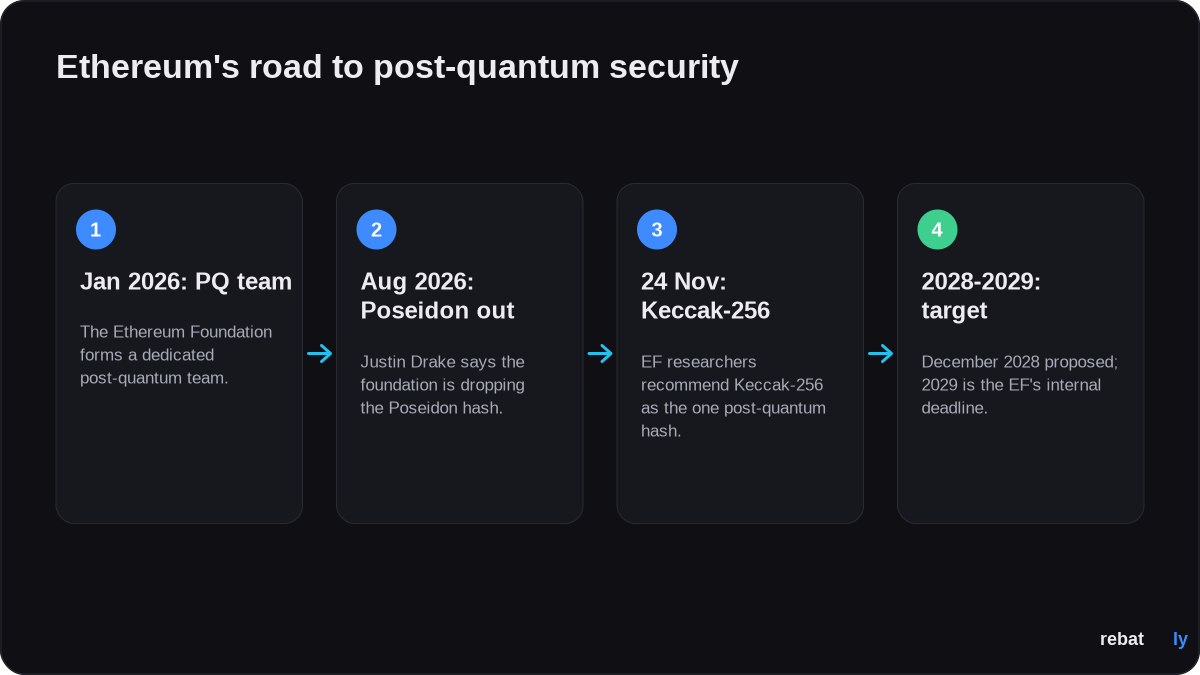
• January 2026: the EF formed a dedicated post-quantum team, Unchained reports.
• August 2026: EF researcher Justin Drake said the foundation was dropping Poseidon and named SHA2 and BLAKE as replacements, Unchained reports. The final pick was neither.
• 11 November 2026: Ethlabs' Julian Ma proposed an approach to post-quantum and post-AI resistance, Cointelegraph reports.
• Devcon, Mumbai: Drake put forward December 2028 as a target. The EF keeps 2029 as its internal deadline, with a review planned for January 2027, The Block reports.
• 23–24 November 2026: the EF published the PQAI plan and the Keccak-256 recommendation. Early specifications have started, and work has begun on a first post-quantum consensus devnet (test network), the Ethereum Foundation said.
What changes for ordinary users and wallets
The plan has three parts, according to the Ethereum Foundation:
• Validators sign with hash-based keys, so finality no longer depends on elliptic curves.
• User accounts: wallets give users a straightforward way to move to hash-based signatures.
• Data: blobs, which rollups use to post data, switch to hash-based commitments.
For now, nothing changes for you. Your address, your ETH and your current wallet keep working, and there is nothing to do today. When the upgrade comes, wallets are expected to offer a move to new keys. The EF says wallets, multisigs and staking pools all need changes, and much larger signatures mean node hardware will be watched closely. How and when users switch has not been published. For client teams, little new code is needed, because Keccak-256 is already in Ethereum.
How Bitcoin's quantum debate compares
Bitcoin faces the same Shor's-algorithm risk to its ECDSA and Schnorr signatures, and its SHA-256 hashing is seen as much less exposed, Cointelegraph explains. Its debate is moving more slowly and in smaller steps:
• BIP-360: merged into Bitcoin's proposal repository in February 2026, Bitcoin Magazine reported. It adds an output type called Pay-to-Merkle-Root (P2MR) that hides public keys better, but it adds no new signature scheme. Being merged is not the same as being activated.
• Legacy signature sunset: researchers proposed phasing out old signatures in stages, The Block reported in April 2026. This is a draft with no activation timeline, and critics object to freezing coins.
The main difference: Ethereum's foundation has set an internal deadline and a full plan for validators, accounts and data, while Bitcoin has no lead organisation and no agreed date.
How the market reacted
At 07:13 UTC on 26 November, CoinGecko showed ether (ETH) at about $1,685.50, up about 1.5% in 24 hours, and bitcoin at about $60,414, up about 2.0%. We found no evidence linking those moves to the announcement, which is a long-term research decision.
Rebatly does not forecast prices. Our guide to trading costs on big news days shows how limit orders can cut costs when prices move fast.
What users should do
• Ignore fake "quantum upgrades": no Ethereum wallet migration is live. Any message asking you to move your ETH to a "quantum-safe" address, or to enter your seed phrase, is a scam.
• Use official channels only: follow upgrade news on the Ethereum Foundation blog and your wallet's own website.
• Protect your accounts: never share passwords, seed phrases or 2FA codes, and check API keys and your withdrawal whitelist. Our article on exchange data breaches and scam messages shows what fake messages look like.
This is general security information, not financial advice.
What happens next
• January 2027 review: whether the EF keeps 2029 or moves towards December 2028.
• A formal proposal: whether the Keccak-256 choice is written into an EIP and agreed on developer calls.
• Devnets: more post-quantum test networks, with validators testing hash-based keys.
• Wallet plans: how wallets will let users move to hash-based signatures, and what it costs.
• Other upgrades: which features are delayed to free up engineers.
Trade with lower fees
Whichever exchange you use, every trade carries a fee. Sign up through Rebatly and part of every trading fee comes back to you: up to 50% on Bybit and Bitget, up to 40% on BloFin and OKX, up to 60% on MEXC and up to 65% on OrangeX futures. On Toobit, code Rebatly gives up to 60%, credited by Toobit itself, and BloFin credits up to 40% itself every hour; the other rebates are paid daily in USDT. Our guide to how a fee rebate works explains the rest.
This article reports news and is not financial advice. Rebatly is an independent affiliate; not financial advice.
Get fees back on every trade
$10M+ rebates paid · Paid daily in USDT · No password or API keys, ever
Already signed up? Check your link and rebate with @rebatlybot on Telegram, or reach our support at @rebatly.
🔔 Get a Telegram alert each time your rebate is paid: tap “Activate notifications” in @rebatlybot. New to trading? Your first trade in 5 steps.
November 26, 2026 — published. Sources: Ethereum Foundation, The Block, Cointelegraph, Unchained, FXStreet, Bitcoin Magazine, NIST, CoinGecko.