Quantum computing and crypto security: what IOSCO's warning says, which coins are exposed and what to check now
Quantum computing is now a crypto security question that regulators want firms to act on. On 19 November 2026 IOSCO, the global body of securities regulators, published a final report on the implications of quantum computing for financial markets. It says a powerful enough quantum computer could break the public-key cryptography that banks, exchanges and blockchains rely on, that preparation across the sector is at an early stage, and that moving blockchains to new cryptography may be especially hard. No quantum computer can do this today, and no one knows when one will. This article sets out what IOSCO said, why crypto signatures are the weak point, how much bitcoin is exposed, what the industry is doing and what users can check now.
 NO KYCSign up to BloFin
 Sign up to Bybit
 Sign up to OKX
 Sign up to Bitget
 Sign up to MEXC
 Sign up to OrangeX
 Sign up to Toobit
What IOSCO's quantum report says
The report, Implications of Quantum Computing on Financial Markets (FR/07/26), comes from IOSCO's Fintech Task Force. It draws on a survey of IOSCO members held in March 2026 and on roundtables with industry experts, The Quantum Insider and Opalesque reported. Its main points:
• The threat: a capable quantum computer could break widely used public-key algorithms, letting an attacker read protected data or forge digital signatures.
• The timing: it says the timeline is uncertain and that conservative estimates put such machines in the 2030 to 2035 period. Some industry participants told IOSCO it could come within five years, which is the figure CoinDesk and Reuters led with.
• Readiness: most firms are still raising awareness, listing their vulnerable systems and drafting plans; testing and real migration are rare, and the work is expected to take several years.
• Blockchains: migration may be "particularly challenging" for blockchains because cryptography is built into their core and any change needs coordinated action across a decentralized network.
• Quantum washing: IOSCO warns that firms may overstate how much quantum technology is in their products, and calls this a current investor protection risk.
IOSCO Board Chair Jean-Paul Servais said the financial sector should start preparing today, Silicon Republic and Opalesque reported. The report makes no forecast of a date and proposes no new rules for crypto.
Why bigger signatures could slow blockchains
Cointelegraph focused on the cost of the fix. Today's blockchain signatures are about 64 bytes. A signature under ML-DSA-44, one of the new NIST standards, is about 2,420 bytes, roughly 35 to 40 times larger, the IOSCO report says. Bigger signatures mean fewer transactions per block, more congestion, higher fees and more storage for nodes. The report cites a Solana quantum-resistant testnet whose throughput fell by about 90% when ordinary signatures were replaced with post-quantum ones; CoinDesk first reported that test in April 2026.
Cointelegraph also noted two gaps that an upgrade alone would not close: coins in dormant wallets whose owners never move them to new addresses, and layer-2 networks or bridges that still settle through older cryptography.
Why quantum computers threaten crypto wallets: Shor and Grover
Two quantum algorithms matter, and they are very different in strength:
• Shor's algorithm could work out a private key from its public key. Bitcoin and Ethereum sign transactions with elliptic-curve cryptography (ECDSA, and Schnorr on bitcoin's Taproot), which Shor's algorithm would break. This is the real exposure: whoever can see your public key could, with such a machine, sign for your coins.
• Grover's algorithm only speeds up brute-force guessing. NIST says it gives little or no practical advantage against strong symmetric cryptography, and it treats SHA-256 as strong (NIST FAQ). Bitcoin mining and address hashes are therefore much less at risk.
How big would the machine need to be? Google Quantum AI estimated on 31 March 2026 that fewer than 500,000 physical qubits could break the curve used by bitcoin and Ethereum, about 20 times fewer than earlier estimates. In May 2025 Google's Craig Gidney estimated that RSA-2048 could be broken with fewer than 1 million noisy qubits. These are estimates, not demonstrations: no machine of that kind exists today.
Which bitcoin is exposed to quantum computers
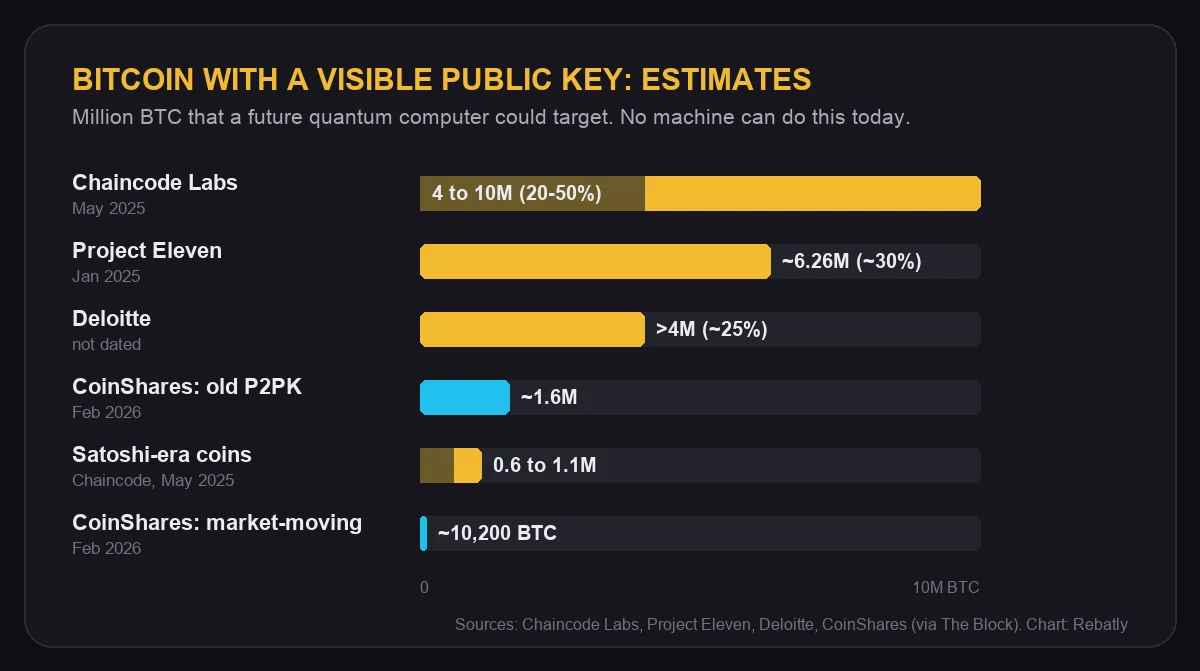
A bitcoin address normally shows only a hash of the public key. The public key itself becomes visible when coins are spent from that address, so coins left on a reused address sit behind a key anyone can read. Some output types show the key from the start: the pay-to-public-key (P2PK) outputs used in bitcoin's first years, and Taproot (P2TR) outputs. Estimates of how much bitcoin sits behind a visible key (Chaincode Labs collects several):
| Estimate by | When | Exposed bitcoin |
|---|---|---|
| Chaincode Labs | May 2025 | About 20% to 50% of supply, 4 million to 10 million BTC |
| Project Eleven | January 2025 | About 6.26 million BTC in about 11.1 million addresses, about 30% |
| Deloitte | Not dated | Over 4 million BTC, about 25% |
| Chaincode Labs (early coins) | May 2025 | 600,000 to 1.1 million BTC of Satoshi-era coins |
| CoinShares | February 2026 | About 1.6 million BTC in old P2PK outputs; only about 10,200 BTC in amounts big enough to move the market |
The estimates differ because they count different things: some include every address whose key has been seen once, others only old P2PK coins. Ether is in a similar position: an Ethereum account's public key becomes visible after its first transaction.
What 'harvest now, decrypt later' means for crypto
The UK's National Cyber Security Centre describes the threat as collecting and storing data today and decrypting it later, once a quantum computer exists. IOSCO says this means some quantum risks may arise, or may already be happening, before such machines are built. For banks the concern is long-lived secret data. For blockchains the main risk is different: forged signatures rather than decrypted messages. Public keys already on a public ledger cannot be taken back, which is why old and reused addresses are the ones most often discussed.
What the industry is doing about quantum risk
The work is planning and standards, not an emergency:
| When | Who | What |
|---|---|---|
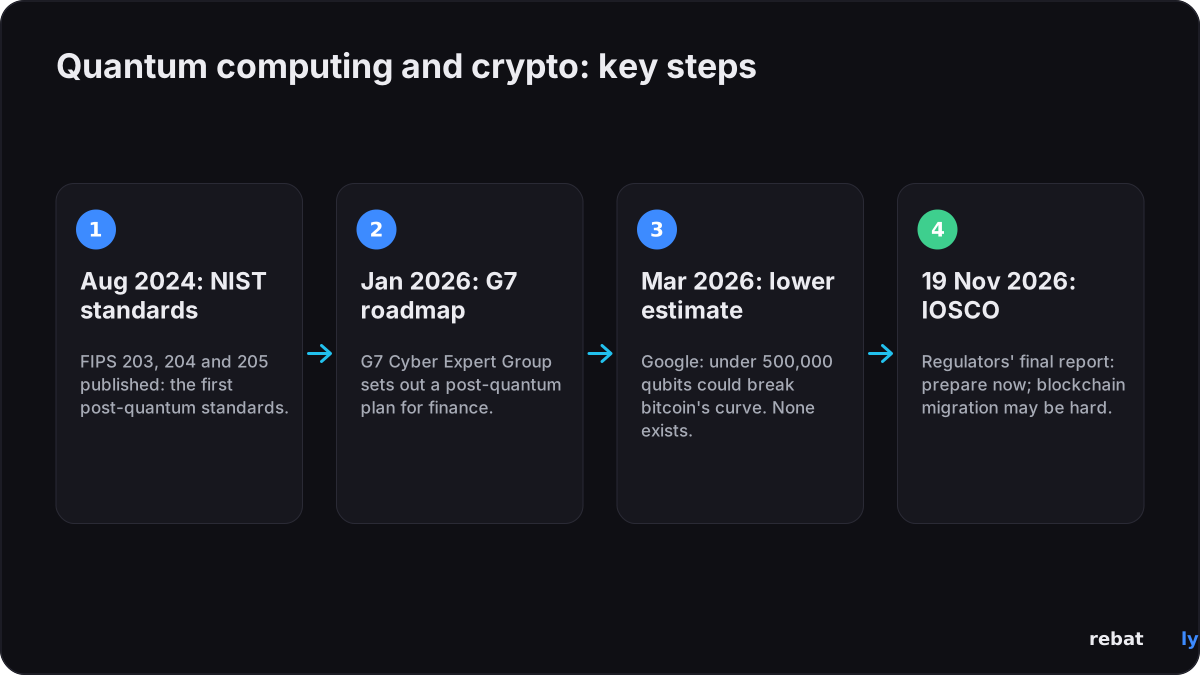
| 13 Aug 2024 | NIST | FIPS 203, 204 and 205 published: the first post-quantum standards (ML-KEM, ML-DSA, SLH-DSA) |
| Jan 2026 | G7 Cyber Expert Group | A roadmap for moving the financial sector to post-quantum cryptography |
| Jan 2026 | Ethereum Foundation | A dedicated post-quantum team; its roadmap points to about 2029, with no fixed date |
| Feb 2026 | Bitcoin developers | BIP-361 draft: a phased sunset of old signatures after a migration |
| May 2026 | G7 central banks' working group | A non-negligible chance of a code-breaking machine within a decade |
| May 2026 | Moody's | The main exposure is key control at custodians, exchanges and issuers, not the ledger |
| Oct 2026 | Coinbase | Sets out priorities for moving bitcoin to post-quantum signatures |
| Oct 2026 | Europol | Wallets are the main point of exposure; crypto will not collapse because of quantum |
| 19 Nov 2026 | IOSCO | Final report: start preparing now; blockchain migration may be especially hard |
For bitcoin, BIP-360 (now called Pay-to-Merkle-Root, P2MR) and BIP-361 are drafts with no activation date, and quantum-safe signatures would still need a separate proposal. Ethereum's plans are on pq.ethereum.org; Decrypt reported on 16 November that Vitalik Buterin backs a way to bundle post-quantum signatures to keep them affordable. Solana has an opt-in quantum-resistant vault. The NIST standards themselves are on NIST's site. Sources: The Block, Decrypt, The Quantum Insider and the organizations named.
When could a quantum computer break bitcoin?
No one knows, and Rebatly does not forecast it. IOSCO describes 2030 to 2035 as a conservative estimate and records that some participants expect it sooner; the G7 central banks' group speaks only of a non-negligible chance within a decade. When Google reported progress on its Willow chip on 16 October 2026, analyst Nic Carter told The Block there was no imminent threat. Rebatly does not forecast prices either. Our guide to trading costs on high-volatility days explains what fast markets do to spreads and fills.
What crypto users can check now
• Avoid address reuse: let your wallet create a new receiving address each time, and move funds you keep long-term off addresses you have already spent from.
• Keep wallet software updated, from the official app store or the maker's own website only. Real quantum upgrades will come through normal releases and network upgrades, announced in public.
• Beware "quantum-safe" scams: no wallet maker needs your seed phrase for an upgrade. Switzerland’s National Cyber Security Centre warned on 18 August 2026 about letters with QR codes that ask for a seed phrase for a "quantum resistance" update, and Ledger-branded letters of the same kind were reported in June 2026. Treat new "quantum" tokens, airdrops and trading bots with the same caution; IOSCO's warning about quantum washing applies to them too.
• Ask your exchange: if you keep coins on an exchange, its keys protect them, so look for what it publishes on post-quantum planning and on how it would move customer funds to new address types.
• Basics still matter more today: phishing and stolen keys cause the losses now. Check 2FA, API keys and the withdrawal whitelist; our article on what to do after a crypto exchange data breach walks through it.
This is general security information, not financial advice.
What happens next
• Regulators: IOSCO says quantum stays a priority and that securities regulators should check that firms' quantum claims are not misleading.
• Bitcoin: debate on BIP-360, BIP-361 and how to treat old coins continues on the developer mailing list; none of it has an activation date.
• Ethereum: research on post-quantum signatures and accounts continues, with mainnet changes pointed at about 2029.
• Standards: NIST is still working on further algorithms, including FN-DSA and HQC.
We will update this article when a major blockchain sets a date for a post-quantum upgrade.
Trade with lower fees
Whatever happens with quantum computing, every trade you make today carries a fee. Sign up through Rebatly and part of every trading fee comes back to you: up to 50% on Bybit and Bitget, up to 40% on BloFin and OKX, up to 60% on MEXC and up to 65% on OrangeX futures. On Toobit, code Rebatly gives up to 60%, credited by Toobit itself, and BloFin credits its 40% itself every hour; the other rebates are paid daily in USDT. Our guide to how a fee rebate works explains the rest.
This article reports news and is not financial advice. Rebatly is an independent affiliate; not financial advice.
Get fees back on every trade
$10M+ rebates paid · Paid daily in USDT · No password or API keys, ever
Already signed up? Check your link and rebate with @rebatlybot on Telegram, or reach our support at @rebatly.
🔔 Get a Telegram alert each time your rebate is paid: tap “Activate notifications” in @rebatlybot. New to trading? Your first trade in 5 steps.
November 19, 2026 — published. Sources: IOSCO, CoinDesk, Cointelegraph, Reuters, The Block, Decrypt, The Quantum Insider, Silicon Republic, Opalesque, NIST, UK National Cyber Security Centre, Google Quantum AI, Chaincode Labs, Project Eleven, Deloitte, CoinShares, Ethereum Foundation, Coinbase, Europol, Moody's, G7 Cyber Expert Group, Swiss National Cyber Security Centre.