MEXC FinCEN cutoff: the U.S. order against MEXC, why Binance halted transfers, and what it means for users
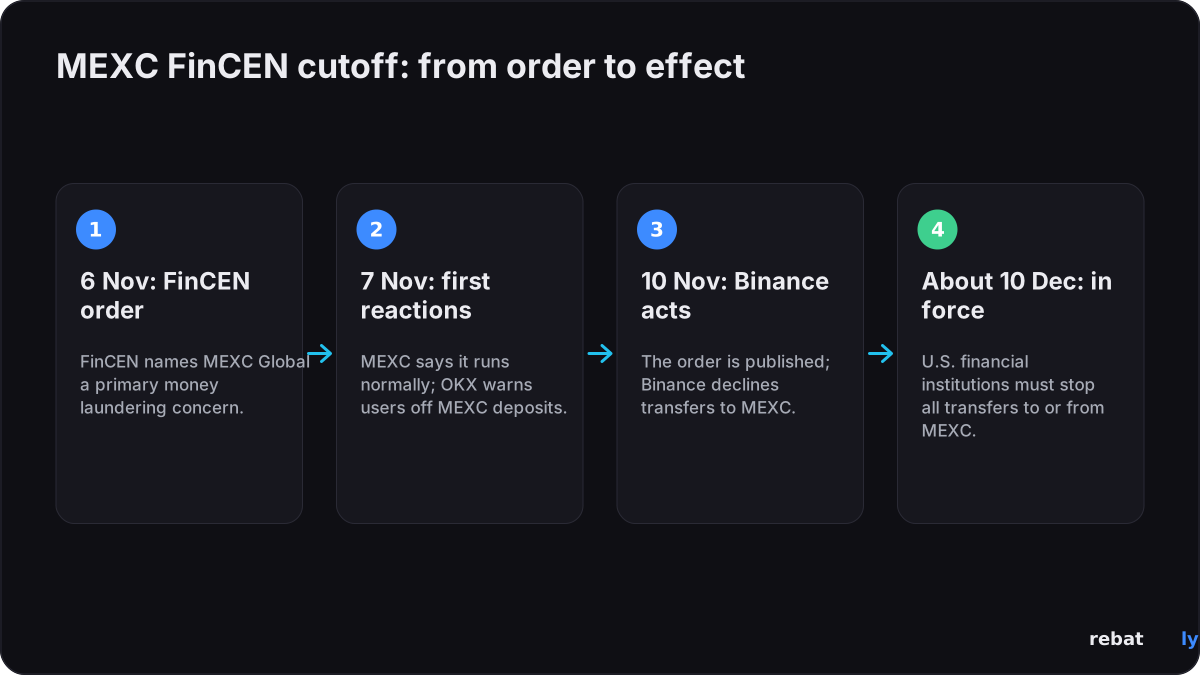
The MEXC FinCEN cutoff will shut one of the world's 20 largest crypto exchanges out of the U.S. financial system. On 6 November 2026 the U.S. Treasury's Financial Crimes Enforcement Network (FinCEN) named MEXC Global a "primary money laundering concern" and ordered U.S. financial institutions to stop all transfers to and from it. FinCEN says MEXC handled at least $16 billion in likely illicit funds from May 2021 to May 2026. The order takes effect 30 days after its publication on 10 November, but Binance said on 10 November it is already declining transfers to MEXC. MEXC says it is operating normally and has started an independent review. This article sets out what FinCEN ordered and alleges, what MEXC says, what Binance and OKX are doing, and what users should watch.
 NO KYCSign up to BloFin
 Sign up to Bybit
 Sign up to OKX
 Sign up to Bitget
 Sign up to MEXC
 Sign up to OrangeX
 Sign up to Toobit
What FinCEN ordered against MEXC
The order is a "special measure" under section 9714 of the Combating Russian Money Laundering Act, a law aimed at financial institutions outside the United States that are linked to Russian illicit finance. FinCEN finds that MEXC Global is of "primary money laundering concern" and bars every U.S. financial institution from sending funds to MEXC or receiving funds from it. The main points, from the order published in the Federal Register and the Treasury press release:
| Item | Detail | Source |
|---|---|---|
| Announced | 6 November 2026, as part of Treasury's "Operation Economic Outcast" | U.S. Treasury, FinCEN |
| Published | Federal Register, 10 November 2026 (document 2026-22962) | Federal Register |
| Takes effect | 30 days after publication, which points to 10 December 2026; no end date | Federal Register (date: our calculation) |
| What is banned | Any transmittal of funds, including crypto, from or to MEXC Global by a U.S. financial institution | FinCEN order |
| Who must comply | U.S. financial institutions, including banks, broker-dealers and money services businesses; willful breaches can bring civil or criminal penalties | FinCEN order |
| MEXC companies named | MEXC Global Ltd and MX Global Ltd (Seychelles), MEXC Estonia OÜ, GIDA Technology AG (Switzerland), MXC Global Ltd (UK), the former Singapore companies MEXC Global Foundation Ltd and MEXC Singapore Pte Ltd, and any successor | FinCEN order |
| Signed by | Jimmy L. Kirby, Deputy Director of FinCEN | FinCEN order |
What FinCEN says MEXC did
FinCEN's case rests on its own analysis of blockchain data from May 2021 to May 2026. These are FinCEN's assessments; they have not been tested in court, and MEXC has not been charged with a crime. The Treasury press release and most outlets, including Decrypt and BleepingComputer, give the headline total as "at least $16 billion"; the order itself puts it at $16.7 billion. The main figures in the order:
| What FinCEN alleges | Amount | Period |
|---|---|---|
| Total likely illicit activity through MEXC | At least $16.7 billion | May 2021 – May 2026 |
| Exposure to Russian sanctions evasion | Nearly $1.5 billion, of which $232 million was direct with entities sanctioned by the U.S., EU or UK | May 2021 – May 2026 |
| Sanctioned Russian exchanges Garantex and Grinex | About $129 million and $4.1 million, continuing as recently as June 2026 | After their designations |
| Iran-linked transactions | About $1.87 billion, including over $1 billion directly with more than 40 Iranian crypto exchanges | May 2021 – May 2026 |
| Illicit cyber actors (scams, stolen funds, ransomware) | At least $1.99 billion, more than $1 million a day on average | May 2021 – May 2026 |
| Suspected ransomware payments received | More than $37.9 million, linked to over 125 ransomware strains | January 2022 – July 2024 |
What MEXC says about the FinCEN order
• Its statement: on 7 November MEXC said it is operating normally and that "user assets remain secure", BleepingComputer reported. It said it is reviewing the order with its legal and compliance teams and has begun an independent review of its anti-money-laundering and sanctions controls.
• Withdrawals: chief executive Vugar Usi acknowledged higher withdrawal volumes after the order but said deposits and withdrawals were running normally, crypto.news reported. No outflow figure has been published by MEXC.
• Regulators: MEXC says it intends to engage constructively with FinCEN and other authorities, Bitcoin.com reported.
• Earlier steps: in October MEXC said it would wind down services in France, CoinMarketCap reported, and exit Russia and Belarus, crypto.news reported.
FinCEN's order also lists earlier regulator warnings that MEXC operated without a licence in Seychelles (May 2026), Hong Kong (March 2024) and Japan (April 2023). A company's statement that funds are secure is its own claim; Rebatly cannot verify it.
Binance halts MEXC transfers, and OKX warns users
• Binance: in a notice dated 10 November, Binance said any request to send funds from a Binance account to MEXC or 12 related names, including MEXC Global Limited, MEXC Singapore Pte Ltd and GIDA Technology AG, "will be declined". Deposits from those entities are "temporarily withheld" for a compliance review, and Binance says accounts involved may be restricted or, in some cases, offboarded. Binance did not give a timeline for the reviews, crypto.news noted.
• OKX: founder Star Xu told users on 7 November not to send funds directly from MEXC and warned that such deposits could be frozen, Finance Magnates and crypto.news reported. Bitcoin.com reported that some MEXC users said their deposits at OKX were frozen.
• Others: TechJuice reported that the payment app RedotPay issued a similar notice. User reports also mention held MEXC deposits at Gate, but Gate has not confirmed a general restriction.
Binance and OKX acted before the order takes effect. The order formally binds only U.S. financial institutions; exchanges outside the U.S. are choosing to apply it to protect their own banking and compliance standing.
How the market reacted
The wider crypto market took little notice. At 09:40 UTC on 11 November, CoinGecko showed bitcoin at about $73,514, down 1.1% in 24 hours, and ether at about $2,048, down 2.4%. MEXC's own token, MX, was at about $1.41, down 1.4% in 24 hours and about 9.5% below its 6 November level of $1.56, according to CoinGecko's daily data. MEXC was the ninth-largest spot exchange on CoinMarketCap, with about $812.5 million in 24-hour spot volume, Decrypt reported.
Rebatly does not forecast prices. Our guide to trading costs on big news days shows with real fee rates how limit orders cut costs when markets move fast.
Earlier FinCEN orders against crypto exchanges
FinCEN's order says MEXC handled about 9% of global trading on centralized crypto exchanges as of December 2025, citing CoinGecko data. How it compares with earlier FinCEN actions:
| Target | Date | Power used |
|---|---|---|
| Bitzlato (Hong Kong-registered exchange) | January 2023, the first section 9714 order | Section 9714 |
| PM2BTC (Russia-linked exchanger) | September 2024 | Section 9714 |
| Huione Group (Cambodia) | Final rule October 2025 | Section 311 of the USA PATRIOT Act |
| MEXC Global | Announced 6 November 2026, effective 30 days after 10 November publication | Section 9714 |
What MEXC users should do now
• Official channels only: follow MEXC's announcements on its own website, app and verified accounts. Expect fake "MEXC support" messages, "fund recovery" services and phishing links; no real exchange will ask for your password, 2FA codes or seed phrase. Our article on exchange data breaches and scam messages shows what fake messages look like.
• Check before you move funds: Binance declines transfers to MEXC and holds deposits from it. If you send crypto between MEXC and another platform, check that platform's latest notice first, or the transfer may be held for review.
• Check your own account: on any exchange, review your withdrawal address list, API keys and login devices, and keep 2FA switched on.
• Know what the order covers: it binds U.S. financial institutions, not MEXC's users directly, and it is not an OFAC sanctions listing. It does not freeze balances held on MEXC.
This is general security information, not financial advice.
What happens next
• About 10 December 2026: the ban on U.S. financial institutions dealing with MEXC takes effect, 30 days after the 10 November publication.
• More exchanges: watch for notices from other exchanges and payment firms; Binance and OKX acted within days.
• MEXC's review: MEXC says an independent review of its anti-money-laundering and sanctions controls is under way; it has not said when results will be published.
• FinCEN: the order has no end date, and FinCEN reserves the right to set conditions or grant exemptions.
We will update this article as FinCEN, MEXC or the exchanges publish more.
Trade with lower fees
Whichever exchange you use, every trade carries a fee. Sign up through Rebatly and part of every trading fee comes back to you: up to 50% on Bybit and Bitget, up to 40% on BloFin and OKX, up to 60% on MEXC and up to 65% on OrangeX futures. On Toobit, code Rebatly gives up to 60%, credited by Toobit itself, and BloFin credits up to 40% itself every hour; the other rebates are paid daily in USDT. Our guide to how a fee rebate works explains the rest.
This article reports news and is not financial advice. Rebatly is an independent affiliate; not financial advice.
Get fees back on every trade
$10M+ rebates paid · Paid daily in USDT · No password or API keys, ever
Already signed up? Check your link and rebate with @rebatlybot on Telegram, or reach our support at @rebatly.
🔔 Get a Telegram alert each time your rebate is paid: tap “Activate notifications” in @rebatlybot. New to trading? Your first trade in 5 steps.
November 11, 2026 — published. Sources: FinCEN, U.S. Treasury, Federal Register, Binance, MEXC, Decrypt, crypto.news, Bitcoin.com, BleepingComputer, Finance Magnates, CoinMarketCap, TechJuice, CoinGecko.