Why is Nvidia stock down? The Huang probe, resignation calls, a shareholder lawsuit, Google's chips and what it means for crypto
Update, 12 November 2026: Jensen Huang resigned as Nvidia's president, chief executive and board member, effective immediately, Nvidia's board announced. Decrypt reported that chief financial officer Colette Kress was named interim CEO. The rest of this guide was written before the resignation.
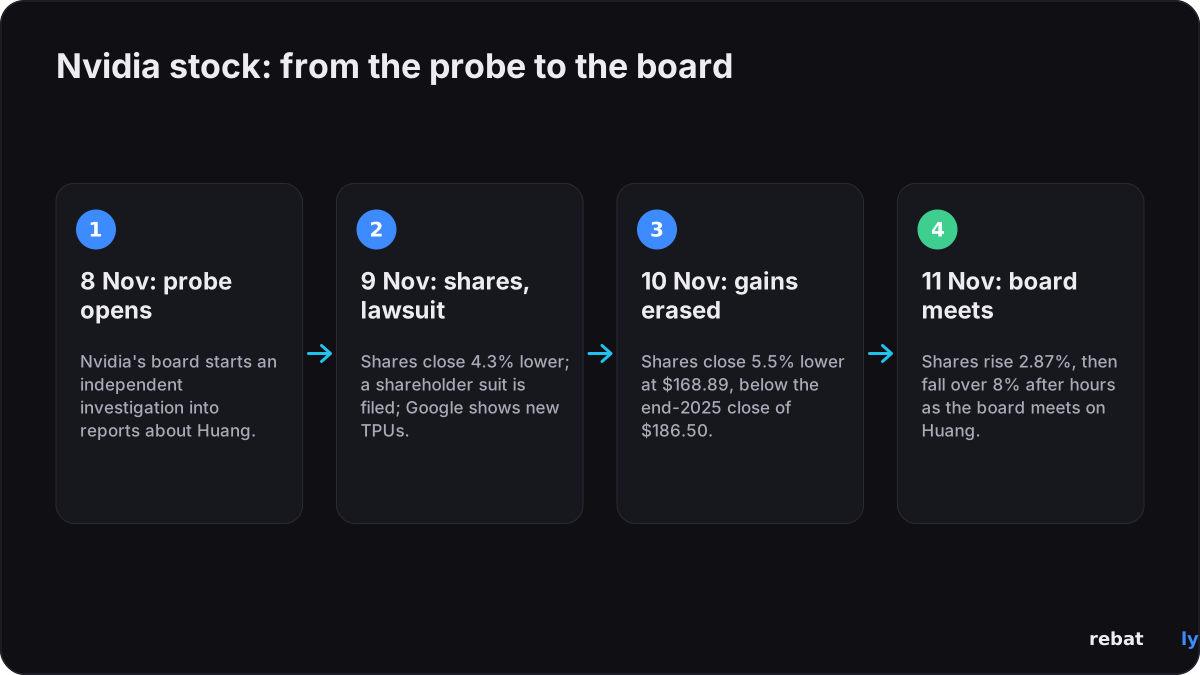
Why is Nvidia stock down? The shares fell 4.3% on Monday 9 November 2026 and 5.5% on Tuesday 10 November, closing at $168.89, below the $186.50 they ended 2025 at, so Nvidia has given back all of its 2026 gains. Decrypt put the two-day loss in market value at roughly $430 billion. The causes have piled up in one week: the board's investigation into reports that CEO Jensen Huang was the target of a foreign intelligence effort, calls in Congress for him to resign, a shareholder lawsuit filed on 9 November and two new AI chips from Google. After a 2.87% rebound on 11 November, the stock fell more than 8% in after-hours trading as the board met to decide Huang's future, according to Reuters, CNBC and NBC News. As of 06:45 UTC on 12 November, Nvidia had announced no decision. This article sets out the numbers, the causes and why crypto traders are watching. For the background to the probe, see our guide to the Jensen Huang investigation. All times are UTC.

 NO KYCSign up to BloFin
 Sign up to Bybit
 Sign up to OKX
 Sign up to Bitget
 Sign up to MEXC
 Sign up to OrangeX
 Sign up to Toobit
Nvidia stock price: the slide in numbers
Closing prices and moves below come from Decrypt, CNBC, CoinDesk and Law Commentary; the after-hours figures from Al Jazeera, NBC News and Reuters via France 24:
| Date (UTC) | Nvidia shares | What was reported |
|---|---|---|
| 6 October 2026 | Record of about $243 | The peak before the slide (CoinDesk; Decrypt gives $243.37) |
| 6 November 2026 | Closed at $186.64 | Close before the board's statement; the 2025 close was $186.50 |
| 9 November 2026 | Down 4.3% to $178.67 | First session after the board's investigation; about $190 billion of market value lost (Decrypt); CoinDesk put it at more than $250 billion during the day |
| 10 November 2026 | Down 5.5% to $168.89 | 2026 gains erased; market value dipped below $4 trillion during the day but closed above it (CNBC) |
| 11 November 2026 | Up 2.87% to about $173.7 | Rebound in the regular session (CNBC) |
| 12 November 2026, 01:00 | About $158.78 after hours | Down 8% to 9% after reports that the board was meeting on Huang's future |
By our calculation from these closes, the 10 November close was about 9% below the end of 2025 and about 30% below the October record. Estimates of the market value lost differ because outlets measure different periods: Decrypt reported roughly $430 billion for 9 and 10 November, and Reuters reported that, if the after-hours fall held, Nvidia would have lost about $600 billion since the board announced its investigation. After-hours prices are thin and can change before the next session.
Why Nvidia stock is down: the causes
Outlets tie the fall to several things at once, not a single headline:
• The Huang investigation: on 8 November Nvidia's board opened an independent investigation after reports that Huang "has been the target of a foreign intelligence effort". On 10 November the independent directors said they had retained former acting US Attorney Joon H. Kim and his firm, Wachtell, Lipton, Rosen & Katz. Our investigation guide covers how it began.
• The board meeting: on 11 November The Wall Street Journal reported that the board was preparing to remove Huang, minutes after a New York Times report of a second alleged relationship with an employee. CNBC confirmed that the board was meeting that evening to decide whether to oust him. Bloomberg reported that the board had been working with an outside firm to identify possible replacements, citing a person familiar with the matter.
• Resignation calls and a subpoena threat: see the section on Congress below.
• A shareholder lawsuit: filed on 9 November in federal court in San Jose, California (details below).
• Google's new AI chips: on 9 November Google announced the TPU 8tx and TPU 8i Max, adding to the competition Nvidia faces (details below).
• A wider AI sell-off: Nvidia was already falling before the investigation. It fell more than 9% on 5 November in a broad sell-off of AI stocks, and CNBC reported that the stock was on pace for its sixth straight weekly fall. Morgan Stanley dropped Nvidia from its top-pick list after a fall of more than 25% since 2 October, CNBC reported.
Jensen Huang resign calls and the subpoena threat
• Senator Kevin Cramer (Republican, North Dakota) told CNBC on 11 November: "As a matter of his own conscience, he should resign." He told Politico earlier that "I just think he's got to go", Decrypt reported.
• Representative Suhas Subramanyam (Democrat, Virginia) told CNBC: "Jensen Huang should resign from Nvidia." Representative Don Bacon (Republican, Nebraska) said "From the little I know, yes" when asked if Huang should step down.
• Larry Kudlow said on Fox Business: "Step down, Mr. Huang, right now", Decrypt reported.
• The subpoena threat: three House committee chairs, Brian Mast (Foreign Affairs), John Moolenaar (China select committee) and Rick Crawford (Intelligence), asked Huang on 4 November for a closed-door briefing on 18 November and set a reply deadline of 11 November. Asked whether he would subpoena Huang if he did not respond, Mast said "absolutely", ABC News reported. As of the latest reports, no subpoena had been issued and Huang had not replied.
• The White House: President Trump said on 9 November that he had asked Huang whether he knew the woman was a spy: "He said, 'I had no idea that she was a spy,' and I really believe him," ABC News reported.
• China called the allegations "baseless and purely slanderous smears", according to ABC News.
The intelligence claims are reports and allegations. US officials have not published evidence, and no one has been charged.
The Nvidia lawsuit: what shareholders claim
• Court and date: a proposed class action was filed in the US District Court for the Northern District of California, in San Jose, on Monday 9 November 2026, just after the market closed, Decrypt reported, citing Reuters.
• Who is suing: shareholder Mark Kistenmacher, represented by the Rosen Law Firm, against Nvidia and Huang (CNBC, Decrypt).
• The claims: fraud claims under Section 10(b) of the Securities Exchange Act and Rule 10b-5 against both, and a control-person claim under Section 20(a) against Huang.
• What it alleges: that Nvidia and Huang made false or misleading statements about his relationship with a former executive of Megaspeed, a Singapore-based buyer of Nvidia chips, whom US officials reportedly suspect of working for Chinese intelligence, and about the risk this created.
• Class period: 9 October 2025 to 8 November 2026. It asks for unspecified damages and a jury trial.
The allegations have not been tested in court, and a judge has not yet decided whether the case can go ahead as a class action. Nvidia did not immediately respond to requests for comment, Law Commentary reported, citing Politico.
Google's AI chips: the competition angle
On 9 November Google announced two more members of its eighth-generation TPU line, Decrypt reported:
• TPU 8tx: built for confidential computing, with Google claiming latency cut by up to half compared with the TPU 8t.
• TPU 8i Max: two TPU 8i chips in one package, aimed at very long AI context windows. Google's Amin Vahdat said it "is built for a different problem: the memory wall."
• Price and timing: Google did not disclose pricing or availability dates, Decrypt reported; CoinDesk said the chips are planned for next year. Google compared them with its own older hardware, not with Nvidia's.
• The pressure on Nvidia: Bloomberg Intelligence analysts estimate Google's TPUs cost about 30% less than Nvidia's GPUs, CoinDesk reported. On 9 November Alphabet rose while Nvidia fell, and CNBC reported that rival chipmakers AMD and Broadcom gained about 13% and 10%.
What Nvidia and its board have said
• 8 November: the board said it "has no reason to believe that either national security or NVIDIA secrets were compromised" and that it "has confidence in Jensen and his leadership team". It said it will provide further updates "as appropriate".
• 8 November: in a message to staff, Huang admitted he had been unfaithful to his wife, said he supports the investigation and will "cooperate fully", and said he is "fully committed to NVIDIA".
• 10 November: the independent directors named Joon H. Kim and Wachtell, Lipton, Rosen & Katz to run the investigation.
• 11 November: Nvidia did not respond to requests for comment on the board meeting, CNBC, NBC News and Reuters reported.
As of 06:45 UTC on 12 November, Nvidia's newsroom showed no statement on the board meeting. Reports that the board will remove Huang rest on unnamed sources and are not confirmed by Nvidia.
What analysts say
These are named analysts' views as reported, not Rebatly's:
• Dan Ives (Yorkville Ives) wrote on 10 November that the Street was "assigning roughly a 15% chance he is removed as CEO", CNBC reported. In a later note he called Huang the "hearts and lungs" of Nvidia and wrote that "Jensen is not replaceable", Al Jazeera reported.
• Jay Goldberg (Seaport Research Partners) told Al Jazeera: "Jensen is Nvidia; without him, the company loses its central, animating spirit."
• Armina Rosenberg (Minotaur Capital) said: "The market is starting to price Nvidia without its founder as the likely outcome, not a tail risk," Reuters reported.
• John Blank (Zacks) told CNBC: "It's not good for Nvidia. It's not good for Jensen Huang. It's certainly not good for the AI trade."
• Vivek Arya (BofA) set out scenarios that include "adverse findings, leadership disruption or tighter restrictions requiring earnings reassessment", CNBC reported.
What Nvidia's slide means for crypto markets
• NVDA perps traded while Wall Street was shut: on Sunday 8 November, before US markets opened, Hyperliquid's Nvidia perpetual fell as low as $180.15 on $200 million of volume by 20:30 UTC, CNBC reported. After the 11 November close it fell as much as 10% to a low of about $156.14 and traded at $158.86 at 00:50 UTC on 12 November, The Block reported. Combined NVDA perp volume across exchanges hit a record of over $4 billion, with Binance about 44% of it, CoinDesk reported, citing CoinGlass. CoinDesk said NVDA perps on Binance, OKX and Bybit showed similar falls.
• Tokenized Nvidia: xStocks' NVDAx token fell as much as 9% before steadying at about $159.51, The Block reported.
• Bitcoin: bitcoin fell to about $73,761 late on 8 November, its lowest since August, and more than $1 billion of leveraged crypto positions were liquidated in 24 hours, CoinDesk reported, citing CoinGlass. CoinGecko showed bitcoin at about $73,500 at 06:47 UTC on 12 November, little changed in 24 hours, and ether at about $2,043. CoinDesk noted that bitcoin "has occasionally shown a strong positive correlation with NVDA": both trade as risk assets, so a big move in the largest AI stock can shift the mood in crypto too.
• Prediction markets: late on 11 November Polymarket put the chance that Huang resigns or is removed by the end of the year at 88%, Reuters reported. These odds move quickly.
Rebatly does not forecast prices. For how scheduled US events affect trading costs, see our guide to FOMC and crypto trading costs, and for the wider crypto fall, why is bitcoin down today.
Bitcoin miners, AI hosting and Nvidia chips
Many bitcoin miners now rent out Nvidia GPUs for AI work, which ties part of the mining sector to the AI trade:
• HIVE Digital reported on 9 November that revenue from its BUZZ HPC unit rose 70.7% from a year earlier to $8.8 million, mainly from an Nvidia B200 GPU cluster in Manitoba, Canada. It has contracts covering 2,304 Nvidia GB200 and 2,016 GB300 GPUs.
• IREN agreed in May 2026 to provide dedicated GPU services to Nvidia at its Childress, Texas, sites over five years, according to its quarterly filing.
• Shares: IREN, Cipher Digital and CoreWeave were down 70% or more from their highs, CoinDesk reported on 9 November.
What traders should know
• Weekend and overnight gaps: stock perps and tokenized shares trade around the clock, while Nvidia's shares trade on a fixed schedule. Prices can gap when news breaks while the US market is closed, as they did on 8 and 11 November.
• Check the contract: read the venue's own page for an NVDA perp's funding rate, leverage limits and trading hours before using it. Our guide to Bybit stock perp fees explains how those costs work.
• Official sources: for decisions on Huang, rely on Nvidia's newsroom and SEC filings, not screenshots or posts on social media.
• Bybit TradFi perps: Bybit lists an NVDAUSDT perpetual among its TradFi perps, and Rebatly's Bybit rebate applies to the trading fees on those contracts.
This is general information, not financial advice.
What happens next
• The board's decision: the board met on 11 November to decide Huang's future, and Bloomberg reported a conclusion could take several hours. Any decision would come from Nvidia's newsroom or an SEC filing.
• Congress: the reply deadline for the 18 November briefing passed on 11 November. Mast has said he would issue a subpoena if Huang did not respond.
• 17 November, Nvidia earnings: Nvidia reports results for the third quarter of fiscal 2027 at about 21:20 UTC, with the conference call at 22:00 UTC.
• The lawsuit: the case is at an early stage. A judge will decide later whether it can proceed as a class action.
• The investigation: Ives said a board review could take four to six weeks, CNBC reported. Nvidia has given no timeline.
We will update this article when Nvidia, its board or Congress publish more details.
Trade with lower fees
Whichever exchange you use, every trade carries a fee. Sign up through Rebatly and part of every trading fee comes back to you: up to 50% on Bybit and Bitget, up to 40% on BloFin and OKX, up to 60% on MEXC and up to 65% on OrangeX futures. On Toobit, code Rebatly gives up to 60%, credited by Toobit itself, and BloFin credits up to 40% itself every hour; the other rebates are paid daily in USDT. Our guide to how a fee rebate works explains the rest.
This article reports news and is not financial advice. Rebatly is an independent affiliate; not financial advice.
Get fees back on every trade
$10M+ rebates paid · Paid daily in USDT · No password or API keys, ever
Already signed up? Check your link and rebate with @rebatlybot on Telegram, or reach our support at @rebatly.
🔔 Get a Telegram alert each time your rebate is paid: tap “Activate notifications” in @rebatlybot. New to trading? Your first trade in 5 steps.
November 12, 2026 — published. Sources: Nvidia, CNBC, Reuters, Decrypt, CoinDesk, The Block, Al Jazeera, NBC News, ABC News, France 24, Law Commentary, HIVE Digital, IREN, CoinGecko.