SBI Solana Global: SBI and SMFG launch a Solana venture for stablecoins and tokenization
SBI Solana Global, a joint venture of SBI Holdings, Sumitomo Mitsui Financial Group (SMFG) and the Solana Foundation, began full-scale operations on 25 November 2026. The three partners said they had completed the agreements to turn SBI R3 Japan into the new venture, Cointelegraph and CoinPost report. It will build stablecoin payment rails and help issue tokenized bonds, funds and other assets on Solana, starting in Japan and then expanding into Asia. The ownership split, the first product and its launch date have not been published. This article explains what the venture will do, how it fits Japan's stablecoin rules and why the partners chose Solana.






What was announced
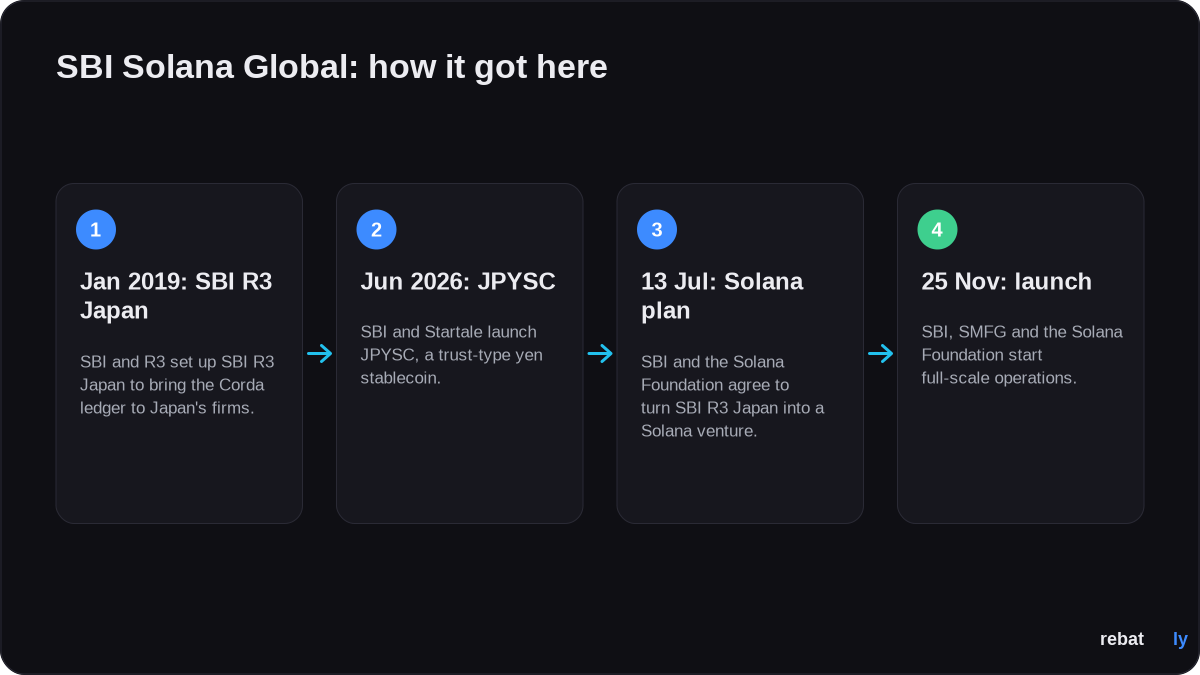
The 25 November announcement completed a plan that SBI Holdings and the Solana Foundation first set out on 13 July 2026. The main facts below come from the company's own website, SBI Holdings and news reports. CoinPost discloses that it is a consolidated subsidiary of the SBI group.
| Item | What is published | Source |
|---|---|---|
| Company | SBI Solana Global Co., Ltd., formerly SBI R3 Japan Co., Ltd., based in Tokyo | SBI Solana Global, Atarashii Keizai |
| Partners | SBI Holdings, Sumitomo Mitsui Financial Group (SMBC Group) and the Solana Foundation | Cointelegraph, CoinPost |
| Start | Full-scale operations announced on 25 November 2026 | CoinPost, crypto.news |
| Ownership split | Not disclosed | CoinPost, Atarashii Keizai |
| Blockchain | Solana, a public layer 1 network | SBI Holdings, SBI Solana Global |
| Market | Japan first, then Asia and global markets | SBI Solana Global, NADA NEWS |
| Partner scale | More than $2.3 trillion in combined assets and more than 80 million customers at SBI and SMFG | Solana (post on X) |
| Launch date of first service | Not announced | Cointelegraph, Ledger Insights |
What SBI Solana Global will do
The company lists four business lines on its SBI Solana Global website:
• Payment rails: stablecoin infrastructure for payments and remittances inside Japan and across borders, including small payments made by AI agents.
• Tokenized financial assets: help to issue and distribute bonds, investment funds and loan receivables on a blockchain, to widen funding options and investor access.
• Tokenized real-world assets: commodities and other rights turned into tokens, with tools to prove where an asset came from and who held it.
• On-chain asset management: new investment services built on stablecoins and tokenized assets, which the company says it is still studying.
In the medium to long term, the aim is to connect payment, issuance, distribution and asset management in one on-chain system, Atarashii Keizai reports. In July, SBI also listed support for the issuance and distribution of stablecoins "including JPYSC" and on-chain services for institutional investors. JPYSC is not named in the November list of four business lines, CoinPost notes. This is a business plan, not a product you can use today.
Which stablecoins are involved
The venture has not said which stablecoin its payment rails will use first. Two coins already sit inside the SBI group, Cointelegraph and TokenPost report:
• JPYSC: a yen stablecoin launched in June 2026 by SBI and Startale. It is issued by SBI Shinsei Trust Bank and distributed by SBI VC Trade, and Japan FinTech Observer reports it is the first "Type 3" (trust-type) electronic payment instrument under Japan's Payment Services Act. At launch it could only be held in SBI VC Trade accounts, according to reports.
• USDC: Circle's dollar stablecoin, which SBI VC Trade has offered for trading since March 2025.
So the group has both a yen coin and a dollar coin. Whether SBI Solana Global will issue or settle JPYSC on Solana is not confirmed, crypto.news notes. Treat any "SBI Solana token" or presale as a likely scam: no such token has been announced.
From Corda to Solana: the history
SBI R3 Japan was set up in January 2019 by SBI and R3, the developer of the Corda ledger for financial firms, Atarashii Keizai reports. SMBC joined in 2020: it took 14%, leaving R3 with 35%, Ledger Insights reports. The company's own record lists 5 commercial projects from 2021 to 2024, including Toyota Tsusho's T-Block Sign and the regional currency platform Machi no Wa.
In May 2025, R3 and the Solana Foundation agreed to connect Corda directly to Solana, so that assets issued on Corda could also trade on Solana, Atarashii Keizai reports. The new structure replaces R3 with the Solana Foundation as a partner. Ledger Insights says it seems likely that the foundation took over R3's stake, but that is its reading, not a published figure.
Why Japan's banking groups are moving on-chain
The partners give three main reasons in their own words.
• Faster, all-hours settlement: the aim is infrastructure that lets assets be issued, traded and settled on-chain across borders and outside normal market hours, Crypto Briefing reports.
• Global reach: SBI Holdings said in July that Japan has deep pools of financial assets and many market participants, and that the plan is to link Japan's home market directly to global liquidity and make Japan Asia's hub for on-chain finance.
• Rules that came early: SBI also pointed to a legal framework "that has advanced ahead of many other jurisdictions".
Hong Kong is moving in the same direction. Our article on the BlackRock tokenized money market fund in Hong Kong shows how a licensed stablecoin there pays for fund units.
How it fits Japan's stablecoin rules
Japan amended its Payment Services Act in June 2022, and the stablecoin rules took effect on 1 June 2023. They treat fiat-backed stablecoins as "electronic payment instruments", and the Financial Services Agency (FSA) supervises the firms involved. There are three types of issuer:
| Issuer type | How it works | Example |
|---|---|---|
| Bank | Issued by a bank as a deposit-like liability | — |
| Funds transfer provider | Licensed money-transfer firm; per-transfer limit of 1 million yen | JPYC, first issued October 2025 |
| Trust company or trust bank | Backing assets are held in trust for holders, apart from the issuer's own money | JPYSC (SBI Shinsei Trust Bank), June 2026 |
What the rules mean for the venture
• Who can issue: only banks, licensed funds transfer providers and trust companies. SBI Solana Global's published plans speak of supporting issuance and distribution; it has not said it will issue a coin itself.
• Who can distribute: selling or exchanging these coins needs a separate registration as an electronic payment instruments exchange service provider. SBI VC Trade distributes JPYSC.
• Why the trust type matters: because JPYSC is trust-based, it is not bound by the 1 million yen transfer limit that applies to funds-transfer coins, Japan FinTech Observer reports. That makes it more useful for large business payments.
• Tokenized securities: tokenized bonds and funds are securities, not stablecoins, and fall under Japan's securities law.
Rebatly reports this as news and explains the rules in general terms. It is not legal advice.
Why Solana, according to the partners
The sources explain the choice of Solana only in general terms. We found no statement comparing it with other blockchains.
• Speed and cost: SBI Holdings called Solana a layer 1 blockchain "known for world-class throughput, low transaction costs and one of the industry's largest ecosystems".
• One network for many assets: the SBI Solana Global website says Solana lets assets and services connect on a single chain, which it wants to use for asset management.
• Token features: for real-world assets, the website points to extensions that build rights into tokens and to compression technology for issuing tokens in large numbers.
• A bridge already built: since the 2025 R3 deal, Corda Enterprise can lock an asset on Corda and issue a matching token on Solana, Atarashii Keizai reports.
How the market reacted
At 05:20 UTC on 26 November, CoinGecko showed Solana (SOL) at about $71.18, up about 3.7% in 24 hours, and bitcoin at about $60,881, up about 2.9%. We found no evidence linking those moves to the announcement. The $2.3 trillion figure is the size of the partners' balance sheets, not money moving onto Solana, crypto.news points out.
Rebatly does not forecast prices. Our guide to trading costs on big news days shows how limit orders can cut costs when prices move fast.
What to watch for
• Fake tokens and airdrops: SBI Solana Global has not announced a token. Treat any "SBI Solana" coin, presale or airdrop as a likely scam, and check news only on the companies' official websites.
• Stablecoin is not a deposit: read who issues a stablecoin and how it is backed before you use it.
• Protect your accounts: use official channels only, never share passwords or 2FA codes, and check API keys and your withdrawal whitelist. Our article on exchange data breaches and scam messages shows what fake messages look like.
This is general security information, not financial advice.
What happens next
• First product: which service goes live first, and when. No date has been given.
• Ownership: whether the partners publish each one's stake.
• JPYSC on Solana: whether the yen coin is issued or settled on Solana, and whether it can leave SBI VC Trade accounts.
• Asia: which markets follow Japan, and whether the payment network grows into remittances across Asia.
Trade with lower fees
Whichever exchange you use, every trade carries a fee. Sign up through Rebatly and part of every trading fee comes back to you: up to 50% on Bybit and Bitget, up to 40% on BloFin and OKX, up to 60% on MEXC and up to 65% on OrangeX futures. On Toobit, code Rebatly gives up to 60%, credited by Toobit itself, and BloFin credits up to 40% itself every hour; the other rebates are paid daily in USDT. Our guide to how a fee rebate works explains the rest.
This article reports news and is not financial advice. Rebatly is an independent affiliate; not financial advice.
Get fees back on every trade
$10M+ rebates paid · Paid daily in USDT · No password or API keys, ever
Already signed up? Check your link and rebate with @rebatlybot on Telegram, or reach our support at @rebatly.
🔔 Get a Telegram alert each time your rebate is paid: tap “Activate notifications” in @rebatlybot. New to trading? Your first trade in 5 steps.
November 26, 2026 — published. Sources: SBI Holdings, SBI Solana Global, Solana Foundation, Cointelegraph, CoinPost, Atarashii Keizai, NADA NEWS, crypto.news, Ledger Insights, TokenPost, Crypto Briefing, Japan FinTech Observer, CoinGecko.