South Korea moves to end its 2017 ICO ban: what changes
South Korea's ICO ban, in place since 2017, would end under a draft law the Financial Services Commission (FSC) presented on 24 November 2026 at a meeting that began at 06:00 UTC. Companies could sell new tokens to the public at home again, but only after filing a white paper with the FSC, having it published and waiting through a cooling-off period, the FSC says. False statements would bring damages, fines and criminal penalties. It is a draft, not a law: the National Assembly still has to pass it. This article explains what the draft would allow, why the ban pushed Korean tokens offshore, and what is in force today.






What ending the ICO ban would change
An initial coin offering (ICO) is a sale of new tokens to the public to raise money for a project. South Korea has not allowed one at home since 2017. The draft would allow them, but only on the condition of full disclosure, the Financial Services Commission says. The steps, from the FSC's summary of the bill and the reports that followed:
| Step | What the draft says | Source |
|---|---|---|
| Who files | The issuer and anyone who took an active part in issuing, developing or running the token; a licensed dealer or broker can file instead | FSC, Block Media |
| White paper | Filed with the FSC before any public sale: who is selling, use of funds, number of tokens, the project and its risks, plus a short summary document | FSC, Decrypt |
| FSC review | Checks the documents and can demand corrections; it does not judge whether the project is any good | FSC, Block Media |
| Waiting period | Sales start only after the filing is accepted, published and a waiting period has passed; the FSC gives 7 days as an example | FSC, CoinCodex |
| Investor limits | No separate cap on how much an individual can invest | Electronic Times |
| Exchange listing | A separate step: the exchange files and publishes its own listing report, for example 7 days before trading | FSC, Businesskorea |
| False disclosure | Damages, fines and criminal penalties; up to 5 years in prison or a fine of up to KRW 200 million, reported | FSC, ZDNet Korea |
Why South Korea banned ICOs in 2017
On 29 September 2017 a government task force on virtual currencies, led by the FSC and including the Bank of Korea, the Financial Supervisory Service and the Ministry of Justice, said it would ban all forms of ICO, whatever the technology or name, the FSC announced at the time. Token sales that looked like securities could be punished under the Capital Markets Act, and regulators promised stern penalties, CoinDesk reported.
The ban was a government policy, not a law passed by the National Assembly. That is why the industry welcomes the draft for replacing rule by guidance with written law, Businesskorea reports. Calls to lift it came early:
• May 2018: a special committee of the National Assembly proposed allowing ICOs with investor protection, but the proposal was not binding, CoinDesk reported.
• August 2022: the Bank of Korea said the ban was not effective, because projects issued tokens abroad and listed them at home, and argued for rules in place of a ban, CoinDesk reported.
How the ban pushed Korean tokens offshore
The ban did not stop Korean companies from issuing tokens. Many set up foundations abroad, often in Singapore or Hong Kong, raised money there and then listed the tokens on Korean exchanges. Game makers Wemade, Netmarble and Com2us are the examples Businesskorea gives.
The FSC names this workaround as a reason for the change. Its summary describes an unnamed platform company that set up a foundation in another country in May 2025 to get around the domestic ICO ban, then saw its token trade on Korean exchanges. The draft aims to end this practice of issuing abroad and listing at home, the FSC says.
How a Korean ICO would work under the draft
The FSC models the white paper on the registration statement that companies file before selling shares. Step by step:
• 1. Filing: the issuer, or a licensed dealer or broker acting for it, files a digital asset white paper with the FSC before offering the token to the public. The FSC says a broker can also file for tokens issued abroad, or when the issuer is hard to identify.
• 2. Review: the FSC checks the filing and can demand corrections if key items or attachments are missing. It does not examine whether the project's claims are true, as under the EU's MiCA rules, the FSC and Block Media say.
• 3. Publication: an accepted white paper is published on a planned central disclosure system, with a short summary document for investors.
• 4. Waiting period: the token can be offered only after a waiting period, so investors have time to read. The FSC gives 7 days as an example; the bill as summarised fixes no length.
• 5. Sale: after the offering, the token can change hands over the counter. Trading on an exchange needs a separate listing.
Acceptance of a white paper is not an approval. It does not mean the FSC vouches for the project or for the safety of an investment.
Issuing a token is not listing it
The draft keeps the sale of a token and its listing on an exchange apart. An exchange that wants to list a token must file a listing report with the FSC and publish it, the FSC says. The report covers the issuer, the number of tokens, the project and its risks, at the same level of detail as a white paper; an updated white paper can stand in for it. The FSC gives 7 days before trading as an example of when it must be published.
• Ongoing disclosure: changes in the number of tokens issued or in circulation, hacks and other news that could move the price must be disclosed at once, Businesskorea and the FSC say.
• Listing review: listing still goes through each exchange's own review, Electronic Times reports. One exchange official told ZDNet Korea that listings could become harder than today, which could shrink the market.
Who is liable for a false white paper
The FSC says anyone who must disclose, including their executives, would face strict liability for damages if a white paper or listing report contains false statements or leaves out key facts. The draft also gives the FSC powers to investigate and request documents, and a legal basis for fines and criminal penalties.
ZDNet Korea reported further details on 26 November, which the FSC's public summary does not list:
• Criminal penalty: up to 5 years in prison or a fine of up to KRW 200 million, or both, for false statements or omissions in a white paper, listing report or summary document.
• Who can be punished: issuers, exchanges, and lawyers and accountants who certified a white paper knowing it was false.
• Defences: no liability for damages if a defendant proves they could not have known, or if the investor knew the facts when buying.
These figures are reported, not confirmed by the FSC's published summary.
Proposed vs in force today
Nothing in the draft is law yet. This is what applies today and what the bill would change:
| Topic | In force today | Proposed in the draft |
|---|---|---|
| ICOs | Banned at home since 2017 by government policy | Allowed after a white paper is filed, published and a waiting period has passed |
| Main crypto law | Virtual Asset User Protection Act, in force since 19 July 2024: user deposits and unfair trading | A new, wider digital asset law covering issuance, listing, licences and stablecoins |
| Exchange listings | Each exchange's own rules and review | A published listing report filed with the FSC, plus immediate disclosure of key events |
| Won stablecoins | No legal framework | Bank-majority consortiums with an FSC licence and at least KRW 5 billion in capital |
| Company accounts | Opened in stages since 2025; investment limited to a pilot for listed firms and professional investors | No change reported; the industry says company investment is left out |
How it fits the Digital Asset Basic Act
The ICO rules are one part of a larger bill, formally the Act on the Innovation of the Digital Asset Industry and Protection of Users and often called the Digital Asset Basic Act. The same draft brings in licences for crypto firms, a 20% cap on major shareholders of exchanges and won stablecoins issued by bank-led consortiums, The Block reported. Our article on the South Korea Digital Asset Basic Act covers those parts.
The FSC treats stablecoins and other tokens differently. Won stablecoins, which the draft calls digital payment tokens, need a licence and at least KRW 5 billion in capital, the FSC says. An ordinary token offering needs a white paper, not a licence.
What the industry and critics say
• Welcome: the industry welcomes rules written into law in place of administrative guidance, Businesskorea reports. Hwang Seok-jin, a professor at Dongguk University, told Block Media the draft brings the industry into the regulated system.
• Concern about cost: Hwang also warned that rules at the level of financial firms could hold back new companies and private investment, Block Media reported. An industry source told Newsis that tighter rules could push users to overseas platforms, The Block reported.
• Investor protection: John Cho of Ratio told CoinCodex that the rules would not make ICOs safe but would give retail investors a better basis for decisions.
• Gaps: the industry says the bill leaves out DeFi and investment by companies, Businesskorea reports.
How the market reacted
No source we read links price moves to the ICO plan. At 11:45 UTC on 26 November, CoinGecko showed bitcoin at about $60,691, up about 3.8% in 24 hours, and ether at about $1,699, up about 3.7%.
Rebatly does not forecast prices. Our guide to trading costs on big news days shows how limit orders can cut costs when prices move fast.
What to watch out for
• No legal Korean ICO yet: the rules exist only in a draft. Be wary of anyone who offers a token as a government-approved Korean ICO today.
• Acceptance is not approval: even under the new law, an accepted white paper would not mean the FSC vouches for a project.
• Read the white paper: the point of the rules is disclosure: use of funds, number of tokens and risks.
• Official channels only: check offers against official FSC announcements, and never share passwords, 2FA codes or API keys. Our article on exchange data breaches and scam messages covers common tricks.
This is general information, not legal or financial advice.
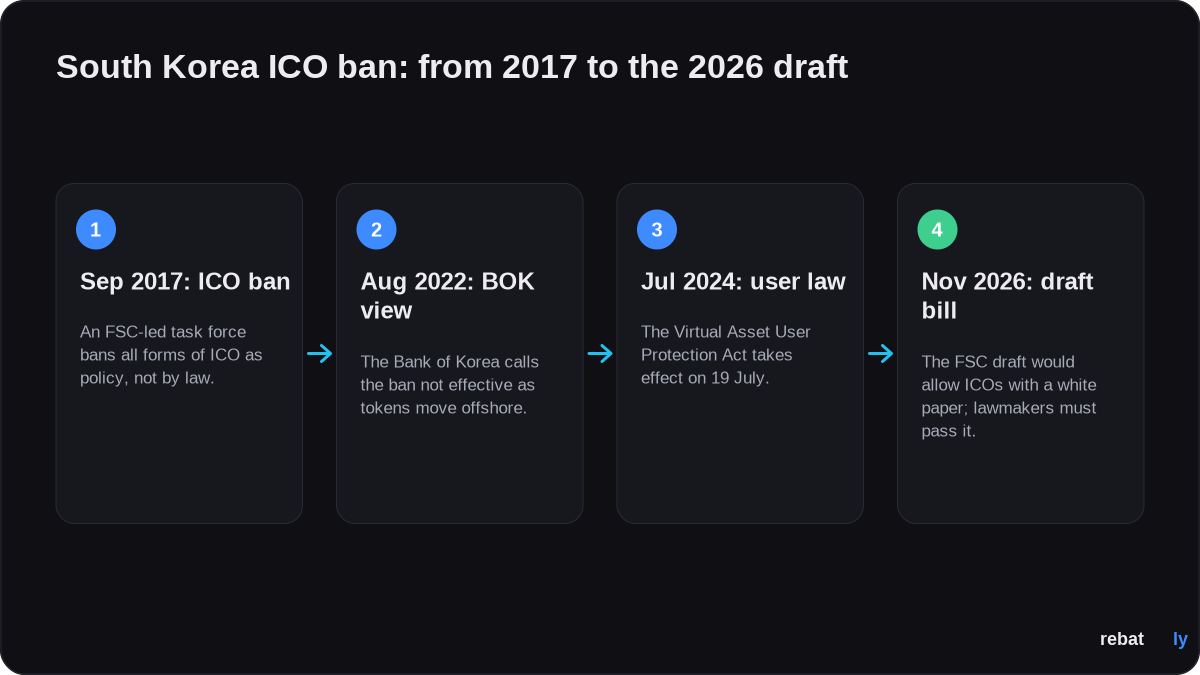
What happens next
• In the Assembly: Yoo Dong-soo, chair of the National Assembly's Political Affairs Committee, tabled the FSC draft as his own bill on 26 November, Block Media reported. Filing it as a lawmaker's bill shortens the steps a government bill needs, such as a public notice period, Block Media wrote.
• Other bills: lawmakers will review it together with earlier crypto bills, including one Min Byung-deok tabled in June 2025, The Block reported. Min plans a public hearing on 4 December, Jaekyung Ilbo reported.
• Timing: FSC chair Lee Eok-won said the government will work to have the bill enacted as soon as possible after full debate. No effective date has been announced.
• Details later: the forms for white papers and which disclosures are mandatory are left to lower rules, the FSC says, and come after the law.
Trade with lower fees
Whichever exchange you use, every trade carries a fee. Sign up through Rebatly and part of every trading fee comes back to you: up to 50% on Bybit and Bitget, up to 40% on BloFin and OKX, up to 60% on MEXC and up to 65% on OrangeX futures. On Toobit, code Rebatly gives up to 60%, credited by Toobit itself, and BloFin credits up to 40% itself every hour; the other rebates are paid daily in USDT. Our guide to how a fee rebate works explains the rest.
This article reports news and is not financial advice. Rebatly is an independent affiliate; not financial advice.
Get fees back on every trade
$10M+ rebates paid · Paid daily in USDT · No password or API keys, ever
Already signed up? Check your link and rebate with @rebatlybot on Telegram, or reach our support at @rebatly.
🔔 Get a Telegram alert each time your rebate is paid: tap “Activate notifications” in @rebatlybot. New to trading? Your first trade in 5 steps.
November 26, 2026 — published. Sources: Financial Services Commission, Block Media, ZDNet Korea, Electronic Times, Businesskorea, Decrypt, The Block, CoinDesk, CoinCodex, Jaekyung Ilbo, CoinGecko.