South Korea Digital Asset Basic Act: what the draft says and what it means for traders
South Korea's government released its draft Digital Asset Basic Act on 24 November 2026, the country's first full rulebook for crypto businesses. The Financial Services Commission (FSC) presented the bill at a meeting that began at 06:00 UTC. It would replace today's notification system with licences, cap any major shareholder of an exchange at 20%, let bank-led consortiums issue won stablecoins backed by at least 100% reserves, and allow domestic token offerings. It is a draft, not a law: the National Assembly still has to pass it. This article sets out what the draft contains, what changes for traders on Korean and offshore exchanges, and what happens next.
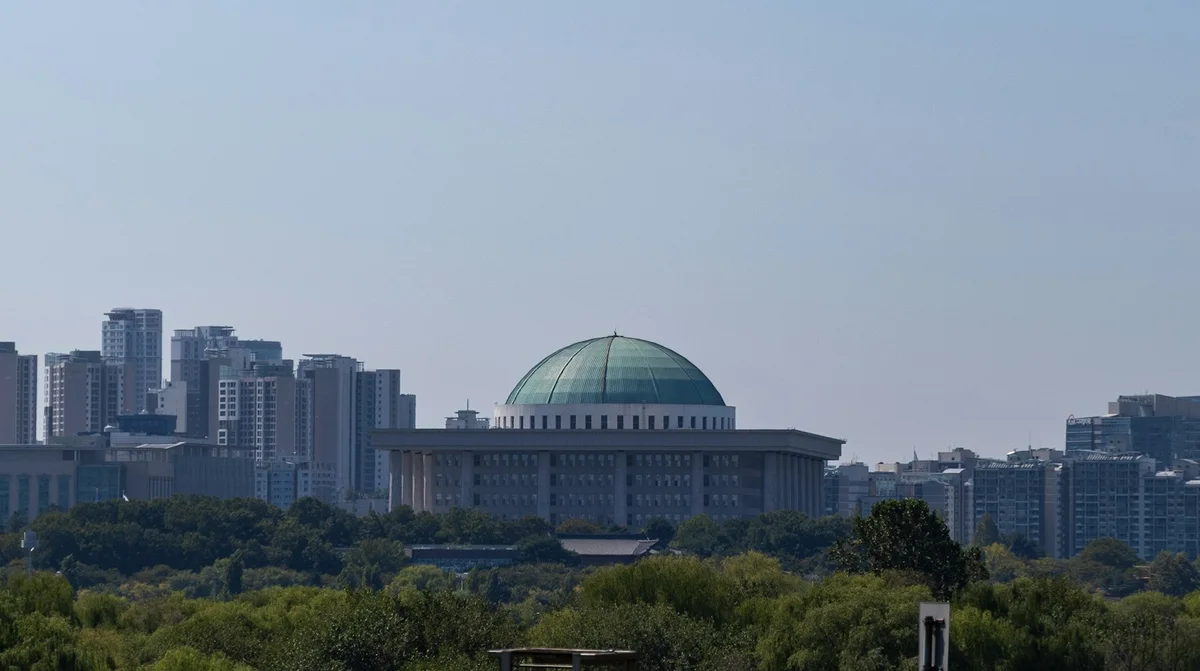





What the draft Digital Asset Basic Act contains
The draft is formally called the Act on the Innovation of the Digital Asset Industry and Protection of Users. It would rename "virtual assets" as "digital assets" and become South Korea's second major crypto law, after the user protection act that took effect in 2024, The Block reported. The main points, from the Financial Services Commission's announcement and the reports that followed:
| Item | What the draft says | Source |
|---|---|---|
| Business licences | Licences for trading, brokerage and custody; registration for asset management; exchanges need all three licences | FSC, The Block |
| Exchange ownership | A major shareholder may hold up to 20%, or up to 34% with FSC approval; 3 years to comply | FSC, CoinDesk |
| Won stablecoins | Bank-majority consortiums first; at least KRW 5 billion in capital; reserves of at least 100%; no interest | FSC, CoinDesk, PANews |
| Foreign stablecoins | Allowed with a local branch and FSC registration | FSC, PANews |
| Token offerings | Domestic ICOs allowed after a white paper is filed with the FSC | FSC, The Block |
| Hacks | Firms compensate users even without fault; fines of up to 10% of revenue | FSC, PANews |
Licences replace the notification system
Today crypto firms in South Korea file a notification with regulators. The draft replaces this with licences by type of business, on the principle of "same risk, same regulation", the FSC says.
• Licence: trading, brokerage and custody (custody includes staking) each need a licence. The FSC lists minimum equity of KRW 2 billion, or KRW 1 billion for firms that handle only stablecoins, with the final amounts set by decree.
• Registration: asset managers that do not hold or move customer assets only register, with equity of at least KRW 500 million.
• Exchanges: a firm that holds all three licences can be designated a digital asset platform operator, The Block and PANews report.
• Duties: 30 days' notice before closing a business, monthly business reports and immediate disclosure of hacks or IT failures.
The 20% cap on exchange shareholders
The most contested part of the draft is a limit on how much of an exchange one major shareholder can own. The FSC sets the cap at 20%, modelled on the rules for alternative trading systems in the stock market. With FSC approval a holder can keep up to 34%, and shares above the cap carry no voting rights. Existing exchanges get 3 years after designation to comply, and the FSC says small and mid-sized exchanges can get up to 3 more years.
Before the release, reports had put the cap anywhere from 15% to 20%, The Block noted. Financial News wrote in an editorial that the owners of the five exchanges with won markets, including Upbit and Bithumb, would have to sell shares, and it expects disputes over property rights. Industry groups say existing platforms face a heavy burden from relicensing and restructuring, The Block reported.
Won stablecoins: bank-led, fully reserved, no interest
The draft calls stablecoins "digital payment tokens": tokens that track the value of a single currency and are used mainly for payments. It settles a long dispute between the FSC and the Bank of Korea over who may issue them, CoinDesk reported.
• Who can issue: at first, only consortiums in which banks together hold a majority. A fintech or tech firm can still be the largest single shareholder, the FSC says.
• Capital: at least KRW 5 billion (about $3.4 million, CoinDesk), plus an FSC licence and an approved issuance plan.
• Reserves: at least 100% of the tokens in circulation, held at banks or other custodians and protected from seizure. Holders are paid first if an issuer fails or is hacked.
• Redemption and interest: tokens are issued and redeemed at face value without delay, and paying interest to holders is banned.
• Large issuers: the FSC can name tokens with KRW 1 trillion or more in circulation as significant, with extra capital and liquidity rules.
Questions remain. Global Economic points out that it is not yet clear how the Banking Act's 15% limit on bank holdings would apply inside a consortium.
Foreign stablecoins such as USDT
Offshore stablecoins such as USDT are not banned. A foreign issuer that is properly supervised at home can issue and redeem in South Korea after opening a local branch and registering with the FSC, and each token must be reported to the FSC. Tokens without an approved or reported issuance plan could not be listed or traded on Korean exchanges, CoinDesk and the FSC say. The draft does not name any specific token as approved.
ICOs, listings and unfair trading
South Korea has not allowed domestic initial coin offerings since 2017. The draft would allow them with full disclosure, The Block reported.
• White papers: an issuer files a white paper with the FSC before any sale. The FSC can demand corrections, and sales start only after the filing is accepted, published and a waiting period has passed.
• Listings: exchanges must file and publish a report on each token they list. False or missing disclosure brings damages, fines and criminal penalties.
• Market makers: licensed firms can provide liquidity under a contract with an issuer or exchange, and exchanges must publish their quote history, The Block reports.
• Unfair trading: the rules cover tokens still under listing review, insider-information bans extend to former staff for 1 year, and coin-to-coin swaps can count as market manipulation. The FSC could freeze accounts or ban trading by its own decision.
Hacks and user protection
Firms would have to compensate users for losses from hacks or IT failures even when they are not at fault. If an incident comes from a breach of IT security duties, the FSC can impose a fine of up to 10% of revenue, the FSC and PANews say. Customer assets must be kept separate and audited, and hacking that steals assets becomes a specific crime. Our article on exchange data breaches and scam messages covers what to watch for after an incident.
What changes for traders, and what does not
The draft is a bill, not a law, so nothing changes for traders today.
• Fees: the draft as reported does not set or cap trading fees on Korean exchanges, and none of the sources we read mention fee rules.
• Korean exchanges: the changes are mostly behind the scenes: new licences, the ownership cap, listing reports and published market-maker data. No-fault hack compensation would be the most direct change for users.
• Stablecoins: won stablecoins would come from bank-led issuers, and USDT on Korean exchanges would depend on its issuer registering in Korea.
• Offshore exchanges: the summaries we read set out no new rules for offshore exchanges. One industry source told Newsis that tighter domestic rules could push users to overseas platforms, The Block reported.
This is general information, not legal or financial advice. Our guide to the cheapest way to trade crypto futures compares trading costs, and our article on the South Korea crypto tax delay covers the tax side.
How the market reacted
Crypto prices were falling on the day, but no source we read links the move to the draft. At 14:19 UTC on 24 November, CoinGecko showed bitcoin at about $60,300, down about 5.1% in 24 hours, and ether at about $1,696, down about 6.6%. USDT traded at about KRW 1,342.
Rebatly does not forecast prices. Our guide to trading costs on big news days shows how limit orders can cut costs when prices move fast.
What happens next
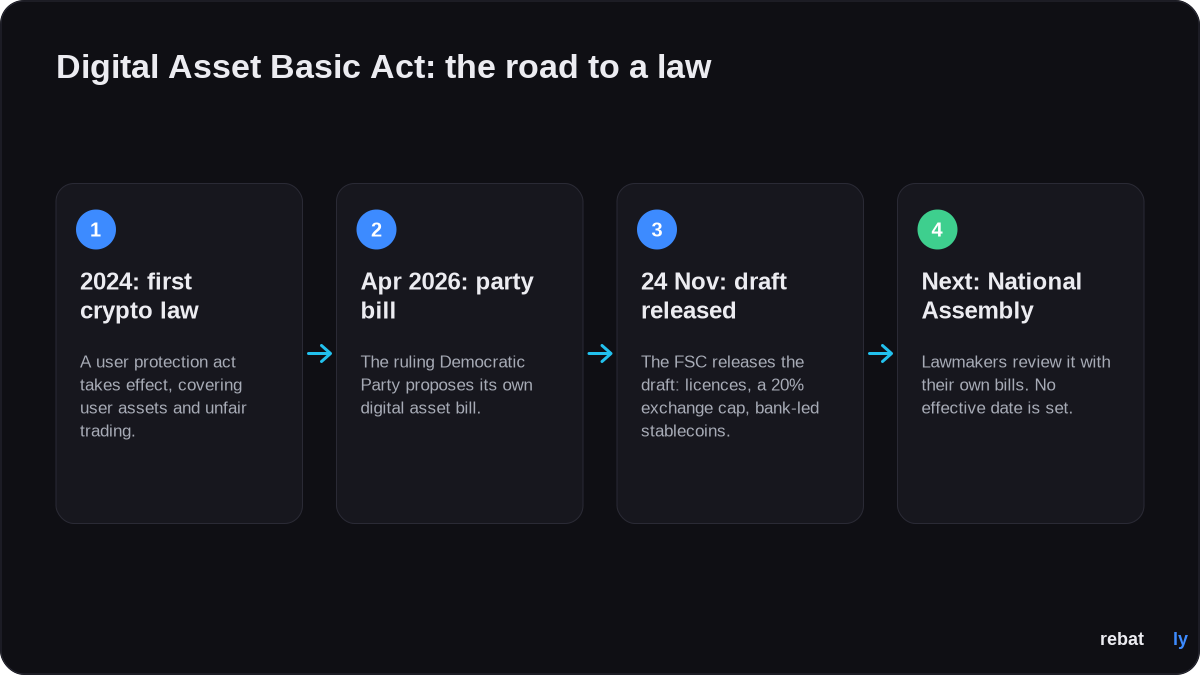
• National Assembly: the draft goes to lawmakers, who are expected to review it together with their own crypto bills, The Block reported. They include a bill the ruling Democratic Party proposed in April 2026, CoinDesk reported. Block Media reported before the release that Yoo Dong-soo, chair of the Assembly's Political Affairs Committee, would table it.
• Timing: FSC chair Lee Eok-won said the government will work to have the bill enacted as soon as possible after full debate. No effective date has been announced.
• Details by decree: capital amounts and the stablecoin shareholder rules are left to presidential decrees, which come later.
• Watch: changes to the 20% cap and to the bank-majority rule for stablecoins, the two points most debated so far.
Trade with lower fees
Whichever exchange you use, every trade carries a fee. Sign up through Rebatly and part of every trading fee comes back to you: up to 50% on Bybit and Bitget, up to 40% on BloFin and OKX, up to 60% on MEXC and up to 65% on OrangeX futures. On Toobit, code Rebatly gives up to 60%, credited by Toobit itself, and BloFin credits up to 40% itself every hour; the other rebates are paid daily in USDT. Our guide to how a fee rebate works explains the rest.
This article reports news and is not financial advice. Rebatly is an independent affiliate; not financial advice.
Get fees back on every trade
$10M+ rebates paid · Paid daily in USDT · No password or API keys, ever
Already signed up? Check your link and rebate with @rebatlybot on Telegram, or reach our support at @rebatly.
🔔 Get a Telegram alert each time your rebate is paid: tap “Activate notifications” in @rebatlybot. New to trading? Your first trade in 5 steps.
November 24, 2026 — published. Sources: Financial Services Commission, The Block, CoinDesk, PANews, Global Economic, Financial News, Block Media, CoinGecko.