Bybit hack: the $1.4 billion postmortem is ready, but Bybit will not publish it
The Bybit hack of 21 February 2025 took about $1.4 billion to $1.5 billion in ether and staked ether from a Bybit cold wallet. On 28 November 2026 CoinDesk reported that Bybit has finished a full internal postmortem of the attack but will not make it public. Bybit's chief technology officer, Rockman Zhang, told CoinDesk the details could help future attackers. This article sets out what the postmortem covers, what is already known about the hack, how much has been traced, frozen and recovered, and what Bybit users can check today.





The Bybit hack postmortem: ready, but private
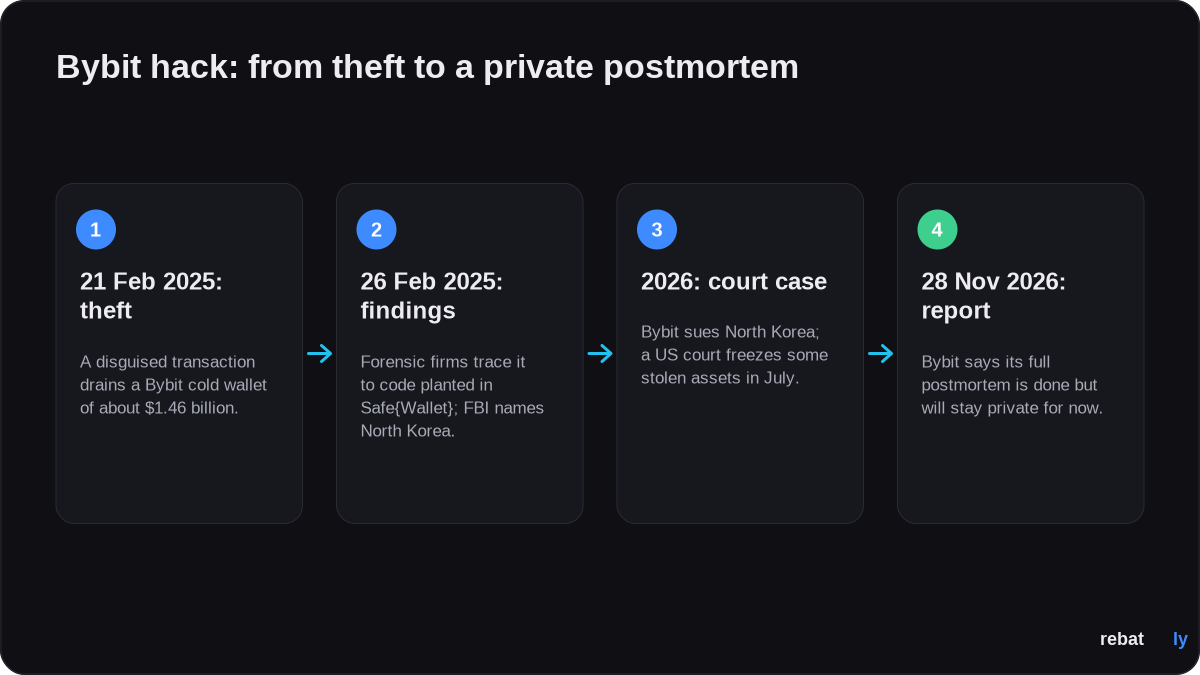
"We have the full postmortem internally already," Zhang told CoinDesk in an interview published on 28 November 2026. According to CoinDesk, the report follows the whole chain of the attack, from the compromised signing interface and the code the attackers injected to the moment they took control of the cold wallet.
• Why it stays private: Zhang said Bybit does not want attackers to learn that much about its systems.
• A promise not kept, for now: Bybit's incident timeline of March 2025 said a full account would follow "shortly". Zhang gave no date for a public version.
• What Bybit says changed: it has rebuilt its cold and hot wallet systems on the assumption that any part could be compromised, and an outside security firm, which CoinDesk does not name, reviewed the incident.
• Bybit's position: Zhang said the breach came through a third-party vendor and that Bybit itself made no mistake.
Without the report, outsiders cannot check what Bybit changed beyond what Bybit says. The public record still rests on the preliminary forensic reports of February 2025 and on Safe's own statements.
What happened in the Bybit hack
On 21 February 2025 Bybit started a routine transfer from an Ethereum multisig cold wallet at 13:30 UTC, according to its own incident timeline. The transaction its signers approved was not what their screens showed: at about 14:13 UTC it handed control of the wallet to the attacker, who emptied it. Blockchain analytics firm Nansen counted what left the wallet:
| Asset | Amount taken | Value at the time |
|---|---|---|
| ETH | 401,347 ETH | About $1.12 billion |
| stETH (Lido staked ether) | 90,376 stETH | About $253 million |
| cmETH (Mantle staked ether) | 15,000 cmETH | About $44 million |
| mETH (Mantle staked ether) | 8,000 mETH | About $23 million |
How much was stolen: $1.4 billion or $1.5 billion?
The totals differ mainly because ether was valued at different moments. Elliptic and CoinDesk put the loss at about $1.46 billion; the FBI, The Block and Arkham use about $1.5 billion; Bybit CEO Ben Zhou, Cointelegraph and Decrypt use about $1.4 billion. Glassnode's count is slightly higher at 403,996 ETH and 91,076 stETH. All agree it was the largest crypto theft on record until the Binance hack of 29 October 2026, about $6.3 billion.
How the Bybit hack happened
Bybit's cold wallet ran on Safe{Wallet}, a widely used multisig service. Two firms hired by Bybit, Sygnia and Verichains, published preliminary reports on 26 February 2025. Both found that malicious JavaScript had been placed in a Safe{Wallet} file stored on Amazon Web Services and that it only targeted Bybit's cold wallet: it changed what the signers saw while sending a different transaction to be signed. Verichains dates the injection to 19 February 2025. Neither firm found any compromise of Bybit's own infrastructure, and the attackers swapped in clean files about two minutes after the theft, the reports say.
Safe said in early March 2025, citing a preliminary review by Mandiant, that a Safe developer's laptop had been infected on 4 February 2025 through a malicious project file, and that the attackers used stolen cloud session tokens to get past multi-factor login checks, according to Decrypt and SecurityWeek. Safe said its smart contracts were not affected. The full Bybit postmortem would show how all of this looked from inside Bybit; that is the part that stays private.
Who is behind the Bybit hack
On 26 February 2025 the FBI attributed the theft to North Korea and named the group it calls "TraderTraitor". Analytics firms TRM Labs and Elliptic assessed it as the work of North Korea's Lazarus Group, and on-chain investigator ZachXBT linked it to earlier attacks. Mandiant tracks the same hackers as UNC4899. The same unit was assessed by TRM Labs as behind the Binance hack of October 2026. Chainalysis counted about $3.4 billion stolen across crypto in 2025, at least $2.02 billion of it by North Korea, with Bybit the largest single case.
What Bybit did: withdrawals, reserves and a bounty
• User funds: on the day, Ben Zhou said Bybit was solvent and that client assets were backed 1:1, and that the exchange would cover the loss.
• Withdrawals: Bybit says it received more than 350,000 withdrawal requests in about 10 hours and kept processing them; Zhou said on 22 February that all of them had been handled.
• Reserves: Bybit refilled its ether through loans, deposits from large holders and purchases; Zhou said the gap was closed on 24 February. A proof-of-reserves report by Hacken said client assets were backed 1:1 within 72 hours.
• Bounty: Bybit set up LazarusBounty.com with a pool of up to $140 million, paying 10% of any funds recovered. It said over $2.2 million had been paid to 12 bounty hunters by 20 March 2025, Cointelegraph reported.
Bybit did not ask Safe for compensation, and we found no lawsuit between the two companies.
Traced, frozen, recovered: where the money went
The attacker swapped most of the ether for bitcoin, mainly through THORChain, and also used the eXch exchange and mixing services, Elliptic and TRM Labs reported. Zhou's own updates show how the trail went cold:
| Update (Bybit CEO) | Still traceable | Gone dark | Frozen |
|---|---|---|---|
| 20 March 2025 | 88.87% | 7.59% | 3.54% |
| 21 April 2025 | 68.57% | 27.59% | 3.84% |
Bybit's lawsuit against North Korea
Bybit has also gone to court. It sued North Korea, its intelligence agency and the Lazarus Group in the US District Court for the District of Columbia; the case was filed under seal on 18 June 2026, and on 30 July 2026 the judge granted a preliminary injunction in part, freezing some of the stolen assets and allowing fast-tracked discovery to trace funds, Decrypt and Cointelegraph reported. Bybit announced the case in August 2026. At that point Bybit said about $48.4 million had been recovered and about $30.5 million frozen across more than 28 platforms, roughly 5% of the loss; these are Bybit's own figures and have not been independently confirmed.
Frozen does not mean returned: frozen funds are blocked where they sit until a court or the platform releases them. There is no final judgment.
Market reaction
The postmortem news did not move prices in any way we could measure. At 15:38 UTC on 28 November 2026 CoinGecko showed ether at about $1,643.95, down 1.8% in 24 hours, and bitcoin at about $59,219, down 1.4%.
Rebatly does not forecast prices. Security headlines can bring fast moves; our guide to trading costs on big news days shows with real fee rates how limit orders cut that cost.
Biggest crypto hacks
Bybit held the record for 20 months:
| Target | When | Stolen |
|---|---|---|
| Binance | October 2026 | About $6.3 billion |
| Bybit | February 2025 | About $1.46 billion |
| Ronin Network | March 2022 | About $625 million |
| Poly Network | August 2021 | About $611 million, mostly returned |
What Bybit users should do
Nothing in this news changes your account. Bybit says client assets were not lost and that it covered the theft from its own funds.
• Follow official channels only: check Bybit's own app, website and verified accounts.
• Expect scams: stories about old hacks bring fake "compensation", "refund" or "bounty claim" messages. Bybit will never ask for your password, 2FA codes or seed phrase. Our article on exchange data breaches and scam messages shows what they look like.
• Check your account: review your withdrawal address whitelist, API keys and login devices, and keep 2FA switched on.
• Know the risk: funds held on any exchange depend on that exchange's security, which is why Bybit's own explanation matters to its users.
This is general security information, not financial advice.
What happens next
• The postmortem: whether Bybit publishes a public version, or a shorter summary, and when. Zhang has listed incident postmortems as a planned topic for Bybit's engineering blog.
• The court case: further freezes or recoveries under the US injunction.
• Binance: Binance has also said some technical details of its own hack will stay confidential.
We will update this article if Bybit publishes the report or new recovery figures.
Trade with lower fees
Whichever exchange you use, every trade carries a fee. Sign up through Rebatly and part of every trading fee comes back to you: up to 50% on Bybit and Bitget, up to 40% on BloFin and OKX, up to 60% on MEXC and up to 65% on OrangeX futures. On Toobit, code Rebatly gives up to 60%, credited by Toobit itself, and BloFin credits up to 40% itself every hour; the other rebates are paid daily in USDT. Our guide to how a fee rebate works explains the rest.
This article reports news and is not financial advice. Rebatly is an independent affiliate; not financial advice.
Get fees back on every trade
$10M+ rebates paid · Paid daily in USDT · No password or API keys, ever
Already signed up? Check your link and rebate with @rebatlybot on Telegram, or reach our support at @rebatly.
🔔 Get a Telegram alert each time your rebate is paid: tap “Activate notifications” in @rebatlybot. New to trading? Your first trade in 5 steps.
November 28, 2026 — published. Sources: CoinDesk, Bybit, FBI, Sygnia, Verichains, Safe, Elliptic, TRM Labs, Nansen, Chainalysis, Cointelegraph, Decrypt, The Block, SecurityWeek, CoinGecko.