Mercado Bitcoin hack: withdrawals halted after $40 million or more drained across 10 chains
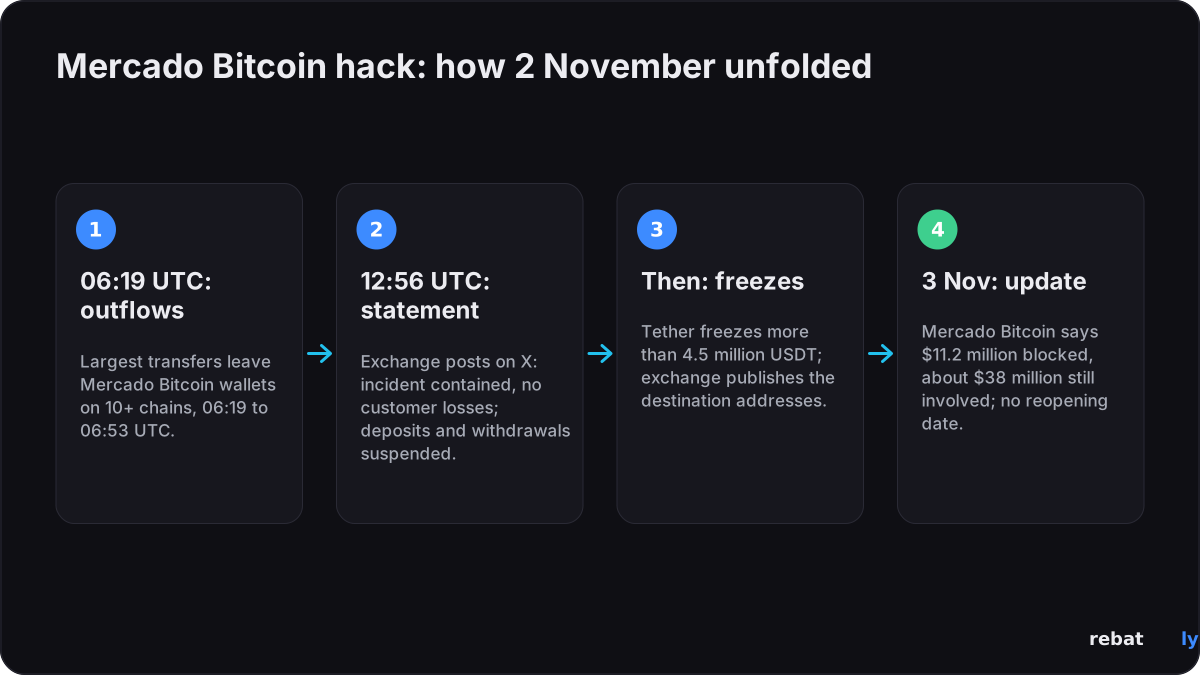
The Mercado Bitcoin hack drained at least $40 million from the wallets of Brazil's largest crypto exchange in the early hours of Monday 2 November 2026, according to blockchain security firms, with the biggest transfers landing between 06:19 and 06:53 UTC (3:19 to 3:53 a.m. in Brasília). Estimates range from more than $40 million (Hypernative) to about $46 million (Arkham). Mercado Bitcoin says it "identified and swiftly contained" a security incident in one of its systems, that no customer lost money and no data leaked, and that deposits and withdrawals are suspended as a precaution. It has not confirmed any loss figure or said when withdrawals will reopen. This article sets out what is known, what is not, and what users of the exchange should check now.

 NO KYCSign up to BloFin
 Sign up to Bybit
 Sign up to OKX
 Sign up to Bitget
 Sign up to MEXC
 Sign up to OrangeX
 Sign up to Toobit
What happened: the Mercado Bitcoin hack in numbers
Mercado Bitcoin, based in São Paulo, is Brazil's largest crypto exchange; it reported 4.5 million users in July 2026, when Tether announced a $20 million investment in the company, Cointelegraph noted. On Monday morning its wallets on at least ten blockchains began sending assets to freshly created addresses. Security firm Hypernative flagged more than $40 million in suspicious transfers across Bitcoin, Ethereum, Solana, Tron and other networks, Decrypt reported, adding that the figure is a preliminary analysis the exchange has not confirmed. The Block put the total at about $46.3 million, citing Arkham data. Cointelegraph also reported more than $46 million. In Brazilian reais the lower estimate is about R$217.7 million, Tecnoblog calculated.
The attacker's holdings as first tracked, from a report relayed by Pablo Sabbatella of security firm Opsek and cited by CoinDesk:
| Asset | Amount taken (reported) | Network |
|---|---|---|
| ETH | About 2,852 ETH | Ethereum |
| BTC | 106 BTC | Bitcoin |
| SOL | About 10,700 SOL | Solana |
| XLM | About 6.7 million XLM | Stellar |
| AVAX | About 77,000 AVAX | Avalanche |
| Other | More than 200 other tokens, including USDT and memecoins | Tron, Polygon, Arbitrum, BNB Smart Chain, Base, Optimism and others |
Why do the totals differ? Hypernative counted outflows as they happened, while Arkham valued what the attacker's addresses held in a snapshot, and prices and token lists differ between trackers. Neither figure is Mercado Bitcoin's own. The exchange's later update, reported by CNN Brasil, spoke of about $38 million in assets still involved after $11.2 million had been blocked, which together point to a total near the top of the range. Treat every number here as an estimate until the exchange publishes a post-mortem.
How the Mercado Bitcoin hack happened
Mercado Bitcoin has said only that the incident hit "one of our systems" and that it was contained quickly. In its first post on X, posted at 12:56 UTC (9:56 a.m. in Brasília), it wrote in Portuguese: "Identificamos e contivemos com rapidez um incidente de segurança em um de nossos sistemas nesta madrugada", which means it identified and quickly contained a security incident in one of its systems in the early hours. It later published the destination addresses on EVM chains, Bitcoin, Solana, Stellar and Tron "exclusively for identification and tracking purposes", Olhar Digital reported. It has not said how the attacker got in.
Analysts describe the method from the chain data. The transfers were ordinary, validly signed transactions, not a smart-contract or bridge exploit, CoinDesk reported, which means the attacker had signing access to the exchange's hot wallets; how that access was obtained is unknown. Dickson Wu, a senior security engineer at CertiK, said in an initial post-mortem cited by Cointelegraph that the attacker first "picked at eight small chains for four hours", including Base, Optimism and Arbitrum, before moving to the main hot wallets, and that tiny amounts of ETH were swept from 27,160 different addresses into one. Arkham analyst Emmett Gallic told The Block that the attacker swept older deposit addresses and sold memecoins and other altcoins. Funds kept moving out of linked addresses for hours after the suspension was announced, Cointelegraph reported.
Bloomberg reported, as relayed by PYMNTS, that the attack targeted hot wallets and that the company plans to absorb a $40 million loss itself, with no customer losses expected.
Who is behind it
Nobody has been identified. Mercado Bitcoin has not attributed the attack, no law-enforcement agency has commented, and no security firm has named a group. Several outlets note the timing, four days after the Binance hack of 29 October, which the FBI attributed to North Korea's TraderTraitor group, but CoinDesk and Decrypt both say there is no public evidence linking the two incidents, and Mercado Bitcoin has not linked them either. Rebatly does not add to that. Until an investigator publishes findings, any claim about who did this is speculation.
What Mercado Bitcoin says
From the exchange's statements on X and to Brazilian media on 2 November, as reported by Olhar Digital, Tecnoblog and CNN Brasil:
• User funds: "Não houve nenhum prejuízo aos clientes", no customer suffered a loss. In its evening update it said no customer will lose assets because security protocols were triggered and access was suspended as soon as the incident was detected.
• Data: "Não houve vazamento de dados", there was no data leak.
• Deposits and withdrawals: suspended temporarily as a preventive measure. App access was also suspended. The platform stays offline until the company judges conditions secure, and it says it will announce the resumption date in its next updates.
• Recovery: it is tracing the assets with authorities and with Tether, Circle, BRL1, Paxos and Chainalysis, and says it has identified further amounts that can be blocked.
• Losses: the company has not published a loss figure of its own. Bloomberg reported it will absorb about $40 million.
• Scams: Mercado Bitcoin says it never asks for a password, verification code or recovery phrase, and that official information appears only in its app, website and verified profiles.
Rebatly has not verified these statements independently. The exchange said it would post regular updates on its official channels.
Frozen or blocked so far
Several freezes have been reported, by different parties at different times. A freeze stops funds moving; it is not a return of funds to the exchange or its customers.
| Who | What was frozen or blocked | Source |
|---|---|---|
| Tether | More than 4.5 million USDT linked to the incident, confirmed by CEO Paolo Ardoino on X | The Block, Decrypt, CoinDesk |
| Tether and Circle | About $6.2 million in stablecoins by 16:42 UTC on 2 November | Cointelegraph |
| Mercado Bitcoin | $11.2 million in assets blocked, with about $38 million still involved, per its evening update on 2 November | CNN Brasil |
The 106 BTC and most of the ether cannot be frozen by anyone, because bitcoin and ether have no issuer. About $20 million had been moved into newly created wallets and more than $20 million remained in the addresses Mercado Bitcoin identified, including all 106 BTC, Cointelegraph reported at its 16:42 UTC snapshot. Whether those funds are later recovered depends on exchanges and law enforcement catching them when they are cashed out.
How the market reacted
Little that can be tied to this event. Bitcoin was at $78,289 at 06:00 UTC on 2 November, just before the main outflows, and $76,845 at 05:00 UTC on 3 November, down 1.8%, by our reading of CoinGecko hourly prices. Ether went from $2,289 to $2,254 over the same period, down 1.5%. The whole market has been digesting the Binance hack since 29 October, so none of this move can be attributed to Mercado Bitcoin, whose $40 million to $46 million is small against daily crypto volume. Rebatly does not forecast prices. Our guide to trading costs on big news days explains why spreads and order types matter most in weeks like this.
Context: exchange hacks in 2026 and before
The Mercado Bitcoin hack is far from the largest exchange theft, but it is the biggest reported at a Brazilian exchange:
| Exchange | Date | Reported loss | What was hit |
|---|---|---|---|
| Binance | 29 October 2026 | About $6.3 billion | Hot wallets; FBI blames North Korea's TraderTraitor |
| Bybit | 21 February 2025 | About $1.5 billion | Cold-wallet transfer, attributed to North Korea |
| Mercado Bitcoin | 2 November 2026 | $40 million to $46 million (estimates) | Hot wallets on 10 or more chains |
| Orionx (Chile) | September 2026 | More than $7 million | Customer assets moved outside its control; exchange closed |
The Orionx case is from Cointelegraph. For the Binance case, see our articles on the Binance hack and Binance withdrawals after the hack. Nothing here means a similar outcome for Mercado Bitcoin; every case is different.
What Mercado Bitcoin users should do
• Official channels only: the status of deposits, withdrawals and the app comes from Mercado Bitcoin's own app, website and verified X account. Do not act on screenshots or forwarded messages.
• Expect scams: after every exchange hack, fake "refund", "asset recovery" and "verify your wallet" messages follow within hours. Mercado Bitcoin says it never asks for a password, verification code or recovery phrase. Our guide to exchange data breaches and scam messages shows what they look like.
• Check your account: when access returns, review your login devices, API keys and withdrawal address list, and keep 2FA switched on with an authenticator app rather than SMS.
• Keep records: note your balances as shown in the app before the suspension, in case you need them later.
• Patience with PIX: withdrawals in reais depend on the same suspension; the exchange has not given a date for either.
This is general security information, not financial advice.
What happens next
• Resumption: Mercado Bitcoin says it will announce when deposits, withdrawals and the app return. No date has been given.
• A loss figure: the exchange has not confirmed one; a post-mortem or a filing would settle the $40 million versus $46 million question.
• More freezes: the company says it has identified further amounts that can be blocked; Tether and Circle can freeze stablecoins that are still sitting in flagged addresses.
• How it happened: the signing-access question is the one that matters for every other exchange.
• Regulators: Mercado Bitcoin holds Brazilian licences; a regulatory statement is possible but none had been reported by 06:00 UTC on 3 November.
We will update this article when the exchange reopens withdrawals or publishes findings.
Trade with lower fees
Whatever exchange you trade on, the fee on each trade is a cost you can cut today. Sign up through Rebatly and part of every trading fee comes back to you: up to 50% on Bybit and Bitget, up to 40% on BloFin and OKX, up to 60% on MEXC and up to 65% on OrangeX futures. On Toobit, code Rebatly gives up to 60%, credited by Toobit itself. Rebates are paid daily in USDT. Our guide to how a fee rebate works explains the rest.
This article reports news and is not financial advice. Rebatly is an independent affiliate; not financial advice.
Get fees back on every trade
$10M+ rebates paid · Paid daily in USDT · No password or API keys, ever
Already signed up? Check your link and rebate with @rebatlybot on Telegram, or reach our support at @rebatly.
🔔 Get a Telegram alert each time your rebate is paid: tap “Activate notifications” in @rebatlybot. New to trading? Your first trade in 5 steps.
November 3, 2026 — published. Sources: CoinDesk, The Block, Decrypt, Cointelegraph, CNN Brasil, Tecnoblog, Olhar Digital, PYMNTS, CoinGecko.