Nvidia SEC investigation: what is reported about the accounting probe, why NVDA had its worst week since 2008, and what it costs to trade Nvidia exposure on crypto exchanges
The Nvidia SEC investigation moved into focus on Friday 20 November 2026, when Reuters, citing two people briefed on the matter, reported that enforcement staff at the US Securities and Exchange Commission are scrutinizing potential accounting issues at the company. The Wall Street Journal had reported on 17 November that the SEC was probing Nvidia, without being able to say what the probe was about. The SEC declined to comment and Nvidia did not immediately respond, Reuters said. Nvidia shares closed down 14% that day at $125.53 and fell 23% over the week, their worst week since October 2008, according to Motley Fool and Investing.com. An investigation is not a finding of wrongdoing, and no charges have been reported. This article sets out what is reported and what is not known, how an SEC enforcement inquiry works, how the stock moved, and what it costs to trade Nvidia exposure on crypto exchanges. All times are UTC.





Nvidia SEC investigation timeline
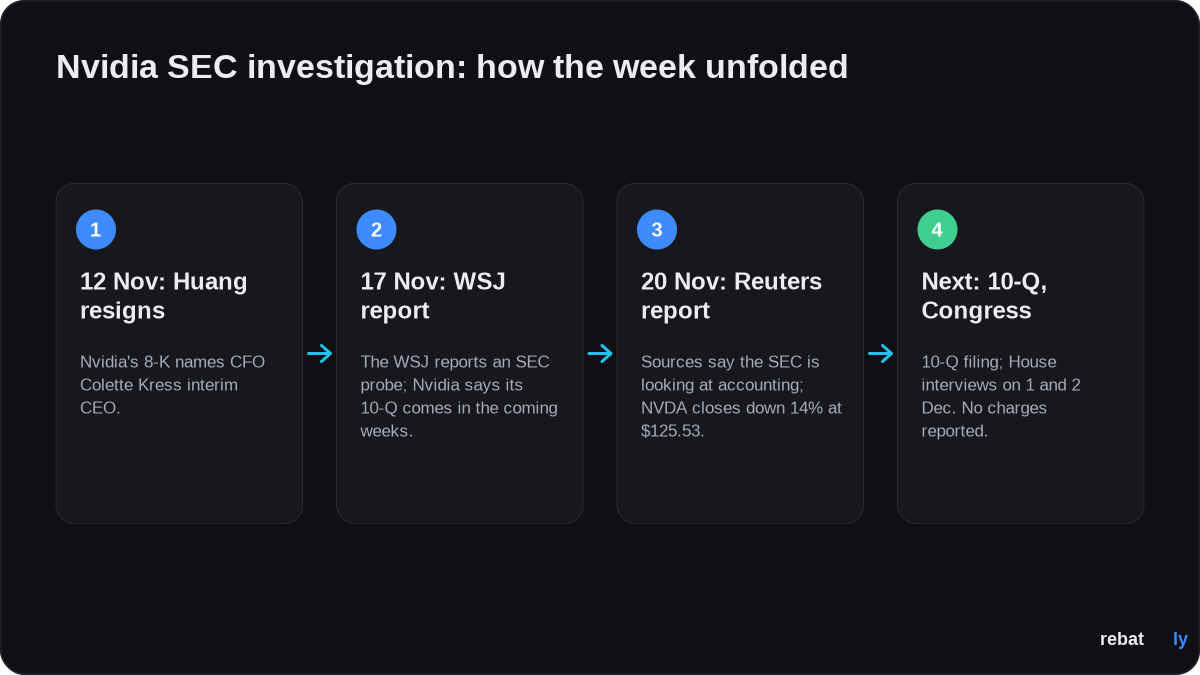
The dates below come from SEC filings and from reporting by Reuters, PYMNTS and Motley Fool. Everything about the probe itself comes from these reports; neither the SEC nor Nvidia has confirmed it.
| Date (UTC) | What happened | Source |
|---|---|---|
| 5 August 2026 | The SEC sets up a Financial Reporting and Accounting Unit inside its Division of Enforcement | SEC |
| 12 November 2026 | Nvidia files an 8-K at 13:52: Jensen Huang has resigned as CEO and director; CFO Colette Kress is interim CEO | SEC EDGAR |
| 17 November 2026 | The Wall Street Journal reports that the SEC is probing Nvidia; some of its sources say the civil probe involves whether Nvidia's disclosures misled investors | PYMNTS, Shacknews |
| 17 November 2026 | Nvidia files its third-quarter results at about 21:20: revenue of $115.8 billion; it says it will file its 10-Q "in the coming weeks" | SEC EDGAR |
| 20 November 2026 | Reuters reports that SEC enforcement staff are scrutinizing potential accounting issues; Nvidia closes down 14% at $125.53 | Reuters, Motley Fool |
| Week to 20 November 2026 | Nvidia shares fall 23%, their worst week since October 2008 | Motley Fool, Investing.com |
The interim CEO, the earnings date and the 10-Q wording come from Nvidia's own filings. The SEC probe and its focus come only from unnamed sources quoted by news outlets.
What is reported, and what is not known
Reported:
• Reuters, 20 November: the SEC is probing Nvidia's accounting practices, according to two people briefed on the matter who spoke on condition of anonymity. They said SEC enforcement staff are scrutinizing potential accounting issues at the company. Reuters said it was the first to report the accounting focus. Bloomberg also carried the Reuters report.
• The Wall Street Journal, 17 November: the SEC has opened a civil probe of Nvidia. Its focus was not immediately clear, but some of the sources said it involves questions about whether Nvidia's disclosures misled investors, PYMNTS and Shacknews reported, citing the Journal. Reuters said the Journal could not ascertain the probe's focus.
• Responses: an SEC spokesperson declined to comment, and Nvidia spokespeople did not immediately respond, Reuters said. PYMNTS quoted the SEC as saying it does not comment on the existence or nonexistence of a possible investigation.
• The 10-Q: Nvidia has not yet filed its quarterly 10-Q report for the third quarter. Its CFO commentary says: "We plan to file our 10-Q in the coming weeks." Nvidia gave no reason, and its filings do not link this to the SEC.
Not known:
• When the SEC opened its inquiry. Reuters said it could not immediately determine this.
• Exactly which accounting issues the SEC is examining. Reuters could not determine this either. Some commentators, including Motley Fool, have speculated about how Nvidia reports revenue by region. That is their own reading, not a reported focus of the probe.
• Whether the inquiry is informal or backed by a formal order. No outlet has reported this.
• Whether it will lead to any action. Reuters noted that investigations are not evidence of wrongdoing and that many close without enforcement action. No charges have been reported, and Nvidia has not been accused of wrongdoing by the SEC.
What an SEC enforcement investigation is
This is how the SEC describes the process in general, on its How Investigations Work page and in its Enforcement Manual. It says nothing about this case:
• Private: "All SEC investigations are conducted privately", the SEC says. It does not normally confirm or deny that one exists, which is why reports rely on unnamed sources.
• Informal inquiry: staff gather facts by asking for documents, interviewing witnesses and reviewing records. At this stage, taking part is voluntary.
• Formal order: if the Commission issues a formal order of investigation, staff can subpoena witnesses to testify and to hand over books and records.
• Wells notice: if staff decide to recommend charges, they usually tell the company or person first, who can then send a written reply arguing against charges.
• Outcome: the Commission decides whether to bring a case in federal court or an administrative proceeding. "In many cases" the parties settle without a trial, the SEC says. Many inquiries close with no action at all.
On 5 August 2026 the SEC set up a Financial Reporting and Accounting Unit in its Division of Enforcement, with attorneys and accountants focused on financial reporting and accounting cases. Reuters mentioned the new unit in its report. It has not been reported whether the unit is involved in the Nvidia inquiry. Probes like this usually take months or longer, Motley Fool noted.
How Nvidia shares moved: the worst week since 2008
These figures are for Nvidia shares on Nasdaq, as reported:
• Friday 20 November: Nvidia closed at $125.53, down $20.45 or 14.01% (Motley Fool, at 21:00 UTC). Shares were already down about 6% to 7% before the Reuters report, according to Reuters and Investing.com.
• The week: down 23%, the worst weekly performance since October 2008, during the financial crisis (Motley Fool, Investing.com, Stocktwits). Motley Fool put the market value lost over the week at roughly $1 trillion.
• Longer run: Investing.com said the shares ended the week nearly 48% below their record high of 6 October and in a seventh straight weekly fall.
• Why it fell: Motley Fool linked the slide to Huang's resignation on 12 November and the SEC reports, and noted that strong results on 17 November were not enough to stop it. For the earlier part of the fall, see why Nvidia stock is down, and for chip stocks more widely, our semiconductor stocks guide.
• Bitcoin over the same days: CoinGecko showed bitcoin at about $65,300 at 00:00 UTC on 16 November and about $58,300 at 21:00 UTC on 20 November, and about $60,045 at 15:21 UTC on 21 November. The two fell in the same week, but that does not show that one caused the other. Our guide bitcoin below $60,000 covers that move.
Rebatly does not forecast prices. For how scheduled US events affect trading costs, see our guide to FOMC and crypto trading costs.
Separate matters: keep them apart
Several other Nvidia matters are in the news. They are not the reported SEC accounting probe:
• The board's own investigation: on 8 November Nvidia's board opened an independent investigation into reports that Huang was the target of a foreign intelligence effort. Nvidia's 17 November results release refers to "the ongoing investigation by an independent committee" of its board. See the Jensen Huang investigation.
• Huang's exit and the CEO search: see Jensen Huang resigns, Nvidia CEO succession and will Jensen Huang return.
• The 2018 class action: a federal judge in California certified a class of investors on 25 March 2026 in a lawsuit over Nvidia's statements about crypto mining demand in 2017 and 2018, The Block and Bloomberg Law reported. Class certification is a procedural step and does not decide whether any statement was false.
• The 2022 SEC settlement: in May 2022 Nvidia paid a $5.5 million penalty to settle SEC charges that it did not adequately disclose how crypto mining affected its gaming business in fiscal 2018. It neither admitted nor denied the findings.
Trading Nvidia exposure on crypto exchanges: what it costs
Some crypto exchanges list perpetual futures that track Nvidia's share price. We checked Bybit's public market data at 15:21 UTC on 21 November 2026: its NVDAUSDT perpetual is trading, settles in USDT, pays funding every 8 hours and allows up to 100x leverage. It is a derivative: you do not own Nvidia shares. Bybit's TradFi perpetual fee schedule, in force since 16 June 2026, sets these fees:
| Cost | Bybit NVDAUSDT perpetual | What it means |
|---|---|---|
| Maker fee | 0% at all VIP tiers | Limit orders that rest on the book pay nothing |
| Taker fee | 0.0275% at VIP 0, down to 0.015% at the top VIP tier | Market orders pay this on the full position size |
| Funding | Every 8 hours; averaged 0.030% per payment over 16–20 November | Paid between traders, not to the exchange; longs paid shorts when it was positive |
| Spread | $0.01 (129.98 / 129.99) at 15:21 UTC on 21 November | The gap between the best buy and sell price |
| Slippage | Not fixed | Large orders in a fast market fill at worse prices |
Worked example: a $10,000 NVDA perp position at VIP 0
• Taker in and out: $10,000 × 0.0275% × 2 = $5.50 in trading fees.
• Maker in and out: $0 in trading fees, if both limit orders fill.
• Funding: at the 16–20 November average of 0.030%, a long paid about $3.00 every 8 hours. Holding it through all 15 payments from 00:00 UTC on 16 November to 16:00 UTC on 20 November cost about $45, far more than the trading fees. The highest payment was 0.138% at 00:00 UTC on 16 November ($13.80). Funding changes every period and can turn negative.
• Spread and slippage: a $0.01 spread is about 0.008%, or roughly $0.77 on $10,000. On 20 November the perp traded between $124.84 and $146.94 (Bybit daily candle, UTC), and in moves like that market orders can fill well away from the last price.
• With a fee rebate: on Bybit, taker fees on TradFi perps count toward a rebate of up to 50% through Rebatly, so up to $2.75 of the $5.50 comes back. Funding is not a fee and earns no rebate, and maker fills at 0% earn nothing. Our guides to Bybit stock perp fees and funding rates vs trading fees explain more.
These are cost examples at stated times, not a recommendation to trade Nvidia or any other asset.
Risks: leverage and price gaps around news
• Leverage cuts both ways: at 10x, a $10,000 position needs $1,000 of margin, and a 10% move against you wipes it out before fees and funding. NVDA fell 14% in one session on 20 November.
• The perp trades when Nasdaq is closed: on Saturday 21 November at 15:21 UTC Bybit's NVDA perp was at $129.98, about 3.5% above Friday's $125.53 close (our arithmetic). News over a weekend or overnight can move the perp, and the share price can open at a different level when trading resumes.
• Reports move fast: the shares, already down about 6% to 7%, fell to a 14% loss after the Reuters report. Liquidations, wider spreads and slippage tend to cluster at such moments.
• Funding can be costly: in a crowded trade, funding can cost more than the trading fees, as the worked example shows.
This is general information about costs and risks, not financial advice.
What happens next
• The SEC: it does not normally comment on investigations. Any action would usually become public only if charges or a settlement are announced.
• Nvidia's 10-Q: Nvidia says it will file its third-quarter 10-Q "in the coming weeks". The filing may include more detail on investigations and legal matters.
• The board's investigation: the independent committee has published no findings or timeline.
• Congress: House Republicans have set closed-door interviews with Huang on 1 December and with Nvidia's general counsel on 2 December, NBC News reported.
• The CEO search: Kress remains interim CEO while the board looks for a permanent one.
We will update this article if the SEC, Nvidia or its board publish more.
Trade with lower fees
Fast-moving news can mean more trades, and every trade carries a fee. Sign up through Rebatly and part of every trading fee comes back to you: up to 50% on Bybit and Bitget, up to 40% on BloFin and OKX, up to 60% on MEXC and up to 65% on OrangeX futures. On Toobit, code Rebatly gives up to 60%, credited by Toobit itself, and BloFin credits its up to 40% itself every hour; the other rebates are paid daily in USDT. Our guide to how a fee rebate works explains the rest.
This article reports news and is not financial advice. Rebatly is an independent affiliate; not financial advice.
Get fees back on every trade
$10M+ rebates paid · Paid daily in USDT · No password or API keys, ever
Already signed up? Check your link and rebate with @rebatlybot on Telegram, or reach our support at @rebatly.
🔔 Get a Telegram alert each time your rebate is paid: tap “Activate notifications” in @rebatlybot. New to trading? Your first trade in 5 steps.
November 21, 2026 — published. Sources: Reuters, The Wall Street Journal, Bloomberg, Motley Fool, Investing.com, PYMNTS, Shacknews, Stocktwits, SEC, The Block, Bloomberg Law, NBC News, Bybit, CoinGecko.