Semiconductor stocks after Nvidia earnings: the results vs estimates, how chip stocks and bitcoin reacted, and how US chip stocks trade 24/7 as stock perps on crypto exchanges
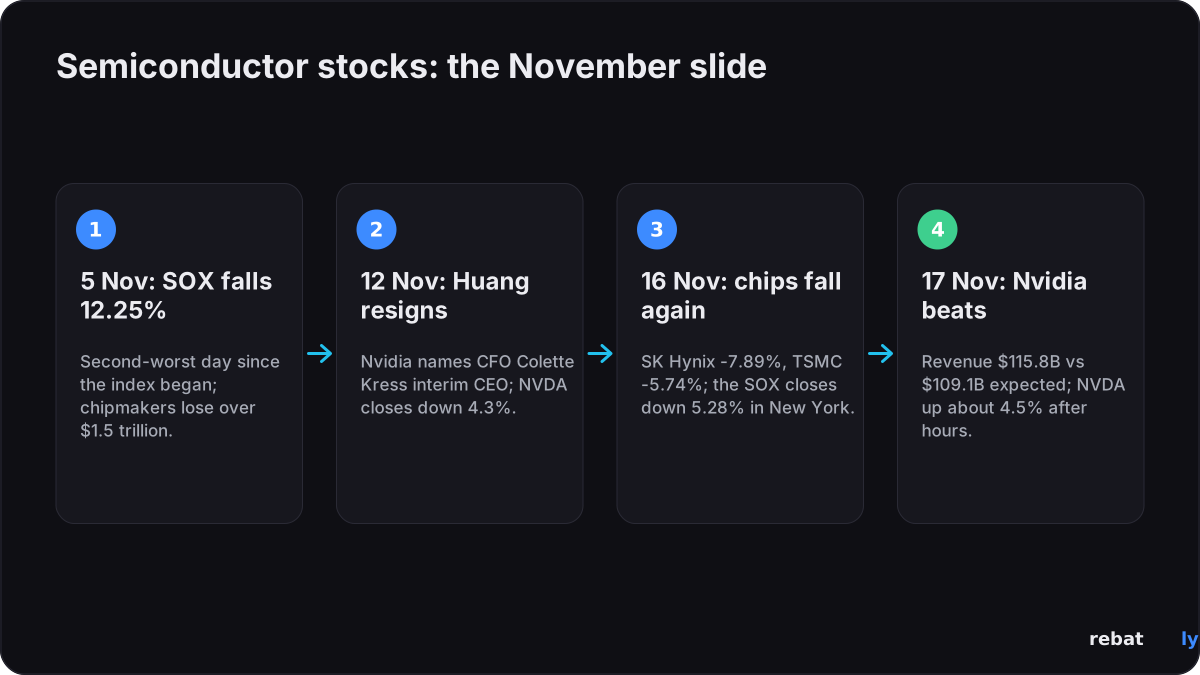
Semiconductor stocks rose in after-hours trading on 17 November 2026 after Nvidia reported third-quarter revenue of $115.8 billion at about 21:20 UTC, above the $109.1 billion analysts expected, according to Nvidia and LSEG data cited by CNBC. Nvidia guided to $130.0 billion for the current quarter, against about $125.1 billion expected. Its shares closed down 0.44% at $155.46 in the regular session, then were up about 4.5% to 5% after hours at 23:23 UTC, StockTitan and NBC News reported. It was Nvidia's first report since Jensen Huang resigned as CEO on 12 November, and it came after a selloff: the Philadelphia Semiconductor Index (SOX) lost 12.25% on 5 November, its second-worst day since the index began, according to 24/7 Wall St. and TokenPost, and fell 5.28% on 16 November. This article sets out the results against estimates, how chip stocks and crypto moved, the drivers outlets cite, and how chip stocks trade around the clock as stock perps on crypto exchanges. All times are UTC. After-hours prices are not closing prices.
 NO KYCSign up to BloFin
 Sign up to Bybit
 Sign up to OKX
 Sign up to Bitget
 Sign up to MEXC
 Sign up to OrangeX
 Sign up to Toobit
What happened: semiconductor stocks in numbers
The moves below are as reported, with the time of each figure. Rows marked "close" are regular-session closes (the US session ends at 21:00 UTC): each stock close matches in two data sources, StockAnalysis and Investing.com, and the moves match news reports from TokenPost, TradingKey, Seoul Economic Daily and CNBC. Sources differ on Arm's 16 November fall, so we give the range. Rows with a clock time on 16 November were taken during the trading session and are not closing prices, and rows marked "after hours" are not closing prices either. The pre-market figures come from MSX data cited in a KuCoin news flash and may differ from exchange quotes. On 5 November, 24/7 Wall St. said, it was the SOX's biggest one-day fall since 16 March 2020, and chipmakers lost more than $1.5 trillion of market value. The SOX rose more than 4% on 6 November, TokenPost reported, before falling again. Its record close was 14,634.72 on 22 June 2026, and on 5 November it was 38.4% below that, according to 24/7 Wall St. and JKN.
| Date and time (UTC) | Stock or index | Move | Source |
|---|---|---|---|
| 5 Nov, close (21:00) | SOX index | −12.25% to 9,011.14 | 24/7 Wall St., TokenPost, JKN |
| 5 Nov, close | Nvidia (NVDA) | −9.26% to $181.60 | 24/7 Wall St. |
| 5 Nov, close | Micron (MU) | −17.46% | 24/7 Wall St. |
| 5 Nov, close | AMD / Broadcom (AVGO) | −17.3% / −10.4% | JKN |
| 12 Nov, close | Nvidia (NVDA) | −4.3% after Huang resigned | CNBC |
| 16 Nov, close (05:30) | TSMC, Taipei | −5.74% | Coinpaper |
| 16 Nov, close (06:30) | SK Hynix, Seoul | −7.89% | Coinpaper |
| 16 Nov, pre-market | NVDA / TSM / AVGO | −4.01% / −5.27% / −4.03% | KuCoin (MSX data) |
| 16 Nov, pre-market | SOXL (3x chip ETF) | −13.34% | KuCoin (MSX data) |
| 16 Nov, about 15:00 | Arm / Marvell | about −7% to −8% | 24/7 Wall St., Investing.com |
| 16 Nov, about 15:00 | Applied Materials (AMAT) | about −5% | 24/7 Wall St., Investing.com |
| 16 Nov, 16:04 | SOX / NVDA / AVGO / MU | more than −3% / −2.38% / −3.82% / −5.59% | IBTimes |
| 16 Nov, close (21:00) | SOX index | −5.28% | Investing.com, TokenPost |
| 16 Nov, close | NVDA / TSM / AVGO | −4.12% to $156.14 / −6.34% to $373.45 / −3.92% to $333.40 | StockAnalysis, Investing.com |
| 16 Nov, close | AMD / MRVL / AMAT | −5.58% to $504.28 / −7.27% to $145.36 / −5.47% to $350.25 | StockAnalysis, Investing.com |
| 16 Nov, close | Arm (ARM) | between −6.3% and −8.1% (sources differ) | StockAnalysis, JKN, TradingKey |
| 17 Nov, close (21:00) | SOX index | +0.34% | TradingKey, Seoul Economic Daily |
| 17 Nov, close | NVDA / TSM / AVGO | −0.44% to $155.46 / −3.68% to $359.69 / +2.46% to $341.60 | StockAnalysis, Investing.com |
| 17 Nov, close | AMD / ARM / MRVL / AMAT | −0.17% to $503.41 / +4.76% to $183.39 / +2.33% to $148.74 / −0.29% to $349.23 | StockAnalysis, Investing.com |
| 17 Nov, after hours, 21:39 | Nvidia (NVDA) | nearly +3% | CoinDesk |
| 17 Nov, after hours, 23:23 | Nvidia (NVDA) | about +4.5% to +5% | StockTitan, NBC News |
| 17 Nov, after hours, 23:31 | Nvidia (NVDA) | +4.46% to $162.40 / +4.61% to $162.63 | StockAnalysis / Investing.com |
Why are chip stocks down? The drivers, and who reports them
Outlets tie the selloff to several things at once, not to one headline:
• Doubts about the AI trade after the midterms: Democratic gains in the US midterm elections raised fears of limits on new AI data centres, the Associated Press (via BNN Bloomberg), 24/7 Wall St. and JKN reported.
• AI spending forecasts: research firm SemiAnalysis cut its forecast for AI-chip spending by about 28% for 2028 and about 40% for 2030, IBTimes reported. Chip-equipment and memory stocks fell harder than Nvidia, 24/7 Wall St. noted.
• Rising Treasury yields: the 10-year Treasury yield closed at 5.15% on 13 November, up from 4.84% on 5 November, according to the US Treasury, and was near 5.13% on the morning of 16 November, AP reported. Higher yields weigh on highly valued growth stocks.
• Fed rate-hike bets: after US consumer prices rose 0.4% in October against 0.3% expected, traders treated a December rate hike as a near certainty, CNBC reported.
• Nvidia's leadership change: on 12 November Nvidia said Jensen Huang had resigned as CEO, effective immediately, and that CFO Colette Kress is interim CEO, according to its SEC filing. See our article on Jensen Huang's resignation and why Nvidia stock is down.
• Positioning: Nomura's Charlie McElligott pointed to hedge funds cutting their exposure, 24/7 Wall St. reported. Broadcom was downgraded by Rothschild & Co Redburn, IBTimes reported, and Applied Materials fell after several brokers cut their targets following its 12 November results, Investing.com reported.
These are reported explanations, not Rebatly's view. Rebatly does not forecast prices.
Nvidia earnings: third-quarter results vs estimates
Nvidia reported results for the third quarter of fiscal 2027 (to 25 October 2026) at about 21:20 UTC on 17 November, after the US close, StockTitan reported, and its conference call began at 22:00 UTC. Every headline figure in the table was above the estimates outlets cited.
• Outlook: Nvidia guided to gross margins of 71.0% to 72.0% for the fourth quarter, which has an extra week, and said its outlook assumes no data-centre compute revenue from China, according to its press release. On the call it raised its growth outlook for fiscal 2028 to about 75%, from about 70%, CNBC, Reuters and Bloomberg reported.
• What Nvidia said: "Our momentum is real," interim CEO Colette Kress said in the release. "Vera Rubin is off to an explosive start, our roadmap is on track and our ambition has never been greater."
• Leadership: chair Harvey Jones said the board does not intend to reinstate Jensen Huang, CNBC and NBC News reported, and the search for a new CEO, led by Heidrick & Struggles, will consider internal and external candidates, NBC News reported. Nvidia's release refers to an ongoing investigation by an independent committee of its board, and Bloomberg, citing The Wall Street Journal, reported that the SEC is also investigating.
• Past reactions: Nvidia shares fell after four earnings reports in a row from August 2025 to May 2026 despite beating estimates, 24/7 Wall St. reported, before rising after the August 2026 report, Invezz reported.
Rebatly does not forecast prices or earnings.
| Measure | Nvidia reported | Estimate | Source of the estimate |
|---|---|---|---|
| Revenue | $115.8 billion, up 20% on the quarter and 103% on the year | $109.1 billion | LSEG via CNBC; NBC News, CoinDesk and Investing.com cite $108.8 billion to $109.3 billion |
| Earnings per share (adjusted) | $2.68 (GAAP: $2.70) | $2.48 | LSEG via CNBC; CoinDesk and Investing.com cite $2.47 |
| Data-centre revenue | $107.6 billion, up 110% on the year | $101.9 billion | StreetAccount via CNBC; CoinDesk |
| Gross margin (adjusted) | 74.9% (GAAP: 74.8%) | 74% | StreetAccount via CNBC |
| Next-quarter revenue guidance | $130.0 billion, plus or minus 3% | about $125.1 billion to $125.3 billion | LSEG via CNBC; Bloomberg, CoinDesk |
Market reaction: Nvidia, chip stocks and bitcoin after the results
• Nvidia: the shares closed down 0.44% at $155.46 in the regular session on 17 November, then rose in after-hours trading: nearly 3% at 21:39 UTC (CoinDesk), about 2% at 21:42 UTC (Investing.com) and about 4.5% to 5% at 23:23 UTC (StockTitan, NBC News). After-hours trading is thin, and prices can change before the regular session opens at 14:30 UTC on 18 November.
• Other chip stocks: in the regular session on 17 November the SOX rose 0.34%, TSMC's US shares fell 3.68% and Arm rose 4.76% (table above). After hours, at about 23:30 UTC, StockAnalysis showed TSMC's US shares up 6.37%, Arm up 4.94%, Marvell up 4.92%, AMD up 4.04%, Applied Materials up 3.66% and Broadcom up 2.61%, and StockTitan showed Micron up 4.46% at 23:24 UTC. These are after-hours moves from one source each, not closes.
• Bitcoin and ether: CoinGecko showed bitcoin at about $64,007 at 21:20 UTC and $64,935 at 23:30 UTC, up about 1.4%, and ether at about $1,798 and $1,822, also up about 1.4%. CoinDesk reported at 21:39 UTC that bitcoin had added about $600. FXStreet saw little movement in bitcoin at 23:16 UTC, while AI-linked tokens rose (NEAR +3.4%, RENDER +2.7%).
• Before the results: crypto moved with tech stocks in November. Bitcoin was at $80,443 at 00:00 UTC on 5 November and fell to an hourly low of $62,612 at 02:00 UTC on 15 November, according to CoinGecko data. CoinGecko showed $64,784 at 17:11 UTC on 16 November. On 12 November bitcoin slipped as a selloff in tech stocks spread, CoinDesk reported, and on 16 November it failed to hold $65,000 as US stocks fell on AI nerves, Cointelegraph reported. See our guides on why bitcoin is down today and why Ethereum is down.
Rebatly does not forecast prices.
Stock perps: how US chip stocks trade 24/7 on crypto exchanges
Several crypto exchanges list stock perpetuals (also called TradFi perps or stock futures): USDT-margined perpetual contracts that track the price of a US stock such as Nvidia, TSMC or Broadcom. What they are, and what they are not:
• Around the clock: Bybit, OKX, Bitget, MEXC and Toobit describe their stock perps as trading 24/7, including weekends, while the shares themselves trade on a fixed schedule. Check each exchange's own page: hours can differ by contract.
• Not shares: you do not own the stock. Bybit says "There are no dividends", and OKX says its stock perps are not securities and carry no dividend distributions. Bitget says it passes cash dividends through funding instead. Toobit says its contracts track an index built from tokenized stock prices.
• Funding: like crypto perps, stock perps charge or pay funding between longs and shorts, usually every 8 hours. See our guide to funding rates vs trading fees.
• Leverage risk: leverage multiplies losses as well as gains, and a position can be liquidated in a fast move.
• Gaps at the open: when news breaks while Wall Street is shut, the perp price moves first, and prices can jump when the US market reopens.
• Where you live matters: availability depends on your country, so check each exchange's terms before you sign up. Rebatly does not target US residents.
For other ways to get US-stock exposure on-chain, see our guide to NYSE tokenized stocks, and for how perp fees compare with spot, see spot vs perpetual fees. This is general information, not financial advice.
Which exchanges list chip stock perps, and their fees
We checked each exchange's public market data at about 17:10 UTC on 16 November 2026. Fees are the base-tier rates each exchange publishes for these contracts; higher VIP tiers pay less, and promotional rates can end. Bitget, OrangeX, Toobit and BloFin apply their standard futures schedules. BloFin's own pages say its stock perps may be limited to reduce-only orders outside US trading hours, and OrangeX publishes no trading-hours page for them, so check before you trade.
| Exchange | Chip stock perps listed (examples) | Maker / taker (base tier) | Source |
|---|---|---|---|
| Bybit | NVDA, TSM, AVGO, AMD, ARM, MRVL, MU, INTC, SOXX, SMH, SOXL | 0% / 0.0275% | Bybit fee page, API |
| OKX | NVDA, TSM, AVGO, AMD, ARM, MRVL, MU, INTC, SMH, SOXL | Standard futures schedule | OKX FAQ, API |
| Bitget | NVDA, TSM, AVGO, AMD, ARM, MRVL, MU, INTC, SOXX, SMH, SOXL | 0.02% / 0.06% | Bitget FAQ, API |
| MEXC | NVDA, TSM, AVGO, AMD, ARM, MRVL, MU, INTC, SOXX, SMH, SOXL | 0% / 0.02% on most | MEXC API |
| OrangeX | NVDA, TSM, AVGO, AMD, ARM, MRVL, MU, INTC, SMH, SOXL | 0.02% / 0.06% | OrangeX API |
| Toobit | NVDA, TSM, AVGO, AMD, ARM, MRVL, MU, INTC, SMH, SOXL | 0.02% / 0.06% | Toobit fee page |
| BloFin | NVDA, TSM, AVGO, AMD, ARM, MRVL, MU, INTC, SMH, SOXL | Standard futures schedule | BloFin API |
Bybit TradFi perp fees and where a rebate applies
Bybit's TradFi perps currently cost 0% maker and 0.0275% taker at VIP 0, falling to 0.015% taker at Supreme VIP, while Bybit's discount lasts (Bybit announcement). Since a maker fill pays nothing, only taker fees can earn a rebate.
• TradFi perps: yes. TradFi Perpetual is one of the categories Bybit counts, so taker fees on these perps count toward your rebate the same way crypto perp fees do. On a 1,000 USDT taker round trip, 1,000 × 0.0275% × 2 = 0.55 USDT in fees, and up to 50% of that (up to 0.275 USDT) comes back. At the lowest tier (up to 40%), up to 0.22 USDT comes back.
• Direct Stocks: no. No rebate is claimed on the Direct Stocks service fee, or on funding, which passes between traders.
• Other exchanges: we have not confirmed whether stock perps on OKX, Bitget, MEXC, OrangeX, Toobit or BloFin count toward a rebate, so no rebate is claimed for them here. Contact us at t.me/rebatly to check before you rely on it.
Our full guide to Bybit stock perp and TradFi fees shows the VIP table and funding costs.
What happens next
• 18 November, 14:30 UTC: the first regular US session after Nvidia's results opens.
• 18 November, 19:00 UTC, FOMC minutes: the minutes of the Fed's 27-28 October meeting are released, according to the Federal Reserve calendar and CoinDesk's week-ahead calendar.
• 1 December, 21:30 UTC, Marvell results: Marvell holds its third-quarter call, according to Marvell.
• 8-9 December, FOMC meeting: the Fed ends its meeting with a rate decision and new projections on 9 December, according to the Federal Reserve calendar.
• 9 December, Broadcom results: Broadcom reports fourth-quarter results after the US close, with a call at 22:00 UTC, according to Broadcom.
Rebatly does not forecast prices.
Trade with lower fees
Volatile weeks mean more trades and more fees, and leverage multiplies what you pay on each one. Sign up through Rebatly and part of every trading fee comes back to you: up to 50% on Bybit and Bitget, up to 40% on BloFin and OKX, up to 60% on MEXC and up to 65% on OrangeX futures. On Toobit, code Rebatly gives up to 60%, credited by Toobit itself, and BloFin credits up to 40% itself every hour; the other rebates are paid daily in USDT. Our guide to how a fee rebate works explains the rest.
This article reports news and is not financial advice. Rebatly is an independent affiliate; not financial advice.
Get fees back on every trade
$10M+ rebates paid · Paid daily in USDT · No password or API keys, ever
Already signed up? Check your link and rebate with @rebatlybot on Telegram, or reach our support at @rebatly.
🔔 Get a Telegram alert each time your rebate is paid: tap “Activate notifications” in @rebatlybot. New to trading? Your first trade in 5 steps.
November 18, 2026 — updated with Nvidia's results, the market reaction and closing prices for 16 and 17 November. November 16, 2026 — published. Sources: 24/7 Wall St., TokenPost, JKN, Coinpaper, KuCoin, IBTimes, Associated Press, Investing.com, CNBC, Nvidia, Reuters, Bloomberg, NBC News, StockTitan, StockAnalysis, TradingKey, Seoul Economic Daily, FXStreet, Marvell, Broadcom, SEC, US Treasury, Federal Reserve, CoinDesk, Cointelegraph, CoinGecko, Invezz, Bybit, OKX, Bitget, MEXC, OrangeX, Toobit, BloFin.