Why is Ethereum down? ETH falls below $2,000 and hits its lowest since July: ETF outflows, Ethereum Foundation sales, liquidations and rate-hike bets
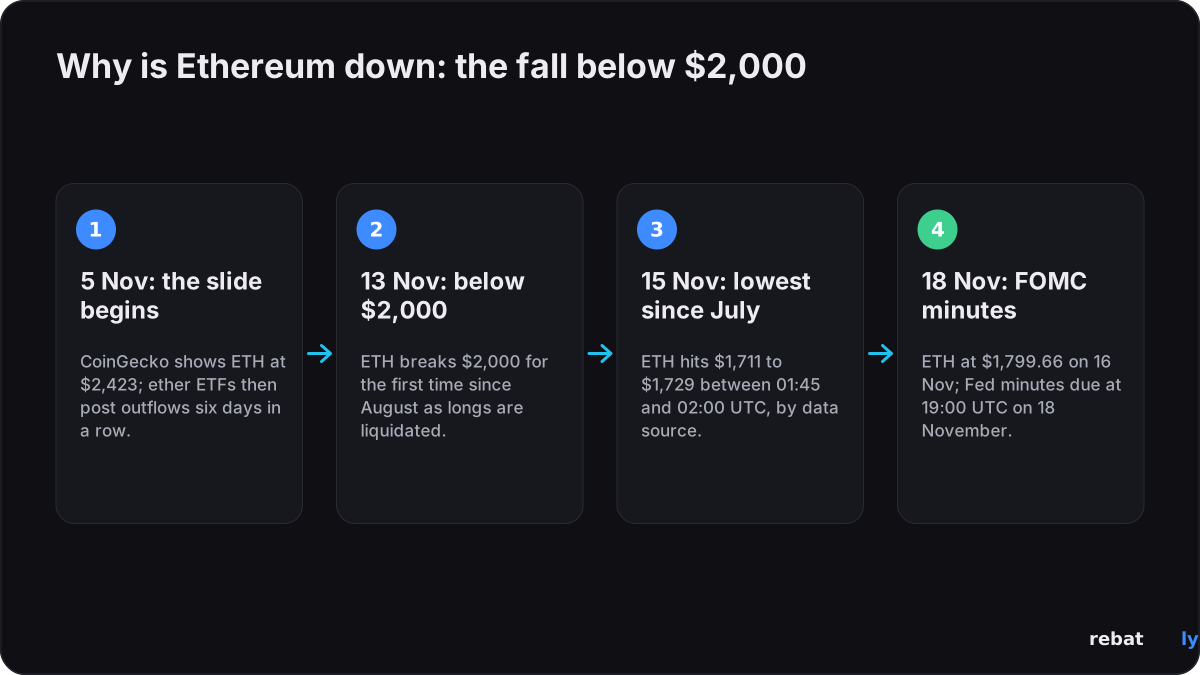
Why is Ethereum down? Ether (ETH) fell below $2,000 on 13 November 2026 for the first time since August and kept falling over the weekend, reaching a low of $1,711 to $1,729 early on 15 November, its lowest price since July, according to Bloomberg, CryptoTicker and CoinGecko. CoinGecko showed ETH at $1,799.66 at 13:30 UTC on 16 November, about 26% below its level on 5 November and 63.6% below its all-time high of $4,946.05 from August 2025. Outlets point to a market-wide selloff led by bitcoin, outflows from US spot ether ETFs, sales by wallets that on-chain trackers link to the Ethereum Foundation, long liquidations in futures, and rising bets on a US rate hike in December after a hot inflation report. This article sets out what happened, each driver and who reports it, and what traders can check. All times are UTC.

 NO KYCSign up to BloFin
 Sign up to Bybit
 Sign up to OKX
 Sign up to Bitget
 Sign up to MEXC
 Sign up to OrangeX
 Sign up to Toobit
What happened: ether's price path
Why the low is a range: data providers sample prices differently. Bloomberg reported $1,711, CryptoTicker $1,715 at 01:45 UTC on five-minute CoinGecko data, and CoinGecko's hourly data $1,729.19 at 02:00 UTC. Bloomberg called it the lowest since 8 July; on CoinGecko's daily data, the last close this low was on 14 July 2026. The 13 November break below $2,000 was the first since August, Crypto Times and CoinDesk reported. Over the week, The Block measured an 18.2% drop and Cointelegraph 19.5%, depending on the start time.
Ether peaked late on 4 November on hourly data and has fallen on most days since. The key moments, with times in UTC:
| Time (UTC) | ETH price | What happened | Source |
|---|---|---|---|
| 4 Nov, 23:00 | $2,434.86 | Hourly high before the slide | CoinGecko |
| 9 Nov, 00:00 | $2,124 | Down about 12% from 5 November | CoinGecko |
| 13 Nov | about $1,900 to $1,958 | Below $2,000 for the first time since August | CoinDesk, Crypto Times, CoinGecko |
| 15 Nov, 01:45 to 02:00 | $1,711 to $1,729 | Low of the move, lowest since July | Bloomberg, CryptoTicker, CoinGecko |
| 16 Nov, 00:00 | $1,834.53 | Partial rebound | CoinGecko |
| 16 Nov, 13:30 | $1,799.66 | Down 15.1% in 7 days | CoinGecko |
Why is Ethereum down? The drivers, and who reports them
• Bitcoin's slide: bitcoin fell from about $80,442 on 5 November to an hourly low of $62,612 at 02:00 UTC on 15 November on CoinGecko data, and The Block called it the lowest since July. Ether, XRP and other large coins fell with it. See why bitcoin is down today and why XRP is down.
• ETF outflows: US spot ether ETFs lost money on six trading days in a row before a small inflow on 13 November (see below).
• Ethereum Foundation sales: on-chain trackers Onchain Lens and Lookonchain reported that wallets they link to the Ethereum Foundation sold 7,500 ETH, about $14.5 million, over four days (see below).
• Liquidations: long positions in ether futures were forced closed as the price broke $2,000 (see below).
• Inflation and December rate-hike bets: the US consumer price index released on 10 November rose 0.4% in October, above the 0.3% expected, and core prices rose 0.3% against 0.2% expected, CNBC and Crypto Times reported. After the report, markets priced a rate hike at the Fed's 8-9 December meeting at about 88% to 92%, as reported by CoinDesk, CNBC and Decrypt. The Fed's target range is 3.75% to 4.00%.
• Treasury yields: the US 10-year Treasury yield closed at 5.15% on 13 November, up from 4.84% on 5 November, according to US Treasury data. Higher yields tend to pull money away from risk assets such as crypto.
Sentiment gauges fell with prices; our guide to the crypto fear and greed index explains how they work. Rebatly does not forecast prices.
Ether ETF flows
The six outflow days from 5 to 12 November added up to $594.4 million. The week of 9-13 November lost $398.9 million on Farside data cited by CryptoTicker (Decrypt reported $338 million), the seventh negative week in a row. On 13 November, Fidelity's FETH took in $11.64 million while a Grayscale ether fund lost $9.28 million, TokenPost reported. The funds held about $10.85 billion in total. October was their largest outflow month, at $1.61 billion, according to Crypto Times.
Daily net flows for US spot ether ETFs, from SoSoValue data as reported by The Block and TokenPost, in US dollars:
| Trading day | Net flow | Reported by |
|---|---|---|
| 5 Nov | −$99.9 million | The Block |
| 6 Nov | −$93.3 million | The Block |
| 9 Nov | −$184.5 million | The Block |
| 10 Nov | −$1.3 million | The Block |
| 11 Nov | −$144.8 million | The Block, Farside |
| 12 Nov | −$70.6 million | The Block, TokenPost |
| 13 Nov | +$2.4 million | The Block, TokenPost |
Ethereum Foundation sales: what is reported
On-chain trackers Onchain Lens and Lookonchain reported that wallets they attribute to the Ethereum Foundation sold 7,500 ETH, about $14.5 million, over four days in mid-November. The latest 2,500 ETH, about $4.7 million, was swapped through CoWSwap for about 4.6 million USDS stablecoins and sent to a Safe multisig wallet, CryptoTicker reported, citing Onchain Lens via CryptoPotato. PANews also carried the reports.
The Ethereum Foundation has not published a statement about these sales, and we found none in CoinDesk, The Block, Decrypt or Cointelegraph. The amounts come from on-chain trackers, not from the Foundation, and we do not know why the coins were sold. At about $14.5 million, the sales are small next to ETF outflows of $594.4 million over six days.
ETH vs BTC: ether fell more
Ether fell further than bitcoin. From 5 November to the weekend lows on CoinGecko's hourly data, ETH lost about 29% and BTC about 22%. The ETH/BTC ratio, the price of one ether in bitcoin, slipped from about 0.0301 on 5 November to 0.02806 at 13:30 UTC on 16 November, CoinGecko data shows. A falling ETH/BTC ratio means ether is weaker than bitcoin, not only that both are falling.
Liquidations, open interest and funding
Ether perpetual futures open interest, the value of open positions, was $38.81 billion on 9 November and $24.64 billion on 13 November in the figures reported by Crypto Times; the snapshots may use different methods, but both point to traders closing positions. By 16 November, ether funding rates had turned negative on Binance, OKX and Bybit, CoinDesk reported, which means shorts were paying longs. The staking exit queue held 269,951 ETH, a KuCoin market update cited by CryptoTicker said. Our guide to crypto liquidations explains how forced closures work.
CoinGlass data, as cited by the outlets below, shows liquidations hit mostly longs. Totals depend on the time window, so they should not be added together:
| Window | ETH liquidated | Longs | Whole market | Reported by |
|---|---|---|---|---|
| 24 hours to 05:00, 9 Nov | $449.03 million | $412.30 million (91.8%) | $1.02 billion | Crypto Times |
| 24 hours to 05:27, 13 Nov | $259.12 million | $234.91 million (90.7%) | $1.47 billion | Crypto Times |
| 24 hours, 13 Nov | $289 million | most | $1.64 billion | CoinDesk |
| 13:00 14 Nov to 13:00 15 Nov | not split out | 83% | $2.02 billion | The Block |
What traders can check
• Spot vs perpetual fees: buying ETH on the spot market has no liquidation price. Perpetual futures add leverage, and fees are charged on the full position size, not the margin.
• Funding: perpetual positions pay or receive funding, usually every eight hours. When funding is negative, shorts pay longs. Our guide to funding rates vs trading fees explains how they add up.
• Liquidation price: every major exchange shows an estimated liquidation price next to each open position. Fast moves through round numbers such as $2,000 can reach it quickly.
• Margin mode: isolated margin limits a liquidation to the margin on one position; cross margin can draw on the whole balance.
• Event days: Fed decisions and minutes often bring wider spreads and bigger swings. See our guide to FOMC and crypto trading costs.
This is general information, not financial advice.
What happens next
• 17 November, Nvidia earnings: Nvidia reports quarterly results after the US market close, CoinDesk noted; the results often move risk assets, crypto included.
• 18 November, 19:00 UTC, FOMC minutes: the minutes of the Fed's last meeting are released, according to CoinDesk's week-ahead calendar.
• 8-9 December, FOMC meeting: the Fed ends its meeting with a rate decision and new projections on 9 December, according to the Federal Reserve calendar.
• Ether ETF flows: daily SoSoValue and Farside data show whether the outflows resume.
Rebatly does not forecast prices. We will update this article on the next major ether move.
Trade with lower fees
Volatile weeks mean more trades and more fees, and leverage multiplies what you pay on each one. Sign up through Rebatly and part of every trading fee comes back to you: up to 50% on Bybit and Bitget, up to 40% on BloFin and OKX, up to 60% on MEXC and up to 65% on OrangeX futures. On Toobit, code Rebatly gives up to 60%, credited by Toobit itself, and BloFin credits up to 40% itself every hour; the other rebates are paid daily in USDT. Our guide to how a fee rebate works explains the rest.
This article reports news and is not financial advice. Rebatly is an independent affiliate; not financial advice.
Get fees back on every trade
$10M+ rebates paid · Paid daily in USDT · No password or API keys, ever
Already signed up? Check your link and rebate with @rebatlybot on Telegram, or reach our support at @rebatly.
🔔 Get a Telegram alert each time your rebate is paid: tap “Activate notifications” in @rebatlybot. New to trading? Your first trade in 5 steps.
November 16, 2026 — published. Sources: CoinGecko, Bloomberg, CryptoTicker, Crypto Times, CoinDesk, The Block, Decrypt, Cointelegraph, CNBC, TokenPost, US Treasury, Federal Reserve, SoSoValue, Farside, CoinGlass, Onchain Lens, Lookonchain.