Russia crypto: retail trading in Bitcoin, Ether and USDT opens on 17 November 2026. The 300,000-ruble cap, the test, the deadlines and what the new rules mean
Russia crypto trading opened to ordinary investors on 17 November 2026, when a Bank of Russia ordinance took effect that lets licensed intermediaries sell Bitcoin, Ether and USDT to non-qualified investors, the Bank of Russia said on 6 November. Each non-qualified investor can buy up to 300,000 rubles a year through each intermediary, about $3,636 at the central bank's official rate for 17 November. Qualified investors face no cap, and every investor must first pass a test. The rules sit under the federal law on digital currencies that Vladimir Putin signed on 4 August and that took effect on 1 September, as reported by Cointelegraph and The Block. This article sets out what changes, the timeline, the rules in one table, and what is still unclear. All dates are UTC.
 NO KYCSign up to BloFin
 Sign up to Bybit
 Sign up to OKX
 Sign up to Bitget
 Sign up to MEXC
 Sign up to OrangeX
 Sign up to Toobit
What changes on 17 November
From 17 November, under the Bank of Russia's ordinance:
• Three assets: non-qualified investors can buy Bitcoin (BTC), Ether (ETH) and Tether (USDT), the only coins on the central bank's list. It picked them on market capitalisation, average daily trading volume and at least five years of price history on foreign exchanges.
• Through licensed firms only: purchases go through intermediaries such as brokers, trust managers and crypto exchange offices, on exchange and over the counter.
• The cap: "Purchases through a single intermediary may not exceed ₽300,000 per year," the Bank of Russia said. Because the cap applies per intermediary, CoinMarketCap and DL News note that each licensed firm carries its own allowance.
• A test for everyone: qualified and non-qualified investors alike must pass a test and read about the risks before trading. Qualified investors get access to all crypto assets with no limit.
The central bank first published the list and the cap as a draft on 11 August and took comments until 24 August.
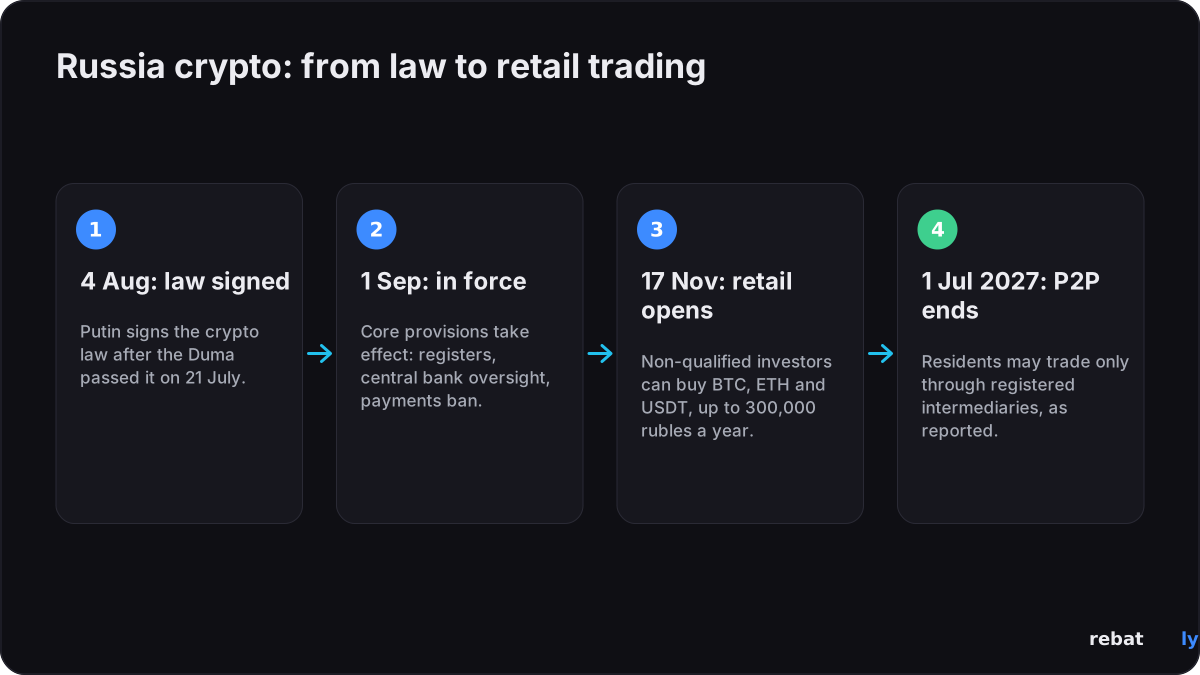
Russia crypto law timeline
How the rules got here, with the outlet or body that reports each step:
| Date (2026) | What happened | Source |
|---|---|---|
| 21 July | The State Duma passes the crypto bill in its second and third readings | Blockhead, Bitcoin.com |
| 4 August | Putin signs the law | Cointelegraph, The Block (citing TASS) |
| 11 August | The Bank of Russia publishes draft rules naming BTC, ETH and USDT and the 300,000-ruble cap | Bank of Russia |
| 1 September | The law's core provisions take effect: registers, Bank of Russia oversight, payments ban | Bitcoin.com, The Block, DL News |
| 6 October | The Bank of Russia opens its registers of crypto exchange providers and digital depositories | DL News |
| 12 October | Sberbank joins the crypto exchange register | DL News (citing Interfax) |
| 6 November | The Bank of Russia publishes the final ordinance | Bank of Russia, Cointelegraph |
| 17 November | The ordinance takes effect: retail purchases of BTC, ETH and USDT can start | Bank of Russia |
By 22 October the exchange register had 17 firms, including Sberbank and VTB, up from four when it opened, DL News reported; Bitcoin.com counted 13 on 18 October.
The rules in one table
What the law and the Bank of Russia's ordinance set, as reported:
| Rule | What it says | Source |
|---|---|---|
| Who is capped | Non-qualified investors: up to 300,000 rubles a year through each intermediary (about $3,636 at the official rate for 17 November) | Bank of Russia |
| Qualified investors | No cap; access to all crypto assets | Bank of Russia |
| Assets for non-qualified investors | Bitcoin, Ether and USDT only | Bank of Russia |
| Test | Every investor must pass a test and read about the risks first | Bank of Russia |
| Who can sell | Firms on the Bank of Russia's registers: brokers, trust managers, crypto exchange offices, exchanges; exchanges also need equity of at least 15 million rubles and membership of a self-regulatory organisation | Bank of Russia, The Block, Bitcoin.com |
| Self-custody | Moving crypto from a regulated account to a self-custody wallet is not allowed | Cointelegraph, CoinMarketCap, Bitcoin.com |
| Payments in Russia | Paying for goods and services with crypto stays banned | The Block, Blockhead, Bitcoin.com |
| Cross-border settlements | Allowed under foreign trade contracts between residents and non-residents | The Block, Blockhead, Bitcoin.com |
| P2P trading | From 1 July 2027 residents may trade only through registered intermediaries, which ends direct P2P trades | DL News, Cointelegraph, Bitcoin.com |
| Transition deadlines | Reports differ: existing exchanges have until 1 March 2027 (The Block); firms can operate unregistered until 1 July 2027 (Blockhead); registered firms must fully comply by 1 September 2027 (DL News) | The Block, Blockhead, DL News |
The dollar figure depends on the rate used. Outlets give about $3,700 (Cointelegraph, The Block, Bitcoin.com, CoinMarketCap) or about $3,800 (Blockhead, DL News). We use the Bank of Russia's official rate for 17 November, 82.5143 rubles per dollar, which gives about $3,636. The deadlines in the last row conflict across outlets, and we have not found the Bank of Russia stating them in one place, so treat them as reported, not confirmed.
Who will offer it, and when
• VTB: plans to open crypto trading to a broad range of retail investors in November, according to a VTB executive quoted by DL News.
• Sberbank: plans its first crypto products on 1 December, through apps its customers already use, if the regulations are ready, DL News reported.
• Moscow Exchange: plans to start trading BTC, ETH and USDT on 1 December with pilot transactions, connecting participants as they are ready, Cointelegraph and Finance Magnates reported. Trading would run from 03:50 to 20:50 UTC on its stock market systems. Some coverage describes 1 December as the date the exchange will be technically ready rather than a fixed launch.
Cointelegraph notes that Moscow Exchange and its clearing house have been under US sanctions since June 2024, when the UK also sanctioned the exchange, and that the EU added it to its sanctions list in July 2026. Not everyone expects much: one foreign-trade adviser quoted by Cointelegraph warned of "absolutely outrageous spreads" for small investors.
What it means for traders
• It covers licensed Russian intermediaries only. The cap, the test and the asset list apply to purchases through firms on the Bank of Russia's registers.
• Foreign exchanges are not licensed under this law. The registers list Russian firms such as Sberbank, VTB and T-Bank's units.
• The cap is small. At CoinGecko's price at 08:07 UTC on 17 November, 300,000 rubles bought about 0.056 BTC per intermediary per year.
• Crypto still is not money inside Russia. The domestic payments ban stays; the cross-border carve-out is for foreign trade contracts.
• Sanctions: outlets including The Block and Bitcoin.com link the cross-border carve-out to Western sanctions on Russia. How sanctions apply to any person or firm is a legal question this article does not answer.
Whether any exchange serves a given country depends on that exchange's own terms and local law. This article reports news and is not legal advice.
Market context
At 08:07 UTC on 17 November, CoinGecko showed Bitcoin at $64,593, down 0.1% over 24 hours, and Ether at $1,829.49, up 0.9%. In rubles, one Bitcoin was about 5,319,288 rubles. Rebatly does not forecast prices. Our guide to why Bitcoin is down today covers the recent moves, and our guide to trading costs on big news days explains why fills can be worse than the price on screen.
Russia is one of several countries rewriting its crypto rules this year. Our guides cover South Korea's crypto tax delay, the US Clarity Act and what the US midterms mean for crypto regulation.
What happens next
• November: VTB plans to open retail crypto trading, DL News reported.
• 1 December 2026: Sberbank's planned launch, and Moscow Exchange's planned start of BTC, ETH and USDT trading with pilot transactions.
• 1 March 2027: end of the grace period for existing exchanges, as reported by The Block.
• 1 July 2027: residents may trade only through registered intermediaries, ending direct P2P trades; penalties for unlicensed intermediaries are planned from the same date, DL News reported.
• 1 September 2027: deadline for registered firms to comply fully (DL News), and further provisions on issuing crypto assets (The Block).
We will update this article as the Bank of Russia publishes more.
Trade with lower fees
Wherever you trade, every trade carries a fee. Sign up through Rebatly and part of every trading fee comes back to you: up to 50% on Bybit and Bitget, up to 40% on BloFin and OKX, up to 60% on MEXC and up to 65% on OrangeX futures. On Toobit, code Rebatly gives up to 60%, credited by Toobit itself, and BloFin credits up to 40% itself every hour; the other rebates are paid daily in USDT. Exchange availability depends on your country and each exchange's terms, so check both before you sign up. Our guide to how a fee rebate works explains the rest.
This article reports news and is not financial or legal advice. Rebatly is an independent affiliate; not financial advice.
Get fees back on every trade
$10M+ rebates paid · Paid daily in USDT · No password or API keys, ever
Already signed up? Check your link and rebate with @rebatlybot on Telegram, or reach our support at @rebatly.
🔔 Get a Telegram alert each time your rebate is paid: tap “Activate notifications” in @rebatlybot. New to trading? Your first trade in 5 steps.
November 17, 2026 — published. Sources: Bank of Russia, Cointelegraph, The Block, Bitcoin.com, Blockhead, DL News, CoinMarketCap, Finance Magnates, CoinGecko.