Binance hack: the US files to forfeit over $1.1 billion in stolen USDC
The US government has gone to court to take ownership of more than $1.1 billion in USDC stolen in the Binance hack of 29 October 2026. On 23 November the Justice Department filed a civil forfeiture complaint in federal court in Washington, D.C., against all the USDC held at 36 addresses on 18 blockchains. The case was filed by the US government, not by Binance, and it does not return any money yet: a judge must first order the funds forfeited. Binance says it has already covered its users' losses from its own resources. This article sets out what was filed, how the funds were traced, how USDC can be frozen and forfeited, what it means for Binance users and what happens next.
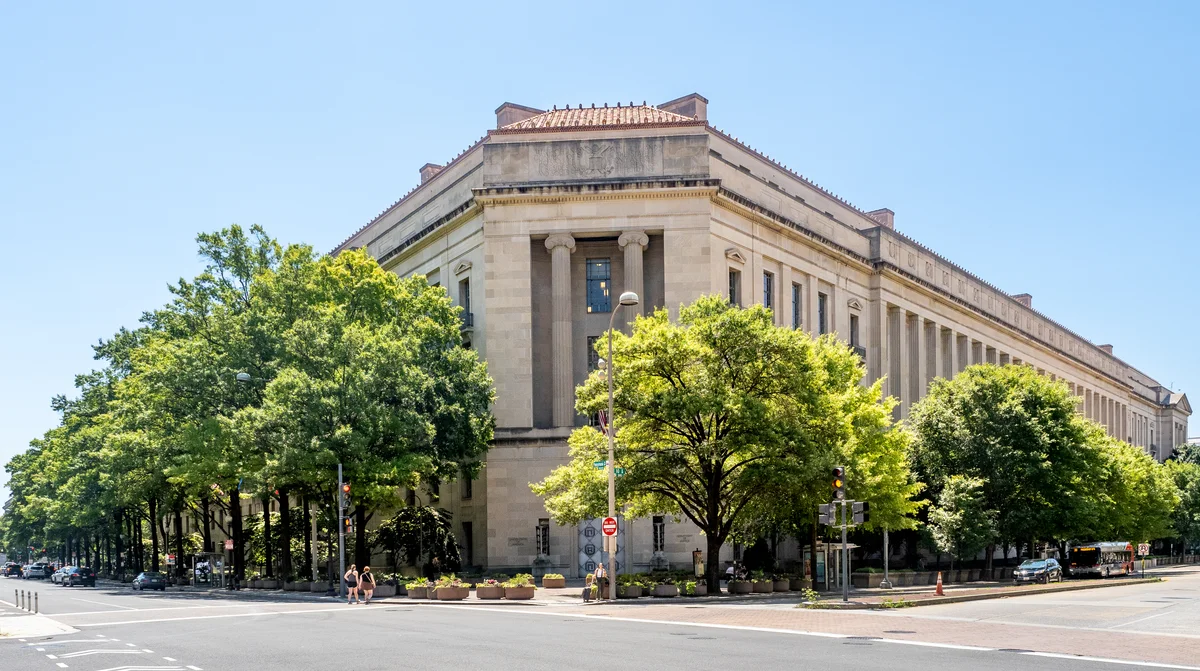





What the US filed in the Binance hack case
The filing is a verified complaint for forfeiture in rem, a case brought against the property itself rather than against a person. The main facts, from the complaint and the Justice Department's announcement:
| Item | Detail | Source |
|---|---|---|
| Filed | 23 November 2026 | Justice Department |
| Court | US District Court for the District of Columbia, Civ. No. 26-4150 | The complaint |
| Filed by | US Attorney's Office for the District of Columbia, with two Justice Department divisions | The complaint |
| What it targets | All USDC at 36 addresses on 18 blockchains | The complaint |
| Amount | Over $1.1 billion in USDC; Crypto Briefing puts it at $1.17 billion | Justice Department, Crypto Briefing |
| Legal basis | Proceeds of computer fraud and wire fraud, and property involved in money laundering | The complaint |
| Investigators | US Secret Service, FBI and IRS Criminal Investigation | The complaint |
How the stolen USDC was traced
According to the complaint, Binance told law enforcement that an employee was approached by a fake job recruiter and asked to download software during an interview. The software contained malware, and the attackers then used EIP-7702, an Ethereum feature added in 2025, to take control of Binance's hot wallets and send funds to a "sweeper" contract.
The complaint follows the USDC step by step. At about 20:41 UTC on 29 October about $780 million in USDC moved from Binance to one Ethereum address, followed by about $43 million at 20:59 UTC. Smaller amounts reached the other addresses after swaps and transfers across chains. Some of the 36 addresses are Binance's own hot-wallet and smart-contract addresses that, the complaint says, the attackers had taken over.
Who is behind the Binance hack
The Secret Service, FBI and IRS Criminal Investigation assess that the theft was carried out by North Korean military hacking groups known as the Lazarus Group and APT38, the complaint says. The FBI has named the actors TraderTraitor. North Korea has denied the accusation, Reuters reported. The complaint sets out the government's case; a court has not yet ruled on it.
How USDC can be frozen and forfeited
USDC is a stablecoin issued by Circle, which can block addresses so the tokens there cannot move. The complaint says Circle denied access to the USDC at the attackers' addresses on or about 29 October, and Circle wrote on 5 November that it had frozen about $1.1 billion in USDC linked to the incident.
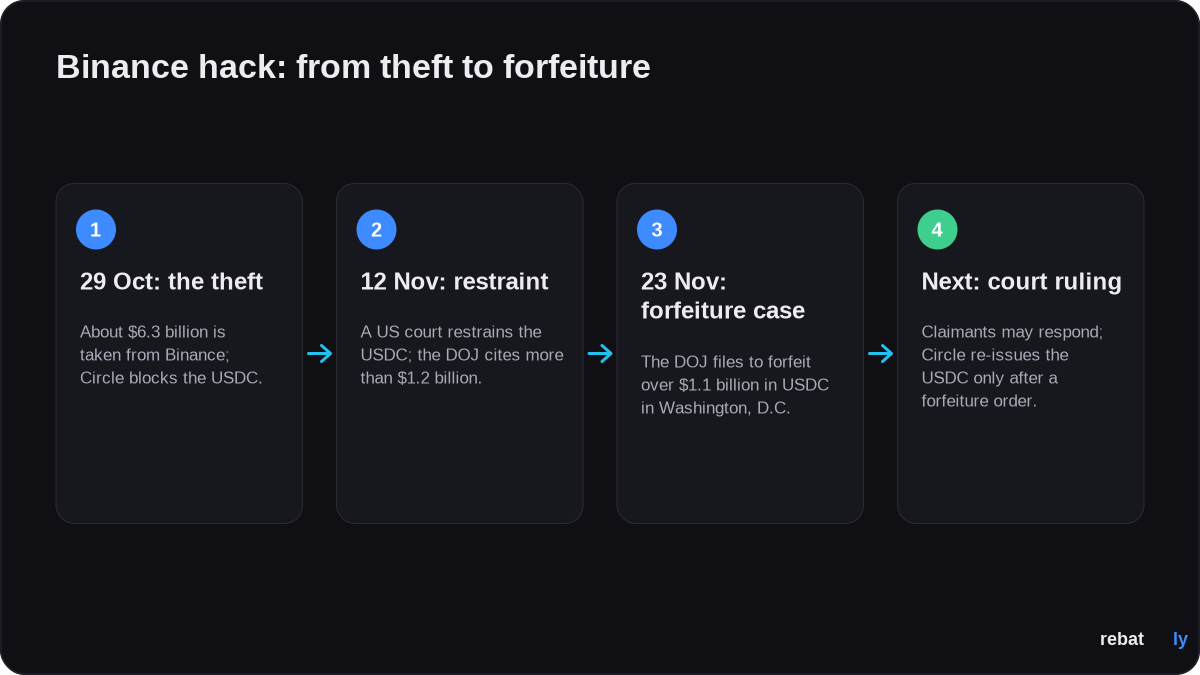
• Restraint: a federal court in Washington, D.C., issued a temporary restraining order over the USDC on 12 November, served on Circle the same day, the complaint says.
• Forfeiture: the complaint asks the court to forfeit the USDC to the United States.
• Re-issue: Circle says it cannot move the blocked tokens, but it has agreed to issue the same amount of new USDC and transfer it to the United States once the court issues a forfeiture order.
Frozen does not mean returned: until a judge rules, the USDC stays blocked where it sits.
Is this the same money as the $1.2 billion?
The Justice Department announced on 12 November that it had court authority to seize or restrain more than $1.2 billion stolen from Binance, CoinDesk reported. The new complaint says the USDC it targets was held under that 12 November restraining order, so this USDC is part of the same effort, not new money on top. Neither announcement says whether the USDC is all of the $1.2 billion or only part of it, so the two figures should not be added together.
This case is also not the FTX estate's $1.76 billion lawsuit against Binance, a separate case about a 2021 share buyback filed in 2024.
Binance hack recovery timeline
The main steps so far, with dates in UTC:
| Date | Event | Source |
|---|---|---|
| 29 October | About $6.3 billion is taken from Binance from 20:05 UTC; Circle blocks the attackers' USDC | Binance, the complaint |
| 1 November | Binance begins reopening withdrawals in phases | TechCrunch |
| 3 November | Binance says about $2.85 billion has been frozen or intercepted | Binance |
| 12 November | A US court orders the USDC restrained; the DOJ cites more than $1.2 billion | Justice Department |
| 12 November | Binance completes covering user losses, using about $6.34 billion of its own resources | CryptoTimes, Crypto Briefing |
| 18 November | Binance announces a worldwide freezing order from the ADGM courts in Abu Dhabi | The Block |
| 23 November | The DOJ files to forfeit over $1.1 billion in USDC | Justice Department |
What it means for Binance users
• Balances: Binance says it covered affected user balances with about $6.34 billion from its company treasury, its futures insurance fund and its SAFU fund, CryptoTimes and crypto.news reported. The forfeiture case does not change user balances.
• Withdrawals: Binance began reopening withdrawals in phases on 1 November, TechCrunch reported. Our guide to Binance withdrawals after the hack has the details, and our Binance hack article covers the theft itself.
• Frozen against recovered: the Justice Department says the US has helped freeze, seize or return over $2.9 billion since the theft. Crypto Briefing reported on 20 November that $2.82 billion was frozen but only $32 million actually recovered, without naming a source for that figure.
• Who gets the money: the Justice Department describes the case as part of an effort to help Binance recover its stolen assets. Neither the complaint nor the announcement says when or how any forfeited funds would reach Binance.
How the market reacted
Prices barely moved on the filing. At 19:45 UTC on 23 November, CoinGecko showed BNB at about $556, nearly unchanged in 24 hours, and bitcoin at about $60,830, up about 0.3%. USDC traded at $1.00.
Rebatly does not forecast prices. Our guide to trading costs on big news days shows how limit orders can cut costs when prices move fast.
Exchange security and trading costs
• Follow official channels only: check Binance's own app, website and verified accounts. Court cases like this one attract fake "refund" and "compensation" messages; no court or exchange will ask for your password, 2FA codes or seed phrase. Our article on exchange data breaches and scam messages shows what they look like.
• Check your account: review your withdrawal address list, API keys and login devices, and keep 2FA switched on.
• Know your costs: every trade carries a maker or taker fee. Our guide to maker and taker fills shows how the order type changes the fee.
• A fee rebate: a rebate returns part of each trading fee; with a rebate of up to 50%, a $10 fee could cost as little as $5.
This is general security information, not financial advice.
What happens next
• Claims: the complaint asks anyone who may have an interest in the USDC to appear and respond. Prosecutors said they were not aware of other claimants, crypto.news reported.
• Court ruling: if the court orders forfeiture, Circle issues the substitute USDC to the United States and the US Marshal disposes of it according to law. No date has been set.
• Abu Dhabi: a hearing in Binance's ADGM case is set for 1 December, crypto.news reported, citing Reuters.
• Ongoing: the Justice Department says efforts to trace, freeze, seize and forfeit the stolen assets continue, so more filings are possible.
We will update this article as the case moves forward.
Trade with lower fees
Whichever exchange you use, every trade carries a fee. Sign up through Rebatly and part of every trading fee comes back to you: up to 50% on Bybit and Bitget, up to 40% on BloFin and OKX, up to 60% on MEXC and up to 65% on OrangeX futures. On Toobit, code Rebatly gives up to 60%, credited by Toobit itself, and BloFin credits up to 40% itself every hour; the other rebates are paid daily in USDT. Our guide to how a fee rebate works explains the rest.
This article reports news and is not financial advice. Rebatly is an independent affiliate; not financial advice.
Get fees back on every trade
$10M+ rebates paid · Paid daily in USDT · No password or API keys, ever
Already signed up? Check your link and rebate with @rebatlybot on Telegram, or reach our support at @rebatly.
🔔 Get a Telegram alert each time your rebate is paid: tap “Activate notifications” in @rebatlybot. New to trading? Your first trade in 5 steps.
November 23, 2026 — published. Sources: US Department of Justice, Bloomberg, Reuters, Crypto Briefing, CryptoTimes, CoinDesk, The Block, crypto.news, Circle, TechCrunch, CoinGecko.