AMD stock falls after Hunterbrook's China report: what the short seller alleges, what is not established, and AMD's response
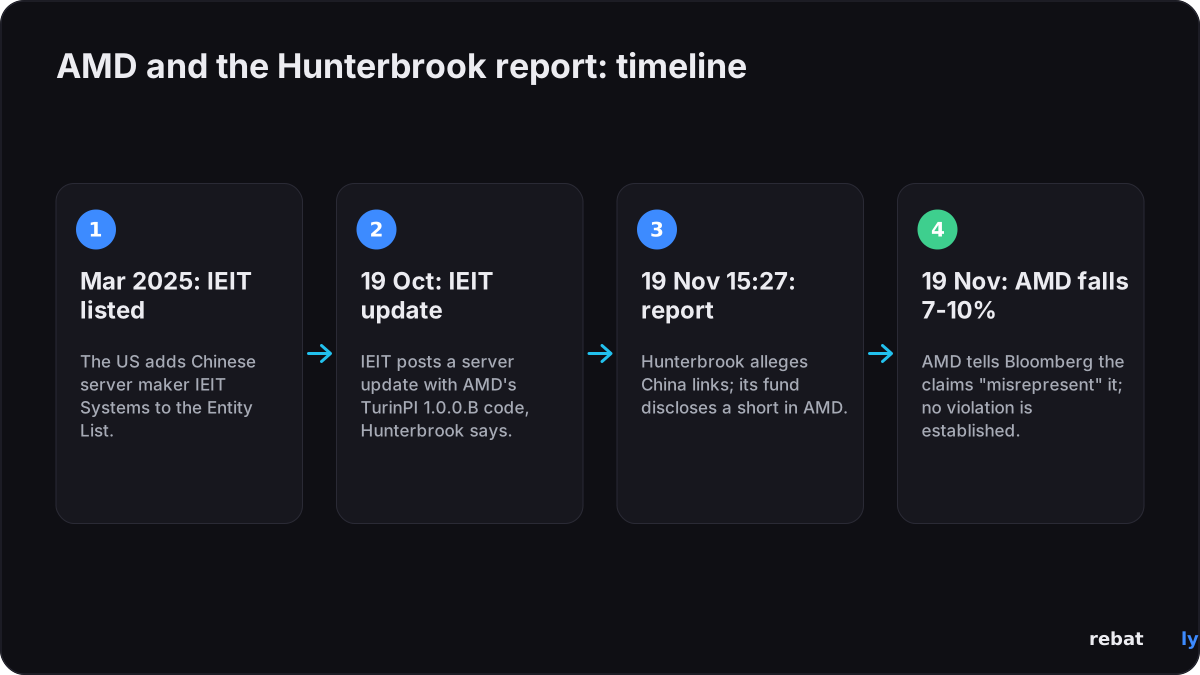
AMD stock fell sharply on Thursday 19 November 2026 after Hunterbrook Media published an investigation at 15:27 UTC alleging that a blacklisted Chinese server maker kept getting newer AMD firmware. Its sister fund, Hunterbrook Capital, disclosed that it is short AMD and long a basket of comparable securities, so the report comes from an investor that gains if the shares fall. AMD's decline during the session was put at about 7% by CNBC, 8% by Reuters, 9.1% by Investing.com and more than 10% at the low by Seeking Alpha. Hunterbrook itself says its findings do not establish that AMD broke US export law. AMD told Bloomberg that the claims "misrepresent" its business practices and relationships and that it complies with US export control laws. These are allegations, not findings by any regulator or court. This article sets out what the report claims, what it does not show, how the market moved and why crypto traders are watching. Figures are as of 18:00 UTC on 19 November, before the US close. All times are UTC.

 NO KYCSign up to BloFin
 Sign up to Bybit
 Sign up to OKX
 Sign up to Bitget
 Sign up to MEXC
 Sign up to OrangeX
 Sign up to Toobit
AMD stock price: the move on 19 November
Outlets measured the fall at different moments of the session, so the figures differ. Stock figures come from Investing.com, investingLive, CNBC, Reuters and Seeking Alpha; perp prices from Bybit's public market data:
| Time (UTC), 19 Nov 2026 | AMD | Source |
|---|---|---|
| 14:30 | Opened at $542.98 | Investing.com |
| 15:27 | Hunterbrook publishes its report and short disclosure | Hunterbrook |
| Morning US session | Down 9.1%, low of $479.64 | Investing.com |
| Morning US session | Down about 9% to $482, low of $470.56 | investingLive |
| During the session | Down about 7% / 8% / more than 10% at the low | CNBC / Reuters / Seeking Alpha |
| 17:02 | AMD's statement to Bloomberg is reported | Newsquawk |
| About 18:00 | AMDSTOCKUSDT perp at $489.17, after a low of $471.46 | Bybit |
On Bybit's AMD stock perpetual, the price traded as high as $555.41 in the hour from 14:00 UTC and fell to $471.46 in the hour from 15:00, the hour the report came out. That is a swing of about 15% from high to low by our calculation. The US session closes at 21:00 UTC; the closing price was not available when this was written, and we will add it.
What Hunterbrook alleges
These are the main claims in Hunterbrook's report, in its own framing. None has been confirmed by AMD, the US Commerce Department or a court:
• IEIT Systems kept getting newer AMD firmware: the US added IEIT Systems, a Chinese server maker, to the Commerce Department's Entity List in March 2025. Hunterbrook says IEIT has since built at least six newer versions of AMD firmware into the BIOS updates for three of its AMD server models, most recently in an update posted on 19 October 2026 containing AMD's "TurinPI 1.0.0.B" code.
• Linked server sellers: Hunterbrook says three companies that are not on the Entity List, Aivres, Kaytus and Maginfra, sell AMD servers whose firmware files it found to be 99.94% identical to IEIT's. It says Kaytus's 2025 accounts name IEIT as its ultimate holding company and that Aivres was called Inspur Systems until May 2023. It adds that the comparison "does not establish common ownership of Maginfra".
• Licensing income from blacklisted ventures: AMD booked $67 million of licensing gains in 2025, up 40%, which Hunterbrook traces to two Chinese chip ventures with Hygon in Chengdu that the US blacklisted in 2019. AMD owns 51% and 30% of them, according to the report. Reuters also reported the $67 million figure.
• Chinese assembly partners: two ventures 85% owned by China's Tongfu Microelectronics do most of AMD's chip assembly, testing and packaging, as AMD's own filings describe, and AMD bought about $2 billion of services from them in 2025. In October 2024 AMD lent one of them $100 million.
• China sales: AMD billed $7.75 billion, or 22.4% of its 2025 revenue, to customers in China and Hong Kong, investingLive and Crypto Briefing reported, citing the report.
• Commitments to AI customers: Crypto Briefing reported that the report also points to more than $33 billion of lease and loan guarantees and pledges of up to 320 million shares tied to AI customers; Bloomberg's headline describes these as "circular deals". We could not confirm these amounts in the report's text.
What the report does not establish
Hunterbrook is explicit about the limits of its own findings:
• "Hunterbrook does not know how IEIT obtained AMD's code, or whether AMD or anyone else held a license to supply it."
• On the licensing income: "The payments do not establish that AMD violated U.S. export controls."
• More broadly, the records it found "don't establish on their own a violation of export laws".
• The Entity List restricts exports to listed companies, not payments from them, the report notes.
• Coinpaper made the same point: firmware turning up in IEIT's updates does not by itself show that AMD supplied restricted technology after the listing date. Server makers can obtain firmware in several ways, and Hunterbrook does not say which applied.
No US agency has announced an investigation of AMD over these claims. The report is the work of a media company whose affiliated fund profits if AMD's shares fall, which readers should weigh.
What AMD says
• Before publication: AMD did not answer Hunterbrook's questions, including whether it holds licences to sell to IEIT, according to the report. Hunterbrook says AMD asked for more time, was given until the following day and did not get back in touch.
• After publication: AMD did not immediately respond to CNBC, Reuters or Seeking Alpha. Later in the session it told Bloomberg that the claims "misrepresent" its business practices and relationships, and a spokesperson said that "AMD complies with applicable US export control laws and regulations". Newsquawk carried the statement at 17:02 UTC.
• Earlier comments: on AMD's last earnings call, CEO Lisa Su called China an "important" market and said AMD intends to comply fully with export controls, CNBC reported.
• Other parties: Hunterbrook says IEIT, Kaytus, Aivres, Maginfra, Hygon, Tongfu and the Commerce Department's Bureau of Industry and Security did not respond to its questions.
As of 18:00 UTC on 19 November, AMD had not published a detailed public rebuttal on its own website.
Export controls: what the rules cover
• The Entity List: run by the Commerce Department's Bureau of Industry and Security (BIS). Sending a listed company anything covered by US export rules needs a licence, and BIS's policy for IEIT is to deny such requests, Hunterbrook writes.
• Software and firmware: Washington treats software updates as exports, the report says. William Reinsch, a former Commerce under secretary for export administration now at CSIS, told Hunterbrook that "it's a lot harder to enforce software transfers than it is hardware transfers", and that needing a licence "does not mean automatically that the license will be denied".
• A recent precedent: in an October 2026 settlement with Lambda Research, Commerce counted each of seven software updates as a separate violation, according to the report.
• The 50% affiliates rule: a rule extending Entity List limits to companies at least 50% owned by listed firms is suspended until 10 January 2027, Hunterbrook notes. It says the rule would create a licence requirement for nearly every US-origin item, chips and firmware alike.
This is a summary of how the report and the experts it quotes describe the rules, not legal advice.
Nvidia's China problems: the context
AMD has often been seen as the main beneficiary of Nvidia's troubles over China, which is part of why the report hit the shares so hard, CNBC and investingLive reported:
• H20 licences: in April 2025 the US government told Nvidia that its H20 chip, built for the Chinese market, needed an export licence, and Nvidia later reported a charge of about $4.5 billion tied to the rule, according to its filings.
• Chip diversion: Investing.com noted that Nvidia chips funnelled to China through a Singapore data-centre operator led to new Commerce Department licensing rules for Southeast Asia, and Reuters pointed to further export tightening announced this week.
• Our Nvidia coverage: our guides cover the Jensen Huang investigation, why Nvidia stock fell and semiconductor stocks.
• Other pressure on AMD this week: Investing.com reported that Lisa Su sold 70,000 AMD shares, about $35.5 million, under a pre-arranged trading plan.
What the AMD drop means for crypto traders
• AMD trades around the clock on some crypto exchanges: Bybit lists an AMDSTOCKUSDT perpetual among its TradFi perps, launched in May 2026 and settled in USDT, with leverage of up to 50x and funding every 8 hours, according to Bybit's public market data. Its 24-hour turnover was about $20.3 million at 18:00 UTC.
• Prices can move before the stock reopens: the Nasdaq session runs from 14:30 to 21:00 UTC on weekdays, but a stock perp keeps trading overnight and at weekends. If news breaks while the market is shut, the perp can move first and the shares may open at a different level, a gap. Liquidity is usually thinner outside US hours, so moves can be sharper.
• Funding: perps have no expiry. Instead, longs and shorts pay each other a funding rate that pulls the perp towards the index price. When many traders bet the same way, funding can become expensive. Bybit showed AMDSTOCKUSDT funding at 0% at 18:00 UTC, with a cap of 0.75% per interval.
• Higher risk: leverage magnifies a 10% move like Thursday's into a much larger gain or loss, and positions can be liquidated. Read the venue's contract page for its index, trading hours and fees first; our guide to Bybit stock perp fees explains the costs.
• Bitcoin: CoinGecko showed bitcoin at about $62,735 and ether at about $1,771 at 17:58 UTC, both little changed in 24 hours.
Rebatly does not forecast prices. For how scheduled US events affect trading costs, see our guide to FOMC and crypto trading costs. This is general information, not financial advice.
What happens next
• The US close: the 19 November session ends at 21:00 UTC. We will add the closing price.
• A fuller AMD response: AMD's statement to Bloomberg denies the claims in general terms. A detailed rebuttal or an SEC filing would be the place to look for specifics.
• Regulators: no US agency has commented. Any BIS action would be published by the Commerce Department.
• The 50% affiliates rule: its suspension runs until 10 January 2027.
• Hunterbrook's position: Hunterbrook says its positions may change at any time.
We will update this article when AMD, Hunterbrook or US officials publish more details.
Trade with lower fees
If you trade stock perps or crypto, every trade carries a fee. Sign up through Rebatly and part of every trading fee comes back to you: up to 50% on Bybit and Bitget, up to 40% on BloFin and OKX, up to 60% on MEXC and up to 65% on OrangeX futures. On Toobit, code Rebatly gives up to 60%, credited by Toobit itself, and BloFin credits its 40% itself every hour; the other rebates are paid daily in USDT. Our guide to how a fee rebate works explains the rest.
This article reports news and is not financial advice. Rebatly is an independent affiliate; not financial advice.
Get fees back on every trade
$10M+ rebates paid · Paid daily in USDT · No password or API keys, ever
Already signed up? Check your link and rebate with @rebatlybot on Telegram, or reach our support at @rebatly.
🔔 Get a Telegram alert each time your rebate is paid: tap “Activate notifications” in @rebatlybot. New to trading? Your first trade in 5 steps.
November 19, 2026 — published. Sources: Hunterbrook, CNBC, Reuters, Investing.com, Bloomberg, Newsquawk, Seeking Alpha, investingLive, Crypto Briefing, Coinpaper, Bybit, CoinGecko.