Chainflip hack: how one validly signed withdrawal emptied its Ethereum vault, why the loss is $4.86 million or about $12 million, and what to check before a cross-chain swap
Chainflip hack: at about 07:10 UTC on 21 November 2026, a single withdrawal took the entire liquid balance of Chainflip's Ethereum vault, 520.22 ETH, about 3.25 million USDC and about 758,000 USDT, worth about $4.86 million, The Block and CoinDesk reported. The withdrawal carried a valid signature from the vault's shared signing key, which on-chain trackers read as a suspected key compromise rather than a smart contract bug. A day later, Chainflip Labs said the attacker had also taken 122.86137042 BTC, which brings the total to about $12 million, and offered a 10% bounty if the other 90% is returned by 18:38 UTC on 23 November. The protocol is in full safe mode: deposits, withdrawals, swaps and quotes are disabled. This article separates what is confirmed from what is claimed, explains the two loss figures, and lists what to check before a cross-chain swap. All times are UTC.





What happened in the Chainflip hack
The key moments, from Chainflip's statement, on-chain trackers and outlet reports (times in UTC):
| Date and time (UTC) | What happened | Source |
|---|---|---|
| 11 November | The attacker is funded through Tornado Cash | Chainflip |
| 18 November, 21:53 | Last scheduled rotation of the Ethereum vault key before the attack | The Block |
| 20 November | The attacker registers a validator account and buys FLIP | Chainflip |
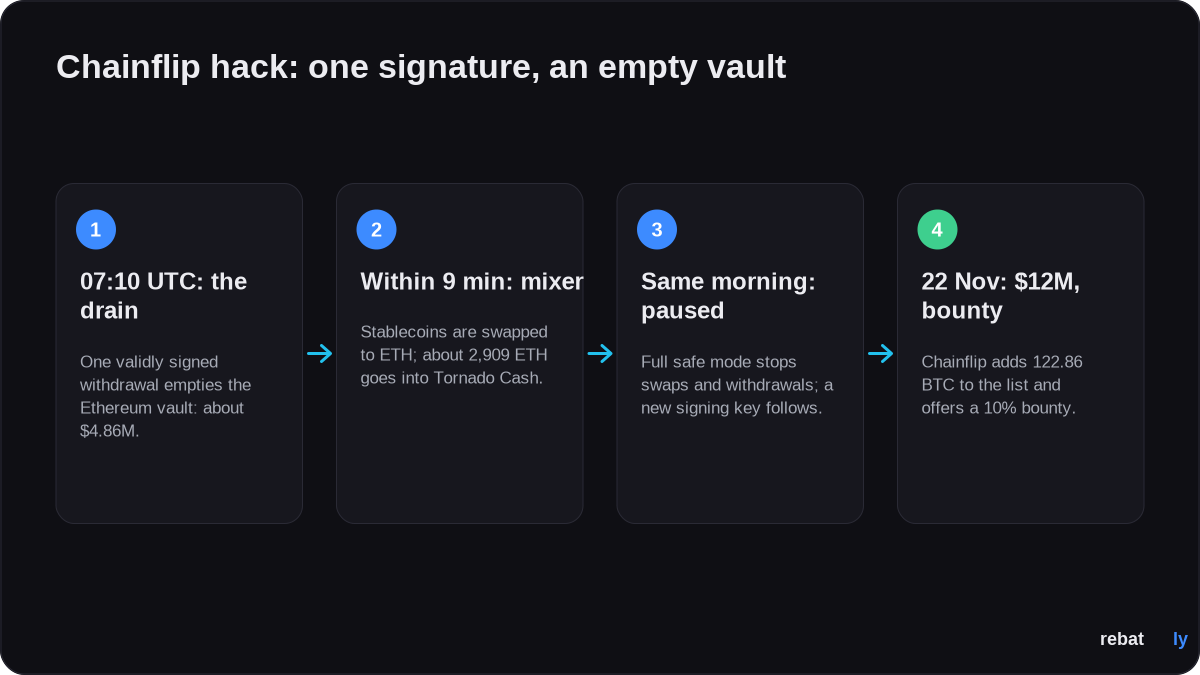
| 21 November, about 07:10 | One withdrawal moves 520.22 ETH, about 3.25 million USDC and about 758,000 USDT out of the Ethereum vault | The Block, CoinDesk, Crypto Briefing |
| Within about 9 minutes | The stablecoins are swapped to ETH and about 2,909 ETH is sent to Tornado Cash | Crypto Briefing, CoinDesk |
| 21 November, morning | Chainflip puts the protocol into full safe mode | Chainflip on X, via The Block |
| About 1 h 42 min to 1 h 45 min after the drain | A new Ethereum signing key is in place | Bitquery, via The Block |
| About 2 hours after the pause | Nearly 10.5 BTC moves from a previous Chainflip vault address; the purpose is not confirmed | The Block |
| 22 November | Chainflip Labs lists everything taken, including 122.86137042 BTC, and offers a 10% bounty | Chainflip, Cointelegraph |
| 23 November, 18:38 | Bounty deadline | Chainflip |
The Block said the whole attack took under 10 minutes. It was first flagged by the security firm Decurity's Defimon alerts, and by the trackers Lookonchain and Onchain Lens.
$4.86 million or $12 million? The two figures explained
Both numbers are right; they count different things. The $4.86 million reported on 21 November is the Ethereum vault alone, as seen on-chain. Chainflip Labs' own list, published on its site, adds 122.86137042 BTC, and Cointelegraph put the total at about $12 million. Rebatly's check, using CoinGecko prices at 07:00 UTC on 21 November (BTC about $57,952, ETH about $1,638):
| Asset | Taken, per Chainflip Labs | Approx. value (CoinGecko, 07:00 UTC, 21 Nov) | In the $4.86M figure? |
|---|---|---|---|
| ETH | 520.2243399 ETH | About $0.85 million | Yes |
| USDC | 3,249,631.41 USDC | About $3.25 million | Yes |
| USDT | 758,141.33 USDT | About $0.76 million | Yes |
| Ethereum vault subtotal | About $4.86 million | This is the $4.86M figure | |
| BTC | 122.86137042 BTC | About $7.12 million | No |
| Total | About $11.98 million | Chainflip's "about $12M" |
What is not yet explained is how the bitcoin was taken. The Block reported on 21 November that the Bitcoin and Solana vaults appeared unaffected, and Chainflip has not said when or how the BTC left. Chainflip's bounty asks for 110.57523337 BTC and 2,618.1 ETH back: the BTC is exactly 90% of 122.86137042, and the ETH matches 90% of the about 2,909 ETH sent to Tornado Cash after the stablecoins were swapped.
How the Chainflip hack happened: a valid signature, not a code bug
Chainflip is a cross-chain swap protocol: you send, say, ETH on Ethereum and receive BTC on Bitcoin, without wrapped tokens. Its funds sit in a vault on each chain, and no single person holds the vault key. Instead, 150 validators share it using threshold signatures, and 100 of the 150 must cooperate to sign a payout. The key is rotated every three days, The Block reported.
That design is why a key compromise is so serious. The vault contract does only one check: is the signature valid for the current key? If someone can produce that signature, the contract pays out whatever it is told to, and here it paid out everything. Decurity said it was not a smart contract bug and that the attacker "apparently obtained access to the validator network's aggregate signing key". Crypto Briefing described the withdrawal as authorized by a valid Schnorr signature derived from the vault's aggregate key.
Bitquery found one detail that stands out: the drain used a 39-digit nonce, against about 315,000 for normal payouts, the only one of 299,677 signatures since 2023 to break the count. It said this suggests the signature was produced "outside that system", but cautioned that "no conclusions can be drawn from timing alone". Chainflip says it has "identified the mechanism of key exposure and have prevented such future attacks", but has not said what the mechanism was. Until it publishes a post-mortem, the cause should be read as suspected, not confirmed.
Who is behind it
No one has been named. Chainflip says it traced the preparation, "the Tornado Cash funding on 11 November, the FLIP purchase, the validator account registered on 20 November and the server behind it", and holds "identifying information surrounding the offending validator" that it says law enforcement could use. It says the attacker's addresses are flagged with the major blockchain analytics firms. These are Chainflip's claims; no analytics firm or authority has publicly attributed the attack.
This is a different story from the Binance hacker's ETH. On 20 November Cointelegraph reported that the attacker behind the Binance hack moved nearly $600 million in ETH, mostly through THORChain, with an analyst estimating about $5 million routed through Chainflip. Nothing reported so far links that activity to the vault drain.
What Chainflip says: swaps, withdrawals and compensation
• Safe mode: "As a precaution, the protocol is being put into full safe mode," Chainflip posted on X. Deposits, withdrawals, swaps and quoting are disabled.
• Swaps in progress: full safe mode also stops payouts on swaps already under way, and liquidity providers cannot withdraw until it ends. Under Chainflip's documentation, deposits not yet finalized will be processed after the protocol exits safe mode, CoinDesk reported.
• The bounty: "Keep 10% as a bounty and return 90%". If both payments arrive by 18:38 UTC on 23 November, Chainflip says it will treat this as a white hat recovery and withdraw its reports to law enforcement. As of 22 November, the deadline was still open and no return had been reported, CoinCentral said.
• Compensation: Chainflip has not announced a reimbursement plan for this incident, The Block and others reported.
• Restart: no date has been given. Chainflip's website shows "Chainflip services are temporarily unavailable" and points users to its Discord.
Frozen or recovered funds
None reported as of 22 November. The funds moved too fast for Circle or Tether to freeze the USDC or USDT, The Block reported, citing AMLBot, which said the laundering "was executed with high-speed automation". The stablecoins were converted to ETH and almost all of it went into Tornado Cash within about nine minutes. Chainflip says every withdrawal from the Tornado Cash pools used "is being watched". Flagged is not the same as frozen, and frozen is not the same as returned.
Market reaction: FLIP
Chainflip's FLIP token fell sharply. On CoinGecko FLIP was about $0.483 at 06:00 UTC on 21 November, about $0.324 at 10:00 UTC (down about 33%), about $0.273 at 06:00 UTC on 22 November and about $0.292 at 17:44 UTC on 22 November, down about 39% from before the drain, with a market value of about $25.1 million. Outlets measured the fall at different times: The Block about 34% (market value from about $41.6 million to $27.1 million), CoinDesk more than 30%, Crypto Briefing about 39% and Cointelegraph 42.9% over 24 hours. Rebatly does not forecast prices. On days like this, prices can jump in seconds and market orders can fill worse than the price on screen; our guide to trading costs on big news days explains why.
Chainflip's second exploit in about 10 weeks
This is the second loss at Chainflip since September:
| Date (UTC) | What happened | Amount | Outcome |
|---|---|---|---|
| 12 September 2026 | A flaw in how Chainflip read TRON transaction memos let one deposit trigger a second payout, six times | 736,442.17 USDT from the TRON vault | Network paused; validators voted to repay liquidity providers from surplus funds |
| 21 November 2026 | One validly signed withdrawal from the Ethereum vault; BTC also taken | About $12 million in BTC, ETH, USDC and USDT (Chainflip) | Full safe mode; 10% bounty offered; no reimbursement plan announced yet |
The two are different kinds of failure: September was a processing bug on one chain, November a valid signature from the key that guards the vaults. For other recent cases, see our guides to the Lighter exploit and the wrapped Monero XMR1 hack.
What to check before a cross-chain swap
Whichever cross-chain protocol you use, check these before you send funds:
• Protocol status: the official status page and the team's verified X or Discord. If a protocol is paused, an app that still shows a quote may not be able to complete the swap.
• The quoted route: which chains, pools and steps the swap goes through, and roughly how long it should take.
• Slippage limit: set one, so the swap refunds instead of filling far below the quote.
• Network and protocol fees: gas on both chains, the protocol's network fee, pool fees and any app or broker fee, all on top of the price.
• Minimum received: the amount you are guaranteed after fees and slippage. Compare that, not the headline rate.
• Pause and incident history: how often the protocol has been paused or exploited, and whether users were repaid. Chainflip has had two incidents in about 10 weeks.
• Size: a large swap has more to lose if a vault is paused mid-swap; some users split large amounts.
On a centralized exchange the trading fee is the part you can compare in advance. Standard entry-tier rates from each exchange's fee pages:
| Exchange (entry tier) | Spot maker | Spot taker | Perpetual maker | Perpetual taker |
|---|---|---|---|---|
| Bybit (VIP 0) | 0.10% | 0.10% | 0.02% | 0.055% |
| OKX (regular user) | 0.08% | 0.10% | 0.02% | 0.05% |
| Bitget (standard) | 0.10% | 0.10% | 0.02% | 0.06% |
On a $10,000 spot trade, a 0.10% taker fee is $10. A fee rebate lowers that part: with up to 50% back on Bybit, the $10 would come down by up to $5. Rebates do not reduce spreads, slippage or network fees, and an exchange holds your funds in custody, which is a different risk from a swap protocol. The table shows fee rates only; it does not mean any of these exchanges lists FLIP, so check the market list in your own account. Our guides to spot vs perpetual fees and maker vs taker fills go further.
What Chainflip users should do
• Official channels only: follow chainflip.io, Chainflip's verified X account and its Discord. Treat any message offering a refund or a "stuck swap recovery", especially one asking for a deposit, a seed phrase or a wallet connection, as a likely scam.
• Swap in progress: keep your deposit transaction hash and the swap ID from the app you used; do not send the deposit again.
• Liquidity providers: withdrawals are paused until Chainflip exits safe mode.
• Your exchange accounts: check API keys, the withdrawal address whitelist and 2FA. Our guide to exchange data breaches and scam messages covers the steps.
Rebatly never asks for your API keys, passwords, seed phrases or 2FA codes. This is general security information, not financial advice.
What happens next
• Bounty deadline: 18:38 UTC on 23 November. Chainflip says it will pursue the attacker through law enforcement if the funds are not returned.
• Post-mortem: how the key was exposed, and how the BTC was taken, have not been published.
• Restart: when deposits, withdrawals and swaps resume, and in what order.
• Compensation: whether liquidity providers and users with swaps in progress are repaid, as they were after the September incident.
• The ETH: about 2,909 ETH went into Tornado Cash; none has been reported frozen.
We will update this article as Chainflip publishes more.
Trade with lower fees
Whatever you trade, every trade carries a fee. Sign up through Rebatly and part of every trading fee comes back to you: up to 50% on Bybit and Bitget, up to 40% on BloFin and OKX, up to 60% on MEXC and up to 65% on OrangeX futures. On Toobit, code Rebatly gives up to 60%, credited by Toobit itself, and BloFin credits its up to 40% itself every hour; the other rebates are paid daily in USDT. Our guide to how a fee rebate works explains the rest.
This article reports news and is not financial advice. Rebatly is an independent affiliate; not financial advice.
Get fees back on every trade
$10M+ rebates paid · Paid daily in USDT · No password or API keys, ever
Already signed up? Check your link and rebate with @rebatlybot on Telegram, or reach our support at @rebatly.
🔔 Get a Telegram alert each time your rebate is paid: tap “Activate notifications” in @rebatlybot. New to trading? Your first trade in 5 steps.
November 23, 2026 — published. Sources: Chainflip, The Block, CoinDesk, Cointelegraph, Crypto Briefing, CoinCentral, CoinGecko, Bybit, OKX, Bitget.