Wrapped Monero (XMR1) hack: how Wagyu's token crashed 99% after a $13.5 million sell-off, what is confirmed, and what to check before swapping a wrapped token
Wrapped Monero XMR1 hack: XMR1, a token issued by the swap service Wagyu to represent Monero on Hyperliquid, fell from about $500 to about $1 in roughly 30 minutes on 20 November 2026, between about 04:45 and 05:20 UTC. A newly created account received 5.2 million XMR1 from the token's deployer account and sold part of it for about $13.5 million, according to on-chain analysis by Bitquery and Hyperliquid trading records reviewed by CoinDesk. Wagyu's pseudonymous founder, PerpetualCow, blamed a breach at the Icelandic web host 1984.hosting and promised on X to refund everyone who lost money personally, without giving a timeline. Native Monero (XMR) was not affected. This article separates what is confirmed from what is claimed, explains why a wrapped token depends on its issuer, and lists what to check before you swap one. All times are UTC.





What happened in the XMR1 hack
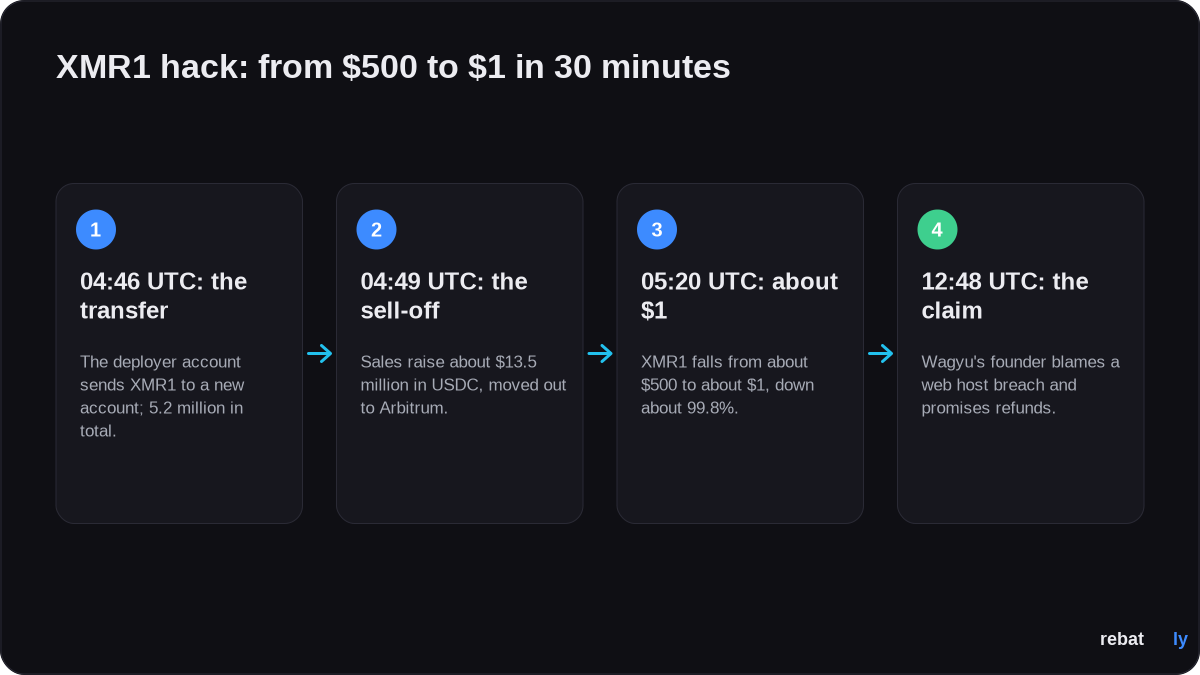
The key moments on 20 November 2026, from Bitquery's on-chain timeline and outlet reports (times in UTC):
| Time (UTC) | What happened | Source |
|---|---|---|
| 03:30 to 03:38 | A new address is funded with 0.098 ETH from Tornado Cash, then an account is set up on Hyperliquid | Bitquery, Decrypt |
| 04:46 | First transfer from the XMR1 deployer account to the new account: 100,000 XMR1 | Bitquery |
| 04:49 | First large sale; XMR1 had traded near $500 earlier in the week | Bitquery, CoinDesk |
| 04:54 to 05:20 | $13.28 million in USDC is withdrawn to Arbitrum in 11 transfers | Bitquery, Cointelegraph |
| 05:14 and 05:16 | Two more transfers from the deployer: 100,000 and 5,000,000 XMR1, for 5.2 million in total | Bitquery, The Block |
| From 05:20 | XMR1 trades at about $1, down about 99.8% | Bitquery, Hyperliquid data |
| 09:36 | PerpetualCow says he is "not yet sure what happened" | Bitquery |
| 11:08 | Icelandic outlet DV reports that host 1984 and CERT-IS have announced a serious cyberattack; the host suspends its services | Bitquery, Decrypt, Bitcoin.com News |
| 11:31 and 12:48 | PerpetualCow promises refunds, then posts a post-mortem blaming the host breach | Bitquery, The Block |
Hyperliquid's public five-minute price data show XMR1 at about $494 at 04:45 UTC, $427 at 04:55, $194 at 05:05, $19 at 05:15 and $1.00 at 05:20. The Block reported a low of $0.65. By 07:00 UTC on 21 November XMR1 last traded at about $0.67, and hourly trading had fallen to a few hundred dollars, against about $6.9 million a day before the crash, Bitquery said.
How the XMR1 hack happened: the founder's account and what analysts say
In his post-mortem on X, PerpetualCow wrote: "The XMR1 deployer key was held on an OLD server on there that I DELETED, but somehow the logs/files were still kept", referring to 1984.hosting. He added that "these hosting providers keep your data/logs even after you delete your server with them". In a joint statement with CERT-IS, Iceland's cyber response team, 1984 ehf. said it had suffered an "extensive and serious cyberattack" and temporarily shut down all services, Decrypt reported, citing DV. The host's statement did not mention Wagyu.
None of this has been independently confirmed. Bitquery said a transfer on Hyperliquid is a signed action, so the sender "most likely had the deployer's main key", but "we cannot confirm how the deployer's key was taken". The Block noted that the host's outage "does not automatically confirm" the founder's explanation. CoinDesk, reporting earlier in the day, said it was unclear whether the transfers were authorized or involved compromised credentials.
Who is behind it
No one has been named. Bitquery said the Tornado Cash funding minutes before the account was created "fits an outside attacker. It does not prove one." Bitquery also found that about $6.6 million of XMR1 had been bought earlier in November with money from four other hacks, including the Lighter exploit, apparently as a route into native Monero, but said "nothing ties those thieves to this drain". Separately, Wagyu disclosed a data leak on 28 October covering three months of swap records and said at the time that funds were not affected; CoinDesk said no link between that leak and the 20 November transfers had been established.
What Wagyu says: refunds and relaunch
• Refunds: "Everyone who lost money due to this will be refunded by me personally and Wagyu will re-launch at a later stage," PerpetualCow wrote, adding: "Give me some time please."
• No timeline: he has not said when, how, or how losses will be counted, Bitcoin.com News and The Block reported.
• Who lost money: earlier, he said market makers took most of the hit and that swap users lost nothing, Bitquery reported. CoinDesk noted that the sale proceeds "do not establish the size of any customer losses".
• Website: Wagyu's site showed a "temporarily unavailable" notice when The Block published at about 16:11 UTC on 20 November.
• Not yet known: how much real Monero backs the XMR1 still in circulation, and whether holders can redeem it.
The numbers, and who reports them
Counts differ because they were taken at different times. Figures for 20 November 2026:
| Item | Figure | Source |
|---|---|---|
| XMR1 sent by the deployer | 5.2 million XMR1 in three transfers | Bitquery, CoinDesk, Lookonchain via The Block |
| Sold, early count | About 364,000 XMR1 by 07:51 UTC, for about $13.5 million (388 buyers); about 4.83 million still held | CoinDesk, Bitquery via Decrypt and Bitcoin.com News |
| Sold, later count | 369,623 XMR1 to 420 buyers for $13.51 million, counted to 13:00 UTC | Bitquery |
| How fast | 76% of the money came in during the first 11 minutes; 75% came from buy orders already on the book | Bitquery |
| Converted | $13.22 million of USDC swapped for 7,467 ETH on CoW Protocol | Bitquery, Cointelegraph |
| Held at last check | About 7,348 ETH, about $12.8 million, across three wallets ("nearly 7,500 ETH" bought, per Lookonchain) | Bitquery, Decrypt, The Block |
| Deployer balance | 18.6 million XMR1 (93% of supply) before, 13.4 million (67%) after | Bitquery |
| Frozen or returned | None reported | Outlets above, as of 21 November |
The dollar figure is what buyers paid for XMR1 as its price collapsed. It is not a measured loss of customer funds, and no exchange or bridge has reported freezing any of the ETH.
Market reaction: XMR1 and native Monero
XMR1 lost about 99.8% of its value on Hyperliquid, where it kept trading thinly at well under $1. Native Monero, which runs on its own blockchain, was not part of the incident: on CoinGecko XMR was about $494 at 04:00 UTC on 20 November, about $448 at 16:00 UTC and about $444 at 07:56 UTC on 21 November, a fall of about 10% on a day when bitcoin also fell below $60,000. CoinDesk reported that Hyperliquid's XMR perpetual futures contract, which is separate from XMR1, traded near $482 during the morning. Rebatly does not forecast prices. On days like this, prices can jump in seconds and market orders can fill worse than the price on screen; our guide to trading costs on big news days explains why.
What a wrapped token is, and why native XMR was unaffected
Monero has its own blockchain and cannot trade directly on Hyperliquid. A wrapped token is an IOU for it on another network: you deposit real XMR with the issuer, the issuer creates XMR1 for you, and you can later hand XMR1 back to get XMR out, Decrypt explained. CoinDesk noted that holders "depend on the service to complete that conversion". That makes the token's price rest on three things:
• The issuer's keys: whoever controls the deployer account can move or create supply. On 20 November that account held 93% of all XMR1, Bitquery said.
• The backing: the real XMR held behind the tokens. Monero's privacy features hide that reserve, so Bitquery said it "cannot tell how much Monero stands behind the tokens that are left".
• Redemption: whether the issuer keeps swapping tokens back. With Wagyu's service down, the price fell to what buyers would pay for an uncertain claim.
Native XMR was unaffected because nothing on the Monero network changed: no XMR moved and no Monero software was broken. Only the issuer-run copy on Hyperliquid was hit. The same pattern, where trust sits with one operator, is behind many bridge losses; our guides to the Liquid Network hack and the Binance hack cover other cases.
What to check before swapping a wrapped or bridged token
Before you buy or swap any wrapped or bridged token, check:
• Contract address or token ID: copy it from the issuer's official docs, not from a search result or a chat. Look-alike tokens with the same ticker are common.
• Issuer: who runs it, whether one person or one key controls minting, and how much of the supply the issuer itself holds.
• Backing proof: whether reserves can be checked on-chain or by an audit, and how often. For privacy coins this is often not possible.
• Redemption: whether you can swap back to the native coin today, at what fee and how fast.
• Liquidity depth: how much the order book or pool can absorb near the current price. XMR1 went from about $6.9 million of trading a day before the crash to a few hundred dollars an hour after it.
• Quoted spread and slippage: compare the quote with the last price, set a slippage limit, and split large orders.
• Network and swap fees: add gas, bridge and swap fees to the trading fee. Bitquery estimated that the attacker's own bridge hop to Ethereum cost about 1.7%.
Trading fees are the part you can compare in advance. Standard entry-tier rates from each venue's fee pages:
| Venue (entry tier) | Spot maker | Spot taker | Perpetual maker | Perpetual taker |
|---|---|---|---|---|
| Hyperliquid (base rate) | 0.040% | 0.070% | 0.015% | 0.045% |
| Bybit (VIP 0) | 0.10% | 0.10% | 0.02% | 0.055% |
| OKX (regular user) | 0.08% | 0.10% | 0.02% | 0.05% |
| Bitget (standard) | 0.10% | 0.10% | 0.02% | 0.06% |
On a $10,000 spot trade, a 0.10% taker fee is $10. That is fixed and predictable; slippage on a thin book is not, and in the XMR1 crash a single five-minute bar ran from about $427 to $85. A fee rebate lowers the fee part: with up to 50% back on Bybit, the $10 above would come down by up to $5. Rebates do not reduce slippage, spreads or network fees. The table shows fee rates only; it does not mean any of these exchanges lists XMR1 or XMR, so check the market list in your own account. Our guides to spot vs perpetual fees and maker vs taker fills go further.
What XMR1 holders and users should do
• Official channels only: follow Wagyu's own site and the founder's verified X account for refund news. Treat any message offering a refund, especially one asking for a deposit, a seed phrase or a wallet connection, as a likely scam.
• Keep records: save your trade history, transaction hashes and balances from before 04:45 UTC on 20 November in case a refund process asks for them.
• Wagyu swap users: if you used Wagyu in the period covered by the October leak, your IP address and swap details may be exposed; be careful with messages that know your history.
• Your exchange accounts: check API keys, the withdrawal address whitelist and 2FA. Our guide to exchange data breaches and scam messages covers the steps.
Rebatly never asks for your API keys, passwords, seed phrases or 2FA codes. This is general security information, not financial advice.
What happens next
• Refunds: promised by PerpetualCow personally, with no date, method or eligibility rules yet.
• Relaunch: Wagyu says it will relaunch "at a later stage".
• Remaining supply: the attacker still held millions of XMR1 at Bitquery's last check, and the deployer account still held about 13.4 million.
• Investigation: 1984.hosting and CERT-IS are still looking into the host breach; how the key was taken has not been confirmed.
• The ETH: about 7,348 ETH sat in three wallets at last check; none has been reported frozen.
We will update this article as Wagyu publishes more.
Trade with lower fees
Whichever token you trade, every trade carries a fee. Sign up through Rebatly and part of every trading fee comes back to you: up to 50% on Bybit and Bitget, up to 40% on BloFin and OKX, up to 60% on MEXC and up to 65% on OrangeX futures. On Toobit, code Rebatly gives up to 60%, credited by Toobit itself, and BloFin credits its 40% itself every hour; the other rebates are paid daily in USDT. Our guide to how a fee rebate works explains the rest.
This article reports news and is not financial advice. Rebatly is an independent affiliate; not financial advice.
Get fees back on every trade
$10M+ rebates paid · Paid daily in USDT · No password or API keys, ever
Already signed up? Check your link and rebate with @rebatlybot on Telegram, or reach our support at @rebatly.
🔔 Get a Telegram alert each time your rebate is paid: tap “Activate notifications” in @rebatlybot. New to trading? Your first trade in 5 steps.
November 21, 2026 — published. Sources: Bitquery, CoinDesk, The Block, Decrypt, Cointelegraph, Bitcoin.com News, GNcrypto, DV, Hyperliquid, CoinGecko, Bybit, OKX, Bitget.