Lighter exploit: a leaked API key drained about $10.4 million in USDC and paused withdrawals. What happened, the numbers, and how to lock down your exchange API keys
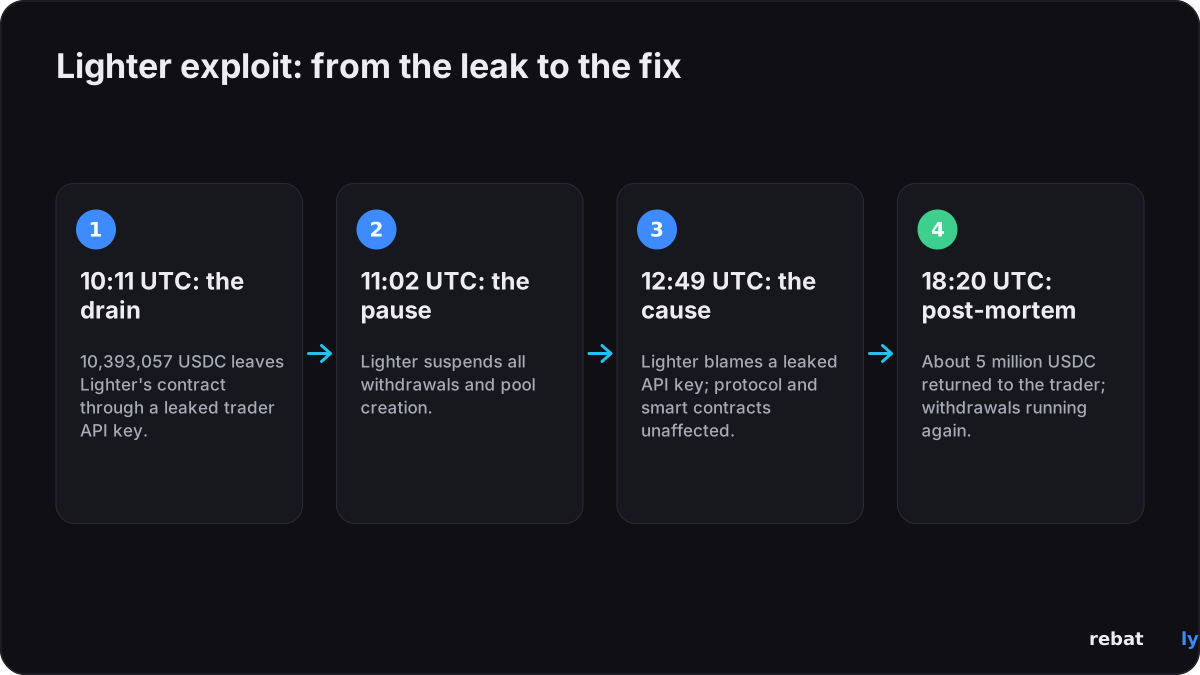
Lighter exploit: the perpetual futures exchange Lighter suspended all withdrawals at 11:02 UTC on 16 November 2026, about 50 minutes after an attacker moved 10,393,057 USDC, about $10.4 million, out of its Ethereum contract, according to Bitquery and CoinDesk. Lighter said on X the cause was "a leaked API key for a specific trader's account" and that its protocol and smart contracts were not affected. Some on-chain analysts put the total at about $15.5 million across two accounts, a figure Lighter has not confirmed. By 18:20 UTC Lighter said about 5 million USDC had been returned to the affected trader and that withdrawals were running again. This article sets out what happened, why one leaked key was enough, the numbers and who reports them, and a checklist for keeping your own exchange API keys safe. All times are UTC.

 NO KYCSign up to BloFin
 Sign up to Bybit
 Sign up to OKX
 Sign up to Bitget
 Sign up to MEXC
 Sign up to OrangeX
 Sign up to Toobit
What happened in the Lighter exploit
The key moments on 16 and 17 November, with times in UTC:
| Time (UTC) | What happened | Source |
|---|---|---|
| 16 Nov, 10:11 | 10,393,057 USDC leaves Lighter's Ethereum contract for the attacker's wallet | Bitquery, Cointelegraph |
| 16 Nov, 10:13 to 10:46 | The USDC is swapped for about 5,764 ETH on CoW Swap | Bitquery |
| 16 Nov, 10:19 to 11:55 | 12 transfers of 160 ETH (1,920 ETH) go to Hyperliquid, where about $3.46 million of XMR1, a token named after Monero, is bought | Bitquery, CoinDesk |
| 16 Nov, 11:02 | Lighter suspends all withdrawals and pool creation | Lighter on X |
| 16 Nov, 11:09 to 11:10 | Upbit and Bithumb suspend LIT deposits and withdrawals | Upbit notice, Economy Block |
| 16 Nov, 12:49 | Lighter blames a leaked API key, says the protocol is unaffected and names the attacker's wallet | Lighter on X |
| 16 Nov, 18:20 | Post-mortem: about 5 million USDC returned to the trader, withdrawals running again | Lighter on X |
| 17 Nov, 02:02 | Upbit resumes LIT deposits and withdrawals | Upbit notice |
Lighter and on-chain analytics firm Bubblemaps both flagged the same wallet, starting 0xb3ff, as the attacker's, Cointelegraph reported. Bitquery said that at 11:55 UTC the wallet still held about 3,845 ETH, worth about $7.0 million. Lighter has not said who the attacker is.
How the Lighter exploit happened
In its post-mortem, Lighter said the affected accounts "used unsafe signing code other than the official Lighter SDKs". That code reused signing nonces, the one-time random numbers inside each signature, which let anyone rebuild the private API keys from public signatures. Lighter said the attacker "needed no access to the accounts or to Lighter's systems". Lighter said its protocol, smart contracts and official SDKs were not compromised, Crypto Briefing reported.
With the keys, the attacker created a public pool from the victim's account, bought pool shares from an account it controlled, moved the victim's USDC into the pool and then redeemed its shares, Lighter said. Analysts cited by crypto.news described the same route earlier in the day, with transfers of about $1 million at a time. Lighter's smart contract Guardian spotted the unusual activity and paused withdrawals, which let the Lighter Security Council return about 5 million USDC to the trader.
What a Lighter API key can do
An API key lets software trade for you without your main wallet. Lighter's documentation says a key on its own can:
• place, cancel and change orders, and change leverage and margin;
• manage sub-accounts and move funds between accounts of the same wallet. "Transfers between the same owner's accounts need no wallet signature," the docs say;
• withdraw, but only to the wallet that owns the account.
Moving funds to someone else's account needs a signature from the wallet itself. The gap was that a public pool created by an account counted as one of its own sub-accounts. "An API key can send funds to its own account's sub-accounts, and a public pool the account creates counts as one," Lighter wrote. So a leaked key was enough to move the money into a pool the attacker could cash out of. Lighter also warned that a leaked key can be used to trade against you at bad prices or to open risky positions, even where it cannot withdraw.
What Lighter has changed
• Done: a wallet signature is now needed to move funds into a public pool, so an API key alone can no longer do it, and API key signatures are no longer public, Lighter said.
• Planned: IP allow-lists for each key, per-key permissions and limits, and monitoring for nonce reuse that voids affected keys.
• For traders: anyone signing with custom or third-party software should rotate their API keys and switch to the official SDKs, Crypto Briefing reported.
The numbers, and who reports them
Lighter has not published a total loss. Figures from on-chain data and outlets:
| Item | Figure | Source |
|---|---|---|
| USDC withdrawn on-chain | 10,393,057 USDC, about $10.4 million | Bitquery, CoinDesk, Cointelegraph |
| Wider estimate | About $15.5 million across two accounts (about $10.39 million and $5.09 million); not confirmed by Lighter | crypto.news, Bitcoin.com, TokenPost |
| Returned | About 5 million USDC, to the affected trader | Lighter, Cointelegraph |
| Still with the attacker at 11:55 UTC | About 3,845 ETH (about $7.0 million) plus about $3.46 million of XMR1 | Bitquery |
| LIT price move | Down more than 10% to under $2.48 (CoinDesk); $2.99 to a low of $2.35, about 16% (Bitcoin.com); more than 17% at one point (crypto.news) | CoinDesk, Bitcoin.com, crypto.news |
| LIT liquidations | More than $3.43 million | Bitcoin.com |
| Korean exchanges | Upbit and Bithumb paused LIT deposits and withdrawals from 11:09 to 11:10 UTC on 16 November; Upbit resumed at 02:02 UTC on 17 November, Bithumb planned 02:55 UTC | Upbit, Economy Block |
On CoinGecko's hourly data, LIT went from $2.75 at 10:00 UTC on 16 November to $2.56 at 13:00 UTC, and stood at $3.02 at 05:51 UTC on 17 November. Outlets give different drops because they measure from different times and price feeds. Rebatly does not forecast prices. On days like this, prices can jump in seconds and market orders can fill worse than the price on screen; our guide to trading costs on big news days explains why.
API key safety checklist for exchange traders
The Lighter exploit did not need a password or a hack of the exchange: a key was enough. If you use API keys on a centralized exchange, for a trading bot, a tax tool or a portfolio app, check these:
• Read or trade only: leave withdrawal permission off unless a tool truly needs it.
• IP allow-list: bind each key to the IP addresses of the server that uses it.
• One key per tool: if one tool leaks, you delete one key, not all of them.
• Rotate and expire: replace keys regularly and let unused ones lapse.
• Delete unused keys: review your key list and remove anything you no longer use.
• Bots on sub-accounts: run bots on a sub-account that holds only what the bot needs.
• Never share keys: never send a key or secret to anyone, and never paste it into unofficial tools, browser extensions or chat groups.
What each exchange documents on its own help or API pages (— means we did not find it there):
| Exchange | Permissions | IP allow-list | Keys without an IP | Sub-account keys |
|---|---|---|---|---|
| Bybit | Read-only or read and write; withdrawal is a separate permission | Yes | Stop working after 90 days | Yes |
| OKX | Read, Trade and Withdraw are separate | Up to 20 IP addresses per key | Keys with trade or withdraw permission expire after 14 days without use | Yes, read and trade only |
| Bitget | Read, Trade, Transfer and Withdraw are separate; withdrawals only from a whitelisted IP | Yes, recommended | — | Yes, once the main account allows it |
| MEXC | Separate permissions; withdrawal has its own | Up to 10 IP addresses per key | Expire after 90 days | Yes |
| BloFin | Read, Trade and Transfer; no withdrawal permission listed | Up to 20 IP addresses per key | Expire after 90 days | — |
| Toobit | Read-only by default | Up to 15 IP addresses per key | Expire after 90 days | — |
| OrangeX | Separate read and read-write scopes; wallet actions have their own | — | — | — |
Settings change, so check the API management page in your own account before you rely on any of this. Rebatly never asks for your API keys, passwords, seed phrases or 2FA codes. Rebates need nothing from you beyond signing up through our link or code. If anyone claiming to be Rebatly asks for them, do not reply, and contact us through the website. Our guides to crypto exchange account theft, exchange data breaches and scam messages and the Binance hack cover more. This is general security information, not financial advice.
What happens next
• Published: Lighter's post-mortem came out at 18:20 UTC on 16 November.
• Planned by Lighter: IP allow-lists, per-key permissions and limits, and nonce-reuse monitoring. Lighter has not given dates.
• Not announced: Lighter has not published a reimbursement plan beyond the about 5 million USDC returned to the trader.
We will update this article as Lighter publishes more.
Trade with lower fees
Whichever exchange you use, every trade carries a fee. Sign up through Rebatly and part of every trading fee comes back to you: up to 50% on Bybit and Bitget, up to 40% on BloFin and OKX, up to 60% on MEXC and up to 65% on OrangeX futures. On Toobit, code Rebatly gives up to 60%, credited by Toobit itself, and BloFin credits up to 40% itself every hour; the other rebates are paid daily in USDT. Our guide to how a fee rebate works explains the rest.
This article reports news and is not financial advice. Rebatly is an independent affiliate; not financial advice.
Get fees back on every trade
$10M+ rebates paid · Paid daily in USDT · No password or API keys, ever
Already signed up? Check your link and rebate with @rebatlybot on Telegram, or reach our support at @rebatly.
🔔 Get a Telegram alert each time your rebate is paid: tap “Activate notifications” in @rebatlybot. New to trading? Your first trade in 5 steps.
November 17, 2026 — published. Sources: Lighter, CoinDesk, Cointelegraph, Crypto Briefing, crypto.news, Bitcoin.com, TokenPost, Bitquery, Upbit, Economy Block, PANews, CoinGecko, Bybit, OKX, Bitget, MEXC, BloFin, Toobit, OrangeX.