Crypto exchange account theft: $106 million suspected lost by an EU entity
A crypto exchange account theft of more than $106 million is suspected to have hit an unnamed entity in the European Union on Saturday 1 November 2026, according to blockchain investigator ZachXBT. The funds left accounts at several centralised exchanges as USDC and USDT and were then swapped into ether and Monero within a day, he said in an alert on his Telegram channel at 12:28 UTC on 2 November. Neither the victim nor any exchange has confirmed a loss, and the exchanges have not been named. This article covers what is known, what is not, where the money went, and what every exchange user should check now.
 NO KYCSign up to BloFin
 Sign up to Bybit
 Sign up to OKX
 Sign up to Bitget
 Sign up to MEXC
 Sign up to OrangeX
 Sign up to Toobit
What happened: the $106 million theft as reported
The alert came from ZachXBT, an independent investigator who tracks stolen crypto on-chain. In his Telegram channel he wrote that an EU entity is suspected of losing more than $106 million from multiple centralised exchange accounts on 1 November, with the funds withdrawn as USDC and USDT by "an illicit actor". He published 11 Ethereum addresses tied to the theft, the first of them 0xADd95cD98E0288ba69785E3151E1db86adF8Dd58, and asked the community to watch them. The word "entity" could mean a company, a trading firm or a fund; ZachXBT did not say which, CoinDesk noted.
Here is what is known and what is not, as of 17:45 UTC on 2 November:
| Question | What is known | Source |
|---|---|---|
| How much | More than $106 million, not independently confirmed | ZachXBT |
| When | 1 November 2026; the alert followed at 12:28 UTC on 2 November | ZachXBT |
| What was taken | USDC and USDT, no split given | ZachXBT, CoinLaw |
| Where from | Accounts at several centralised exchanges; a flow chart labels them Exchange 1, 2 and 3 | Unchained |
| Who lost it | An entity based in the European Union, not named | Crypto Briefing |
| How the accounts were accessed | Not disclosed | All sources |
This is different from the Binance hack of 29 October, where an attacker drained an exchange's own hot wallets. Here the funds appear to have left customer accounts, which points to stolen credentials, compromised API keys or an insider rather than a flaw in an exchange's systems. That is an inference from the pattern, not a finding from any investigation.
Where the money went
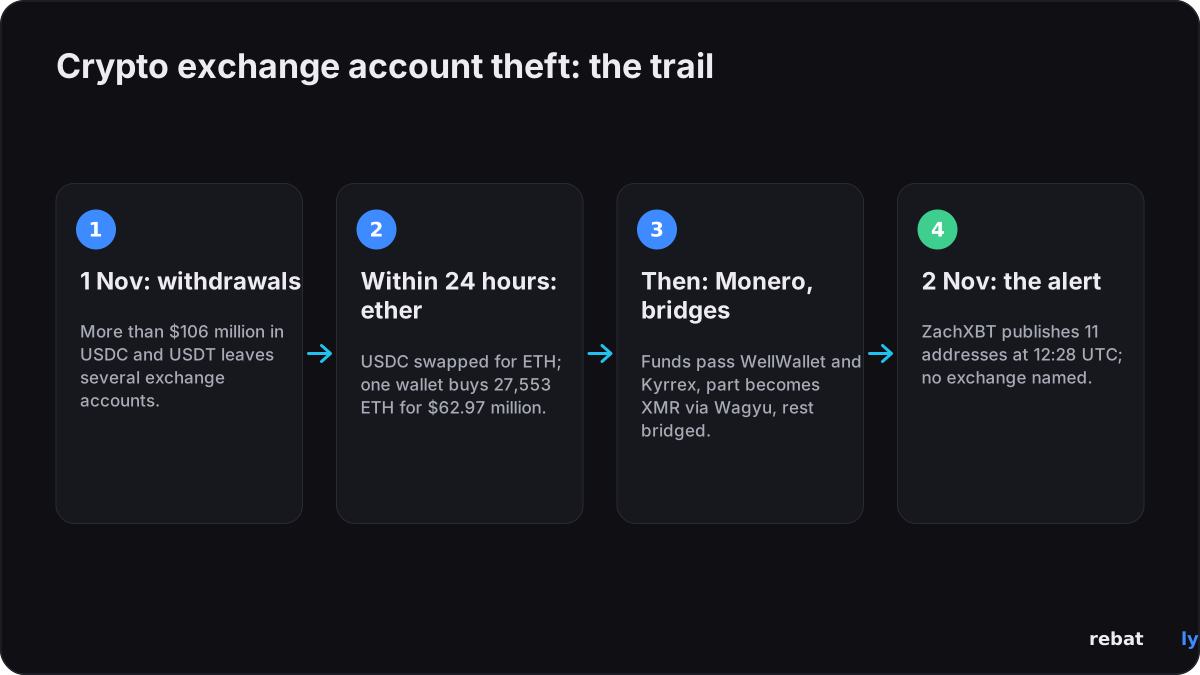
Within 24 hours of the withdrawals the funds were on the move. The trail, as described by ZachXBT and the outlets that examined his data:
| Step | What happened | Who reports it |
|---|---|---|
| 1. Withdrawal | USDC and USDT leave several exchange accounts on 1 November | ZachXBT |
| 2. Swap to ether | USDC is swapped "aggressively" for ETH; one linked wallet bought 27,553 ETH for $62.97 million at an average of about $2,286 | ZachXBT; Lookonchain via PANews |
| 3. Instant exchanges | Funds sent to WellWallet, Kyrrex and other instant-swap services | ZachXBT, Unchained |
| 4. Monero | Part converted to XMR through Wagyu; about 2.64 million USDC moved on 2 November to an address feeding a Wagyu-tagged cluster | ZachXBT, Unchained |
| 5. Bridges | Assets bridged across several chains, including 2,200 ETH sent to an address that then bridged to a Tron-format address | Unchained |
The ether purchases had first been noticed as bullish "whale" buying before Lookonchain's fund-flow chart linked the buying wallet to the theft addresses, PANews reported. A flow graph credited to ZachXBT, the investigator Specter and TRM Labs shows the USDC passing through dozens of fresh wallets before reaching the services above, Unchained reported. Monero hides senders, receivers and amounts by default, so whatever reached XMR is far harder to trace than the USDC and ETH that came before it.
Who is behind it
Nobody has been identified. ZachXBT said he could state "with a high degree of confidence" that the actor is not Lazarus Group, the North Korean unit the FBI blamed for the Binance hack, based on "multiple laundering indicators". He did not say what those indicators were, Unchained noted. No law-enforcement agency has commented. Any attribution beyond that is speculation, and Rebatly does not add to it.
What the exchanges say
Nothing yet. Because ZachXBT did not name the exchanges, none has had to respond, and as of this writing no exchange had confirmed a loss, CoinDesk and Crypto Briefing reported. The victim has not come forward either. Three points follow from that:
• The $106 million figure is ZachXBT's estimate from on-chain data, not a number from the victim or an exchange.
• No user funds at the exchanges are known to be affected. The reported loss is from one entity's own accounts, not from exchange reserves.
• Withdrawals are not suspended anywhere because of this incident, as far as any report shows.
Frozen or recovered: nothing so far
No freeze has been reported. USDC and USDT can be frozen by their issuers, Circle and Tether, and CoinLaw noted that any USDT still sitting in the 11 flagged addresses would fall within Tether's freeze powers. But the trail shows most of the USDC was already swapped into ether, and ether and Monero cannot be frozen by any issuer. If a freeze happens, it would most likely be of the remaining stablecoins, and a freeze is not a return: frozen funds stay locked until a court or the issuer decides who gets them.
How the market reacted
Barely. Ether was at $2,254 at 00:00 UTC on 1 November and $2,253 at 17:43 UTC on 2 November, by our count of CoinGecko hourly prices, after touching $2,284 at 12:00 UTC on 2 November. The 27,553 ETH bought with the suspected proceeds is a small amount against daily ether volume. Monero was at $599 at both times. Bitcoin went from $77,521 to $76,942 over the same period, down 0.7%. Rebatly does not forecast prices. Our guide to trading costs in fast markets explains why spreads and fees matter most on days like this.
Three thefts in five days
This is the third large crypto theft reported since 29 October. They differ in what was attacked:
| Incident | Date | Reported loss | What was hit | Status |
|---|---|---|---|---|
| Binance | 29 October | About $6.3 billion | Exchange hot wallets | FBI blames North Korea's TraderTraitor; Binance says about 95% replaced with its own funds |
| EU entity | 1 November | More than $106 million (ZachXBT, unconfirmed) | Customer accounts at several exchanges | Victim and exchanges unnamed; funds moved to ETH and XMR |
| Mercado Bitcoin | 2 November | More than $40 million (Hypernative estimate) | Exchange wallets on at least 10 chains | Deposits and withdrawals paused; Tether froze about 4.5 million USDT |
The Mercado Bitcoin figures come from Decrypt and CoinDesk; the exchange said it "identified and swiftly contained" the incident and that no customer lost money. No public evidence links the three cases. For the Binance case, see our articles on the Binance hack and Binance withdrawals after the hack.
What exchange users should check now
An account theft is the kind of loss a user can do something about. Whatever happened to this entity, these checks take ten minutes:
• API keys: open the API page of every exchange you use. Delete keys you do not recognise or no longer use, and make sure the rest have no withdrawal permission unless you need it, with an IP whitelist.
• Withdrawal whitelist: turn on address whitelisting so funds can only go to addresses you have approved, with a time lock on new additions.
• 2FA: use an authenticator app or hardware key, not SMS. Check the devices and sessions list and log out anything you do not recognise.
• Email: the email account behind your exchange login needs its own strong password and 2FA; most account takeovers start there.
• Scam messages: every big theft is followed by fake "security alert" and "verify your wallet" messages. Exchanges never ask for your password, 2FA codes or seed phrase. Our guide to exchange data breaches and scam messages shows what they look like.
• Official channels only: if an exchange you use is named in a later report, read its own announcement before acting on anything.
This is general security information, not financial advice.
What happens next
• A name: the victim or one of the exchanges may confirm the loss, which would also show how the accounts were accessed.
• Freezes: Tether or Circle could freeze stablecoins still in the flagged addresses.
• The trail: ZachXBT and others are watching the 11 addresses; more swaps, bridges and Monero conversions are likely.
• Exchange responses: if the funds reached a centralised exchange at any point, that exchange may freeze or report them.
We will update this article when the victim, an exchange or an investigator publishes more.
Trade with lower fees
Checking your accounts is a good moment to look at what your trades cost. Sign up through Rebatly and part of every trading fee comes back to you: up to 50% on Bybit and Bitget, up to 40% on BloFin and OKX, up to 60% on MEXC and up to 65% on OrangeX futures. On Toobit, code Rebatly gives up to 60%, credited by Toobit itself. Rebates are paid daily in USDT. Our guide to how a fee rebate works explains the rest.
This article reports news and is not financial advice. Rebatly is an independent affiliate; not financial advice.
Get fees back on every trade
$10M+ rebates paid · Paid daily in USDT · No password or API keys, ever
Already signed up? Check your link and rebate with @rebatlybot on Telegram, or reach our support at @rebatly.
🔔 Get a Telegram alert each time your rebate is paid: tap “Activate notifications” in @rebatlybot. New to trading? Your first trade in 5 steps.
November 3, 2026 — published. Sources: CoinDesk, Unchained, Crypto Briefing, CoinLaw, PANews, Decrypt, CoinGecko.