Liquid Network hack: L-BTC fully backed again, two months after the $320 million exploit
The Liquid Network hack of 6 September 2026, in which a bug in the Elements software behind Blockstream's bitcoin sidechain let an attacker create about 4,000 L-BTC with nothing behind them and cash them in for roughly $320 million of real bitcoin, has reached its first clean milestone. The Liquid Federation said on X on Monday 2 November that its reserves were "fully restored, reestablishing 1:1 BTC backing for all LBTC", after a final transfer of 250 BTC closed a gap that had stood at about 600 BTC since the attacker returned 3,400 of the coins on 7 September. What is still restricted is the direct route out: ordinary users can swap L-BTC for bitcoin one-for-one through SideSwap, AQUA and Bull Bitcoin, but the federation's own peg-outs stay under "enhanced operational controls" while an independent audit finishes. This article puts the whole incident in order, from the two bugs behind it to where the missing coins went, and what the restoration does and does not mean.
 NO KYCSign up to BloFin
 Sign up to Bybit
 Sign up to OKX
 Sign up to Bitget
 Sign up to MEXC
 Sign up to OrangeX
 Sign up to Toobit
What happened in the Liquid Network hack: 4,000 unbacked L-BTC, 3,996 real bitcoin out
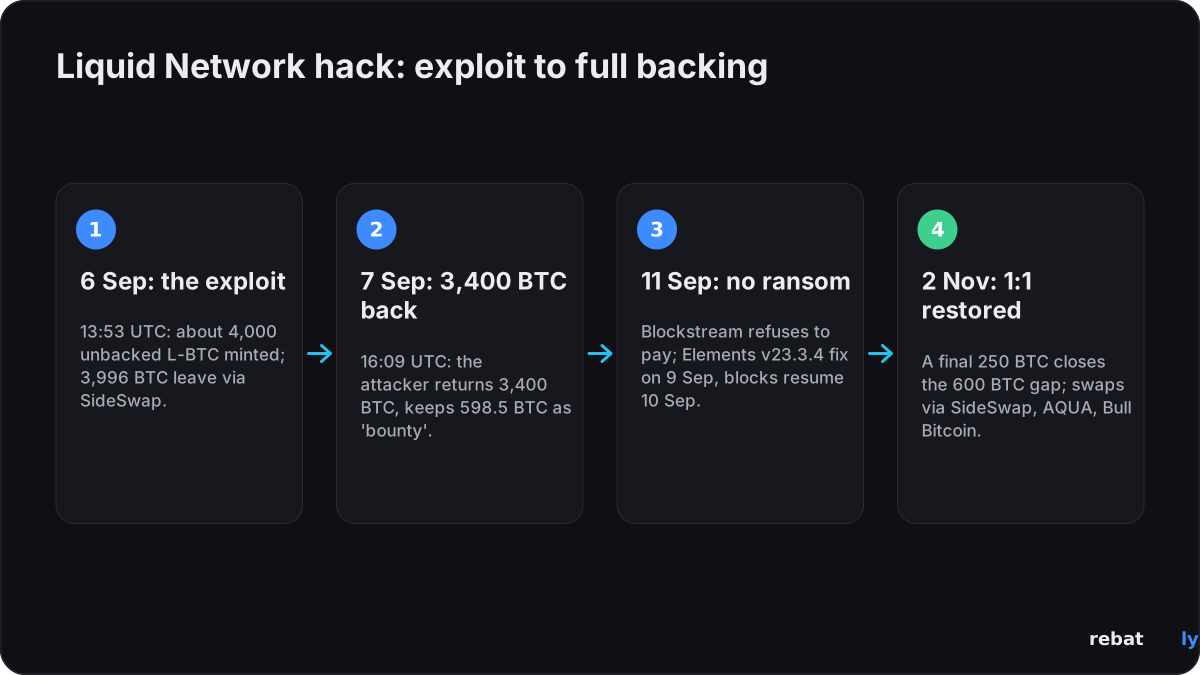
Liquid is a sidechain where bitcoin is locked in a wallet controlled by a federation of companies and an equal amount of L-BTC is issued on the sidechain; the L-BTC is, in effect, an IOU for bitcoin held by the federation, and 11 of its 15 signing members must approve any withdrawal. On Sunday 6 September 2026 at 13:53 UTC, in Liquid block 4,050,336, a transaction created about 4,000 L-BTC that no bitcoin had been deposited for, according to Blockstream's incident assessment. The attacker then used the normal exit: the unbacked L-BTC went to SideSwap, a federation member that runs a withdrawal service, and at 14:28 UTC a single peg-out confirmed in Bitcoin block 965,783 released 3,996.02 BTC from the federation's reserve. Bitquery, which traced the transaction, counted 83 inputs, all from the peg wallet, signed by 11 of the 15 functionaries exactly as every peg-out is signed; SideSwap kept its 0.1% fee and forwarded 3,995.99999857 BTC to the attacker's address in the same block. Blockstream halted the bridge nodes at 18:26 UTC.
| When (UTC) | What | Amount / source |
|---|---|---|
| 6 Sep, 13:53 | Unbacked L-BTC created on Liquid (block 4,050,336) | about 4,000 L-BTC, Blockstream incident assessment |
| 6 Sep, 14:28 | Peg-out via SideSwap confirmed in Bitcoin block 965,783 | 3,996.02 BTC, Blockstream and Bitquery |
| 6 Sep, 18:26 | Bridge nodes halted, network paused | Blockstream |
| 6 Sep, 18:30 | First message from the attacker on the Bitcoin chain | "we are whitehats. contact us on chain", Bitquery |
| 7 Sep, 16:09 | 3,400 BTC returned to the federation wallet (block 965,950) | 598.5 BTC kept, Bitquery and Bitcoin Magazine |
| 9 Sep | Elements v23.3.4 released with the fix | Blockstream |
| 10 Sep | Liquid block production resumes, peg-outs stay off | The Defiant |
| 11 Sep | Blockstream refuses to pay a "ransom" | Bitcoin Magazine |
| 20 Oct | Phase 1: swaps through providers; SideSwap reopens | Liquid Federation, TokenPost |
| 28 Oct | 50 BTC added, gap 550 BTC | The Defiant |
| 2 Nov | Final 250 BTC (block 974,307); 1:1 backing restored | Liquid Federation, The Defiant |
The reserve fell from about 4,205 BTC to 197 BTC, a figure that appears in Blockstream's report and in CoinDesk's coverage; the difference from 3,996 is explained by smaller, legitimate peg-outs processed before the halt. The dollar value depends on the price used: most outlets, including CoinDesk, Chainalysis and Decrypt, put the haul at about $320 million, while Tech Times reported $316 million. By our count of CoinGecko hourly prices, bitcoin was $79,912 at 12:00 UTC on 6 September, which values 3,996 BTC at $319 million. Bitcoin Magazine's first report on 6 September gave a larger withdrawal figure, 4,019.4 BTC, read from the reserve address before the exact exploit transaction had been isolated. Other assets issued on Liquid, including USDt, were not affected, Blockstream said, though they could not move while the network was paused.
How it happened: a bug in the fix for a bug
Liquid hides transaction amounts, so each output carries a "range proof" showing the hidden amount is valid, and nodes keep a cache of proofs they have already checked so they do not verify the same one twice. Blockstream's assessment, published on 23 September, describes two defects in that cache. Bug A, in the code since an Elements release of May 2018, left the asset and the receiving script out of the cache's lookup key. An outside researcher known as stutxo reported it on 2 August 2026 and Blockstream deployed an internal fix on 3 August; a second group, Bitcoin Red Team, found the same flaw independently on 7 August. Bug B was created by that fix: the fields of the key were joined together without length prefixes, so a deliberately constructed input could produce the same key as a genuine, already-verified proof and be waved through as checked. In Blockstream's words, "No reviewer, internal or external, identified this risk prior to exploitation." Halborn describes it as a cache-key collision; Crypto Briefing, summarising SlowMist's analysis, notes that before version v23.3.4 "the software generated cache keys without length prefixes". The final fix, Elements pull request #1600, adds length prefixes to all four fields and a start-up option to disable the cache; it shipped in v23.3.4 on 9 September after review rounds that included the independent firm Alpen Labs.
The federation's keys were never touched. "The Liquid Federation functionaries were not hacked, and no private keys were compromised," Liquid said in its incident report, and SideSwap's peg-out authorisation key was "not compromised, forged or stolen". What failed on the operational side is spelled out in SideSwap's own statement, reproduced in Blockstream's assessment: its peg-out signing key was kept online although the federation's charter requires offline custody, payouts were forwarded automatically in the same block, and no size limit, velocity control or wallet-history check applied to peg-out orders. That is why a fake 4,000 L-BTC could leave as 3,996 real bitcoin in one transaction, 35 minutes after it was minted.
Who is behind it
Nobody has been identified, and no blockchain analytics firm has attributed the exploit to a known group. The attacker's first on-chain message, in a Bitcoin OP_RETURN at 18:30 UTC on 6 September, read "we are whitehats. contact us on chain"; Blockstream answered within an hour with a security e-mail address, and a conversation followed on the chain itself, partly in plain text and partly PGP-encrypted, that Bitcoin Magazine and Bitquery have reconstructed. On 7 September the attacker wrote "Please fix the bug first. The chain is under risk at latest commit right now. Make sure every node is patched.", Blockstream replied "Yes, thank you." and later "Bridge nodes are patched, safe to return the funds.", and at 16:09 UTC the attacker sent 3,400 BTC back and kept 598.5 BTC, about 15%, as what they called a bug bounty. A later message, quoted by Bitcoin Magazine, stated: "You SHALL pay 10% using your own money as bug bounty". Blockstream's reply came in public on Friday 11 September: "Blockstream will not pay a ransom for the return of stolen funds", adding that "Taking assets without authorization and withholding their return is a crime, not responsible disclosure." Ledger's chief technology officer Charles Guillemet, quoted by Decrypt, wrote that "it looks more like extortion than white-hat hacking!" Whether the people behind it are researchers who overreached or thieves with a cover story is a judgement Rebatly does not make; the facts are that they took 3,996 BTC, returned 3,400 and still hold about 598.5, which was sitting untouched in their own address when Bitquery last updated its trace on 9 September.
What Liquid and Blockstream say
The federation's position, from its incident report, the incident assessment, the staged recovery plan of 20 October and its 2 November post on X:
• Backing: reserves are "fully restored, reestablishing 1:1 BTC backing for all LBTC", and anyone can check the balance against the L-BTC supply on the public Liquid explorer.
• Getting bitcoin out: since 20 October users can swap L-BTC for BTC one-for-one through participating providers; the 27 October update named AQUA, Bull Bitcoin and SideSwap. SideSwap pays from its own bitcoin wallet, minus a 0.1% fee, and warned that some requests may wait in a queue while it refills; TokenPost reported more than 60 BTC paid across about 600 peg-outs in its first day.
• Direct peg-outs: the federation's own withdrawals remain under "enhanced operational controls" and will be reactivated, under the plan, only for authorised Peg-out Authorization Key holders once "the remaining security and operational requirements" are complete. Full backing was a precondition for that step, not the step itself, as The Defiant noted.
• No compensation question: because L-BTC was never redenominated and the shortfall has now been filled, the federation has not announced any loss to holders. Adam Back, Blockstream's chief executive, had said on 10 September that the one-for-one peg would be covered.
• Other assets: USDt, DePix and other Liquid-issued tokens were unaffected.
• Governance: the federation's board and Blockstream are reviewing "broader governance, security, and operational changes", with more promised "in the coming weeks". The assessment lists a dedicated bug bounty for Elements, independent audits before consensus-critical fixes ship, and recurring scans, fuzzing and mutation testing of the code.
Returned, replaced and still missing
Returned is not the same as recovered, and three different numbers describe the hole:
| Item | Amount | Where it stands |
|---|---|---|
| Taken in the exploit peg-out | 3,996.02 BTC | Blockstream, Bitquery |
| Returned by the attacker, 7 Sep | 3,400 BTC | Block 965,950, 16:09 UTC |
| Kept by the attacker | 598.5 BTC (about $46 million at $77,065) | Still in the attacker's address as of Bitquery's 9 Sep update |
| Shortfall after the return | about 602 BTC | Blockstream assessment; 602.53 BTC on 20 Oct per The Defiant |
| Reserve coverage, 20 Oct | 85.8% (3,632.23 BTC vs 4,234.76 L-BTC) | The Defiant, from the Mempool Liquid explorer |
| Reserve coverage, 28 Oct | 87.07% after a 50 BTC top-up (block 973,548) | The Defiant; "550 BTC to go" (Samson Mow) |
| Reserve coverage, 2 Nov | 100.00% after a final 250 BTC (block 974,307) | 4,268.95 BTC vs 4,268.95 L-BTC, The Defiant, 00:08 UTC 3 Nov |
The gap was closed with new bitcoin, not with the attacker's. Coverage went from 85.8% on 20 October to 87.07% on 28 October, when JAN3 chief executive Samson Mow posted "Another 50 $BTC added. 550 $BTC to go.", to 94.14% early on 2 November and 100.00% after the 250 BTC transfer confirmed in block 974,307. The federation did not say who supplied the roughly 600 BTC, worth more than $40 million, a point CoinDesk makes explicitly, and neither the Defiant's reports nor the recovery plan name a source. Rebatly checked the explorer's reserve feed itself at 11:36 UTC on 3 November: 4,270.54 BTC held against 4,270.54 L-BTC in circulation, as of Bitcoin block 974,383. The circulating supply has grown by about 36 L-BTC since 20 October because swap providers have been pegging bitcoin in to serve their customers. The 598.5 BTC the attacker kept are therefore still missing from the attacker's side of the ledger even though they are no longer missing from Liquid's. No freeze is possible: this is bitcoin on the base chain, and no issuer can lock it.
How the market reacted
Barely, on either occasion. Bitcoin was $79,912 at 12:00 UTC on 6 September, two and a half hours before the peg-out, $79,189 at 18:00 UTC the next day after the 3,400 BTC came back, and $79,093 at 00:00 UTC on 8 September, down 1.0% over the whole episode, by our count of CoinGecko hourly prices. Around the restoration it was $78,294 at 00:00 UTC on 2 November and $76,722 at 08:00 UTC on 3 November, down 2.0%, with $77,065 at 11:34 UTC. The exploit was large for a sidechain, about 95% of Liquid's reserve, but small next to the hundreds of billions of dollars of bitcoin traded each week, and nothing in the price series separates it from the rest of the market. Rebatly does not forecast prices. Where an event like this does reach ordinary traders is in costs: our guide to trading costs in fast markets explains why spreads and fees matter most when a headline lands.
How it compares with other large hacks
At about $320 million gross and about $47 million net after the return, Liquid sits in the second tier of crypto exploits, and in the small group where most of the money came back:
| Event | When | Amount | Returned? |
|---|---|---|---|
| Binance hot wallets | 29 Oct 2026 | about $6.3 billion | No (FBI attributes it to North Korea) |
| Bybit | 21 Feb 2025 | about $1.5 billion | No |
| Ronin bridge | Mar 2022 | about $625 million | A small part |
| Poly Network | Aug 2021 | about $611 million | Yes, almost all |
| Wormhole bridge | Feb 2022 | about $326 million | Reserve refilled by Jump |
| Liquid Network | 6 Sep 2026 | about $320 million | 3,400 of 3,996 BTC; gap refilled |
| DMM Bitcoin | May 2024 | about $305 million | No |
The amounts for the older events are the figures widely reported at the time; the Binance figure is from our article on the Binance hack. The closest parallel is Poly Network in 2021, where the attacker also claimed to be a white hat and returned nearly everything. Liquid's case differs in one important way: the shortfall was covered by the federation side rather than by the attacker, so holders were made whole while the people who took the coins still have them.
What Liquid users and exchange users should do
• L-BTC holders: you do not need to do anything to be "backed"; the reserve already covers the supply. If you want bitcoin on the base chain, the working routes are the swap providers the federation named, SideSwap, AQUA and Bull Bitcoin, at one L-BTC for one bitcoin minus the provider's fee (0.1% at SideSwap). Expect queues at busy times.
• Official channels only: Blockstream published a phishing alert on 9 September telling users not to act on unsolicited Liquid or Blockstream messages. Bitcoin Magazine noted that at least one on-chain message offering a "contact" during the incident was probably spam. Use the federation's X account, blog.liquid.net and the providers' own apps; nobody from Liquid will ask you to move coins to be "re-pegged".
• Node operators: run Elements v23.3.4 or later; every earlier version has the bug.
• Exchange users: if you hold or trade on a centralised exchange, this is also a reminder to review your own account: delete API keys you do not use and strip withdrawal rights from the rest, turn on a withdrawal address whitelist with a time lock, use an authenticator app or hardware key rather than SMS, and log out sessions you do not recognise. Exchanges never ask for your password, 2FA codes or seed phrase. Our guide to exchange data breaches and scam messages shows what the fakes look like.
This is general security information, not financial advice.
What happens next
• Direct peg-outs: the last phase of the recovery plan, reactivation for authorised key holders, now has its precondition met; the federation has given no date.
• The audit: the independent audit of Elements v23.3.4 was "nearing completion" on 27 October; its publication would be the next milestone.
• Governance: changes to how the federation and Blockstream handle consensus-critical fixes, and the promised bug bounty programme, are due "in the coming weeks".
• The 598.5 BTC: any move from the attacker's address will be visible immediately, and exchanges that receive the coins may act on them.
• Who paid: the federation has not said where the replacement bitcoin came from; a quarterly update or a governance post may.
We will update this article when peg-outs reopen, the audit is published or the federation names the source of the funds.
Trade with lower fees
If this story has you reviewing where and how you trade, it is also worth checking what each trade costs. Sign up through Rebatly and part of every trading fee comes back to you: up to 50% on Bybit and Bitget, up to 40% on BloFin and OKX, up to 60% on MEXC and up to 65% on OrangeX futures. On Toobit, code Rebatly gives up to 60%, credited by Toobit itself. Rebates are paid daily in USDT. Our guide to how a fee rebate works explains the rest.
This article reports news and is not financial advice. Rebatly is an independent affiliate; not financial advice.
Get fees back on every trade
$10M+ rebates paid · Paid daily in USDT · No password or API keys, ever
Already signed up? Check your link and rebate with @rebatlybot on Telegram, or reach our support at @rebatly.
🔔 Get a Telegram alert each time your rebate is paid: tap “Activate notifications” in @rebatlybot. New to trading? Your first trade in 5 steps.
November 3, 2026 — published. Sources: CoinDesk, The Defiant, Bitquery, Chainalysis, Bitcoin Magazine, Decrypt, Crypto Briefing, Halborn, TokenPost, Blockstream, CoinGecko.