Stablecoin supply falls at its fastest pace since 2022 and USDT trades a fraction under $1: what the numbers show
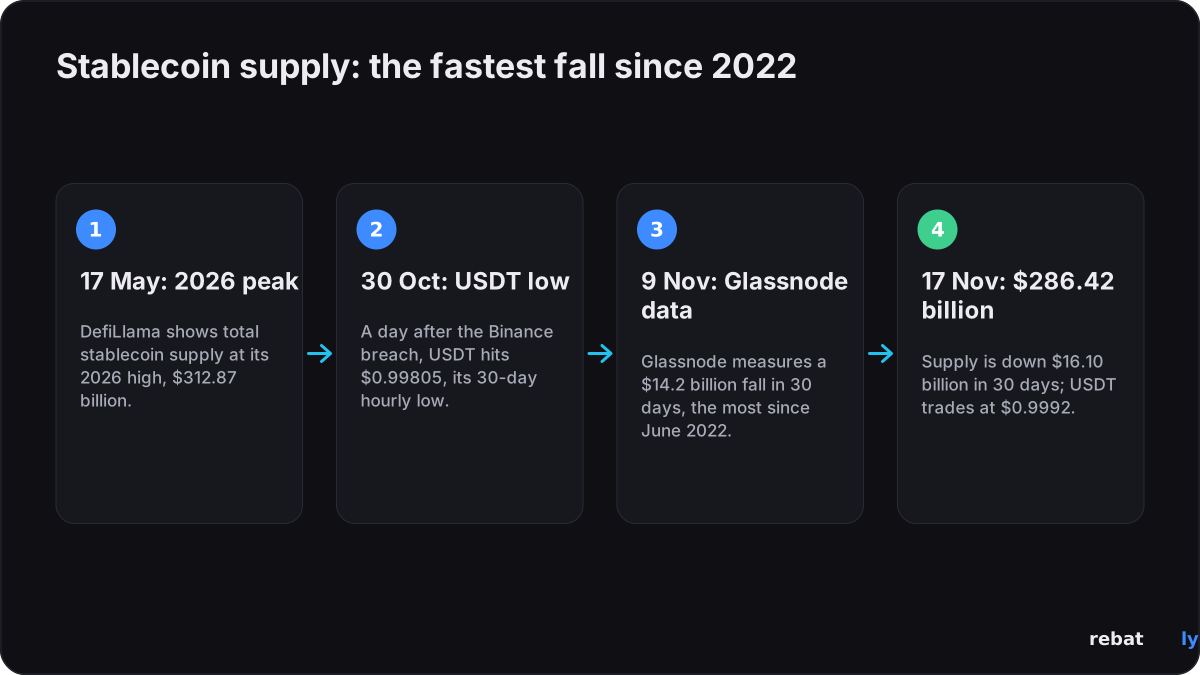
Stablecoin supply is shrinking at its fastest pace since June 2022. The total value of dollar-pegged stablecoins fell to $286.42 billion on 17 November 2026, down $16.10 billion in 30 days, according to DefiLlama data; analytics firm Glassnode measured a $14.2 billion drop in the 30 days to 9 November, as reported by Cointelegraph. Tether's USDT, the largest stablecoin, lost $8.14 billion of supply over the same 30 days and traded at $0.9992 on CoinGecko at 13:05 UTC on 17 November. That is less than a tenth of a cent under $1: slightly under the peg, not a depeg in any material sense. This article sets out the numbers and who reports them, the reasons analysts give, how the peg works, and what traders can check. All times are UTC.

 NO KYCSign up to BloFin
 Sign up to Bybit
 Sign up to OKX
 Sign up to Bitget
 Sign up to MEXC
 Sign up to OrangeX
 Sign up to Toobit
Key numbers
Figures we pulled on 17 November 2026 unless the row says otherwise:
| Measure | Figure | Date (UTC) | Source |
|---|---|---|---|
| Total stablecoin supply | $286.42 billion | 17 Nov | DefiLlama |
| Change over 7 days | −$3.96 billion | 10 to 17 Nov | DefiLlama |
| Change over 30 days | −$16.10 billion (−5.3%) | 18 Oct to 17 Nov | DefiLlama |
| Change over 30 days to 9 Nov | −$14.2 billion | 10 Oct to 9 Nov | Glassnode, via Cointelegraph |
| 2026 peak | $312.87 billion | 17 May | DefiLlama |
| USDT supply | $175.41 billion (7 days −$1.04 billion, 30 days −$8.14 billion) | 17 Nov | DefiLlama |
| USDC supply | $69.46 billion (7 days −$0.94 billion, 30 days −$3.18 billion) | 17 Nov | DefiLlama |
| USDT price | $0.999242 | 17 Nov, 13:05 | CoinGecko |
| USDC price | $0.999571 | 17 Nov, 13:05 | CoinGecko |
| Bitcoin (BTC) | $65,014 | 17 Nov, 13:05 | CoinGecko |
| Ether (ETH) | $1,823.54 | 17 Nov, 13:05 | CoinGecko |
Why the figures differ: data providers count different tokens and sample at different times. On DefiLlama data, the same window Glassnode used (10 October to 9 November) shows a $12.6 billion drop, Stablecoin Insider noted, and the 30 days to 14 November show $16.34 billion, the largest 30-day fall since 10 June 2022. Glassnode later put the monthly drop at about $17 billion, CoinDesk reported on 15 November. The Block and Cryptowisser put total supply just below $280 billion, while CoinDesk cited $284.24 billion on 17 November. All of them agree on the direction: the fastest contraction since mid-2022, though still well short of the $28.58 billion 30-day fall DefiLlama recorded on 30 May 2022, after the TerraUSD collapse.
Why stablecoin supply is shrinking: the reasons given
No single cause has been established. These are the explanations outlets and analysts give, each as reported:
• Redemptions for dollars: Glassnode said holders are redeeming stablecoins for dollars and taking the cash out of the market, which leaves less money ready to buy crypto, Cointelegraph reported. When a stablecoin is redeemed, the issuer burns the tokens, so supply falls.
• Tether shrinking faster than after FTX: CryptoQuant said USDT's market value fell $6.6 billion in the 60 days to 7 November, more than double the $3.2 billion drop after the FTX collapse in December 2022, as reported by Blockonomi and Stablecoin Insider. CryptoQuant uses its own method; DefiLlama's 60-day USDT change to 17 November is −$7.98 billion.
• ETF outflows: US spot bitcoin ETFs lost $1.282 billion from 2 to 6 November and $1.065 billion from 9 to 13 November, Farside data cited by crypto.news shows. Grayscale called fund outflows a secondary factor.
• Risk-off market: bitcoin fell from $80,443 on 5 November on CoinGecko's daily data to a low of $62,029 on 15 November, according to Grayscale, as reported by crypto.news. See why bitcoin is down today and our guide to the crypto fear and greed index.
• The Binance breach: Grayscale's head of research, Zach Pandl, wrote that the decline in stablecoin supply sped up after the 29 October security breach at Binance, and that some investors may be leaving digital assets for now, crypto.news reported. The same report said Grayscale did not establish how much of the fall came from the incident. Our article on the Binance hack covers the breach itself.
Rebatly does not forecast prices.
Which stablecoins are shrinking
Supply on DefiLlama, 17 November 2026, compared with 7 and 30 days earlier:
| Stablecoin | Supply | 7-day change | 30-day change |
|---|---|---|---|
| USDT (Tether) | $175.24 billion | −$1.04 billion | −$8.13 billion |
| USDC (Circle) | $69.41 billion | −$0.97 billion | −$3.21 billion |
| USDS (Sky) | $5.24 billion | −$0.16 billion | −$1.62 billion |
| USDe (Ethena) | $4.84 billion | −$0.14 billion | +$0.16 billion |
| DAI | $4.63 billion | −$0.03 billion | −$0.09 billion |
| USD1 | $2.96 billion | −$0.39 billion | −$1.09 billion |
These rows are a live snapshot taken at about 13:05 UTC, so they differ slightly from the daily close used in the key numbers table. USDT and USDC together hold about 85% of all stablecoins and account for most of the fall; Stablecoin Insider put their share of the 30-day decline at 77% on 12 November. A few smaller coins, such as Ripple's RLUSD, grew over the same period.
What 'slightly under $1' means
A stablecoin like USDT has two prices. One is the redemption value: the issuer promises to swap each token for $1 with approved customers, and to mint new tokens when they deposit dollars. The other is the market price on exchanges, where traders buy and sell the token among themselves.
When more people want to sell than buy, the market price can slip a little below $1. Large firms that can redeem directly then have a reason to buy cheap tokens on exchanges and redeem them for $1, which pushes the price back up. Redemption takes time and has minimum sizes and fees set by the issuer, so a gap of a few hundredths of a cent can last for days.
On CoinGecko's hourly data, USDT's lowest price in the past 30 days was $0.99805 at 03:00 UTC on 30 October, the day after the Binance breach. On 17 November it was $0.99924. Stablecoin Insider found a range of $0.99875 to $0.99945 on DefiLlama's daily prices in the two weeks to 12 November. A gap of 0.08% is small: on a $10,000 balance it is about $8. A depeg in the sense traders usually mean is a move of several cents or more.
Past depegs, for context
Two well-known depegs, for scale. These are past events and say nothing about what USDT will do:
| Date | Stablecoin | What happened | Source |
|---|---|---|---|
| 9 to 16 May 2022 | TerraUSD (UST) | Algorithmic stablecoin broke its peg on 9 May and fell to about $0.11 by 16 May; it never recovered | DefiLlama, Wikipedia |
| 10 to 13 March 2023 | USDC | Fell below $1 after Circle said $3.3 billion of its reserves sat at the failed Silicon Valley Bank; $0.961 on DefiLlama's daily data on 12 March, back near $1 within days | DefiLlama, Wikipedia |
| 30 October 2026 | USDT | Lowest hourly price in 30 days, $0.99805 | CoinGecko |
UST had no dollar reserves behind it; USDC's dip came from a bank failure that held part of its reserves. The current USDT discount is far smaller than either.
What Tether says about its reserves
Tether's transparency page says its most recent reserves report is as of 30 September 2026, with an assurance report by the accounting firm BDO Italia, and that its reserves are greater than the redemption value of tokens in circulation. That report showed about $191.5 billion of reserves against $183.5 billion of liabilities, Blockonomi reported. Separately, Tether said on 13 August 2026 that KPMG had completed an audit of its 2025 financial statements, with reserves exceeding liabilities by $6.814 billion at 31 December 2025. Tether has not commented publicly on the latest fall in supply, and Stablecoin Insider noted that issuers had not explained the moves. These are the company's own statements; Rebatly has not checked the reserves.
What it means for traders
• Fees, rebates and margin in USDT: on most exchanges, futures margin, fees and many fee rebates are paid in USDT. A price of $0.9992 changes their dollar value by less than a tenth of a percent.
• Check the quote asset: BTC/USDT and BTC/USDC are different markets. A small gap between USDT and USDC shows up as a small price difference between the two pairs.
• Spreads on USDT/USDC pairs: the spread between the best buy and sell price can widen when one stablecoin is under pressure. Look at the order book before converting large amounts.
• Liquidations: fast market moves can force-close leveraged positions. Our guide to crypto liquidations explains how.
• Exchange announcements: exchanges publish notices when they change collateral rules, pairs or deposit networks for a stablecoin. Read them on the exchange's own site or app.
This is general information, not financial advice.
What happens next
• Daily supply data: DefiLlama and Glassnode publish supply figures every day. Glassnode has said a return to growth would be the first sign of new money coming in, Cointelegraph reported.
• USDT price: CoinGecko and exchange order books show whether the small discount closes.
• Tether's next reserves report: the next quarterly report covers 31 December 2026.
• Fed: the minutes of the Fed's last meeting are due on 18 November, and the next rate decision on 9 December. See our guide to a possible Fed rate hike in December.
Rebatly does not forecast prices. We will update this article on the next major move in stablecoin supply.
Trade with lower fees
When stablecoins are under the spotlight, every fee paid in USDT counts. Sign up through Rebatly and part of every trading fee comes back to you: up to 50% on Bybit and Bitget, up to 40% on BloFin and OKX, up to 60% on MEXC and up to 65% on OrangeX futures. On Toobit, code Rebatly gives up to 60%, credited by Toobit itself, and BloFin credits up to 40% itself every hour; the other rebates are paid daily in USDT. Our guide to how a fee rebate works explains the rest.
This article reports news and is not financial advice. Rebatly is an independent affiliate; not financial advice.
Get fees back on every trade
$10M+ rebates paid · Paid daily in USDT · No password or API keys, ever
Already signed up? Check your link and rebate with @rebatlybot on Telegram, or reach our support at @rebatly.
🔔 Get a Telegram alert each time your rebate is paid: tap “Activate notifications” in @rebatlybot. New to trading? Your first trade in 5 steps.
November 17, 2026 — published. Sources: DefiLlama, CoinGecko, Glassnode, CryptoQuant, Cointelegraph, CoinDesk, The Block, Stablecoin Insider, Blockonomi, crypto.news, Cryptowisser, Grayscale, Farside, Tether, Wikipedia.