MSCI removes Strategy (MSTR) from its indexes at the 30 November close: the rule, the estimated passive selling, and what it does and doesn't mean for bitcoin
Strategy MSCI removal: index provider MSCI will delete Strategy (MSTR), the largest corporate holder of bitcoin, from the MSCI USA Index at the close of trading on 30 November 2026, according to the November index review it published at 22:23 UTC on 11 November (MSCI). It is the first review under MSCI's new rule for non-operating companies, adopted on 15 October, and Japan's Metaplanet is being deleted too. Funds that track MSCI indexes will have to sell their Strategy shares; estimates of that selling range from about $1.6 billion to $2.8 billion. The exit is not a delisting, and it does not require Strategy to sell any of its 850,849 bitcoin. This article sets out the facts, the rule in plain words, who has to sell and who doesn't, and the two views on what it means for bitcoin. All times are UTC.

 NO KYCSign up to BloFin
 Sign up to Bybit
 Sign up to OKX
 Sign up to Bitget
 Sign up to MEXC
 Sign up to OrangeX
 Sign up to Toobit
Key facts
The main facts, each with its date and source:
| Fact | Detail | Date (UTC) | Source |
|---|---|---|---|
| What MSCI decided | Strategy (listed as "STRATEGY A") is deleted from the MSCI USA Index | 11 Nov, 22:23 | MSCI |
| When it happens | At the close of 30 November; the indexes change from 1 December | 30 Nov to 1 Dec | MSCI, Coin Edition |
| Why | First review under MSCI's non-operating company rule | Rule adopted 15 Oct | MSCI |
| Shares held by MSCI-tracking funds | About 13 million MSTR shares, about 3.1% of basic shares | Strategy estimate | Cointelegraph, Decrypt |
| Estimated passive selling | About $1.6 billion (BloFin Research) to $2.8 billion (JPMorgan, earlier proposal) | 11 to 12 Nov | CoinDesk, Bitcoin Magazine, BeInCrypto |
| Strategy's bitcoin | 850,849 BTC, total cost $64.20 billion, average $75,452 per BTC | 15 Nov | Strategy 8-K |
| Bitcoin price | $63,730, about 15.5% below Strategy's average cost | 17 Nov, 18:59 | CoinGecko |
| Metaplanet | Deleted from the MSCI Japan Small Cap Index | 11 Nov | MSCI, Bitcoin Treasuries |
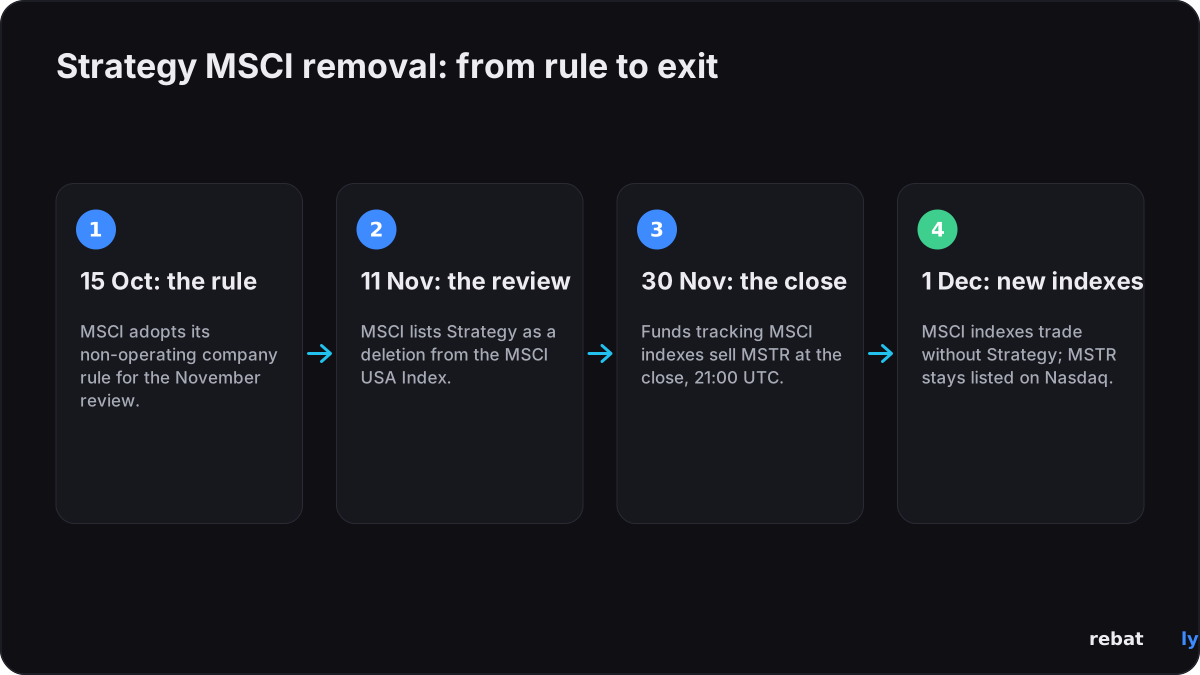
MSCI's press release says all changes "will be implemented as of the close of November 30, 2026". For US stocks, that close is at 21:00 UTC. Because MSCI USA is part of the MSCI World and ACWI indexes, Strategy also leaves those, Bitcoin Magazine reported.
What MSCI's rule says, in plain words
MSCI's index rules now treat some companies as "non-operating": businesses whose balance sheet is mostly a pile of assets, such as bitcoin, rather than a working business. Those companies cannot be in MSCI's global indexes. The rule MSCI adopted on 15 October works in two steps:
• Step 1, operating assets: MSCI first checks whether a company has substantial operating assets. Bitcoin Magazine reports the line is operating assets of at least 50% of total assets; MSCI's announcement text does not state the threshold.
• Step 2, five ratios: a company that fails the first check is tested on five financial ratios. If it is flagged on four or more of the five, it is not eligible.
• A buffer for members: a company already in an index is removed only if it fails in each of its two most recent annual filing periods. A company outside the index fails if it fails in either one.
The rule is written to be asset-neutral, so it is not only about crypto: a simulation on May data also flagged uranium holder Yellow Cake, investingLive reported. Strategy still runs a software business, but its bitcoin dominates its balance sheet. It went straight onto the deletion list rather than a watch list, which means it had already failed in both annual periods.
Timeline: how Strategy got here
The road from MSCI's first proposal to the 30 November deletion:
| Date (UTC) | What happened | Source |
|---|---|---|
| 10 Oct 2025 | MSCI proposes excluding companies whose digital assets are 50% or more of total assets | MSCI |
| 20 Nov 2025 | JPMorgan estimates about $2.8 billion of selling, up to $8.8 billion if other index providers follow | CoinDesk |
| 6 Jan 2026 | MSCI drops the crypto-only plan, freezes these companies' index weights and opens a wider review | MSCI |
| Aug 2026 | MSCI consults on all non-operating companies; Strategy writes to oppose it | MSCI, Decrypt |
| 15 Oct 2026, 20:48 | MSCI adopts the non-operating company rule for the November review | MSCI |
| 11 Nov 2026, 22:23 | November review list: Strategy deleted from MSCI USA, Metaplanet from MSCI Japan Small Cap | MSCI |
| 30 Nov 2026, close | Index funds rebalance at the closing price | MSCI |
| 1 Dec 2026 | First trading day of the indexes without Strategy | Coin Edition |
Some outlets date the rule to 16 October; MSCI published it at 20:48 UTC on 15 October, which was already 16 October in Asia.
Who has to sell, and who doesn't
• Index funds tracking MSCI USA, World and ACWI: they must sell. Passive funds hold what the index holds, so they sell their MSTR shares, mostly at or near the 30 November closing price. Strategy estimates these funds hold about 13 million shares, about 3.1% of its basic shares, which it calls less than one day's trading volume (Decrypt, Cointelegraph). At the 16 November close of $103.03, 13 million shares are worth about $1.34 billion (our calculation).
• Active funds that use MSCI as a benchmark: they are not forced to sell; they choose.
• Strategy itself: it does not have to sell anything. Leaving an index is not a delisting: MSTR stays listed on Nasdaq and keeps trading. And the rule does not touch Strategy's bitcoin. "Any bitcoin sale would be a separate decision for the company that owns it," Bitcoin Treasuries noted.
• Other index families: S&P, Nasdaq and FTSE Russell make their own rules. None has followed MSCI so far, according to the outlets we read.
The selling estimates, and where they come from: JPMorgan's widely quoted $2.8 billion dates from November 2025 and was calculated for MSCI's earlier crypto-only proposal, not the final rule, CoinDesk and BeInCrypto note. The same JPMorgan note put the total at up to $8.8 billion if other index providers followed MSCI; that larger figure depends on decisions that have not been made. BloFin Research estimates about 13 million shares to be sold, worth about $1.6 billion at 11 November prices, CoinDesk reported.
What Strategy says
• In its August 2026 letter to MSCI, Strategy called the proposal "discriminatory, arbitrary, and misguided" and said MSCI should be a "mirror of the market, not an arbiter of it", Decrypt reported.
• The same letter said a deletion "would have no meaningful impact on Strategy's business", Bitcoin Magazine reported.
• In its quarterly filing on 2 November, Strategy said it expected the removal and warned that index selling could reduce trading liquidity and make it harder to raise capital, Coin Edition reported.
• After the decision, chief executive Phong Le told CNBC that "MSCI has been on a multiyear campaign against digital assets", Crypto Briefing reported.
• Strategy argues its bitcoin business is an operating segment under US accounting rules (GAAP), Bitcoin Treasuries and Coin Edition reported.
Strategy's bitcoin is below its cost
Strategy's 8-K filing of 16 November shows it held 850,849 BTC on 15 November, bought for $64.20 billion in total, an average of $75,452 per bitcoin. In the week of 9 to 15 November it bought 485 BTC for $33.4 million, at an average of $68,887, and sold 2,087,040 MSTR shares for $244.7 million.
Bitcoin has traded below $75,452 since about 9 November on CoinGecko's daily data. At $63,730 at 18:59 UTC on 17 November (CoinGecko), the holdings were worth about $54.2 billion, about $10.0 billion below what Strategy paid (our calculation). This is a paper loss: Strategy has not sold, and nothing in the MSCI decision requires it to.
What it could mean for bitcoin: two views
Analysts and outlets disagree. Both views, as reported:
• "Mostly priced in": the decision was flagged for a year. "This outcome has been widely expected, so most of it is already priced in," Markus Thielen of 10x Research told CoinDesk. Strategy says the shares MSCI funds hold are less than one day's trading volume, and the forced selling is in MSTR shares, not in bitcoin.
• "Slower buying": Strategy pays for most of its bitcoin by selling new shares. A smaller base of passive shareholders could make that funding more expensive, investingLive and CoinDesk reported. CoinDesk put Strategy's mNAV, its market value against its bitcoin, at about 1.08x; the closer it is to 1, the less each new share sale adds in bitcoin per share. If other index providers followed MSCI, JPMorgan's estimate rises to up to $8.8 billion.
Neither view says MSCI's decision forces bitcoin itself to be sold. Rebatly does not forecast prices.
Market context on 16 and 17 November
• Bitcoin: $63,730 at 18:59 UTC on 17 November, down about 2% in 24 hours, CoinGecko data shows. Its hourly low over the past week was $62,612 at 02:00 UTC on 15 November. See why bitcoin is down today.
• MSTR: closed at $122.35 on 11 November, before MSCI's list came out, and at $103.03 on 16 November, down 24.7% from its 16 October close of $136.83, according to StockAnalysis data; outlets measure the decline over different windows. It traded near $97 during the 17 November session; we could not confirm the close at the time of writing.
• Spot bitcoin ETFs: US spot bitcoin ETFs took in a net $7.9 million on 16 November, ending a seven-day run of outflows of about $1.91 billion, on Farside data cited by Crypto Briefing and Bloomingbit; BlackRock's IBIT took in $76.5 million. Figures for 17 November were not yet published. Our guide to bitcoin ETF outflows explains the data.
• Sentiment and cash: see our guides to the crypto fear and greed index and stablecoin supply.
This article reports news. It is not a recommendation on MSTR or any other stock.
Metaplanet and the other deletions
Japan's Metaplanet, a bitcoin treasury company that held 44,000 BTC on 30 September according to Bitcoin Treasuries, is deleted from the MSCI Japan Small Cap Index on the same date. It was the only deletion from that index in the November review, Bitcoin Treasuries reported. Coin Edition counted five other deletions under the new rule besides Strategy, including Metaplanet and Upexi, and Cointelegraph and investingLive reported that SharpLink is on MSCI's watch list. We found no statement from Metaplanet on the decision.
What happens next
• 30 November, US market close (21:00 UTC): funds that track MSCI indexes sell their Strategy shares.
• 1 December: the MSCI indexes trade without Strategy and Metaplanet.
• Other index providers: watch whether S&P, Nasdaq or FTSE Russell adopt similar rules; that is the condition behind JPMorgan's $8.8 billion figure.
• Strategy's weekly 8-K: its Monday filings show whether it keeps buying bitcoin and how it pays for it.
• ETF flows: daily spot bitcoin ETF data show whether the 16 November inflow holds.
Rebatly does not forecast prices. We will update this article after the 30 November rebalance.
Trade with lower fees
Big index days and volatile weeks mean more trades and more fees, and leverage multiplies what you pay on each one. Sign up through Rebatly and part of every trading fee comes back to you: up to 50% on Bybit and Bitget, up to 40% on BloFin and OKX, up to 60% on MEXC and up to 65% on OrangeX futures. On Toobit, code Rebatly gives up to 60%, credited by Toobit itself, and BloFin credits up to 40% itself every hour; the other rebates are paid daily in USDT. Our guide to how a fee rebate works explains the rest.
This article reports news and is not financial advice. Rebatly is an independent affiliate; not financial advice.
Get fees back on every trade
$10M+ rebates paid · Paid daily in USDT · No password or API keys, ever
Already signed up? Check your link and rebate with @rebatlybot on Telegram, or reach our support at @rebatly.
🔔 Get a Telegram alert each time your rebate is paid: tap “Activate notifications” in @rebatlybot. New to trading? Your first trade in 5 steps.
November 18, 2026 — published. Sources: MSCI, Strategy, CoinGecko, CoinDesk, Bitcoin Magazine, Cointelegraph, Decrypt, BeInCrypto, Bitcoin Treasuries, Coin Edition, investingLive, Crypto Briefing, Bloomingbit, StockAnalysis, Farside.