EU crypto theft: suspected loss rises to $133 million as ZachXBT alleges a cover-up
The EU crypto theft first flagged on Monday is now put at more than $133 million by blockchain investigator ZachXBT, up from the $106 million he reported a day earlier, after he found a further $27 million of withdrawals from centralised exchanges by the same actor. In an update on his Telegram channel on Tuesday 3 November 2026, last edited at 07:31 UTC, he also gave his "working theory": that "a large financial institution in Western Europe was exploited and it's currently being covered up". No institution, exchange or regulator has confirmed any of this, and the victim is still unnamed. This article separates what is verified on-chain from what is one investigator's theory, shows where the money is now, and lists what exchange users should check. Our first report, on the $106 million account theft, has the background.
 NO KYCSign up to BloFin
 Sign up to Bybit
 Sign up to OKX
 Sign up to Bitget
 Sign up to MEXC
 Sign up to OrangeX
 Sign up to Toobit
What changed: from $106 million to $133 million
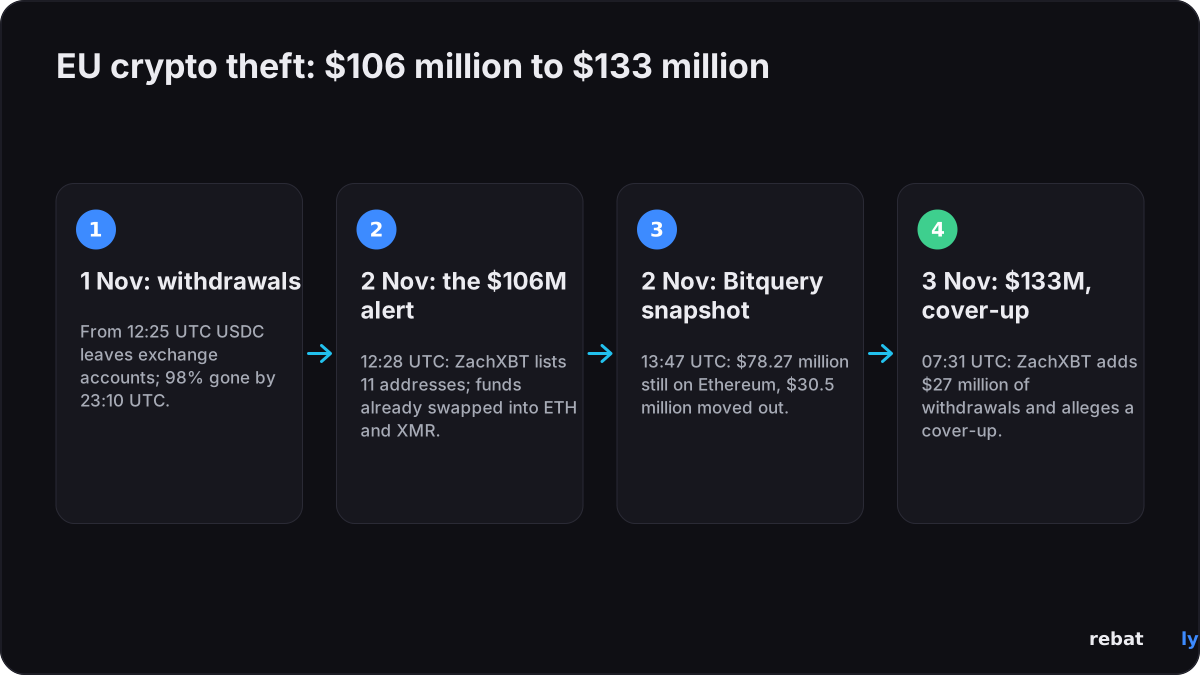
The number has moved three times in two days, and each figure comes from a different method. ZachXBT's first alert at 12:28 UTC on 2 November said an EU entity was suspected of losing more than $106 million from several exchange accounts on Sunday 1 November, and listed 11 Ethereum addresses. The analytics firm Bitquery, tracing the same addresses back to the exchange wallets that paid them, counted $108.80 million of USDC sent to 15 wallets over about 21 hours; without two wallets it could link only indirectly, its total would be $95.71 million. Then ZachXBT's update on his Telegram channel on 3 November added "an additional $27M+ of CEX withdrawals by the illicit actor", some of them made after his first post, and put the total at more than $133 million. Bitquery had already noticed four paid addresses missing from the original list of 11, taking $28.00 million between them, and two of those match the four new addresses ZachXBT published, so the two counts broadly agree.
| When (UTC) | Figure | Who | How it was counted |
|---|---|---|---|
| 2 Nov, 12:28 | More than $106 million | ZachXBT | Withdrawals to 11 listed addresses |
| 2 Nov, 13:47 | $108.80 million ($95.71 million on the strict count) | Bitquery | USDC paid by exchange wallets to 15 addresses |
| 3 Nov, by 07:31 | More than $133 million | ZachXBT | Earlier figure plus $27 million of further exchange withdrawals |
None of these is a confirmed loss. The $133 million is the value of funds an investigator has linked to the case, and Cointelegraph and TokenPost both note that the victim's identity and the loss itself remain unverified. Where the counts differ, the difference is the method: which wallets are counted as the thief's, not a dispute about the transfers themselves.
The cover-up claim, and what is actually verified
ZachXBT's update went further than the numbers. He wrote that a large Western European financial institution had, in his view, been exploited and that the incident was being covered up, that there had been no proper incident disclosure, and that the delay had let more than $30 million be laundered, money he said EU law enforcement could have frozen. Three things should be kept apart:
• Verified on-chain: the withdrawals, the swaps into ether, the services the funds passed through and the roughly $30 million that has left the tracked addresses. Bitquery's independent trace gives a very similar figure, $30.5 million moved out.
• Assessed by ZachXBT: that the victim is a large financial institution in Western Europe. He did not name it, gave no evidence for the description in the post, and called it a working theory.
• Alleged, unverified: that the victim is concealing the incident. No institution has been named, none has denied anything, and no regulator has commented, BlockBeats and Cointelegraph reported.
Silence in public is also not the same as silence to a supervisor. Under the EU's Digital Operational Resilience Act, in force since January 2025, banks, investment firms and crypto-asset service providers must notify their regulator of a major ICT incident within hours of classifying it as major, with a final report due later; that notification is not published. So a lack of a public statement does not by itself show that reporting rules were broken, and Rebatly has no information either way. If the victim is a regulated institution, the first public word may well come from a supervisor rather than the institution itself.
Which exchanges paid out the funds
ZachXBT has not named the exchanges, and in his data they appear only as unnamed centralised exchanges. Bitquery, reading the labels on the Ethereum wallets that sent the USDC, attributed the paying hot wallets to Kraken, Crypto.com and OKX. On its reading the first withdrawal left OKX at 12:25 UTC on 1 November, Kraken followed 44 minutes later and paid out about 95% of the total, $73.2 million had left by 23:00 UTC and 98% by 23:10 UTC, and the last payment went out at 09:09 UTC on 2 November. One receiving wallet took 43 separate Kraken withdrawals in 91 minutes, each under $50,000.
Two cautions. First, this is Bitquery's attribution from wallet labels, and none of the three exchanges has commented; Rebatly contacted none of them for this article and reports the finding as Bitquery's. Second, nothing in any report suggests the exchanges themselves were breached. The funds left accounts that belonged to the victim, and 11 of the 15 receiving wallets had been paid by the same exchanges before the theft, which is consistent with an attacker using the entity's own established withdrawal addresses. Bitquery says plainly that it cannot tell how access was gained, and neither can we. Customer funds held by other users of those exchanges are not reported to be affected, and no withdrawals have been suspended anywhere because of this case.
Where the money is now
As of Bitquery's snapshot at 13:47 UTC on 2 November, most of the money had not gone far:
| Where | Amount | Detail |
|---|---|---|
| Still on Ethereum | $78.27 million (about 72%) | 30,200 ETH, 5.64 million DAI and 3.74 million USDC across 229 wallets |
| Deposited to exchanges | $8.2 million | Largest single exit $8.12 million to a deposit address TRM Labs tags as Kyrrex |
| Bridged to other chains | $7.1 million | Including $4.34 million through LI.FI, part of it towards Wagyu, a route into Monero |
| Instant exchanges | $2.3 million | FixedFloat $1.32 million, Bridgers $935,000, Rango $802,000, WellWallet $250,000 |
| Unlabelled addresses | $12.9 million | Destinations Bitquery could not identify |
The biggest single move was the swap of $62.98 million of USDC and USDT into 27,553 ETH through UniswapX between 23:44 UTC on 1 November and 04:02 UTC on 2 November, at about $2,286 per ether. Cointelegraph and Decrypt both describe the ether and Monero route; Decrypt adds that the attacker also used the instant-exchange services WellWallet and Kyrrex and bridged across several chains, as ZachXBT first described. The ETH is parked in a few large wallets, the biggest holding 8,744 ETH, 7,824 ETH and 6,217 ETH. Bitquery traced Ethereum only, so funds that were bridged away are counted at the point they left. The $30.5 million that has moved out matches the "$30M+" ZachXBT says has been laundered; the remaining $78 million is in principle still traceable, but ether and DAI cannot be frozen by any issuer.
Who is behind it
Nobody has been identified. ZachXBT repeated that the laundering pattern does not match North Korea's Lazarus Group, the unit the FBI blamed for the Binance hack of 29 October, Cointelegraph reported; in his first post he had said he could rule Lazarus out "with a high degree of confidence" from "multiple laundering indicators". He has not said who he thinks it is. The four addresses he added on 3 November are being watched alongside the original 11. No arrest, no law-enforcement statement and no claim of responsibility has been reported. Any attribution beyond that is speculation, and Rebatly does not add to it.
Frozen or recovered: nothing so far
No freeze has been reported by Circle, Tether or any exchange. Bitquery's count shows why there is little left to freeze: of the $78.27 million still on Ethereum, only about $3.74 million is USDC, which Circle could in principle freeze, and nearly all of it sat in five wallets; the rest is ether and DAI, which have no issuer with a freeze button. The $8.2 million deposited to exchanges is the other place a freeze could happen, if the receiving platforms act on the published addresses. That is the basis of ZachXBT's complaint: the window in which stablecoins could have been frozen closed within hours of the withdrawals, while no one had publicly reported a theft. A freeze is also not a return. Frozen funds stay locked until a court or the issuer decides who gets them.
How the market reacted
Not visibly. Ether was $2,254 at 00:00 UTC on 1 November, before the first withdrawal, and $2,255 at 08:00 UTC on 3 November, by our count of CoinGecko hourly prices; in between it reached $2,296 at 09:00 UTC on 2 November while the ether bought with the suspected proceeds was being parked. Monero rose from $599 to $625 over the same period, 4.3%, and bitcoin slipped from $77,521 to $76,722, down 1.0%. Whether a few million dollars of Monero conversions moved a coin that trades far more than that each day cannot be read from the price, and Rebatly does not forecast prices. Our guide to trading costs in fast markets explains why spreads and fees matter most on days like this.
What exchange users should check now
Whatever the victim turns out to be, this was a loss from exchange accounts, and that is the kind of loss an individual user can reduce. The full checklist is in our first article on this theft; the short version:
• API keys: delete keys you do not recognise or use, and strip withdrawal permission from the rest unless you need it, with an IP whitelist.
• Withdrawal whitelist: turn on address whitelisting with a time lock on new addresses. In this case the funds went to addresses the entity had used before, so also review the addresses already on your list.
• 2FA and sessions: an authenticator app or hardware key, not SMS; log out devices you do not recognise.
• Scam messages: a story with a "cover-up" in it is perfect bait for fake "your exchange was breached, verify your account" messages. Exchanges never ask for your password, 2FA codes or seed phrase. Our guide to exchange data breaches and scam messages shows what they look like.
• Official channels only: if an exchange you use is named, read its own announcement before acting on anything.
This is general security information, not financial advice.
What happens next
• A name: ZachXBT's description, a large financial institution in Western Europe, narrows the field, and a regulator, the institution or a journalist may put a name to it. Until then it is a theory.
• A denial or a filing: if the victim is listed or regulated, a disclosure to its supervisor or shareholders may become public.
• More withdrawals: the $27 million was found after the first alert; the total may rise again if the actor still has access.
• Freezes: the exchanges that received deposits, and Circle for the remaining USDC, could act on the 15 published addresses.
• The ether: 30,200 ETH sitting in a handful of wallets is easy to watch; any move to an exchange or a bridge will be reported within hours.
We will update this article when the victim, an exchange, a regulator or an investigator publishes more.
Trade with lower fees
If this story has you reviewing where and how you trade, it is also worth checking what each trade costs. Sign up through Rebatly and part of every trading fee comes back to you: up to 50% on Bybit and Bitget, up to 40% on BloFin and OKX, up to 60% on MEXC and up to 65% on OrangeX futures. On Toobit, code Rebatly gives up to 60%, credited by Toobit itself. Rebates are paid daily in USDT. Our guide to how a fee rebate works explains the rest.
This article reports news and is not financial advice. Rebatly is an independent affiliate; not financial advice.
Get fees back on every trade
$10M+ rebates paid · Paid daily in USDT · No password or API keys, ever
Already signed up? Check your link and rebate with @rebatlybot on Telegram, or reach our support at @rebatly.
🔔 Get a Telegram alert each time your rebate is paid: tap “Activate notifications” in @rebatlybot. New to trading? Your first trade in 5 steps.
November 3, 2026 — published. Sources: Cointelegraph, Bitquery, TokenPost, BlockBeats, Decrypt, CoinDesk, CoinGecko.